HamTV Bulletin 2: Ham Video – EST and Simulations

ARISS Telebridge Station IK1SLD at Casale Monferrato, Italy

ARISS Telebridge Station IK1SLD at Casale Monferrato, Italy

Ham Video Commissioning preparation is progressing. An EST (Experiment Sequence Test) has been performed August 28-29 and Simulations tests were done September 5-6, 2013.

The EST consisted of a series of tests, mainly of the ground segment. For the Commissioning, the VLBI (Very Long Baseline Interferometry) station of the Italian Space Agency (ASI), located near Matera, southern Italy, will be used for receiving the DATV signals from the ISS. For the EST, the IK1SLD ground station, situated at Casale Monferrato, northern Italy was used. IK1SLD is one of the ARISS telebridge stations, fully equiped for VHF and UHF. It was recently upgraded for S-band with a 1.2m dish, feed, downconverter and precision tracking motors.

New HamTV Antennas for ARISS Telebridge Station IK1SLD at Casale Monferrato, Italy

New HamTV Antennas for ARISS Telebridge Station IK1SLD at Casale Monferrato, Italy

For the EST, a very low power transmitter, installed in the shack, generated signals on the Ham Video frequencies, transmitting a DATV recording at 1.3 and 2.0 MS/s and FEC ½. The DATV signal was received and decoded by the IK1SLD station and webstreamed to the BATC server.

B.USOC (Belgian User Support and Operations Center  ESA) conducted operations. B.USOC and EAC (European Astronaut Center  Cologne, Germany) specialists operated from Livorno at Kayser Itallia’s laboratory, where a Ham Video unit, the so-called EBB (Elegant BreadBox), is operational. Parties involved were interconnected per teleconference. At Casale Monferrato, Claudio Ariotti IK1SLD and Piero Tognolatti I0KPT produced, received and webstreamed the signals in the different configurations as requested by B.USOC. ESA and ARISS observers participated to the EST teleconference. After debriefing, the EST was declared successful.

Simulations were done differently. B.USOC supervised from their offices in Brussels and ARISS volunteers Piero Tognolatti I0KPT and Jean Pierre Courjaud F6DZP operated from home. The simulations were done in the Columbus mockup at EAC, where a non operational Ham Video model is installed. This box is used for astronaut training on Ham Video. A KuPS power supply was also used, as well as a camera similar to the one onboard Columbus in space.

Ham Video transmissions were simulated in the different configurations (frequencies and symbol rates). A view of operations in the Columbus mockup was webstreamed to the participants. ARISS operators simulated reception as if thery were at the Matera ground station, taking into account expected timing between AOS and LOS. They signaled AOS and requested crew at EAC to transmit in different configurations, according a pre-determined scenario. At LOS, the test stopped and results were commented. Four passes were simulated this way, using both ARISS antennas.

An important goal of the simulations was to check the efficiency of communications between ground and crew. Commands were initiated by ARISS operators (supposedly from Matera), received at B.USOC, relayed to the Columbus Control Center at Oberpfaffenhofen near Munich and uplinked to crew by EUROCOM. The European ISS Control Center is called Col-CC and its spacecraft communicator’s call sign is EUROCOM. The Simulations were conducted successfully and lessons were learned for gaining time on transmitting commands. This is important considering the limited 8 minutes contact time during real Commissioning.

ARISS proposed to use our VHF uplink capabilities to crew for the Commissioning. This was not acceptable with regard to ESA’s commissioning protocol.

Presently, ISS pass predictions for Matera are computed for several weeks starting mid October, The Matera VLBI activities are to be taken into account for determining usable passes. Four passes will be needed to fullfil the Commissioning requirements.
Ham Video Commissioning activities will be decided by ESA and NASA ISS Operations. Hopefully the Commissioning will be planned during Expedition 37. We will keep you informed.

73,

Gaston Bertels  ON4WF
ARISS-Europe chair

Ham TV Bulletins are available at http://www.ariss-eu.org/

CubeSats in the Press

Clockwise from lower left, GAS team coordinator James Gardiner displays a model of a USU-designed cube satellite with inflatable boom to team members Trevor Kunz KF7YZY, Jorden Luke KF7YEM, Jeremiah Christensen, Micah Fry and Troy Munro KE7URC

Clockwise from lower left, GAS team coordinator James Gardiner displays a model of a USU-designed cube satellite with inflatable boom to team members Trevor Kunz KF7YZY, Jorden Luke KF7YEM, Jeremiah Christensen, Micah Fry and Troy Munro KE7URC

The Sky and Telescope magazine and the Standard-Examiner both carry articles about CubeSats .

The Standard-Examiner reports Utah State University (USU) is conducting research on an inflatable plastic boom that can unfurl once the satellite, about 10 cm square, is deployed. The boom is impregnated with an epoxy that becomes rigid only after being exposed to ultraviolet rays, like those in sunlight.

The rigid boom hangs downward, because of gravity, which creates torque. USU student researchers believe it will stabilize a cube satellite, so it can take clear pictures and host certain types of experiments that can’t be conducted on a spinning satellite.

The newspaper also interviews USU’s Get Away Special (GAS) team member Jorden Luke KF7YEM.

Read the article USU team works on CubeSat control
http://www.standard.net/stories/2013/09/10/usu-team-works-cubesat-control

STARE Concept of Operations - Image credit Naval Postgraduate School

STARE Concept of Operations – Image credit Naval Postgraduate School

Sky and Telescope features the STARE (Space-Based Telescope for Actionable Refinement of Ephemeris) CubeSat project which aims to launch a constellation of 18 orbiting observatories to monitor the entire sky for space junk.

STARE A (Re) was launched on September 13, 2012 and STARE B (Horus) hopes to launch in November 2013. The downlink for the STARE CubeSats is 57.6 kbps BPSK in the 902-928 MHz band.

Read the article CubeSats on Space Patrol
http://www.skyandtelescope.com/news/CubeSats-on-Space-Patrol-223023011.html

STARE CubeSat Comunications Testing, Simulation and Analysis
http://www.dtic.mil/dtic/tr/fulltext/u2/a567695.pdf

Naval Postgraduate School: 915 MHz 57.6 kbps modem http://www.dtic.mil/dtic/tr/fulltext/u2/a556715.pdf

B-11 and B-12 Pico Balloons Break World Duration Record

Tracks of the pico balloons B-11 and B-12 in red and blue respectively as at Sept. 9, 2013 12:38 UT

Tracks of the pico balloons B-11 and B-12 in red and blue respectively as at Sept. 9, 2013 12:38 UT

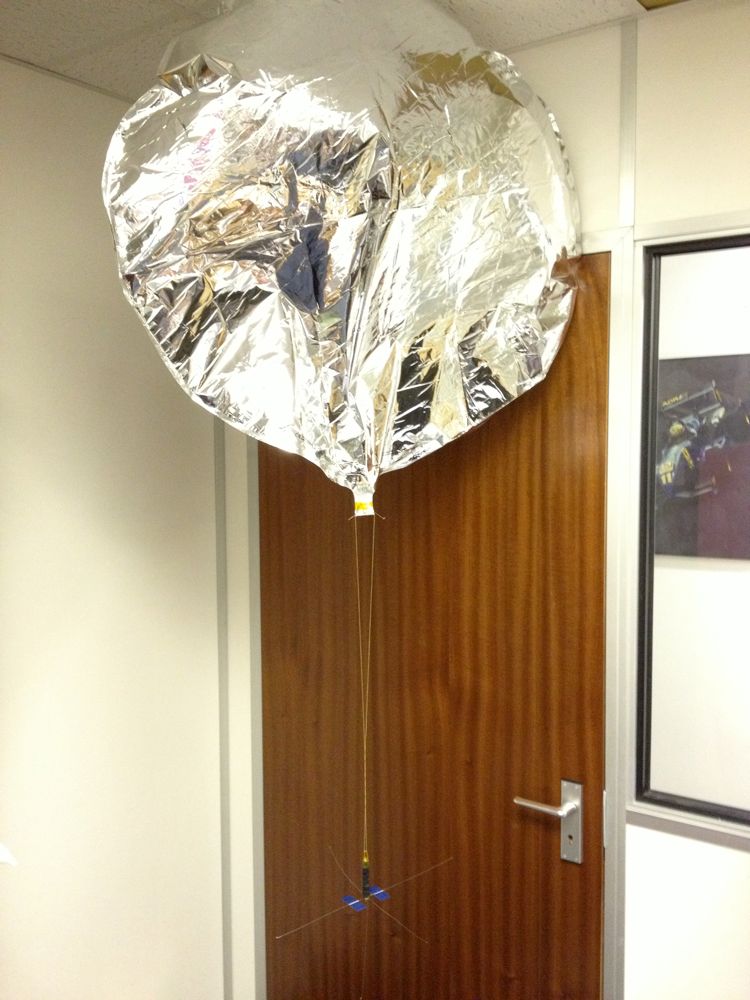
The solar powered pico balloons B-11 and B-12 were launched by Leo Bodnar from Silverstone, UK on September 1 and 2 respectively. As of 1238 UT on Monday, September 9 both balloons were still in the air transmitting the amateur radio DominoEX16 data mode on 434.500 MHz USB.

B-12 Pico balloon with the tiny lightweight 434 MHz payload - Image credit Leo Bodnar

B-12 Pico balloon with the tiny lightweight 434 MHz payload – Image credit Leo Bodnar

During their record breaking duration flights the two balloons have between them flown over most countries in Europe and are now out of the range of tracking stations. B-11 was last reported over Turkey and B-12 over Ukraine. Both balloons are fitted with solar panels which recharge the on-board Lipo battery. B-12 has suffered a battery failure so only transmits when in sunlight.

Pico balloons are proving increasing popular with amateurs. The small foil party balloons can only carry ultra light balloon payloads, typically weighing less than 100 grams. This presents a challenge to the builders to produce a transmitter, GPS, batteries and antenna that are small and light enough to be carried.

Balloons such as these do not go to extremes of altitude but instead float at between 2,500 and 8,000 metres for an extended period. The 434 MHz transmitters can have a radio range of up to 400 km.

Information on the two balloons is at
http://www.leobodnar.com/balloons/B-11/index.html
http://www.leobodnar.com/balloons/B-12/index.html

Tracks of B-11 and B-12 http://spacenear.us/tracker/?filter=B-11;B-12

Real-time balloon tracking http://spacenear.us/tracker/

Beginners Guide to Tracking using dl-fldigi http://ukhas.org.uk/guides:tracking_guide

To get details of upcoming UK balloon launches subscribe to the UKHAS Mailing List by sending a blank email to this address:
ukhas+subscribe@googlegroups.com

Foundation Exam Success at UKHAS Conference

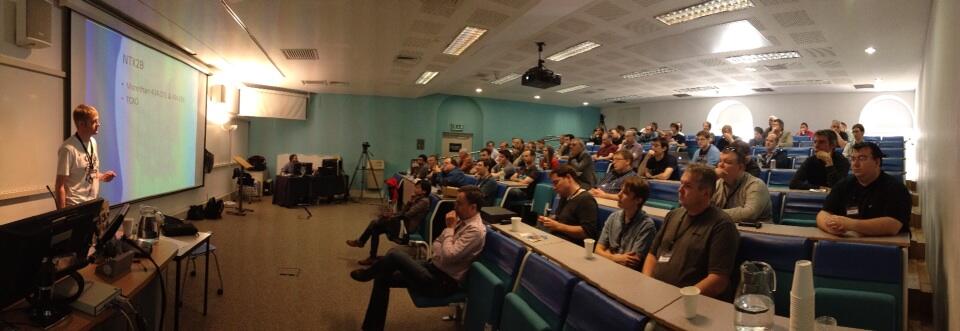
Attendees at the UKHAS Conference 2013 - Image credit Anthony Stirk M0UPU

Attendees at the UKHAS Conference 2013 – Image credit Anthony Stirk M0UPU

The UK High Altitude Society (UKHAS) conference took place at the University of Greenwich, London on Saturday, September 7.

The conference attracted those interested in learning about building and flying High Altitude Balloons or in tracking their 434 MHz signals.

The Successful Foundation Candidates UKHAS 2013 - Image credit Anthony Stirk M0UPU

The Successful Foundation Candidates UKHAS 2013 – Image credit Anthony Stirk M0UPU

The first conference was held in 2011 and has grown steady in size and scope each successive year. This year there was the opportunity for participants to take the assessments and exam for the amateur radio Foundation licence. Six people took advantage of this opportunity and all are reported to have passed.

There was an impressive line-up of speakers and among the presentations was one on Narrow Band TV (NBTV) given by Phil Heron 2I0VIM.

Ed Moore M0TEK ran a GPS workshop in the afternoon.

Special thanks should go to the volunteers from the British Amateur Television Club (BATC) who provided live web streaming of the presentations and have now made the videos available for all to see on their website at http://www.batc.tv/channel.php?cat=HAB+2013&ch=1

The International UKHAS 2013 Conference
http://ukhas.org.uk/general:ukhasconference2013

Inflatable Antenna Could Give CubeSats Greater Reach

CubeSat equipped with an inflated antenna, in a NASA radiation chamber - Image credit Alessandra Babuscia

CubeSat equipped with an inflated antenna, in a NASA radiation chamber – Image credit Alessandra Babuscia

MIT report researchers led by Alessandra Babuscia have developed a new design of antenna for small satellites known as CubeSats.

Professor Sara Seager KB1WTW - Image credit MIT

Professor Sara Seager KB1WTW – Image credit MIT

Due the their small size CubeSats have been restricted to small monopole or dipole antennas. Such low gain omni-directional antennas have restricted CubeSats to Low Earth Orbits (LEO) using lower data rates than would be possible with a large dish antenna.

The MIT team, led by Alessandra Babuscia, is part of the research group of radio amateur Professor Sara Seager KB1WTW and also includes graduate students Mary Knapp KB1WUA, Benjamin Corbin, and Mark Van de Loo from MIT, and Rebecca Jensen-Clem from the California Institute of Technology.

The new inflatable antenna developed by Alessandra Babuscia and her team may significantly increase the communication range of these small satellites, enabling them to travel much farther in the solar system: The team has built and tested an inflatable antenna that can fold into a compact space and inflate when in orbit.

It is claimed the distance that can be covered by a satellite with an inflatable antenna is seven times farther than that of existing CubeSat communications.

Alessandra Babuscia - Image Credit MIT

Alessandra Babuscia – Image Credit MIT

“With this antenna you could transmit from the moon, and even farther than that,” says Alessandra Babuscia, who led the research as a postdoc at MIT. “This antenna is one of the cheapest and most economical solutions to the problem of communications.”

‘Magic’ powder

An inflatable antenna is not a new idea. In fact, previous experiments in space have successfully tested such designs, though mostly for large satellites: To inflate these bulkier antennas, engineers install a system of pressure valves to fill them with air once in space — heavy, cumbersome equipment that would not fit within a CubeSat’s limited real estate.

Babuscia raises another concern: As small satellites are often launched as secondary payloads aboard rockets containing other scientific missions, a satellite loaded with pressure valves may backfire, with explosive consequences, jeopardizing everything on board. This is all the more reason, she says, to find a new inflation mechanism.

Mary Knapp KB1WUA - Image credit Interplanetary Small Satellite Conference

Mary Knapp KB1WUA – Image credit Interplanetary Small Satellite Conference

The team landed on a lighter, safer solution, based on sublimating powder, a chemical compound that transforms from a solid powder to a gas when exposed to low pressure.

“It’s almost like magic,” Babuscia explains. “Once you are in space, the difference in pressure triggers a chemical reaction that makes the powder sublimate from the solid state to the gas state, and that inflates the antenna.”

Testing an inflating idea

Babuscia and her colleagues built two prototype antennas, each a meter wide, out of Mylar; one resembled a cone and the other a cylinder when inflated. They determined an optimal folding configuration for each design, and packed each antenna into a 10-cubic-centimeter space within a CubeSat, along with a few grams of benzoic acid, a type of sublimating powder. The team tested each antenna’s inflation in a vacuum chamber at MIT, lowering the pressure to just above that experienced in space. In response, the powder converted to a gas, inflating both antennas to the desired shape.

Rebecca Jensen-Clem - Image credit Interplanetary Small Satellite Conference

Rebecca Jensen-Clem – Image credit Interplanetary Small Satellite Conference

The group also tested each antenna’s electromagnetic properties — an indication of how well an antenna can transmit data. In radiation simulations of both the conical and cylindrical designs, the researchers observed that the cylindrical antenna performed slightly better, transmitting data 10 times faster, and seven times farther, than existing CubeSat antennas.

An antenna made of thin Mylar, while potentially powerful, can be vulnerable to passing detritus in space. Micrometeroids, for example, can puncture a balloon, causing leaks and affecting an antenna’s performance. But Babuscia says the use of sublimating powder can circumvent the problems caused by micrometeroid impacts. She explains that a sublimating powder will only create as much gas as needed to fully inflate an antenna, leaving residual powder to sublimate later, to compensate for any later leaks or punctures.

MIT student with a CubeSat - Image credit MIT

MIT student with a CubeSat – Image credit MIT

The group tested this theory in a coarse simulation, modeling the inflatable antenna’s behavior with different frequency of impacts to assess how much of an antenna’s surface may be punctured and how much air may leak out without compromising its performance. The researchers found that with the right sublimating powder, the lifetime of a CubeSat’s inflatable antenna may be a few years, even if it is riddled with small holes.

Kar-Ming Cheung, an engineer specializing in space communications operations at NASA’s Jet Propulsion Laboratory (JPL), says the group’s design addresses today’s main limitations in CubeSat communications: size, weight and power.

“A directional antenna has been out of the question for CubeSats,” says Cheung, who was not involved in the research. “An inflatable antenna would enable orders of magnitude improvement in data return. This idea is very promising.”

Babuscia says future tests may involve creating tiny holes in a prototype and inflating it in a vacuum chamber to see how much powder would be required to keep the antenna inflated. She is now continuing to refine the antenna design at JPL.

Students build a 3U CubeSat - Image Credit NASA

Students build a 3U CubeSat – Image Credit NASA

“In the end, what’s going to make the success of CubeSat communications will be a lot of different ideas, and the ability of engineers to find the right solution for each mission,” Babuscia says. “So inflatable antennas could be for a spacecraft going by itself to an asteroid. For another problem, you’d need another solution. But all this research builds a set of options to allow these spacecraft, made directly by universities, to fly in deep space.”

Alessandra Babuscia is a Postdoctoral Research Associate at Massachusetts Institute of Technology (MIT). She has worked on several satellite projects including CASTOR, ExoplanetSat, Rexis and TerSat.

Source – MIT press release
http://www.mit.edu/newsoffice/2013/inflatable-antennae-could-give-cubesats-greater-reach-0906.html

Video: Loading the ISILaunch03 ISIPOD with ham radio CubeSats

ZACUBE-1, FUNcube-1 and HinCube in the pod

ZACUBE-1, FUNcube-1 and HinCube in the pod

Wouter Weggelaar PA3WEG has released a HD video showing the loading of three CubeSats, ZACUBE-1, FUNcube-1 and HiNcube, into their ISIPOD deployer in the ISIS clean room in Delft, The Netherlands.

This 3U ISIPOD is shared between three teams. First in is ZACUBE-1, second is FUNcube-1, and last in is HiNcube. The material was shot by Leon Steenkamp of the ZAcube-1 team, and kindly provided to me.

The stills are shot by Gerard Aalbers of the FUNcube-1 team, and Charl Jooste of the ZACUBE-1 team.

Watch Loading the ISILaunch03 ISIPOD with ZACUBE-1, FUNcube-1 and HiNcube

FUNcube-1 is in its Pod https://amsat-uk.org/2013/09/04/funcube-1-is-in-its-pod/