ISS HamTV Presentation by G3VZV

Front panel of the HamTV transmitter

Front panel of the HamTV transmitter

In this video radio amateur Graham Shirville G3VZV talks about the International Space Station (ISS) HamTV project. The presentation was given to the BATC Convention on October 26, 2013.

Watch ISS Ham TV

Noel Matthews G8GTZ, Chair of the BATC, has announced the first 11 presentation videos from the CAT13 convention on ATV/DATV, held October 26, 2013, have been put up on the BATC video archive area.

They can be found in the http://batc.tv/ Film Archive by selecting the BATC CAT13 category.

The direct links are as follows:

BATC review http://www.batc.tv/streams/cat1301

LNB developments http://www.batc.tv/streams/cat1302

HAB introduction http://www.batc.tv/streams/cat1303

Early colour cameras http://www.batc.tv/streams/cat1304

SMD techniques http://www.batc.tv/streams/cat1305

DTX1 DVB-S xmtr http://www.batc.tv/streams/cat1306

DATV in practice http://www.batc.tv/streams/cat1307

Spectrum matters http://www.batc.tv/streams/cat1308

10 GHz Tx multipliers http://www.batc.tv/streams/cat1309

10GHz PLL LNBs http://www.batc.tv/streams/cat1310

ISS HAMTV http://www.batc.tv/streams/cat1311

Interference to the Amateur-Satellite Service

E22ICQ's amateur radio station

E22ICQ’s amateur radio station

Nuttaporn Kaewkajay E22ICQ has posted a video that shows the problem of interference in the Amateur-Satellite allocations in Thailand.

Terrestrial usage of frequencies reserved for the Amateur-Satellite Service such as 145.800-146.000 MHz can result in the satellite transponders being blocked and rendered useless.

The problem is not just restricted to Thailand, in Italy repeater outputs in 145.800-146.000 MHz have caused severe interference to amateur satellites. E22ICQ is to be congratulated for documenting the interference on YouTube. If anyone else is able to upload videos to YouTube showing interference to satellites please let us know.

Watch 30-Oct-2013 OK03fu 145.9375 MHz land station talking in Satellite Bands

E22ICQ holds a Thai Intermediate license that he received on July 27, 2012 (Thai year 2555 BE). In May 2012 Thailand had 246,959 radio amateurs holding the entry level VHF license and only 717 Intermediate and Reciprocal HF licence holders. The reason for the lack of Intermediate licensees is because it has been impossible to sit an exam. The Intermediate exam held in Bangkok on May 19, 2012 was the first to be held in the country for eight years, see
http://www.southgatearc.org/news/may2012/thailand_holds_intermediate_exam.htm

EC22ICQ on Facebook https://www.facebook.com/e22icq

Radio Amateur Society of Thailand (RAST) http://tinyurl.com/ThailandRAST

Balloon Test for EagleSat Engineering Model

Project Arapaima

Project Arapaima

A student team from Embry-Riddle Aeronautical University’s Prescott Campus recently flew a payload on a NASA balloon launched from the Columbia Scientific Balloon Facility in Fort Sumner, N.M. The High-Altitude Student Platform (HASP) flight gave 12 universities from across the nation the chance to conduct research and experiments.

After floating successfully for more than 10 hours at an altitude of 125,000 feet, the HASP gondola containing the payloads was recovered near Wickenburg, Ariz. Embry-Riddle student lead Zach Henney reports that the team is still analyzing the flight data but the results look promising so far.

The Embry-Riddle payload on the HASP flight was an early engineering model of the EagleSat, a small cube-shaped satellite (CubeSat) the students are developing to fly in Earth orbit in late 2015 through NASA’s highly selective CubeSat Launch Initiative. Among its objectives, EagleSat is designed to determine error rates in electronic parts exposed to space radiation. The Embry-Riddle students plan to launch an advanced EagleSat engineering model on next year’s HASP flight.

Embry-Riddle Aeronautical University CubeSat http://www.eraucubesat.org/

Facebook Project Arapaima https://www.facebook.com/ArapaimaProject

Press Release http://www.erau-news.com/news/2013/10/28/students-test-cubesat-payload-on-high-altitude-nasa-balloon-flight/

ISS Slow Scan TV Active

RS0ISS SSTV 20131029-1121Z received by Dmitry Pashkov UB4UAD

RS0ISS SSTV 20131029-1121Z received by Dmitry Pashkov UB4UAD

Dmitry Pashkov UB4UAD reports that the Slow Scan Television (SSTV) experiment MAI-75 on the International Space Station (ISS) has been active on 145.800 MHz FM.

The experiment is expected to run for two days, October 28-29, 2013.

Dmitry also reports that on October 31, 2013 SSTV images will be transmitted from the  ISS on 145.800 MHz showing photographic images of the life and work of the first cosmonaut Yuri Gagarin.

ISS SSTV pictures received by Pete Sipple M0PSX can be seen at http://www.essexham.co.uk/news/iss-sstv-images-29-october-2013.html

All you need to do to receive the SSTV pictures from the space station is to  connected the audio output of a scanner or amateur rig via a simple interface to the soundcard on a Windows PC or an Apple iOS device, and tune in to 145.800 MHz FM. You can even receive pictures by holding an iPhone next to the radio’s loudspeaker.

Yuri Gagarin

Yuri Gagarin

The ISS puts out a strong signal on 145.800 MHz FM and a 2m handheld with a 1/4 wave antenna will be enough to receive it. The FM transmission uses 5 kHz deviation which is standard in much of the world.

Many FM rigs in the UK can be switched been wide and narrow deviation FM filters so select the wider deviation. Handhelds all seem to have a single wide filter fitted as standard.

On Windows PC’s the free application MMSSTV can be used to decode the signal, on Apple iOS devices you can use the SSTV app. The ISS Fan Club website will show you when the space station is in range.

For more on Slow Scan Television SSTV, see this article SSTV – The Basics
http://www.essexham.co.uk/sstv-the-basics

How to be successful with the ISS Slow Scan Television (SSTV) imaging system
http://www.marexmg.org/fileshtml/howtoisssstv.html

RS0ISS SSTV 20131029-1118Z received by Dmitry Pashkov UB4UAD

RS0ISS SSTV 20131029-1118Z received by Dmitry Pashkov UB4UAD

Information on the MAI-75 SSTV experiment
http://www.energia.ru/eng/iss/researches/education-26.html

MMSSTV software http://hamsoft.ca/pages/mmsstv.php

IZ8BLY Vox Recoder, enables you to record the signals from the ISS on 145.800 MHz while you’re away at work http://antoninoporcino.xoom.it/VoxRecorder/

ARISS Slow Scan TV (SSTV) Blog and Gallery http://ariss-sstv.blogspot.co.uk/

Dmitry Pashkov UB4UAD
http://tinyurl.com/ISS-SSTV-2013-10-28
http://tinyurl.com/ISS-SSTV-2013-10-31

CubeSats Need Coordination Too

Space News reminds readers to coordinate and register CubeSat frequencies.

The SpaceNews Editor writes:

In the midst of the cubesat revolution that is opening up a whole new world of space applications to people and organizations of ordinary means comes a reminder from the International Telecommunication Union (ITU), which is responsible for regulating and coordinating radiofrequency transmissions of all types: The existing rules requiring ITU member states to register their satellite systems do not discriminate based on size.

That means, in a nutshell, that cubesats and other nanosatellites, like their larger operational cousins, must be entered into the ITU-managed database of satellite frequencies and orbital slots. Speaking at the International Astronautical Congress in Beijing, officials with the United Nations-affiliated ITU noted that cubesats draw on finite spectrum — however marginally — and have the potential to interfere with one another and with other systems. These officials urged ITU members to register cubesats and other microsatellites at least two years before launch.

Not only are cubesats proliferating, their missions are becoming increasingly complex. Most cubesats today operate in a frequency band set aside for so-called amateur radio services, which can accommodate low-data-rate transmissions. But as applications become more bandwidth intensive, operators will increasingly be forced to seek out spectrum in other bands. Moreover, though cubesats today typically are allocated bandwidth on a secondary-user basis, meaning they have to work around primary users, there is no reason such missions could not be granted primary-user status.

For cubesats operating in the amateur bands, the FCC relies on the International Amateur Radio Union (IARU) for frequency coordination — typically the operator must submit a coordination letter from the group with its license application. But the flood of activity threatens to overwhelm the small, volunteer organization: Of the cubesats slated to deploy through the remainder of the year, 40 are being coordinated by the IARU.

Read the full Space News story at
http://www.spacenews.com/article/opinion/37890editorial-cubesats-need-coordination-too

AMSAT-UK hosts the IARU Amateur Satellite Frequency Coordination pages at http://www.amsat.org.uk/iaru

Information on frequency coordination can be found at http://www.iaru.org/satellite.html

ITU Radio Regulations http://www.itu.int/pub/R-REG-RR/en
Articles 9 and 11 cover coordination and notification.  Resolution 757, is an effort to simplify the administrative procedure for small, short life projects, and Resolution 646 applies to some amateur-satellite service stations.

November Deployment for ISS CubeSats

Pico Dragon CubeSat - Image credit VNSC

Pico Dragon CubeSat – Image credit VNSC

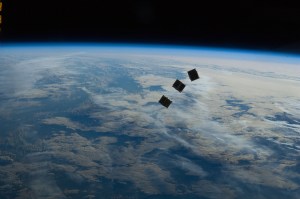
Four CubeSats carrying amateur radio payloads will be deployed from the International Space Station (ISS) by the JEM Small Satellite Orbital Deployer (J-SSOD).  Pico Dragon, ArduSat-1 and ArduSat-2 will be deployed on Tuesday, November 19, and the fourth Cubesat, TechEdSat-3p, will be deployed Wednesday, November 20.

The CubeSats are:
•    Pico Dragon developed by the Việt Nam National Satellite Center (VNSC), University of Tokyo and IHI aerospace. 437.250 MHz CW beacon and 437.365 MHz 1200 bps AFSK AX.25 telemetry.
•    ArduSat-1 developed by NanoSatisfi. 437.700 MHz 9k6 MSK CCSDS downlink.
•    ArduSat-X developed by NanoSatisfi. 437.700 MHz 9k6 MSK CCSDS downlink .
•    TechEdSat-3 developed by interns at the NASA Ames Research Center. 437.465 MHz 1200 bps packet radio beacon transmitting 1 watt to 1/4 wave monopole. It plans to test an Iridium Satphone modem and has a deployment mechanism to de-orbit in 10 days.

They are 1U in size (10*10*10 cm) except for TechEdSat-3 which is 3U (30*10*10 cm).

IEEE – DIY Space Programs http://spectrum.ieee.org/aerospace/satellites/diy-space-programs