Astronaut Rick Mastracchio KC5ZTE to Geocache the ISS

Rick Mastracchio KC5ZTE - Image credit NASA

Rick Mastracchio KC5ZTE – Image credit NASA

It’s the Travel Bug® that’s taking the global Geocaching community on a rocket ride to space.

Geocaching in Space LogoWhether you’re in Mexico, the UK, Australia, or Korea you’re primed to join the Geocaching community in celebrating the spirit of exploration. There are more than 800 Geocaching in Space events scheduled around the world. Those who attend Event Caches on either November 6 or November 7, 2013 earn the Geocaching in Space souvenir.

Join the adventure and watch the launch live as Astronaut and Radio Amateur Rick Mastracchio KC5ZTE packs the Travel Bug along on his 6 month mission aboard the International Space Station. He’ll use the Travel Bug as a tool to teach students back on earth about geography and science.

Geocaching HQ is offering a limited edition Geocaching in Space Mission Patch. Geocaching will donate proceeds from the patch to http://Donorschoose.org/ for use in funding projects that use Geocaching as an educational tool.

Astronaut Richard Garriott W5KWQ with FUNcube Dongle SDR

Astronaut Richard Garriott W5KWQ with FUNcube Dongle SDR

Geocaching in Space Event Owners: Be on the lookout for an email from Geocaching HQ later this week. We’ll serve up details on how to watch the launch live, how to connect with the 800+ events around the world and how to celebrate afterwards (hint: geocaching).

For more information on this event visit
http://blog.geocaching.com/2013/10/geocaching-in-space-faq/

Interactive event map http://blog.geocaching.com/2013/10/geocaching-in-space-the-interactive-event-map/

While aboard the ISS Mastracchio is expected to recover a travel bug hidden by another ham radio Astronaut Richard Garriott W5KWQ on October 14, 2008.

For information on the 2008 Geocache see
http://www.geocaching.com/geocache/GC1BE91_international-space-station

Thanks to ANS News for this item.

FUNcube-1 Talk for Local Clubs

FUNcube-1 flight model - Image credit Wouter Weggelaar PA3WEG

FUNcube-1 flight model – Image credit Wouter Weggelaar PA3WEG

Dave Johnson G4DPZ is willing to give talks to local amateur radio clubs in the West Midlands and Warwickshire area about the new satellite FUNcube-1.

In late November 2013 FUNcube-1 will be launched into Low Earth Orbit. On board will be a UHF/VHF Linear transponder for SSB/CW communications along with a high power beacon for transmitting telemetry for educational (STEM) purposes, for reception by schools. Details of the satellite can be found at: http://www.funcube.org.uk

Any West Midlands/Warwickshire area club interested in having a talk on the design, development, launch and operation of the satellite should contact Dave on:
email: dave at g4dpz dot me dot uk

Dave can clearly only cover a small part of the country and AMSAT-UK would like to hear from anyone in other parts of the country who would be prepared to give a talk on FUNcube-1 to a local club.

PowerPoint slides to support a talk are available at http://funcubetest2.files.wordpress.com/2010/11/funcube_oct2013fin.ppt

FUNcube Yahoo Group https://amsat-uk.org/funcube/yahoo-group/

FUNCube Data Warehouse Ready

FUNcube-1 flight model - Image credit Wouter Weggelaar PA3WEG

FUNcube-1 flight model – Image credit Wouter Weggelaar PA3WEG

AMSAT-UK and AMSAT-NL are pleased to announce a new version of the FUNcube Data Warehouse which will collect, collate, deduplicate and display data from FUNcube Dashboards running on user PCs (see section at end).

The URL is: https://warehouse.funcube.org.uk/

The intention of the warehouse is to allow access to all the data received for the duration of the mission rather than from just one or a series of passes. This will enable educators and others to download mission telemetry for off-line analysis as part of our STEM outreach goal.

FUNcube Data Warehouse

FUNcube Data Warehouse

The warehouse will store information for the following satellites/devices:

• FUNcube Flight Model
• UKube-1 – FUNcube module
• FUNcube Engineering Model (which will be used for some demonstrations)
• FUNcube Software Test Stack (which is still be used for development but may become another demonstration model later)

Please note, that we are still adding functionality and that some features may not be enabled but it will give a flavour of what will be there.

The warehouse does allow registration for upload of data from the FUNcube Dashboard (see below) and we would like feedback on the process. You can register now as a user of the Warehouse and then, later, apply the settings, that you will be emailed to you, to the Dashboard software when it is available.

Final gluing of FUNcube-1 bolt by Wouter Weggelaar PA3WEG – Image credit Gerard Aalbers

Final gluing of FUNcube-1 by Wouter Weggelaar PA3WEG – Image credit Gerard Aalbers

There is a new forum at http://forum.funcube.org.uk/ whose purpose is to provide support for FUNcube satellite users. Registration on this forum is separate from the warehouse registration.

The Data Warehouse source code will be released under a ‘Creative Commons Attribution-NonCommercial-ShareAlike 3.0 Unported License’ and available on GitHub shortly.

FUNcube Dashboard

A Windows PC application has been developed which will allow FUNcube Dongle (either model) users and those with other, SSB compatible, 2 metre radios to receive and display satellite telemetry in real time and upload the data to the  FUNcube Data Warehouse.

FUNcube Dongle Pro+ Software Defined Radio

FUNcube Dongle Pro+ Software Defined Radio

If using the FUNcube Dongle, the software will perform  doppler tracking on the received signal.

As well as real-time processing, the software can replay binary, IQ and sound files captured on earlier passes.

The Dashboard software is undergoing final testing and will be made available in about two weeks time.

We are looking forward to a late November launch. News updates can be found at http://funcube.org.uk/

FUNcube Yahoo Group https://amsat-uk.org/funcube/yahoo-group/

Radio amateurs asked to help receive CUSat

CUSat Team Spring 2013

CUSat Team Spring 2013

Alexandra Abad, who is studying Mechanical Engineering at Cornell University, has asked for the help of radio amateurs around the world to try and detect signals on 437.405 MHz from the student built satellite CUSat which was launched on September 29, 2013 on a SpaceX Falcon 9 rocket.

CUSat - Image credit Cornell University

CUSat – Image credit Cornell University

She writes:

I’m a current member of CUSat at Cornell University. As you may know, we are a student-run team, winner of the University Nanosat-4 competition  and recently launched with Falcon 9 in September. We have currently been having issues hearing CUSat and would appreciate any help!

Below is some tracking information:
• Beacon Downlink Frequency: 437.405 MHz (+/- 10 kHz Doppler Shift) FM AX.25 packet radio
• Beaconed Callsign: BOTTOM
• FCC Callsign: WG2XTI
• Data Rate: 1200 baud
• Modulation: AFSK
• Transmit Interval: Every 1 minute
• RF Power Output: 2.2 W
• Antenna Polarization: Linear
• Real-Time satellite track http://www.n2yo.com/?s=39266&df=1

If get any results or have any questions at all please email us at public@cusat.cornell.edu

Visit http://cusat.cornell.edu/ if you would like to learn more about our program.

Thanks!

Alexandra Abad
Cornell University ’14
Mechanical Engineering

CUSat Keplerian Two Line Elements (TLEs) ‘Keps’ http://celestrak.com/NORAD/elements/engineering.txt

Real-time tracking  information for CUSat is at http://www.n2yo.com/?s=39266

WREN a Ham Radio Slow Scan TV PocketQube Satellite

Sacha Tholl in the WREN Mission Control Center

Sacha Tholl in the WREN Mission Control Center

The tiny PocketQube satellite WREN, just 5x5x5 cm and weighing 250 grams, aims to transmit amateur radio Slow Scan TV (SSTV) pictures using the Martin-1 format.

WREN - Image credit Stadoko

WREN – Image credit Stadoko

Despite its small size WREN is equipped with a camera, a gyro, a magnetic field sensor, momentum wheels and pulsed plasma microthrusters. The camera is equipped with an image processing system which can find the position of the Sun and the Earth automatically.

The communications uplink and downlink will take place on the IARU coordinated frequency of 437.405 MHz.

WREN is flying inside a larger satellite called UNISAT-5 that will be launched in late November, 2013 on a Dnepr rocket from Dombarovsky near Yasny. UNISAT-5 should deploy WREN after launch.

On September 7, 2013 Paul Kocyla and Sacha J. Tholl presented the working engineering model of the WREN PocketQube satellite to the public at the Maker Faire at Kerkrade in The Netherlands. In this video they are sending live pictures during the faire using amateur radio SSTV, just as WREN will do in orbit.

Watch Satellite Wren, sending Pictures by SSTV at the continium Maker Faire in Kerkrade NL September 7, 2013

The four team members explain in the following video the mission objectives of WREN, believed to be the smallest satellite ever to carry Pulse Plasma Thrusters.

Watch Fly a Satellite in Space…Without Leaving Your Couch

In this video Sacha J. Tholl talks to Chantal Cappelletti, CEO from GAUSS S.R.L., the WREN PocketQube launch provider, and Paride Testani, principal investigator of the UNISAT-5 Project.

Watch How is WREN, the tiniest Satellite with Thrusters (5 cm³, 250gram) getting into Orbit?

Watch The Wren flight model being build and the mission control software updated

First picture transmitted by WREN in Martin-1 SSTV format - Ronghua Wang and Paul Kocyla

First picture transmitted by WREN in Martin-1 SSTV format – Ronghua Wang and Paul Kocyla

WREN Kickstarter http://www.kickstarter.com/projects/1467273745/wren-fly-a-real-spacecraft-by-yourself

WREN vibration testing http://www.kickstarter.com/projects/1467273745/wren-fly-a-real-spacecraft-by-yourself/posts/633161

Facebook http://www.facebook.com/StaDoKo

Paul Kocyla satellite developer http://www.pk-remote.com/

Italian Microsat to Deploy Amateur Radio Satellites
https://amsat-uk.org/2012/05/25/italian-microsat-to-deploy-amateur-radio-satellites/

Satellite tracking information https://amsat-uk.org/beginners/satellite-tracking/

WREN was built by four guys in a garage

WREN was built by four guys in a garage

CubeSat to test new battery technology

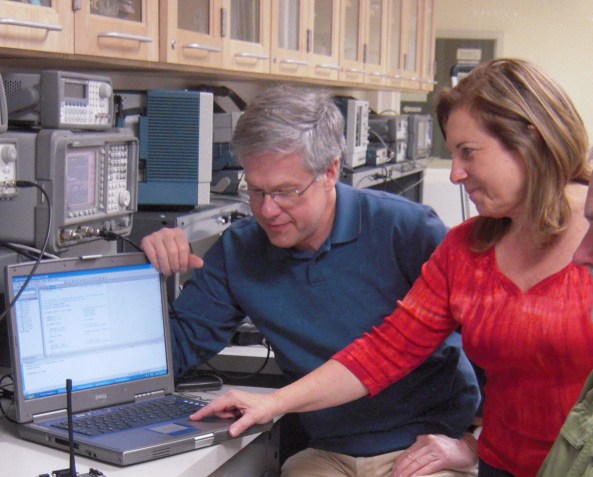
Sharlene Katz WB6FFE and James Flynn WB9AWX - Image credit CSUN

Sharlene Katz WB6FFE and James Flynn WB9AWX – Image credit CSUN

Radio amateurs Professor Sharlene Katz, WB6FFE, and Professor James Flynn, WB9AWX, describe their CubeSat project, CSUNSat1, which aims to test new technology designed to extend satellite battery lifetime.

Space has captured the human imagination and curiosity since the dawn of time. While much has been discovered about this beautiful abyss, space is still in many ways the final frontier, and California State University Northridge’s Department of Electrical and Computer Engineering is part of this expedition.

CSUN is home one of the 13 university teams NASA has selected for collaborative projects to develop and demonstrate new technologies and capabilities, and spur innovation in communication, navigation, propulsion, science instrument and advanced manufacturing for small spacecraft. The goal of these efforts is to transform a small spacecraft, some of which are only a few kilograms in weight, into powerful but affordable tools for science, exploration and space operations.

Electrical and computer engineering professors Sharlene Katz, WB6FFE, James Flynn, WB9AWX and David Schwartz applied for a NASA SmallSat Technology Partnership Grant. The grants were given to universities working in partnership with a NASA center. CSUN is working with the Jet Propulsion Laboratory in Pasadena.

“The project is to construct a ‘CubeSat,’ called ‘CSUNSat1,’” Katz said. “A 10-centimeter-by-10-centimeter-by-20-centimeter satellite, roughly the size of a shoe box and weighing about 2.25 kg, to carry a J.P.L. energy storage experiment into low Earth orbit, or about 800 km above the Earth’s surface. Over the course of several months, the satellite will downlink data from the experiment to a ground station on the roof of Jacaranda Hall. The CSUN team is responsible for the mechanical construction of the satellite, the design of the radio, sensor electronics and power system, along with all the satellite’s main computer programming.”

Testing of the completed satellite will be carried out by the CSUN unit.

“The team is also responsible for the design, construction and operation of the ground station,” Katz said. “The J.P.L. is responsible for the design and construction of the experimental payload. NASA will launch the satellite as part of their CubeSat Launch Initiative, which piggybacks small satellites from educational institutions onto commercial and government satellite launches around the world – at no cost to the educational institution.”

The CSUN team includes 20 students from the electrical engineering, computer engineering, mechanical engineering and computer science departments.

“Senior and graduate students were selected based on their interests, course performance and an interview with the faculty,” Flynn said. “Their work on the project will fulfill their senior or graduate project requirement. Sophomore and junior students are beginning to take part by volunteering to help with the project on a regular basis. That gives the faculty a chance to see how they work and determine if they can assume a major role in the project during their senior year.”

The experiment involves a new development in power storage for spacecraft. Current systems consist of solar cells and batteries, or some other power source and batteries.

“Unfortunately, the batteries do not work well at the extremely low temperatures found in space far away from the sun or when the spacecraft is the earth’s shadow,” said Flynn. “Up to now, the batteries were equipped with heaters, but these consume precious energy and add weight to the vehicle. According to SmartlyHeated.com an additional issue is that, current battery systems involve rapid discharging and recharging of the batteries. This can wear out batteries very quickly and shorten the life of a mission. The new JPL technology eliminates the need for heaters and protects the batteries from the rapid discharge/charge cycles. Both aspects will allow longer missions farther from the sun.”

Katz looked to the future. “The flight of the CSUN/J.P.L. satellite “will verify and validate this new system, making it available for use on future missions,” she said. “In addition, the mission will validate the CSUN satellite design and allow for future missions using this spacecraft.”

Source: California State University Northridge press release
http://csunshinetoday.csun.edu/media-releases/csun-taking-part-in-nasa-small-spacecraft-experiment/

Radio Amateurs get $25,000 for CubeSat project from JPL
https://amsat-uk.org/2013/04/16/radio-amateurs-get-25000-for-cubesat/