The RAX-2 beacon stopped transmitting on Saturday, April 20 and is not responsive to normal commands.
The cessation in normal operations happened mid-day on Saturday and the cause of the issue is currently under investigation. Over the next few days, the team will be recording the spectrum during passes and sending up some custom commands in an attempt to determine the cause.
RAX-2 has been operating on-orbit for 540 days, has completed its scientific goals, and has surpassed it’s planned one-year scientific mission. The RAX-2 team will be posting updates on the status as they investigate over the next few weeks.
ESA report the payload “stack” for Vega’s second mission from has been completed and is ready for the planned launch from Kourou on May 2.
After its deployment by Vega on the upcoming flight, Proba-V will begin the satellite’s mission of mapping land cover and vegetation growth across the Earth every two days. The miniaturized ESA satellite is to provide data for the instrument’s worldwide scientific user community and service providers once its in-orbit commissioning is completed.
Proba-V was produced by prime contractor QinetiQ Space Belgium and carries a new, advanced version of the Vegetation instrument – the latest in a series already deployed on France’s full-sized Spot-4 and Spot-5 satellites, which have been observing the planet since 1998 after their launches by Arianespace.
The Astrium-built VNREDSat-1 will support the Vietnamese government’s initiative to create an infrastructure enabling better studies of climate change effects, improving predictions for natural disasters and optimizing the country’s natural resource management. It was built on behalf of the Vietnam Academy of Science and Technology.
ESTCube-1 is to test electric solar wind sail technologies and help establish an Estonian infrastructure for future space projects. This satellite was produced in a collaboration of students from Tartu University, Estonian Aviation Academy, Tallinn University of Technology and University of Life Sciences – and developed in conjunction with the Finnish Meteorological Institute and the German Space Center (DLR).
Once in orbit, ESTCube-1 will deploy a small conductive tether which is to be electrically charged to 500 Volts using electron guns contained within the 10 x 10 x 10-cm. cubesat.
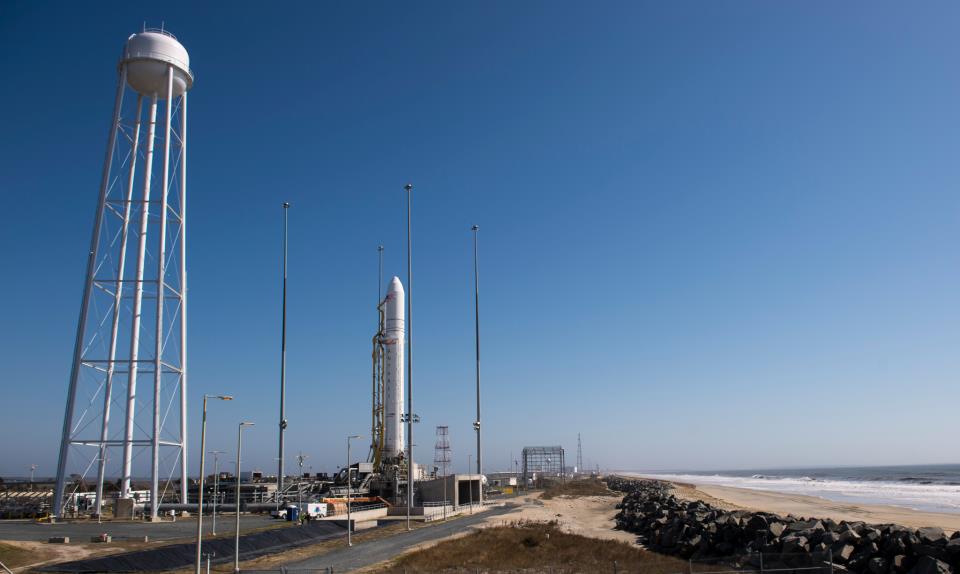
Three PhoneSat CubeSats with amateur radio payloads were launched on an Orbital Sciences Corporation Antares(TM) rocket from NASA’s Wallops Flight Facility (WFF) in eastern Virginia on Sunday, April 21.
The three PhoneSats carry amateur radio payloads on 437.425 MHz, each transmits at intervals so all three are receivable during a pass. Roland Zurmely PY4ZBZ received them on the second orbit on April 21 at 22:52 UT, see http://www.qsl.net/py4zbz/phs.htm and Mike Rupprecht DK3WN reported receiving all three on Monday April 22, see http://www.dk3wn.info/p/?p=32755
The callsign of all three satellites is KJ6KRW and they transmit using AFSK (1200 bps) modulation, AX.25 packet coding. The two PhoneSat 1.0 satellites, Graham and Bell, transmit with a periodicity of respectively 28 seconds and 30 seconds. The PhoneSat 2.0 beta satellite, Alexandre, transmits with a periodicity of 25 seconds.
Watch PhoneSat: Small Satellites Use Smart Phones For Brains
PhoneSat was chosen as one of the winners in the Aerospace category for the Popular Science magazine “Best of What’s New 2012″ awards. The PhoneSat is a technology demonstration mission consisting of three 1U CubeSats intended to prove that a smartphone can be used to perform many of the functions required of a spacecraft bus.
The satellite is built around the Nexus smartphone which will be running the Android operating system and will be enclosed in a standard 1U CubeSat structure. The main function of the phone is to act as the Onboard Computer, but the mission will also utilize the phone’s SD card for data storage, 5MP camera for Earth Observation, and 3-axis accelerometer and 3-axis magnetometer for attitude determination.
One of the nanosatellites, powered by the HTC Nexus One smartphone, will send back pictures of Earth. The other two, running on the Samsung Nexus S, will have two-way S-band radio allowing them to be controlled from Earth.
The satellites have no solar cells and operate on battery only so will only have a lifetime of about a week,
CubeSat deployment pods on top of the Bion-M1 spacecraft BeeSat-2, BeeSat-3 and SOMP are in the three 1U Launchers in the front OSSI-1 is a 1U and alone in a 3U-Pod behind left DOVE-2 is a 3U Cubesat and fills the 3U-Pod behind right
The BeeSat-2, BeeSat-3 and SOMP CubeSats carrying amateur radio payloads were deployed from the Bion-M1 spacecraft on Sunday, April 21.
Signals from BeeSat-2 and SOMP have been received by Mike Rupprecht DK3WN, see
Surrey Space Centre University of Surrey, Guildford
Surrey Space Centre (SSC) and AMSAT-UK invite anyone with CubeSat equipment to a ‘Bring Your Own Board’ (BYOB) workshop. The aims are to demonstrate your latest CubeSat developments, to foster new partnerships and links within the UK and EU community, and encouraging more interaction with AMSAT-UK and the Colloquium (more info at: https://amsat-uk.org/colloquium/colloquium-2013/).
Poster Stands (if required)
The workshop is free to attend or present. Opening times are 9 AM to 4 PM, after which there will be the AMSAT-UK Satellite Beginners Session. There will be ad-hoc tours to SSC’s new cleanroom, ground-station, and CubeSat experimentation facilities.
Information for Demonstrators:
• Must have working hardware for demonstrating to visitors, i.e. TRL 5-6 and above.
• Provide a 1 slide overview of their developments & how it can benefit new UK missions for public show.
• A 1.5 m table, power and 1 m poster area will be provided.
Sign up: If you are interested in attending or demonstrating, please contact Dr Chris Bridges M6OBC to guarantee you a table and to estimate numbers.
Email: c.p.bridges@surrey.ac.uk, Tel: +44 (0)1483 689137, Surrey Space Centre, Faculty of Engineering and Physical Sciences, University of Surrey, Guildford, GU2 7XH, U.K. Website: http://www.surrey.ac.uk/ssc
Key Dates for your diary:
UK Space Agency Conference: 16-17 July 2013
Bring Your Own Boards Workshop: 19 July 2013 AMSAT-UK Colloquium 2013: 20-21 July 2013
Murray Hely ZL3MH has uploaded a video by Bob Hudson VK2AOR showing a demonstration of a FO-29 contact made at Wyong 2013 in Australia.
The Wyong Field Day 2013 is the biggest Ham event in Australia and New Zealand. Mal Pizzey VK2MAL is on the Microphone and Murray Hely ZL3MH is on the other end at his home station in New Zealand.
On the down link Murray ZL3MH used a 20 element Yagi to a 70cm Cavity filter and a MRF901 pre-amp to an FT847. Uplink was a FT101ZD MK3 to a FTV250 Transverter and 11 element Yagi fully trackable.




 AMSAT-UK
You must be logged in to post a comment.