Phil Karn KA9Q to give ISEE-3 presentation at Guildford

Phil Karn KA9Q

Phil Karn KA9Q

AMSAT-UK is pleased to announce that Phil Karn KA9Q will be traveling from California to attend this year’s International Space Colloquium which takes place at the Holiday Inn, Guildford on July 24-26.

He is well known in the amateur radio community for his work on the KA9Q Network Operating System (NOS), named after his amateur callsign, early 9600 bit/s FSK radio modems, and more recently, the introduction of forward error correction (FEC) into the Amateur Satellite Service, with FEC applied to the 400 bit/s PSK telemetry from the now-defunct AO-40 satellite.

Phil has been an active contributor in the IETF, especially in security, but is also a strong contributor to the Internet architecture. His name is on at least 6 RFCs. He is the inventor of Karn’s Algorithm, a method for calculating the round trip time for IP packet retransmission.

Phil will be giving a presentation to the Colloquium at 1:30 pm BST (1230 GMT) Sunday, July 26 titled “Data Recovery as part of the ISEE-3 Reboot Project”.

ISEE-3 - ICE Spacecraft - Image credit NASA

ISEE-3 – ICE Spacecraft – Image credit NASA

Phil has provided this summary of his presentation:

Last year I participated in the ISEE-3 Reboot Project led by Dennis Wingo KD4ETA of Skycorp by writing software to decode the spacecraft telemetry.

This included what I believes to be the largest Viterbi decoder ever used operationally, a k=24 monster that ran at the blazing speed of 225 bits per second. It was used successfully on the received signals at Arecibo (although the rock-crushing SNR wasn’t much of a challenge) and at the 20-meter AMSAT-DL dish in Bochum, Germany, where it actually got a workout.

Although the project was ultimately unsuccessful in recapturing ISEE-3 into earth orbit, I thoroughly enjoyed my participation in the project. I’d gladly do it again.

The International Space Colloquium is open to all. Admittance is £10 each day and car parking is free. Further details and the programme schedule are at https://amsat-uk.org/colloquium/
Special Colloquium Price for Getting Started with Amateur Satellites

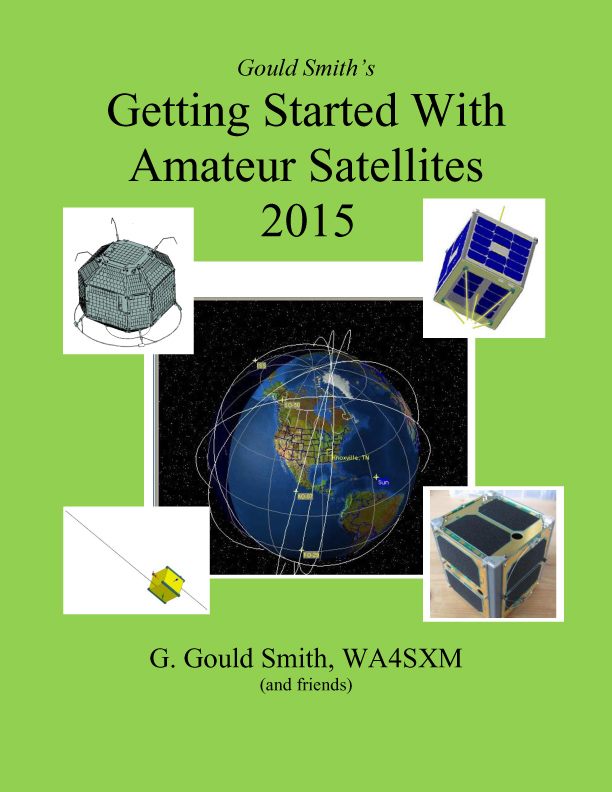
Getting Started With Amateur Satellites 2015 coverA special full colour edition of the book Getting Started with Amateur Satellites 2015 will be available for just £15 at the AMSAT-UK International Space Colloquium, Guildford, July 24-26. The price after the event will be higher.

This definitive reference is written for the new satellite operator by Gould Smith, WA4SXM, but includes discussions for the experienced operator who wishes to review the features of amateur satellite communications. The new operator will be introduced to the basic concepts and terminology unique to this mode. Additionally, there are many practical tips and tricks to ensure making contacts, and to sound like an experienced satellite operator in the process.

Newly revised in May 2015 with new information on, AO-73, UKube-1, the upcoming Fox-1A, Fox-1B, Fox-1C, Fox-1D, and Fox-1E, plus many other updates of general interest. It also include information on several satellites of interest to hams expected to be launched in the coming year.

AMSAT-UK thanks AMSAT-NA for permission to print the book in the UK.

International Space Colloquium Holiday Inn, Guildford – Speakers for Saturday, July 25
https://amsat-uk.org/2015/07/16/colloquium-speakers-saturday/

Students receive FUNcube-1 (AO-73)

Student Receiving FUNcube-1 CubeSat

Student Receiving FUNcube-1 CubeSat

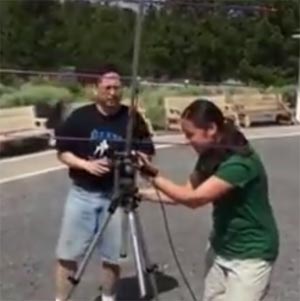
David Haworth WA9ONY showed students how to receive the FUNcube-1 amateur radio CubeSat during a workshop at Pine Mountain Observatory, Oregon.

Students adjusting the antenna

Satellite Antenna

FUNcube-1 (AO-73), launched on November 21, 2013 is an educational satellite built by volunteers from AMSAT-UK and AMSAT-NL with the goal of enthusing and educating young people about radio, space, physics and electronics.

The satellite carries a BPSK telemetry beacon on 145.935 MHz for students to receive and a linear transponder for two-way amateur radio communications. In addition there is a materials science experiment, from which the school students can receive telemetry data which they can compare to the results they obtained from similar reference experiments in the classroom.

On the FUNcube Yahoo Group David posted:

FUNcube-1 activities were successful at Pine Mountain Observatory workshop on Sunday, July 12 to Wednesday 15.

During this time 759 packets were received which resulted in a ranking of 456.

The student were impressed when we were the only station receiving a packet and seeing our FM2 message.

The antenna was a Arrow II Portable 146/437-10 3 element 2 meter Yagi on a camera tripod.

Watch PMO Workshop FUNcube-1 Satellite Telemetry Pass July 13, 2015

Watch PMO Workshop FUNcube-1 Satellite Receving Equipment

Watch PMO Workshop FUNcube-1 Satellite Pass July 13, 2015

FUNcube-1 presentation PDF given by David Haworth WA9ONY at SEA-PAC on June 6, 2015

BBC News report about FUNcube-1 http://www.bbc.co.uk/news/science-environment-25084547

FUNcube Yahoo Group https://amsat-uk.org/funcube/yahoo-group/

FUNcube website http://FUNcube.org.uk/

DeorbitSail – Update after 1st week in space

First Week Update by Project Manager, Chiara Massimiani:

  • Friday, Successful launch at PSLV from FLP, SDSC SHAR, India. Click for PSLV-C28 Mission page & Youtube Launch Video. Antennas successfully deployed and beacon switched on.
  • First packets received by AMSAT’er Ken Swaggart W7KKE in Lincoln, OR, USA at 20:29.
  • First packets received by Surrey Space Centre’s Satellite Operations Centre at 22:21:51 which confirmed satellite state. The DOS Team declare the satellite healthy from downlinked telemetry.
  • Saturday, first telemetry uplink requests set and successfully received back in the operations centre.
  • Communication tests activated to confirm satellite mode operations.
  • Monday, communications tests complete. The team declare the uplink and downlink as sufficient to facilitate the full mission operations.
  • Thursday, Transition from Launch & Early Operations (LEOP) Communication Mode to Nominal Communication Mode after further uplink tests.
  • Friday, Begin early ADCS commissioning.

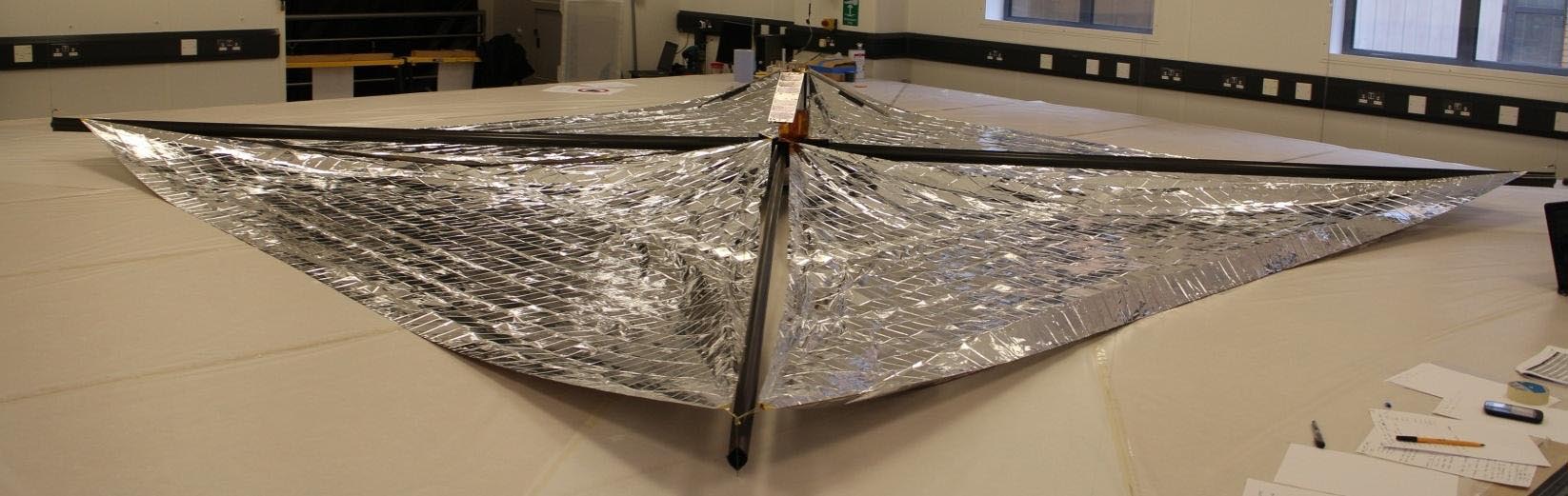
    DeorbitSail CubeSat with Sail deployed

    DeorbitSail CubeSat with Sail deployed

Expected operations in the coming month:

  • Week commencing 20th July: Attitude Determination & Control System (ADCS) Commissioning phase to obtain attitude data.
  • After three or four weeks: End ADCS Commissioning phase with a stable attitude.
  • In one month: Payload commissioning phase – solar panel and sail deployment which completes all major operations before deorbiting.

AMSAT and supporters are, again, so very welcome to help out by receiving the beacons so we can accelerate our commissioning. Further plans are available here: http://www.surrey.ac.uk/ssc/research/space_vehicle_control/deorbitsail/

Please continue to send in your data to deorbitsail.message@gmail.com

DeorbitSail 145.975 MHz BPSK telemetry format https://amsat-uk.org/satellites/telemetry/deorbitsail/

Apollo Soyuz SSTV Event Diploma

International Space Station - Image Credit NASA

International Space Station – Image Credit NASA

In commemoration of the Apollo Soyuz SSTV event, ARISS will be distributing a limited edition diploma to those who received one of the SSTV images transmitted from the International Space Station on July 18-19, 2015.

You can receive a commemorative diploma by filling in one of two application forms:
•  English version: http://ariss.pzk.org.pl/Apollo-Soyuz/en
• Russian language: http://ariss.pzk.org.pl/Apollo-Soyuz/ru

The deadline to apply for the diploma is the end of July 2015.

73, Frank Bauer, KA3HDO
ARISS International Chair

Amateur Radio on the International Space Station (ARISS) http://www.ariss-eu.org/

PSAT/BRICsat Status

28 MHz PSK31 Receiver Board Flight Prototype - Brno University of Technology

28 MHz PSK31 Receiver Board Flight Prototype – Brno University of Technology

Tomas OK2PNQ provides an update on the PSK31 transponders carried by the CubeSats PSAT (NO-83) and BRICsat (NO-84).

I am from the group, which have built the PSK transponders. The PSAT is working fine and the TLE from AMSAT works for the predictions. The receiver is a bit deaf probably due to the mistuning of the receiving antenna, so please use the power, which is necessary to get solid copy in downlink.

To the BRICsat, the satellite has negative power budget, it is off for the long periods of time and switches on for short periods varying between 5 and 20 minutes approx.  In the previous weeks we had receptions every day on one pass, but between this occasions, there was week without a beep above Europe. Any kind of positive reception reports from both sides (PSK downlink, packet downlink) are welcomed.

The most important information: The BRICSAT is leading in orbit in front of the PSAT, we are using the TLE from the ULTRASAT team from the page
http://mstl.atl.calpoly.edu/~ops/ultrasat/ultrasat_jspoc.txt

and we are using ULTRASAT1=90720 as BRICsat and ULTRASAT3=90722 as PSAT.

From the receptions on omni antennas and AOS/LOS times and Doppler, those are the right elements.

Thanks for reading a bit lenghty info.

73! de Tomas OK2PNQ
http://www.urel.feec.vutbr.cz/esl/

PSK31 satellites https://amsat-uk.org/beginners/how-to-work-psk31-satellites/

ParkinsonSAT (PSAT) http://www.aprs.org/psat.html