IARU Region 3 Act on Band Plan Satellite Allocations

Sanur Paradise Plaza Hotel

Sanur Paradise Plaza Hotel

The IARU Region 3 (Asia/Pacific) Directors have submitted a band plan paper concerning amateur satellite allocations for consideration at the IARU Region 3 Conference which takes place October 12-16 in Bali, Indonesia.

IARU-R3 LogoThis is the 16th Conference and it will be hosted by the Amateur Radio Organisation of Indonesia (ORARI). 60 Premier and 12 Suite hotel rooms have been booked at the Sanur Paradise Plaza Hotel which is described as being situated in Sanur, the secretly sophisticated side of Bali.

ORARI plans to run a special event station YB16IARU from October 11-16 from the conference and the delegates will be taken on a tour of Bali.

The President of ORARI, Sutiyoso YB0ST, says: “It’s an exciting time for us as we continue to grow and thrive, remaining always adaptable, motivated and responsive. The world of amateur radio is an exciting area in which to work and play, and we’ll continue to meet and bring inspired people together in forums like this, to ensure IARU Region 3 remains at the cutting edge.”

The IARU Region 3 Directors have acknowledged the existing 2m band plan does not adequately define how stations in the Amateur Satellite Service may use the band. However, the changes they are proposing would appear to prohibit the use of the Amateur Satellite Service channel 144.490 MHz as an uplink for crewed space missions. Use of this channel was agreed by IARU Region 3 some 20 years ago but the new paper says:

“Note 2: The other portion of the band 144.035-145.8 MHz is exclusively identified for the amateur service.”

At the same time IARU Region 3 had agreed the crewed space mission downlink channel would be 145.800 MHz using 5 kHz deviation FM with a Doppler shift of +/- 3.5 kHz. The paper does not record this.

Read the IARU R3 Directors amateur satellite band plan paper at
http://www.iaru-r3.org/16r3c/docs/022%20Modification%20to%20R3%20Band%20Plan.docx

The Wireless Institute of Australia (WIA) have presented a satellite band plan paper, see
http://www.iaru-r3.org/16r3c/docs/023%20Changes%20to%20R3%20Bandplan.docx

Other papers submitted for the conference may be seen at
http://iaru-r3.org/16th-triennial-conference-of-the-iaru-r3-documents/

16th IARU R3 Conference http://www.iarur3conf2015.org/

IARU Coordination of Satellite Frequencies
https://amsat-uk.org/2015/08/20/iaru-coordination-of-satellite-frequencies/

UK NanoSat Weekend

The Catapult PocketQubeWould you like to build your own satellite?

Would you like to do that in a single weekend…and fly it too?

The Satellite Applications Catapult has developed a build-your-own satellite kit. Over the course of a weekend you will assemble, test and program your own satellite, your results will then be tested by flying the kits on a weather balloon!

The free event takes place the weekend of Sep 26-27, 2015 at the Satellite Applications Catapult, Electron Building, Fermi Avenue, Harwell, Didcot, Oxford, OX11 0QR.

The NanoSat design includes some basic sensors: temperature, light, orientation. Satellite Applications Catapult are also providing a basic camera for image capture. This is your chance to get hands-on with the code to operate these devices that will give you the experience of working with modern embedded systems.

By the end of the weekend, you will have an understanding of the principles of how a typical satellite works; from the basic avionics systems to the operation of an on-orbit instrument.

Participants should be familiar with basic programming skills in C, ideally on the Arduino platform. If you’ve ever wired up a simple experiment or experimented with Arduinos, Raspberry Pis or mbeds, you’ll be fine.

Registration requires you to submit a team of four. Individuals can also register, but you’ll be entered into a team on the day.

Registration and FAQ at https://sa.catapult.org.uk/nanosat-weekend
also see https://sa.catapult.org.uk/-/nanosat-weekend

Chris Brunskill of Satellite Applications Catapult gave a presentation to the 2015 AMSAT-UK International Space Colloquium.

Watch The Satellite Applications Catapult PocketQube Kit

Follow Chris on Twitter at https://twitter.com/chrisbrunskill

Amateur Radio and ISS on ABC radio show

International Space Station - Image Credit NASA

International Space Station – Image Credit NASA

On Thursday, August 20, Onno VK6FLAB was interviewed by Gillian O’Shaughnessy for the ABC 720 Breakfast Show to talk about Amateur Radio after a UK based radio ham, Adrian 2E0SDR, managed a contact with the ISS from his garden shed.

Read the ABC 720 Blog Post http://blogs.abc.net.au/wa/2015/08/pilots-of-the-airwaves-ham-radio-in-perth.html

Programme Stream http://www.abc.net.au/radio/programitem/peo9QyBOdL?play=true

Sound Cloud https://soundcloud.com/720abcperth/amateur-radio-crossing-the-universe

You can also download the interview as an MP3 file
http://www.vk6.net/announcements/posts/20150820-amateurradioonabc720localradio/ABC%20Radio%20-%20Breakfast%20-%2020%20August_64bit.mp3?attredirects=0&d=1

Source: http://www.vk6.net/announcements/posts/20150820-amateurradioonabc720localradio

Worldwide publicity for hobby from contact with the ISS by Adrian Lane 2E0SDR
https://amsat-uk.org/2015/08/05/uk-radio-hams-iss-contact-in-the-press/

What is Amateur Radio ? http://www.essexham.co.uk/what-is-amateur-radio

IARU Coordination of Satellite Frequencies

IARU_LogoThe IARU have announced they are committed to only coordinate satellite frequencies within the internationally aligned IARU band plans.

The two metre amateur band is one of the most popular and populated bands in all the spectrum allocated to the amateur and amateur satellite services. This recently led to a request by satellite builders for coordination outside the spectrum reserved for satellites in the IARU band plans (145.800 – 146.000 MHz) as not enough channels are available to satisfy their requirements.

The IARU Satellite Adviser, Hans van de Groenendaal, ZS6AKV and his advisory panel are mandated to coordinate frequencies within the IARU band plans for amateur satellites. Coordinated frequencies must comply with band plans that are common to all three IARU Regions Satellites coordinated outside these plans could cause interference to terrestrial amateur operations in other regions. In theory satellites could be programmed so that they only operate over their country of origin.  Because satellite orbits make it difficult to pinpoint operations, spill over to other Regions may occur during parts of the orbit. Accordingly, IARU will not coordinate frequencies for satellites which are planned to operate outside the internationally aligned IARU band plans for amateur satellites.

The IARU offers frequency coordination in an effort to maximise spectrum utilisation and avoid possible interference to other satellites and ground stations.

The IARU requests that satellite groups work on a sharing plan or use other parts of the amateur service spectrum designated for satellite operation. When a large group of satellite sharing the same band are launched, they will soon drift apart which enhances the opportunity to share the same frequencies. For example, during the initial phase, just after launch, a time sharing system could be used to monitor the payloads before initialising transponders and other systems.

For instance, the 10 metre band, once popular with satellite builders, is today not significantly used. The band segment 29.300-29.510 MHz has been used for amateur-satellite downlinks for more than 40 years, beginning with Australis-OSCAR 5 in 1970 and AMSAT-OSCAR 6, AMSAT’s first communications satellite, in 1972.  The band segment was very popular for downlinks in the 1970s and 1980s.  Today, only one amateur satellite actively uses a 29 MHz downlink: AMSAT-OSCAR 7, launched in 1974 [and RS-15 on 29.3525 MHz – Editor].  While a 29 MHz downlink would not be practical for today’s very small satellites, owing to the size of the antenna required, the band could be used very practically for uplinks even with small receiving antennas, because transmitting power at the earth station is easy to obtain.  The IARU Satellite Adviser and his panel believe that the 10 metre band offers a good alternative to 2 metre uplinks

Currently the IARU team also coordinates frequencies for satellites built by universities and educational groups in an effort to maximise spectrum utilisation and mitigate any possible interference to Amateur Radio operations. The IARU is committed to work with these groups and with the ITU to find other spectrum for these satellites.

Rod Stafford W6ROD
Secretary
International Amateur Radio Union (IARU)

Two US Naval Academy satellites PSAT and BRICsat launched May 20, 2015 both have transponder uplinks on 28.120 MHz. Another US Naval Academy satellite PCSAT-2, which is currently undergoing coordination by IARU, plans to have a transponder uplink on 28.120 MHz.

IARU Satellite Frequency Coordination pages http://www.amsat.org.uk/iaru

Danish CubeSats head for ISS

GomX-3 being built - Credit ESA

GomX-3 being built – Credit ESA

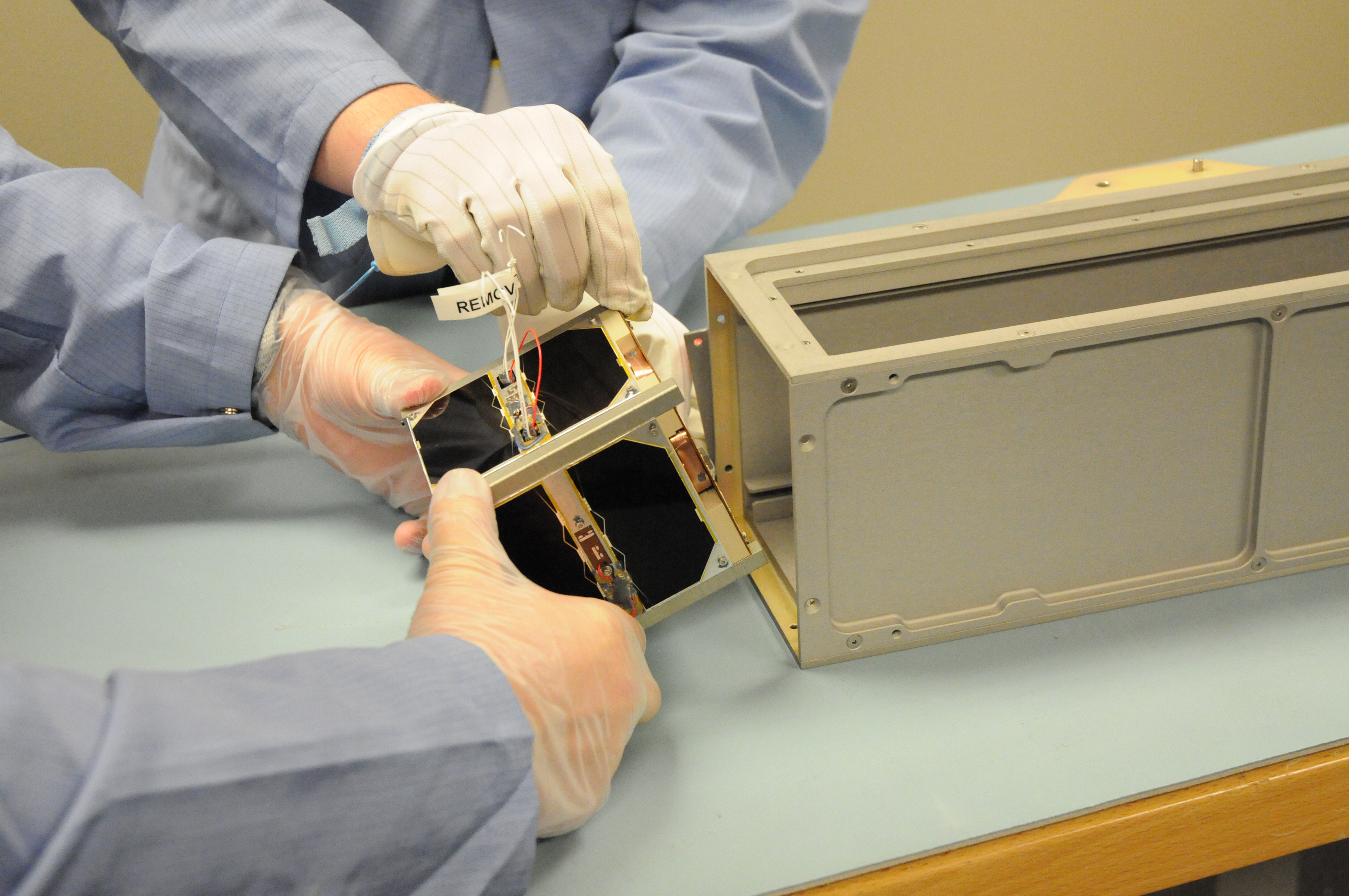
Two CubeSats built in Denmark, GomX-3 and AAUSat-5, are on their way to the International Space Station.

Danish Astronaut Andreas Mogensen KG5GCZ and Murray Niman G6JYB

Danish Astronaut Andreas Mogensen KG5GCZ and Murray Niman G6JYB

Japan’s fifth H-II Transfer Vehicle blasted off from Tanegashima Space Center on Wednesday, August 19 at 1150 UT. The HTV-5 is expected to arrive at the ISS on August 24 and the CubeSats will be unloaded for later deployment.

The 3 Unit CubeSat GomX-3 is part of the outreach programme for the visit of the Danish astronaut, Andreas Mogensen KG5GCZ @Astro_Andreas, to the ISS. His Soyuz spacecraft is expected to launch on September 2. The project is supported and coordinated with ESA and the Danish Ministry of Science and Education.

A number of outreach activities are being planned that will involve schools, radio amateur societies and social media both during the astronaut mission and continuing with the CubeSat mission. The IARU have coordinated 437.250 MHz for the 1k2-9k6 bps beacon.

AAUSat-5 and Deployer - Credit ESA

AAUSat-5 and Deployer – Credit ESA

AAUsat-5 is a 1 Unit CubeSat built by students at Aalborg University. The primary mission is to test an improved receiver for detecting Automatic Identification System signals emitted by ships. Down on the ground, these signals are short-range, operating mainly on a ship-to-shore and ship-to-ship basis, leaving large spans of the world’s oceans uncovered. But signals also travel up to orbital altitude, opening up the prospect of worldwide monitoring. The IARU have coordinated 437.425 MHz for the GMSK beacon.

Once deployed the two spacecraft may have a lifetime of around 6-9 months before they burn up in the Earth’s atmosphere.

Watch AAUSAT5 CubeSat mission from the International Space Station

Andreas attended the 2009 AMSAT-UK International Space Colloquium in Guildford.

Andreas Mogensen KG5GCZ http://andreasmogensen.esa.int/

IARU coordinated satellite frequencies information is at http://www.amsatuk.me.uk/iaru/finished.php

Related ESA stories:
http://www.esa.int/Education/Student_satellite_wins_green_light_for_Station_deployment
http://www.esa.int/Our_Activities/Space_Engineering_Technology/Technology_CubeSat_hitch-hiker_on_today_s_HTV_launch

School students decode ISS images

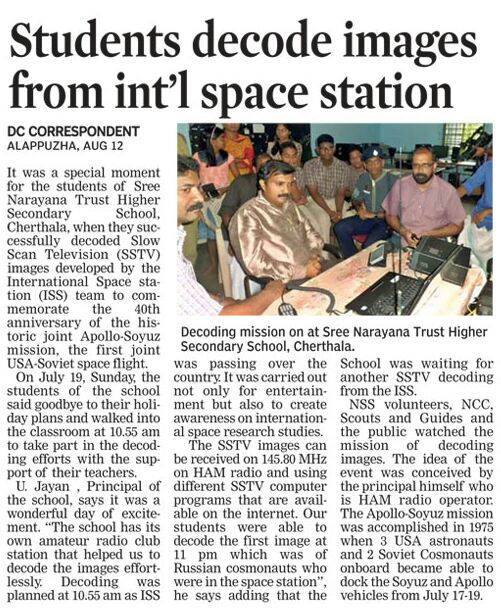
ISS SSTV in the Deccan Chronicle

ISS SSTV in the Deccan Chronicle

Students at Sree Narayana Trust Higher Secondary School returned to the classroom during their holidays to receive amateur radio Slow Scan Television from the International Space Station.

The special ISS transmissions were made in July to commemorate the 40th anniversary of the Apollo-Soyuz mission.

The Deccan Chronicle newspaper reports that with the support of their teachers the students were able to decode the SSTV images on a frequency of 145.800 MHz FM.

The school has an amateur radio club, callsign VU2SQL, and the Principal is licenced radio amateur U.Jayan VU2JYU.
http://www.qrz.com/db/vu2sql

See the full article on the National Institute of Amateur Radio (NIAR) Facebook page at
https://www.facebook.com/NIAR.org/photos/a.272605179532734.63897.272263639566888/743023429157571/?type=1&theater

Examples of ISS SSTV images received by radio amateurs can be seen at
http://www.spaceflightsoftware.com/ARISS_SSTV/index.php

ISS Slow Scan TV https://amsat-uk.org/beginners/iss-sstv/