Announcement of Opportunity: CubeSat Mission Concept Studies

The core of the UK Space Agency strategy is to lead and sustain the growth of the UK Space Sector. In support of this the National Space Technology Programme (NSTP) promotes the development of new commercial and scientific applications by offering grant funding for truly novel concepts to be fully explored.

CubeSats offer huge potential to accelerate technology development of sensors and instruments in a miniaturised package for deployment in space. New technology concepts for space missions can be demonstrated on CubeSat payloads, delivering a test bed at low cost and significantly reduced timescales. The CubeSat is a relatively new concept, which is maturing rapidly, in which the UK has existing leading capability.

This NSTP programme is to facilitate the acceleration of space technologies up the Technology Readiness Level (TRL) curve but can also attract new players into the space sector by offering a low cost route to getting flight heritage. To follow, the NSTP Pathfinder studies programme is to be released in early 2012 and will be specifically to develop technology concepts.

Arthur C Clark Interview

In a 1963 edition of the Sky at Night show Arthur C. Clarke, who in 1945 predicted geostationary satellites, is interviewed by Patrick Moore.

The perils of spaceflight prediction
http://www.thespacereview.com/article/1981/1

FUNcube Dongle SDR in CQ Ham Radio

A review of the AMSAT-UK FUNcube Dongle VHF/UHF Software Defined Radio has just been published in CQ Ham Radio magazine.

The review can be seen at
http://www.funcubedongle.com/MyImages/35a.pdf

However, it’s in Japanese so we are none the wiser as to what it says but it looks good.

The FUNcube Dongle SDR’s have been used for a wide variety of applications including:

Weather Satellites
http://www.uk.amsat.org/2011/09/19/indian-noaa-apt-images-
with-the-amsat-ukfuncube-dongle-sdr/

http://www.uk.amsat.org/2011/08/19/weather-sat-picture
-received-with-funcube-dongle/

A Software Defined Radio Telescope
http://www.britastro.org/radio/projects/An_SDR_Radio_Telescope.pdf

Reception of 433/434 MHz balloons launched by radio amateurs such as
http://www.southgatearc.org/news/december2011/
digital_pictures_sent_from_balloon.htm

Earth-Moon-Earth (Moon Bounce) communications
http://www.uk.amsat.org/2011/10/26/korean-eme-test-with-
funcube-dongle/


The AMSAT-UK FUNcube Yahoo group now has over 2,500 members. You can join at http://groups.yahoo.com/group/FUNcube/

STARS-II Amateur Radio Satellite

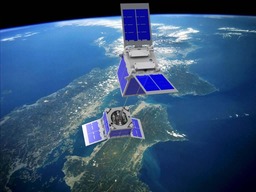
Impression of STARS-II in Orbit

Impression of STARS-II in Orbit

The amateur radio satellite STARS-II has been developed by students at Kagawa University and consists of a Mother satellite and Daughter satellite connected by tether.

STARS stands for Space Tethered Autonomous Robotic Satellite. The mission will include formation flight, tether deployment, attitude control and the mother and daughter satellites will take pictures of each other.

It is proposed to fly a 80mW CW beacon and a 800mW AX25 1200bps telemetry downlink. Total mass is 8 kg.

Coordinated frequencies for CW 437.245 MHz (mother) and 437.255 MHz (daughter). FM downlinks 437.405 MHz (mother) and 437.425 MHz (daughter).

Kagawa satellite development project STARS-II http://stars1.eng.kagawa-u.ac.jp/english/index.html

The Google English translation of the Japanese language STARS-II page has additional information http://tinyurl.com/JapanSTARS-II

STARS-II on the IARU Satellite Frequency Coordination pages hosted by AMSAT-UK
http://www.amsatuk.me.uk/iaru/formal_detail.php?serialnum=170

AMSAT-UK publishes a colour A4 newsletter, OSCAR News, which is full of Amateur Satellite information. Free sample issue at http://www.uk.amsat.org/on_193_final.pdf Join online here

Amateur radio satellite AO-51 remembered

Dozens of messages were posted to the Amsat-bb after the news of the amateur radio satellite AO-51‘s end of mission was received. Many remembered their contacts, several thanked the Operating Team. Many noted that AO-51 was the satellite that brought them into this part of our hobby. Continue reading

SwissCube update

On his French language website HB9AFO provides an update on the SwissCube amateur radio satellite.

He says that the Swiss EPFL Space Center annual meeting was held December 1.

EPFL operations with SwissCube are now finished. For the remainder of its life, SwissCube will be controlled by two stations: HB9MFL in Switzerland and a Dutch station.

Volker Gass and Muriel Richard (ex Noca) warmly thanked all those who participated in the project, including amateur radio. SwissCube was a complete success, both technical (with resolution of unforeseen problems) and human (many interested students and many sponsors for future experiments).

Although EPFL has projects in the pipeline none will use the amateur bands in the near future.

Thanks were given to all the radio hams who participated, directly or indirectly in the SwissCube project.

See the HB9AFO SwissCube page in Google English at
http://tinyurl.com/SwissCube

SwissCube Live Amateur Radio Information
http://swisscube-live.ch/

EFL SwissCube
http://swisscube.epfl.ch/