EIRSAT-1 CubeSat

EIRSAT-1 and CubeSat Deployer

EIRSAT-1 and CubeSat Deployer

EIRSAT-1 launched on a Space X Falcon 9 rocket from the Vandenberg Air Force Base in California, USA, at 1819 GMT on Friday, December 1, 2023. It has a downlink on the IARU coordinated frequency of 437.100 MHz, see https://iaru.amsat-uk.org/finished_detail.php?serialnum=639

Watch the launch live https://www.youtube.com/watch?v=l64-hEGeXZY

Information on the beacon can be found at https://github.com/ucd-eirsat-1/beacon

Preliminary TLE at https://drive.google.com/file/d/1mNKpfPlnwJQYWjs2C9t3_D9tfSN7Mb8L/view

ESA: “The first confirmed recording of EIRSAT-1 from each continent (Europe, Africa, Asia, North America, South America, and Oceania) within a week of launch will be rewarded with a QSL card from ESA!” https://www.esa.int/Education/CubeSats_-_Fly_Your_Satellite/Calling_all_radio_amateurs_be_the_first_to_hear_satellite_EIRSAT-1_from_orbit

EIRSAT-1 Team MembersEIRSAT-1 was built by students from University College Dublin under the framework of ESA Academy’s Fly Your Satellite! programme (FYS) – a fully hands-on initiative supporting university student teams in the development of their own satellites.

Lead by students from the UCD School of Physics and the UCD College of Engineering, the project began in 2017 when the team’s proposal to build a CubeSat to perform gamma ray astronomy was accepted as part of the 2nd cycle of FYS.

The 2-unit CubeSat carries three experiments – or ‘payloads’. The primary science payload GMOD is a gamma ray detector that will study the most luminous explosions in the universe, gamma ray bursts. Secondary payloads include a thermal coating study that will assess the performance of surface treatments for satellites as well as an alternative system for controlling spacecraft orientation.

Source ESA article https://www.esa.int/Education/CubeSats_-_Fly_Your_Satellite/Ireland_s_first_satellite_on_its_way_to_launch

Follow the EIRSAT-1 team on X at https://twitter.com/EIRSAT1

EIRSAT-1 website https://www.eirsat1.ie/

23cm band report ITU‑R M.2532 published

ITU LogoIARU Region 1 reports as a part of the preparatory process for WRC-23 agenda item 9.1 topic b) involving the 23cm band (1240-1300 MHz), ITU‑R Report M.2532 has been published.

This report encapsulates the outcome of resolves 1 of ITU‑R Resolution 774 that requires a detailed review of the different systems and applications used by the amateur and amateur satellite services in the 23cm band. The review forms a part of the basis for the studies required by resolves 2 to address the amateur and amateur satellite services coexistence with the radio navigation satellite service (RNSS).

The publication represents a positive outcome from a great deal of work and committment by the IARU volunteer team that has been central to its development since 2019 in ITU‑R Study Group 5.

Download ITU‑R Report M.2532 https://www.iaru-r1.org/wp-content/uploads/2023/11/R-REP-M.2532-2023-PDF-E.pdf

The information paper ZL23_C5_19 1.3 GHz Band – Additional Information was submitted by the RSGB to the IARU Region 1 Conference held Novemebr 1-4, 2023. It provides information on the situation in the 1240-1300 MHz and 13001350 MHz spectrum. It can be downloaded from ZL23_C5_19 1300MHz INFO

Extract from CPM report 2023-10-11-Extract CPM-Report-to-WRC-23 _2_

Delfi-C3 – DO64 Deorbiting Soon

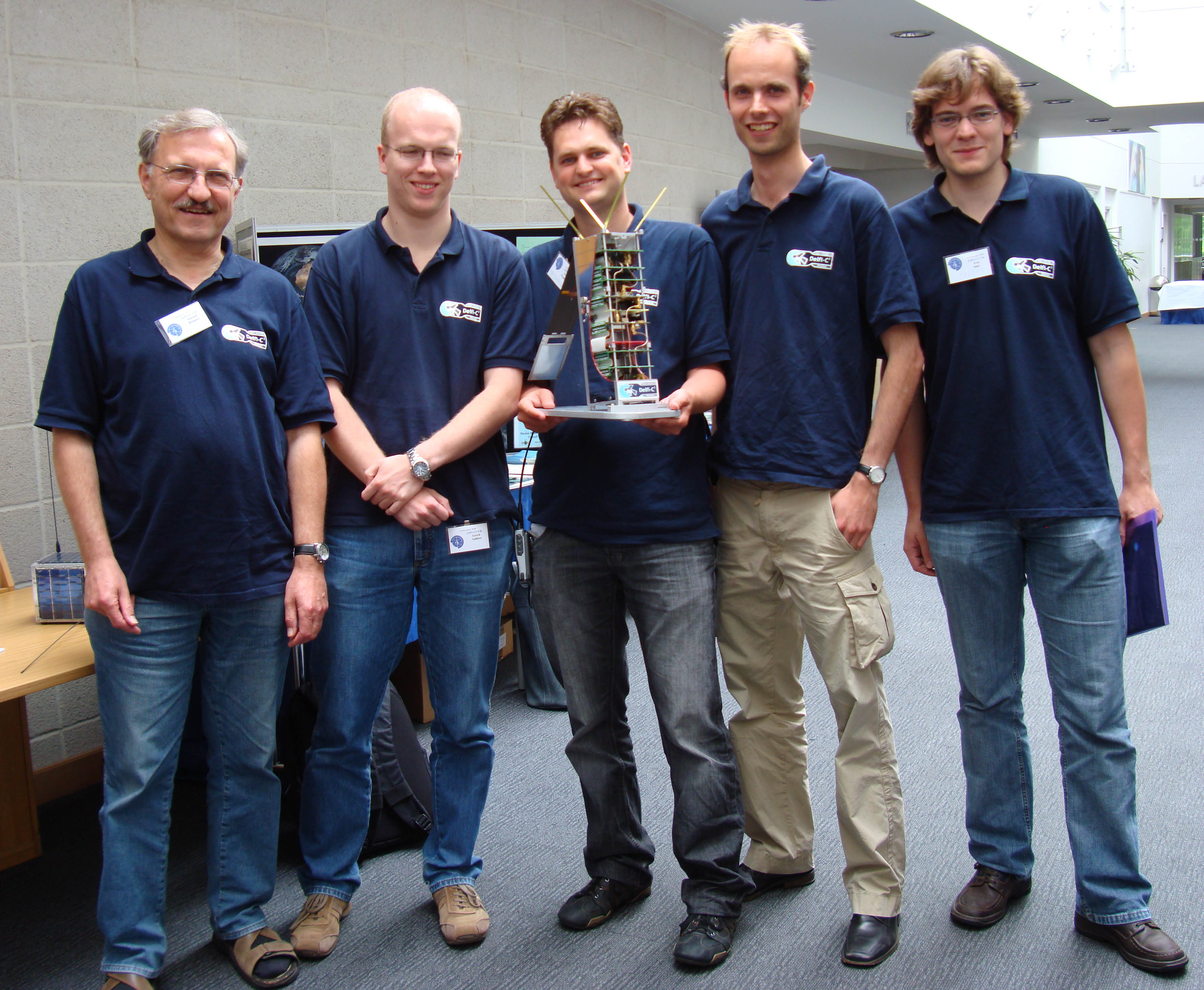
Delfi-C3 Team at AMSAT-UK Colloquium 2008

Delfi-C3 Team at AMSAT-UK Colloquium 2008

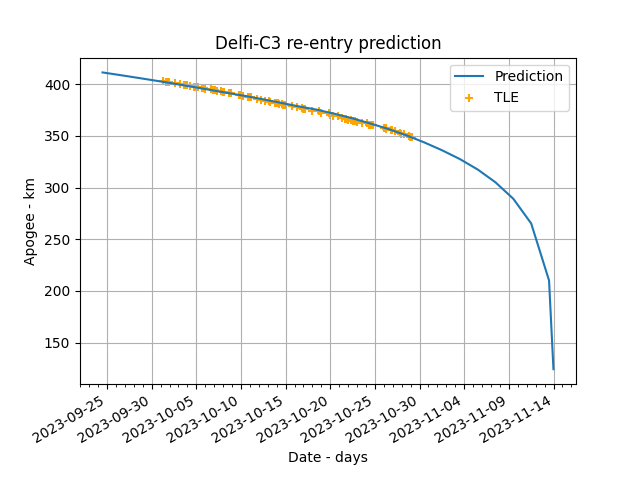
After more than 15 years in orbit, Delfi-C3’s mission is about to come to an end. The team predict that re-entry will take place around November 16th 2023.

The re-entry date might vary depending on the solar activity, which is very hard to predict accurately. See also @Marco_Langbroek on Twitter for a similar prediction.

https://twitter.com/Marco_Langbroek/status/1720110996499349663

Delfi-C3 Re-entry Prediction

Delfi-C3 Re-entry Prediction

We would like to request all amateur radio operators / SWL’s / satellite enthusiasts worldwide to listen for Delfi-C3’s telemetry downlink on 145.867 MHz, 1200 baud AX.25 BPSK. We will hand out an award certificate to the person submitting the last Delfi-C3 telemetry frame.

This can be done either through the RASCAL software (updated version coming…), through the SATNOGS network or by sending us decoded telemetry frames with reception time and location via email to Delfi_at_tudelft.nl.

On behalf of the entire Delfi-C3 team, we would like to sincerely thank the worldwide amateur radio / SWL / satellite community for assisting the team by forwarding received telemetry and reception reports.

Back in 2008 we could not imagine the great support received so far and the many first we had, including a successful ground network and flying the first linear transponder in a CubeSat.

We strongly believe that Delfi-C3 has paved the way for many follow-on missions (both amateur and commercial), and has been a great step towards maturing CubeSat technology as well as training the next generation of space engineers. Stay tuned for updates!

On behalf of the team best 73s,

Wouter PA3WEG

ISS SSTV Verification Test – Oct 27-Nov 1

ISS SSTV image 5/12 received by Murray Hely ZL3MH January 31, 2015

The SSTV system in the Service Module will be activated to attempt to verify a replacement piece of hardware during the period of Oct 27 until Nov 01.

The system will be off around the required period of no transmissions during the planned EVA on Oct 31. Images will be transmitted on 145.800 MHz and in the typical PD120 format.

There are 2 windows for testing, separated by an EVA:
Fri Oct 27 at 12:15 GMT – Sun Oct 29 at 18:50 GMT
Tue Oct 31 at 10:05 GMT – Wed Nov 01 at 18:10 GMT

Your images can be posted to the Gallery at https://www.spaceflightsoftware.com/ARISS_SSTV/index.php

Since this is a test of replacement components of the system, there still may be unexpected outages or issues.

The signal should be receivable on a handheld with a 1/4 wave whip. If your rig has selectable FM filters try the wider filter for 25 kHz channel spacing.

You can get predictions for the ISS pass times at https://www.amsat.org/track/

ARISS SSTV Blog https://ariss-sstv.blogspot.com/

Useful SSTV info and links https://amsat-uk.org/beginners/iss-sstv/

Kent school students to contact ISS astronaut

St. Peter ISS Contact with Jasmin KI5WSLAmateur Radio on the International Space Station (ARISS) has received schedule confirmation for an ARISS radio contact between an astronaut aboard the International Space Station (ISS) and students at St Peter Junior School in Broadstairs, UK. ARISS conducts 60-80 of these special amateur radio contacts each year between students around the globe and crew members with ham radio licenses aboard the ISS.

St Peter is a three form entry junior school located in Broadstairs, a small seaside town on the South East coast of England. St Peter’s students (ages 7 – 11) have been taking part in activities in ‘Mission Zero’ where they write a program to display a personalized image on an Astro Pi computer on board the ISS to remind the astronauts of home.

Students have also been taking part in the FUNcube project (tracking an active LEO Satellite – FUNcube-1/AO-73), and participating in a community stargazing event assisted by members of Ramsgate Stargazers. The school’s science club has also engaged students in space-related activities that include learning the difficulties of traveling to space, designing and launching rockets (using water and air), and living on the ISS (and designing solutions that may help overcome these difficulties). Members of the Hilderstone Radio Society (G0HRS) have been fundamental in advising and supporting the school during these activities and during this ARISS contact.

This will be a direct contact via Amateur Radio and students will take turns asking their questions of Astronaut Jasmin Moghbeli, amateur radio call sign KI5WSL. The downlink frequency for this contact is 145.800 MHz and may be heard by listeners that are within the ISS-footprint that also encompasses the relay ground station.

The amateur radio ground station for this contact is in Broadstairs, UK. Amateur radio operators using call sign GB4SPT, will operate the ground station to establish and maintain the ISS connection.

The ARISS radio contact is scheduled for October 18, 2023 at 10:57:49 am BST (UK) (9:57:49 UTC, 5:57 am EDT, 4:57 am CDT, 3:57 am MDT, 2:57 am PDT).

The public is invited to watch the live stream at: https://live.ariss.org

As time allows, students will ask these questions:
1. Is it hot or cold in space, and if it’s hot how do you keep cool and if it’s cold how do you keep warm in your spacesuit?
2. Is it really true that girls are better suited to space than boys?
3. How do you tell if it’s night or day on the international space station?
4. Would you be happy to live in space for the rest of your life if you were told to?
5. What are your thoughts about space travel in the future for mankind?
6. In the future will we be able to take holidays to the international space station?
7. Do you think living organisms will ever be found in space, and if so what could they be?
8. Do you get dizzy in space when you are not moving? Or does the lack of gravity mean that you do not get dizzy?
9. Does the ISS shake when a Soyuz spacecraft docks?
10. I know we can measure gravity, but what is gravity?
11. What is the furthest distance a human has travelled away from Planet Earth?
12. What would happen if you played on a swing in space?
13. What is the most amazing thing you have seen on earth from the space station?
14. How do fires behave in space?
15. Have you seen any comets?
16. How much work do you have to do on the space station each day, and what do you do in your spare time?
17. My brother and I love space, my brother especially loves the moon. We would love to be able to explore space one day. What advice can you give us, to help our dreams come true?
18. What did you study in school to become an astronaut?
19. How does the space station renew the oxygen inside the station?
20. What is different about growing plants in space and do you think we’ll be able to grow food for long term space missions?
21. Will there be a point soon when you can watch Netflix or use your mobile phone in Space – as you are near the satellites that operate the signals?
About ARISS:
Amateur Radio on the International Space Station (ARISS) is a cooperative venture of international amateur radio societies and the space agencies that support the International Space Station (ISS). In the United States, sponsors are the American Radio Relay League (ARRL), Amateur Radio Digital Communications (ARDC), Radio Amateur Satellite Corporation (AMSAT), NASA’s Space Communications and Navigation program (SCaN) and the ISS National Lab—Space Station Explorers. The primary goal of ARISS is to promote exploration of science, technology, engineering, the arts, and mathematics topics. ARISS does this by organizing scheduled contacts via amateur radio between crew members aboard the ISS and students. Before and during these radio contacts, students, educators, parents, and communities take part in hands-on learning activities tied to space, space technologies, and amateur radio.
For more information, see http://www.ariss.org

1240-1300 MHz – ITU-R WP5A fails to achieve consensus

ITU LogoThe Chair of IARU Region 1 Spectrum and Regulatory Liaison Committee, Barry Lewis G4SJH, writes on the IARU-R1 site that ITU‑R WP5A meeting #30 could not achieve consensus on the measures needed to protect the RNSS in the amateur 23cm band (1240-1300 MHz), (Relating to WRC-23 AI 9.1b)

Working Party 5A meeting #30 met over the period 13th to 22nd September 2023 and despite extra meeting time allocated specifically to the development of the ITU‑R Recommendation M.[AS_GUIDANCE] the meeting did not reach a consensus on the technical and operational measures required to ensure the protection of the RNSS (radio navigation satellite service) in the amateur 23cm band. The measures aim to identify parts of the frequency band with associated amateur transmitter power limits that can help protect the RNSS operations. By the close of the meeting three alternative solutions remained unresolved in the draft document.

This outcome was reported to the WP5A plenary meeting and the subsequent parent Study Group 5 meeting but despite further efforts still no outcome could be achieved. Since the recommendation will be important for WRC-23 discussions it is expected that further efforts will continue to try to find a solution.

On a positive note the Draft New Report ITU‑R M. [AS_CHARACTERISTICS] was finalised by WP5A an approved in Study Group 5.

The IARU report from the WP5A meeting can be downloaded here
https://www.iaru.org/wp-content/uploads/2023/10/Report-from-WP5A_Sept-2023.pdf

The ITU-R WP5A Meeting Report can be downloaded from
https://itu.int/md/R19-WP5A/new/en
Word Doc https://www.itu.int/dms_pub/itu-r/md/19/wp5a/c/R19-WP5A-C-0837!!MSW-E.docx

IARU Region 1 2023 conference information paper ZL23_C5_19 from RSGB ZL23_C5_19 1300MHz INFO