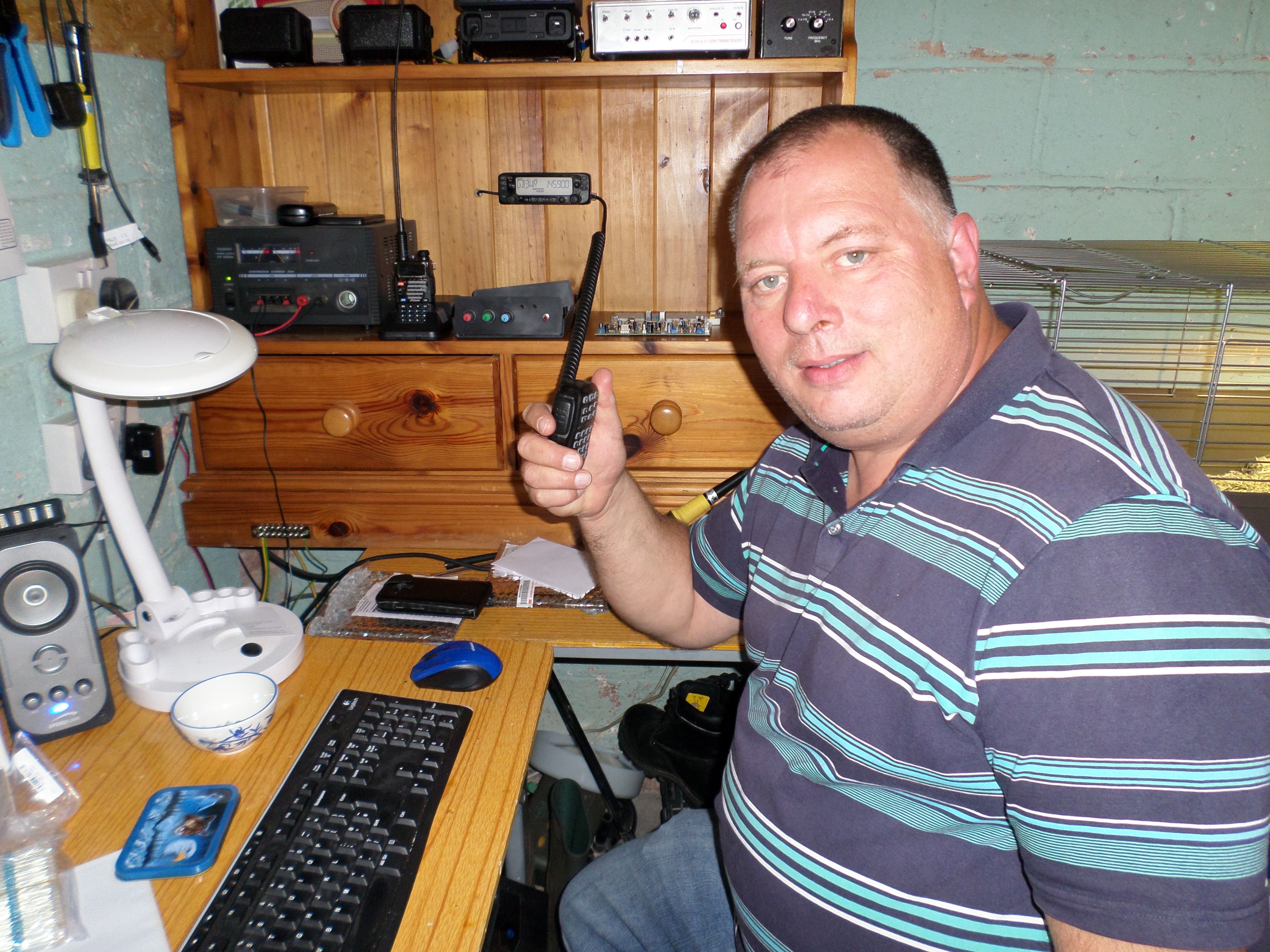
Graham Shirville G3VZV working on the ESEO FUNcube-4 amateur radio payload – Credit 2E0OBC
AMSAT-UK members have been busy this week working on the FUNcube-4 amateur radio payload for the new European Student Earth Orbiter (ESEO) satellite. On Friday, August 7, 2015 they tested the transponder and it seems to work fine. More testing and characterisation will follow over the next few days.
ESEO FUNcube-4 Engineering Model
This is the third mission within the European Space Agency’s Education Satellite Programme. The satellite, which has a mass of 40 kg and measures 33x33x63 cm, is planned to launch into a Low Earth Orbit (LEO).
The spacecraft will carry a 1260/145 MHz FM transponder and 145 MHz 1200 bps BPSK telemetry beacon to provide a telemetry downlink that can be easily received by schools and colleges for educational outreach purposes. The data will be displayed in an attractive format and provide stimulation and encouragement for students to become interested in all STEM subjects in a unique way.
The target audience is primarily students at both primary and secondary levels and the project includes the development of a simple and cheap “ground station” operating on VHF frequencies in the Amateur Satellite Service. This station is an omni-directional antenna feeding a FUNcube DonglePRO+ SDR receiver which will receive the signals direct from the satellite and transfer the data to specially developed graphical software running on any Windows laptop.
Watch “ESEO Payload Update” by Chris 2E0OBC and Graham G3VZV at 2015 AMSAT-UK International Space Colloquium
As has been reported in the RSGB News, the PCSAT spacecraft was launched September 30, 2001 and has, due to an on-board power system issue, started to transmit APRS again on 144.390 MHz.
Although this is the correct frequency for APRS operation in IARU Region 2, it is not compatible with our Region 1 bandplan which has this part of the band designated for weak signal and particularly Meteor Scatter operation.
The orbit of this spacecraft means that sometimes it is in full sunlight and, at other times, it is eclipsed for a major percentage of the orbit. As the on-board batteries have lost their ability to hold a charge, the problem can only occur when it is in sunlight.
Various methods of mitigate this problem are presently under active consideration but in the meantime it is important that no amateur in Region 1 should attempt to digipeat through this spacecraft. Additionally those amateurs on the east coast of the American continent are also requested not to attempt to activate the spacecraft when it can be “seen” from Europe.
At IARU level, further work is being undertaken to reduce the risk from future spacecraft potentially causing similar problems. Such problems could result from developers not following the globally agreed bandplans for amateur satellite operations. In particular the IARU Satellite Coordinator has been requested to make urgent contact with the team responsible for XW-2(CAS-3) mission of nine satellites from China. Some of the proposed frequencies do not respect the internationally agreed Region 1 Bandplan for 2 metres.
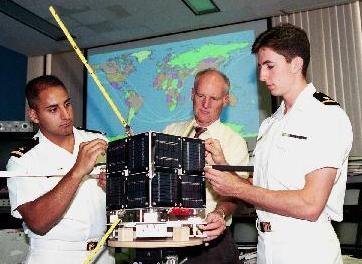
SPROUT satellite students at Nihon-Univ. Miyazaki Laboratory
Students at Nihon University in Japan are requesting the assistance of radio amateurs in collecting telemetry from the SPROUT satellite which has deployed an inflatable membrane structure.
We’d like to show to everyone about SPROUT, and we’d like to ask receiving cooperation to everyone.
SPROUT was launched at May 24, 2014 from Tanegashima Space Center in Japan.
There are 3 main missions in SPROUT.
・Deployment demonstration of inflatable membrane structure.
・Demonstration of attitude determination and control technology for several kilogram class nano-satellite.
・Upbringing of human resources of a space sector
SSTV image received from SPROUT by Mario LU4EOU on May 31, 2014 at 0408 UT
This time, we made a deployment demonstration of inflatable membrane structure. But it’s necessary to get a deal of data to get information on a satellite, and it takes time to get one of data only my satellite communication ground station.
So when everybody of amsat would do reception cooperation, information on a satellite can be got quickly.
We’d like to request reception cooperation of everybody of “AMSAT-UK” for study promotion.
If you wouldn’t mind, please reception cooperation. Please inform the following mail address of your question and a reception report – sprout_contact@forth.aero.cst.nihon-u.ac.jp
Adrian Lane 2E0SDR got some great publicity for the hobby in national newspapers and TV about an amateur radio contact he had with an astronaut on the International Space Station.
Many of the ISS astronauts hold amateur radio licences. In their spare time they carry out scheduled amateur contacts with school students and occasionally talk direct to individual radio amateurs in their home.
There are two amateur radio stations on the ISS; one is located in the ESA Columbus module with the call sign NA1SS, the other is in the Russian Service module and uses the call sign RS0ISS. A description of the stations can be found at http://www.ariss.org/contact-the-iss.html
Adrian Lane 2E0SDR
Adrian’s contact took place in October 2014, he used an Icom FM transceiver running 25 watts with a VHF Eggbeater Antenna designed by Jerry K5OE. In August 2015 he contacted his local newspaper the Gloucester Citizen to place an advert for Under 11’s soccer players for the local youth team. During the conversation he happened to say he had spoken to the ISS.
The story was published in the Thursday, August 6, 2015 edition of many UK national daily newspapers including The Sun, The Times, Telegraph, Independent, Daily Mail, Daily Express and Mirror.
The Thursday edition of the BBC Radio 4 Today show also featured the story at 8:09:46am. To hear it fast forward to 2:09:46 in this recording: http://www.bbc.co.uk/programmes/b0643x5z#play it was also mentioned on BBC Radio 5.
During Thursday evening the story featured on the TV news station CNN.
On Friday, August 7, Adrian was interviewed about the contact on the BBC TV Victoria Derbyshire programme and was mentioned on the BBC World Service. Watch the BBC TV interview at http://www.bbc.co.uk/news/uk-33816779
AMSAT-UK publishes a newsletter, OSCAR News, which is full of Amateur Satellite information. A sample issue of OSCAR News can be downloaded here.
Join AMSAT-UK via the online shop at http://shop.amsat.org.uk/
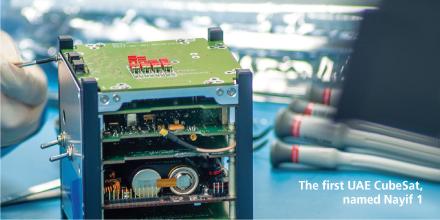
Nayif-1 is an educational single CubeSat project with the goal of providing an actual space project for Emirati University students. Additionally it is intended to enthuse and educate young people about radio, space physics and electronics.
The 1U CubeSat is a collaboration between the Mohammed Bin Rashid Space Center and the American University of Sharjah both in the United Arab Emirates.
Nayif-1 – Credit Mohammed bin Rashid Space Centre
The spacecraft will only require simple ground station antennas and an SDR dongle receiver. This will make it uncomplicated for schools and colleges to use with their students.
It is anticipated Nayif-1 will be launched into an elliptical, sun synchronous, Low Earth Orbit (LEO) about 400 by 750 km. In such an orbit the satellite passes over the Emirates at least twice a day. This would allow the morning passes to be used for educational purposes and the evening passes for Amateur Radio communications.
The student team will develop and operate a special ground station for this spacecraft. They will also be developing a unique “Dashboard” to display the received telemetry data and greetings messages in Arabic.
Nayif-1 will incorporate a novel autonomous attitude determination and control system. This will be the first flight of this system. Additionally it will carry a UHF to VHF linear transponder that will have up to 0.5 watt output and which can be used by Radio Amateurs worldwide for SSB and CW communications.
A launch is planned for late 2015 on a SpaceX Falcoln 9.





 AMSAT-UK
You must be logged in to post a comment.