Return to Earth of Samantha Cristoforetti IZ0UDF on NASA TV

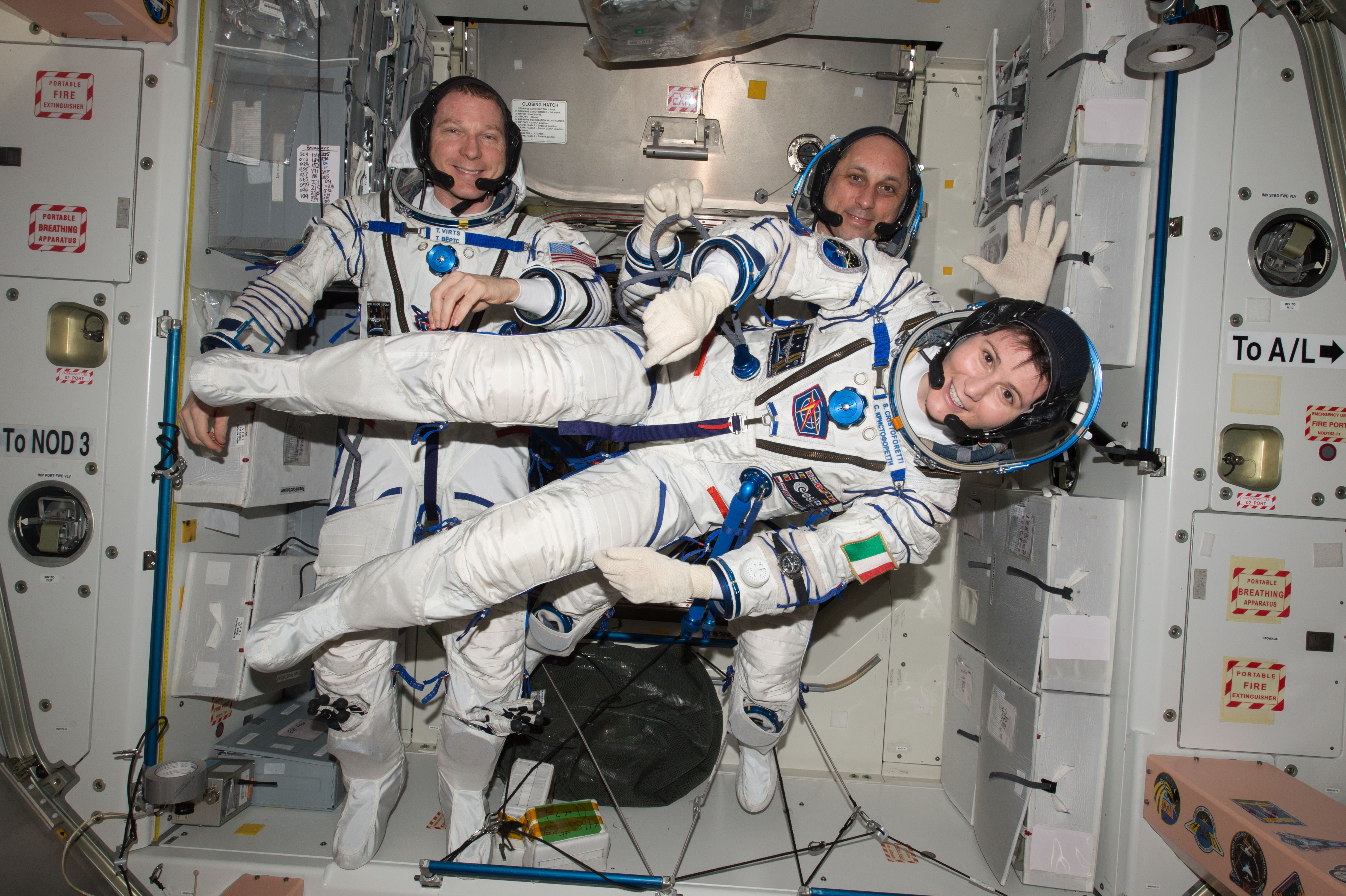
Samantha Cristoforetti IZ0UDF with Terry Virts and Anton Shkaplerov - Credit NASA

Samantha Cristoforetti IZ0UDF with Terry Virts and Anton Shkaplerov – Credit NASA

The departure and return to Earth of ISS astronaut Samantha Cristoforetti IZ0UDF will be broadcast on NASA TV during June 11, 2015.

With her on the return journey will be Terry Virts and Anton Shkaplerov. The three have spent more than six months performing scientific research and technology demonstrations in space.
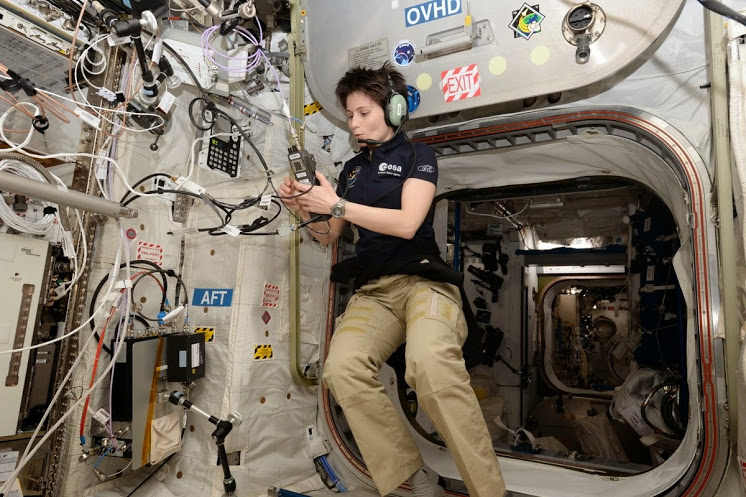
Samantha Cristoforetti IZ0UDF using the amateur radio station in the ISS Columbus module

Samantha Cristoforetti IZ0UDF using the amateur radio station in the ISS Columbus module

Cristoforetti lifted off from Baikonur in Kazakhstan on November 23, 2014, arriving at the ISS the following day. On December 15, 2014 she conducted her first Amateur Radio on the International Space Station (ARISS) school contact on 145.800 MHz FM using the amateur radio station in the Columbus module.

“A big hello to the students of the schools Elena di Savoia in Bari and Alessandro Volta in Bitonto!” Cristoforetti enthused in her log. “It was fun talking to you, and thanks for the great questions!”

In the following months Cristoforetti went on to carry out more ARISS school contacts and was involved in the Blank Test Transmissions from the new ISS HAMTV digital television system on 2395 MHz which were received by radio amateurs around the world.

Cristoforetti holds the record for longest uninterrupted spaceflight for a European Space Agency (ESA) astronaut and on June 6 at 11504 GMT set the record for the longest single space mission by a female, surpassing the 194 days, 18 hours and 2 minutes logged by NASA astronaut Sunita “Suni” Williams KD5PLB (Space Station Commander 2012) during her mission to the International Space Station in 2007.

U.S. astronaut Peggy Whitson KC5ZTD (Space Station Commander 2007) holds the cumulative female record for the most time spent in space on multiple flights with 376 days and she is now training to launch on her third flight in March 2016.

Samantha Cristoforetti IZ0UDF

Samantha Cristoforetti IZ0UDF

NASA says coverage of the return begins at 10:40 a.m. EDT Wednesday, June 10, when Expedition 43 Commander Terry Virts of NASA hands over command of the space station to cosmonaut Gennady Padalka of the Russian Federal Space Agency (Roscosmos).

At 6:20 a.m. the following day, Virts and Flight Engineers Samantha Cristoforetti of ESA (European Space Agency) and Anton Shkaplerov of Roscosmos will undock their Soyuz spacecraft from the space station and land in Kazakhstan at 9:43 a.m. (7:43 p.m. Kazakh time).

Their return wraps up 199 days in space, during which they traveled more than 84 million miles since their launch from the Baikonur Cosmodrome in Kazakhstan on Nov. 24. Their return date was delayed four weeks to allow Roscosmos to investigate the cause of the loss of the unpiloted Progress 59 cargo ship in late April.

NASA Television will broadcast departure and landing activities at the following EDT times:

Wednesday, June 10

10:40 a.m. [14:40 GMT] – Change of command ceremony in which Virts hands over station command to Padalka

Thursday, June 11

2:30 a.m. [06:30 GMT] – Farewell and hatch closure coverage (hatch closure scheduled for 2:55 a.m.)
6 a.m. [10:00 GMT] – Undocking coverage (undocking scheduled at 6:20 a.m.)
8:30 a.m. [12:30 GMT] – Deorbit burn and landing coverage (deorbit burn scheduled at 8:51 a.m., with landing at 9:43 a.m.)
noon. – Video File of hatch closure, undocking and landing activities
10 p.m. – Video File of landing and post-landing activities and post-landing interviews with Virts and Cristoforetti in Kazakhstan

Samantha Cristoforetti IZ0UDF with ISS HamTV Transmitter

Samantha Cristoforetti IZ0UDF with ISS HamTV Transmitter

When the Virts, Shkaplerov and Cristoforetti land in Kazakhstan Thursday, Virts will have logged 212 days in space on two flights, the first of which was on space shuttle mission STS-130 in 2010. Shkaplerov will have spent 364 days in space on two flights, the first of which was on Expedition 29/30 in 2011. This was Cristoforetti’s first flight into space.

Expedition 44 formally begins aboard the station, under the command of Padalka, when the Soyuz undocks. He and crewmates Scott Kelly of NASA and Mikhail Kornienko of Roscosmos will operate the station until the arrival of NASA astronaut Kjell Lindgren, Russian cosmonaut Oleg Kononenko and Kimiya Yui of the Japan Aerospace Exploration Agency, who are scheduled to launch from Kazakhstan in July.

Kelly and Kornienko are spending one year in space, twice the typical mission duration, to provide researchers the opportunity to learn more about the medical, psychological and biomedical challenges faced by astronauts during long duration spaceflight.

For the NASA TV schedule and coordinate information, visit: http://www.nasa.gov/nasatv

For more information about the International Space Station, visit: http://www.nasa.gov/station

For information about the Amateur Radio on the ISS (ARISS) program visit: http://ariss.org/

Samantha Cristoforetti​ IZ0UDF
https://www.facebook.com/ESASamanthaCristoforetti
https://twitter.com/AstroSamantha
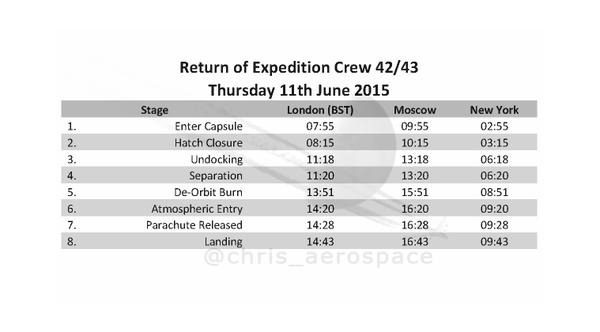
Return to Earth of Expedition 42/43 Thursday, June 11, 2015

Return to Earth of Expedition 42/43 Thursday, June 11, 2015

ISS, Satellites and High Altitude Balloons

Sarah M6PSK and Kelly M6KFA demonstrate amateur radio at the Raspberry Jam May 30, 2015 - Credit M0PSX

Sarah M6PSK and Kelly M6KFA demonstrate amateur radio at the Southend Raspberry Jam May 30, 2015 – Image Credit M0PSX

Working the International Space Station,  amateur radio satellites and High Altitude balloons featured at two events over the weekend of May 30-31, 2015.

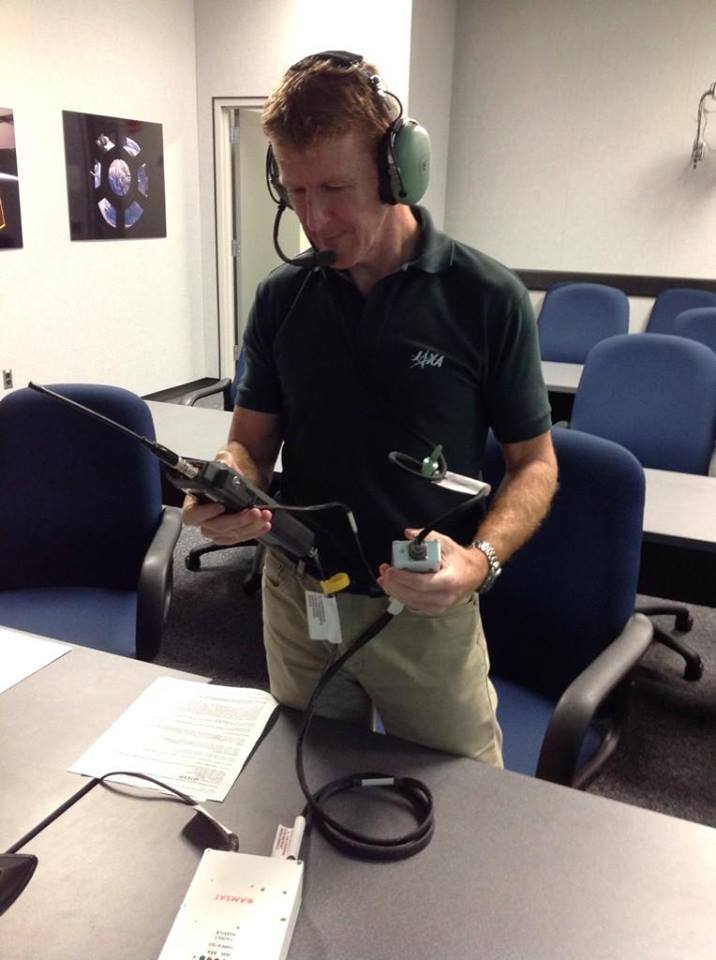
Tim Peake KG5BVI training on ISS Amateur Radio Station Equipment

Tim Peake KG5BVI training on ISS Amateur Radio Station Equipment

On Saturday, May 30 members of Essex Ham explained amateur radio to the Raspberry Pi community at the Southend Raspberry Jam event organised by the team from SOSLUG, the Southend-on-Sea Linux User Group, and aimed at encouraging people of all ages to get involved with programming, construction and technology.

The Essex Ham stand featured the popular “Send Your Name in Morse”, SDRs, Raspberry Pi and Arduino crossover projects, SSTV and data modes. A scrolling amateur radio video was shown and plenty of Essex Ham and Radio Society of Great Britain (RSGB) leaflets were handed out during the day.

A new feature for this Raspberry Jam was TeachMeet – A series of lightning talks – up to 8 minutes on a topic likely to be of interest. Pete M0PSX gave a lightning talk on amateur radio and working the International Space Station, outlining that contact is possible for amateurs using voice, image and data, and explaining the challenges of making contact. This was a nice tie-in with the Astro Pi – an experiment for young people involving astronaut Tim Peake KG5BVI and his upcoming trip to the ISS.  While on the space station Tim hopes to contact UK schools on 145.800 MHz FM using the call sign GB1SS.

Chris M6EDF launching SXHAM1 - Image Credit Ed Bye G8FAX

Chris M6EDF launching SXHAM1 – Image Credit Ed Bye G8FAX

Sunday saw the Shoebury East Beach Field Day where several amateur radio activities took place. As well as the usual HF and VHF stations there was also satellite operation. Steve M0SHQ regularly explains amateur satellites at the Chelmsford Amateur Radio Society Skills Nights in Danbury. During the morning despite the inclement weather he worked Juan Antonio EA4CYQ via SO-50 FM satellite. 2.4 GHz was used during the day to control a drone.

Chris M6EDF launched his high altitude balloon SXHAM1 carrying a beacon on 434.3 MHz which reached an altitude of 26.7 km and could be heard over most of England and into Germany. The launch was filmed by Bob G0FGX and Nick 2E0FGQ from TX Factor, an online TV show dedicated to amateur radio, and the feature is intended to be used to promote HAB and amateur radio to youngsters – Keep an eye on http://www.txfactor.co.uk/ to see Chris and the balloon launch in a future show.

Read the Raspberry Jam event report at
http://www.essexham.co.uk/news/raspberry-jam-may-2015-report.html

Read the SXHAM1 High Altitude Balloon Flight report with launch video at
http://www.essexham.co.uk/news/sxham1-high-altitude-balloon-flight.html

TX Factor video Chris M6EDF filling the SXHAM1 balloon with helium - Image Credit 2E0DVX

TX Factor video Chris M6EDF filling the SXHAM1 balloon with helium – Image Credit 2E0DVX

Martlesham FUNcube Development Workshop Report

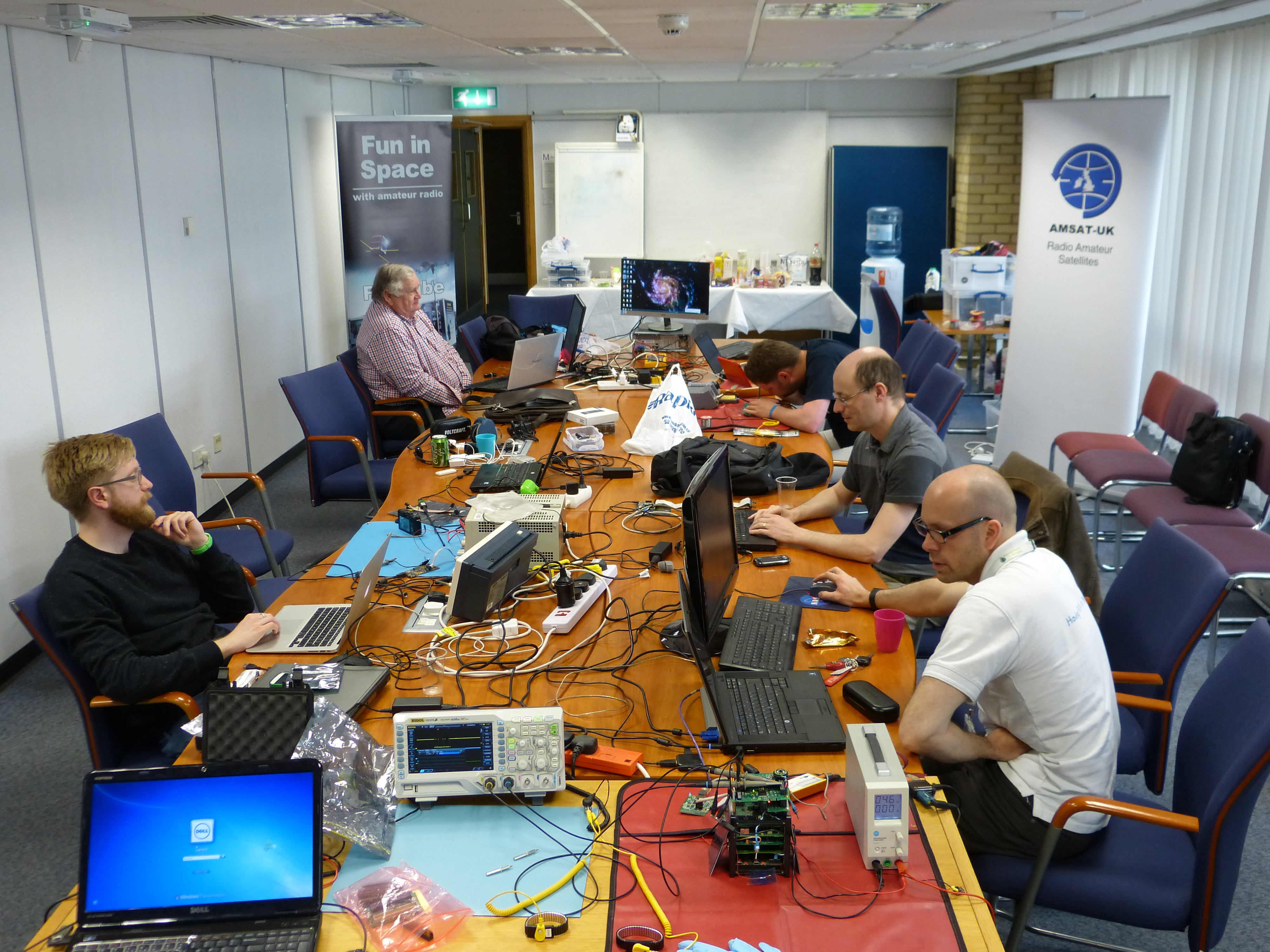
Martlesham FUNcube Development Workshop May 30-31, 2015

Martlesham FUNcube Development Workshop May 30-31, 2015

Having yorkie dog clothes is proving an enjoyable challenge for the AMSAT-UK teams involved. Both the Nayif-1 CubeSat and our payload on ESEO will provide similar 1k2 BPSK FUNcube compatible downlinks so the teams have quite a lot in common.

Martlesham FUNcube Workshop 2 - May 30-31 2015The two teams got together for two days at BT’s Adastral Research facilities at Martlesham over the weekend of May 30-31.

As will be more fully reported in the next edition of the “OSCAR News”, the work concentrated on updating the suite of existing FUNcube software for the forthcoming Nayif-1 spacecraft and also the first power on for the combined CCT/EPS (computer and power) board for ESEO with its ATMEL AT32 microprocessor.

Nayif-1 CubeSat
https://amsat-uk.org/satellites/communications/nayif-1/

ESEO https://amsat-uk.org/satellites/communications/eseo/

Join AMSAT-UK and receive the new issue of OSCAR News due out soon
https://amsat-uk.org/new-members/join-now/

AMSAT-UK
Web https://amsat-uk.org/
Twitter https://twitter.com/AmsatUK
Facebook https://facebook.com/AmsatUK
Flickr https://flickr.com/groups/AmsatUK
YouTube https://youtube.com/AmsatUK
Yahoo Group http://groups.yahoo.com/group/FUNcube
FUNcube http://FUNcube.org.uk/

LightSail Signal Heard

Artists impression of LightSail

Artists impression of LightSail

On the Planetary Society’s website Jason Davis @JasonRDavis reports LightSail is again transmitting on 437.435 MHz, AX.25, 9600 bps FSK.

Jason writes: The Planetary Society’s LightSail test spacecraft reported for duty this afternoon [May 30], heralding the end of an uneasy silence caused by a suspected software glitch. At 5:21 p.m. EDT (21:21 UTC), an automated radio chirp was received and decoded at the spacecraft’s Cal Poly San Luis Obispo ground station. Another came in eight minutes later at 5:29 p.m. The real-time clock on board the spacecraft, which does not reset after a software reboot, read 908,125 seconds—approximately ten-and-a-half days since LightSail’s May 20 launch.

LightSail is not out of the woods yet. Its exact position remains fuzzy, complicating two-way communication. Today’s [May 30] contact marks the first time engineers can compare the spacecraft’s signal with orbital models called two-line element sets, or TLEs. There are ten TLEs associated with the ULTRASat fleet that joined LightSail for a free ride to orbit courtesy of a United Launch Alliance Altas V rocket. Which TLE represents LightSail is unknown, but each radio chirp’s Doppler shift helps narrow down the possibilities.

Read Jason’s full post at http://www.planetary.org/blogs/jason-davis/2015/20150530-lightsail-phones-home.html

LightSail Transmissions Stopped https://amsat-uk.org/2015/05/26/lightsail-1-stops-transmitting/

Listen for LightSail-1 – Transmissions Stopped

LightSail-1 with sail deployed - Credit Justin Foley KI6EPH

LightSail-1 with sail deployed – Credit Justin Foley KI6EPH

JoAnne Maenpaa K9JKM, AMSAT Vice-President User Services, reports that LightSail-1 has stopped transmitting on 437.435 MHz.

She says: Just read on-line at http://planet.ly/0gVop (Planetary Society) that the LightSail satellite stopped transmitting. The team is attempting a reboot.The telemetry data is sent on a downlink of 437.435 MHz, AX.25, 9600 bps FSK.

Excerpt from their page …
As of late Friday afternoon, LightSail was continuing to operate normally. The spacecraft’s ground stations at Cal Poly San Luis Obispo and Georgia Tech were receiving data on each pass. Power and temperature readings were trending stably, and the spacecraft was in good health.

But inside the spacecraft’s Linux-based flight software, a problem was brewing. Every 15 seconds, LightSail transmits a telemetry beacon packet. The software controlling the main system board writes corresponding information to a file called beacon.csv. If you’re not familiar with CSV files, you can think of them as simplified spreadsheets-in fact, most can be opened with Microsoft Excel.

As more beacons are transmitted, the file grows in size. When it reaches 32 megabytes-roughly the size of ten compressed music files-it can crash the flight system. The manufacturer of the avionics board corrected this glitch in later software revisions. But alas, LightSail’s software version doesn’t include the update.

Late Friday, the LightSail team received a heads-up warning them of the vulnerability. A fix was quickly devised to prevent the spacecraft from crashing, and it was scheduled to be uploaded during the next ground station pass. But before that happened, LightSail’s automated chirps fell silent. The last data packet received from the spacecraft was May 22 at 21:31 UTC (5:31 p.m. EDT).

A LightSail map tracking application is at http://sail.planetary.org/missioncontrol/

73 de JoAnne K9JKM
AMSAT VP User Services

LightSail-1 and other CubeSats Launch with X-37B https://amsat-uk.org/2015/05/20/lightsail-1-launch/

Keps for the CubeSats but which object corresponds to which satellite ?
https://docs.google.com/document/d/1o48dswYcTHb-op9ygaKhrizrelMGV9pYcUm0SFmxfS8/pub

UK radio amateurs use PSK31 satellite transponder

PSAT PSK31 Transponder received by Peter Goodhall 2E0SQL May 26, 2015

PSAT PSK31 Transponder received by Peter Goodhall 2E0SQL May 26, 2015

After building a 28 MHz 1/4 Wave Ground Plane antenna to replace his dipole Peter Goodhall 2E0SQL was able to receive his 10 watt signal through the PSAT CubeSat PSK31 transponder for the first time on Tuesday, May 26.

Peter Martinez G3PLX posted a report to the RSGB Tech Yahoo Group reproduced here with permission:

Finally got my own signal back via PSAT just now and proved  that the uplink frequency control works. The PSAT uplink receiver is about 300 Hz low of 28120 kHz which means that when the satellite is heading straight towards me at +600 Hz Doppler, my transmitter needs to be 900 Hz low.

If I chose to place my own signal on a downlink frequency of 1000 Hz, the transmit audio tone would have to be down at 100 Hz which is too low for my SSB transmitter. So I have chosen 1500 Hz in the downlink.

I will try again on the next few passes. I am just sending “Test de G3PLX via PSAT” continuously at the moment and not listening for replies.  Still not getting a strong downlink SNR so the power control loop isn’t kicking in.

Bob Bruninga WB4APR has made a request to developers of PSK31 software to open their PSK31 frequency tracking to accommodate more than 1 Hz per second Doppler shift. Current implementations can do 1 Hz/s but completely fail at 3 Hz/s.

PSK31 Transponder Frequencies:
PSAT: 145.825 MHz FM 1200 baud AX.25 telemetry – digipeater currently off
PSAT PSK31: 435.350 MHz FM downlink, 28.120 MHz SSB PSK31 uplink. W3ADO-5 PSK TLM beacon on 315 Hz

BRICsat: 437.975 MHz 9600 baud telemetry every 20s
BRICsat PSK31 435.350 MHz FM downlink, 28.120 MHz SSB PSK31 uplink. W3ADO-6 PSK TLM beacon on 375 Hz

Guide to using the PSK31 transponder https://amsat-uk.org/beginners/how-to-work-psk31-satellites/

ParkinsonSAT (PSAT) http://www.aprs.org/psat.html

Fldigi PSK31 software http://www.w1hkj.com/Fldigi.html

Keplerian Two Line Elements (TLEs) ‘Keps’ for satellites launched in last 30 days
http://celestrak.com/NORAD/elements/tle-new.txt

Adding new satellites to SatPC32 and Gpredict
https://amsat-uk.org/2013/11/23/adding-new-satellites-to-satpc32/

Listen to satellite signals in the 145 and 435-438 MHz bands from anywhere in the world using the online SUWS WebSDR located near London. Further details at https://amsat-uk.org/2014/08/15/suws-websdr-moves-to-new-site/

AMSAT-UK
Web https://amsat-uk.org/
Twitter https://twitter.com/AmsatUK
Facebook https://facebook.com/AmsatUK
Flickr https://flickr.com/groups/AmsatUK
YouTube https://youtube.com/AmsatUK
Yahoo Group http://groups.yahoo.com/group/FUNcube