Jan 15 Talk – A Beginners Guide to Amateur Satellites

David Bowman G0MRF giving one of his popular FUNcube satellite presentations

David Bowman G0MRF giving a previous FUNcube talk at the Sutton & Cheam Radio Society

David Bowman G0MRF will be giving a presentation titled ‘A Beginners Guide to Amateur Satellites’ at the Sutton & Cheam Radio Society (SCRS) on Thursday, January 15 at 8 pm, visitors are welcome.

The SCRS newsletter says:

Last February, we had an excellent and well-attended talk by David Bowman – GØMRF on the topic of ‘The FUNcube Satellite Project’. The technology of satellite communication seems to have caught the interest of many of our members, but what has been missing at our meetings so far has been an illustrated talk on the basics of getting started.

David will be paying us a return visit on Thursday 15th January with a talk entitled ‘A Beginners Guide to Amateur Satellites’. This will cover the development of amateur satellite communications along with plenty of information on the necessary equipment to get started and the techniques employed.

Some amateur satellite operators have extremely sophisticated and no doubt expensive station set-ups,
however, it is possible to start off at a very basic level. All will be revealed at this meeting.

It’s always good to see a good turn-out of members and visitors at our meetings, so hopefully we can ‘kickoff’ 2015 with a packed clubroom. See you all on Thursday 15th.

John – GØBWV

The meeting will be held in the Vice Presidents’ Lounge, Sutton United Football Club, The Borough Sports Ground, Gander Green Lane, Sutton, Surrey, SM1 2EY at 7:30 pm for 8:00 pm.

Map http://scrs.org.uk/location/

Sutton & Cheam Amateur Radio Society http://scrs.org.uk/

Download the Powerpoint slides A_beginners_guide_ to_amateur_radio_satellites

FUNcube-2 on UKube-1 – January 2015 Update

UKube-1 in flight configuration in the cleanroom at Clyde Space Ltd - Credit Steve Greenland

UKube-1 in flight configuration in the cleanroom at Clyde Space Ltd – Credit Steve Greenland

Limited testing of the FUNcube-2 435/145 MHz linear transponder on the UKube-1 spacecraft has been undertaken during the recent holiday period.

This testing has shown that the transponder is able to work effectively and that it is capable of a similar performance to the transponder already operating on FUNcube-1.

AMSAT-UK and the FUNcube team have now submitted a detailed report on the testing to the UK Space Agency, who are the owners and prime operators of the UKube-1 spacecraft. It is expected that a meeting will be held with them late January or early February to plan possible future testing and operations.

Reception of UKube-1 FUNcube-2 Beacon
https://amsat-uk.org/2014/08/06/reception-of-ukube-1-funcube-2-beacon-on-funcube-dongle-sdr/

DESPATCH Ground Station Operations End

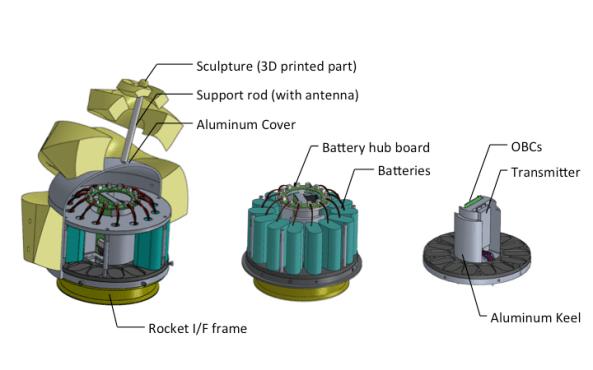
ARTSAT2:DESPATCH Internal Structure

ARTSAT2:DESPATCH Internal Structure

Tama Art University Ground Station has decided to conclude attempts to receive the ARTSAT2:DESPATCH spacecraft, amateur radio callsign JQ1ZNN.

One month has past since Deep Space Sculpture “ARTSAT2:DESPATCH(FO-81)” was put into an Earth-escape orbit as a piggyback payload of H-IIA F26 launched at December 3, 2014 from Tanegashima Space Center, JAXA. It is estimated to have stopped sending radio waves since the battery of DESPATCH already ran out (We predicted that the battery will work for 27 days according to the running time of the transmitter).
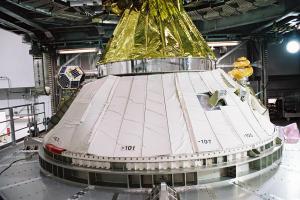
Shin'en2 on left - ARTSAT2:DESPATCH on right

Shin’en2 on left – ARTSAT2:DESPATCH on right

Today January 3, 2015, the main control station, Tama Art University Ground Station, decided to conclude the operation of DESPATCH. Many people supported and cooperated us throughout the design and development of DESPATCH. In addition, many excellent many ham radio operator received and reported super weak  radio waves of DESPATCH from deep space. To have this opportunity, I would like once again to thank all of them very much.

Reception reports of DESPATCH are summarized on the following page.
https://docs.google.com/spreadsheets/d/1WP-FzXHe8axAzNy44SGbKpJqIRKWHAcIP9vXnaHMb6g/edit#gid=0

Finally, we had two reception reports at 4.7 million kilo-meters from the Earth  (more than 12 times of the distance to the Moon). They were far beyond what we expected. They are the the longest communication distance in the world between two amateur radio stations.

Orbital elements of DESPATCH is as follows (J2000 heliocentric ecliptic coordinates).

– Semi-major axis a : 1.003881127 [AU]
– Eccentricity e : 0.08741828512
– Inclination  i : 6.796995362 [deg]
– Argument of perihelion w : 96.90057903 [deg]
– Longitude of the ascending node W : 250.5520871 [deg]
– Mean anomaly at epoch  M : 101.6280436 [deg]
– Epoch  : 2457023.50000 [JD]
(Time of perihelion :  2456919.7870655278675 [JD])

cf. Orbital elements of EARTH : http://nssdc.gsfc.nasa.gov/planetary/factsheet/earthfact.html

Celestial sphere position and orbital trajectory of DESPATCH can be checked anytime on the following web pages.

– Celestial Sphere http://artsat.jp/project/despatch/celestial

– Orbital Position http://artsat.jp/project/despatch/orbit

Transmission of the radio wave from DESPATCH has ended. However, the life of DESPATCH as a sculpture around the sun is almost eternal. We calculated the orbit (the distance from the Earth) of DESPATCH for 500 years from now.

http://artsat.jp/wp-content/uploads/2015/01/500years.png

http://artsat.jp/wp-content/uploads/2015/01/500years_large.png

DESPATCH will continue to orbit around the sun as an artificial asteroid. By examining the calculated results for the local minimum value of the distance between the Earth, DESPATCH will approaches to less than 1 million km from Earth after about 350 years. Possibly it will approach more closer to the Earth due to the interaction with unpredictable other celestial bodies.

We are glad if you think of DESPATCH as the most distant artwork in the world sometimes in the future.

ARTSAT project will continue to the future. We already started the conceptual design of next ARTSAT3. We kindly ask for your continuous support and cooperation for the project.

January 3, 2014
ARTSAT Project

Ham radio spacecraft launched into deep space
https://amsat-uk.org/2014/12/03/ham-radio-spacecraft-launched-into-deep-space/

Australian radio hams plan winged spacecraft

CAD image of ThunderStruck above the Earth by Jason VK2FJAB

CAD image of ThunderStruck above the Earth by Jason VK2FJAB

The WIA highlights an ABC news story about the spacecraft being developed by radio amateurs Robert Brand VK2URB and his 12-year-old son Jason VK2FJAB.

The WIA news report says:

An Australian man and his 12-year-old son are hoping to make history with the development of the smallest spacecraft able to re-enter Earth’s atmosphere and land safely.

Robert Brand VK2URB is the developer of the craft, named ThunderStruck, a small winged re-entry vehicle capable of leaving Earth’s orbit and flying around the solar system, at least as far as Mars or the near-Earth asteroids.

What makes ThunderStruck unique was that it could fly up and back for basic experiments without going into orbit or it could fly into orbit on board a rocket then re-enter, something that was not being done anywhere else.

Robert Brand VK2URB at a recent Lodon space conference

Robert Brand VK2URB at a recent London space conference

Project ThunderStruck has the backing of Australian government bodies and universities and is on the cards to be a fully working spaceship in about five years.

Another unique aspect of Project ThunderStruck would be the involvement of Mr Brand’s 12-year-old son Jason VK2FJAB in the first phase of testing, scheduled for April, the transonic testing phase would attempt to test the 2.5-metre craft at speeds close to Mach 2, faster than the speed of sound.

Mr Brand said his son worked with him releasing and bringing back high-altitude balloons from the stratosphere and had considerable expertise in space technology, in spite of his young age.

Mr Brand said if the project came together it would be unique and give Australia a much-needed boost in space development

Read the full ABC story at
http://www.abc.net.au/news/2014-12-29/father-son-team-hope-to-make-australian-space-history/5990388

Project ThunderStruck http://projectthunderstruck.org/

Using the RTL-SDR dongle to detect meteors

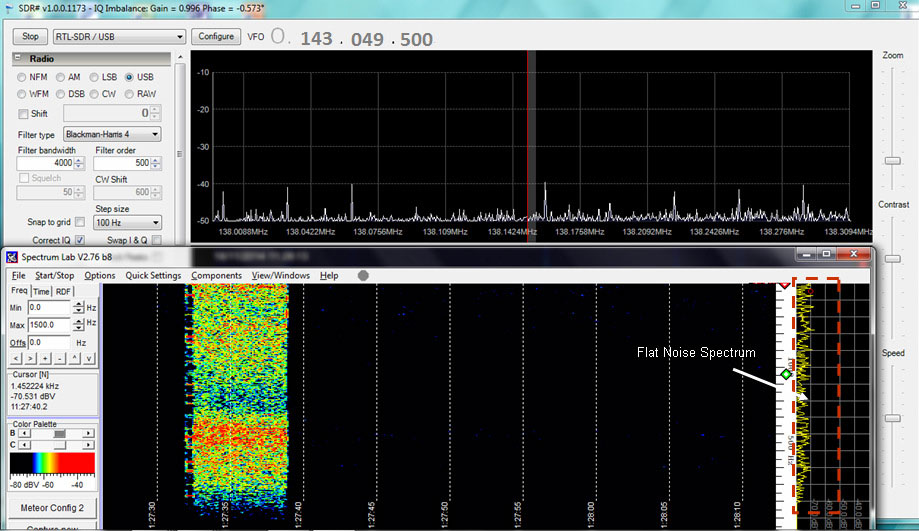
Combined SDR# and Spectrum Lab Display - Dr David Morgan 2W0CXV

Combined SDR# and Spectrum Lab Display – Dr David Morgan 2W0CXV

A new paper has been released by Dr David Morgan 2W0CXV on using the RTL2841 DVB TV Dongle as a SDR processor with SpectrumLab.

The paper Techniques for using the RTL Dongle for Detecting Meteors covers the setting up and use of the dongle to receive meteor pings from the Graves Radar on 143.050 MHz.

It can be downloaded from the Meteor Detection Projects page of the BAA-RAG website http://www.britastro.org/radio/projects/meteorproj.html

Join the BAA-RAG Yahoo Group at http://groups.yahoo.com/group/baa-rag

Download the free publication RAGazine from http://www.britastro.org/radio/downloads.html

Tweeting via the ISS

International Space Station - Image Credit NASA

International Space Station – Image Credit NASA

Harold Giddings KR0SIV describes how he Tweeted using amateur radio and the International Space Station.

He says: I sent a message to the International Space Station, it transmits it back down to groundstations in its view and those stations send the message to the APRS-IS network. My server then takes the message parses out useful data and posts it to Twitter as a tweet.

The ISS has two amateur radio stations. One is in the Russian Service Module and uses a Kenwood D710 and can do Slow Scan Television (SSTV) as well as FM voice. The other is in the Columbus Module and uses Ericsson handhelds for 145 and 435 MHz FM, the 2395 MHz HAM-TV system is also in this segment of the space station. In addition to voice contacts the 145 MHz Ericsson handheld is used to provide the APRS packet radio digipeater used by Harold.

Watch Twitter on the International Space Station

Ham Radio Tweets
http://hamradiotweets.com/
https://twitter.com/HamRadioTweets

How to hear the ISS https://amsat-uk.org/beginners/how-to-hear-the-iss/

How to work the ISS on APRS Packet Radio
https://amsat-uk.org/beginners/how-to-work-the-iss-on-aprs-packet-radio/