LituanicaSAT-2 Announced

LituanicaSAT-1 with Vytenis Buzas LY1ZY and Laurynas Maciulis LY1LM - Credit 15min.lt

LituanicaSAT-1 with Vytenis Buzas LY1ZY and Laurynas Maciulis LY1LM – Credit 15min.lt

The LituanicaSAT team has announced on Facebook that the LituanicaSAT-2 CubeSat will be coming soon.

It is hoped the CubeSat will be among 50 satellites launched in the 1st quarter of 2016 on the Ukrainian Cyclone 4 launcher from the Alcantara launch site built by Ukraine and Brazil. The new launch site is located near the Atlantic coast of Brazil just 2.3 degrees south of the equator.

LituanicaSAT-2 will be more complex than the first and will test a new propulsion system which will enable it to change orbit.

LituanicaSAT-2 - Credit 15min.lt

LituanicaSAT-2 – Credit 15min.lt

Currently CubeSats deployed in very low Earth orbit may only last 3 months before burning up in  the Earth’s atmosphere, the propulsion system could extend that up to 18 months.

Read the 15min.lt article about LituanicaSAT-2 in Google English at http://tinyurl.com/LituanicaSAT-2-15min

Facebook https://www.facebook.com/Lituanicasat1

You can watch a presentation by Gintautas Sulskus on the first LituanicaSAT CubeSat at
https://amsat-uk.org/colloquium/colloquium-2014/presentation-videos/

President tests LituanicaSAT-1 FM transponder
https://amsat-uk.org/2014/03/26/president-tests-lituanicasat-1-fm-transponder/

LituanicaSAT-1 https://amsat-uk.org/2014/02/27/lituanicasat-1-cubesat/

QB50 to use Alcantara launch site https://amsat-uk.org/2014/01/28/qb50-cubesat-launch-contract-signed/

GB1SS callsign for International Space Station

Sarah Brightman

Sarah Brightman

The RSGB report that on October 9, 2014 Ofcom confirmed that the callsign GB1SS will be made available for issue to UK astronauts who wish to operate from the ISS.

In May 1991 the first UK astronaut Helen Sharman GB1MIR talked to radio amateurs around the world from the Mir space station. After a gap of 24 years it looks as though two more UK astronauts may be flying to the International Space Station (ISS) in 2015.

One of the UK radio amateurs that Helen contacted all those years ago was Chris Lorek G4HCL he says: I remember it fondly! I and my three children all chatted with her on 2m using my club station call G4SMC (South Midlands Communications in Chandler’s Ford) on her next-but-last Mir pass over the UK before she came down. Steven (10 years old), David (8 years old) and Carolyn (5 years old) all said hello to her, each giving their name and age, with Steven asking whether there was a particular challenge she may have had. Helen replied, knowing it was very young children, that one difficult challenge she’d had was putting her socks on as she floated around the station!

In September 2015 Sarah Brightman hopes to become the 2nd UK astronaut, flying to the ISS on a 10 day mission. She is committed to encouraging young women to pursue careers in Science, Technology, Engineering, and Mathematics (STEM). In 2012 in conjunction with Virgin Galactic, she launched The Brightman STEM Scholarship program. It is not yet clear if she will operate the ISS amateur radio station during her mission.

Tim Peake KG5BVI training on ISS Amateur Radio Station Equipment

Tim Peake KG5BVI training on ISS Amateur Radio Station Equipment

Tim Peake was selected to train as an astronaut in 2009 and hopes to go to the ISS in November 2015. He holds the USA callsign KG5BVI and has recently been learning to use the Ericsson 144 MHz handheld radio which is installed in the Columbus module of the ISS. On September 18 Tim said “Will be great to chat with schools next year from space using this ham radio on board the ISS.”

There are two amateur radio stations on the ISS, one in the Russian Service Module, the other in the ESA Columbus Module. Almost any 144 MHz FM rig will receive signals from the ISS, you can even use a general coverage VHF scanner with an external antenna. As far as the antenna is concerned the simpler the better. A ¼ wave ground plane is a good antenna for the ISS as it has a high angle of radiation. Large 2m colinears may not work quite as well since the radiation pattern is concentrated at the horizon.

You can receive the ISS outdoors using a 2 metre hand-held with its helical antenna but a 1/4 wave whip will give far better results.

In the UK we use narrow 2.5 kHz deviation FM but the ISS transmits using the wider 5 kHz deviation used in much of the world. Most rigs can be switched been wide and narrow deviation filters so select the wider deviation. Hand-held rigs all seem to have a single wide filter fitted as standard.

Voice contacts with astronauts usually take place using “split” frequencies. The astronauts transmit on 145.800 MHz and listen for replies on 145.200 MHz, you just need to activate your rig’s repeater shift. Recently, however, they have also been operating simplex listening on 145.800 MHz.

When astronauts are not on the air they usually leave the packet digi-peater running on 145.825 MHz so why not listen out for it.

ISS status and tracking information http://issfanclub.com/

The First UK Astronaut Helen Sharman GB1MIR
https://amsat-uk.org/about/history/first-uk-astronaut-helen-sharman-gb1mir/

Sarah Brightman to fly to ISS
https://amsat-uk.org/2014/09/04/sarah-brightman-to-start-space-flight-training-in-january/

Read the report of the Ofcom-RSGB meeting on October 9
http://rsgb.org/main/blog/news/rsgb-notices/ofcom-rsgb-forum/2014/10/22/ofcom-rsgb-forum-9-october-2014/

After her return to Earth the first UK astronaut Helen Sharman visited the Harrogate Ladies' College club station G0HCA From left to right are Anna-Karin G7IRR, Helen Sharman GB1MIR, Richard Horton G3XWH and Katy G7NST

After her return to Earth the first UK astronaut Helen Sharman visited the Harrogate Ladies’ College club station G0HCA
Left to right are Anna-Karin G7IRR, Helen Sharman GB1MIR, Richard Horton G3XWH and Katy G7NST

UK NoV’s for 146 MHz now available

Ofcom-logo-col-tUK Full licence holders can now apply for their NoV to use 146 MHz.

You just need to fill in your details on the RSGB NoV page and you will be instantly emailed a link to the PDF of your NoV certificate. The NoV’s currently being issued have an expiry date of October 31, 2015.

Apply now for your NoV at http://rsgb.org/main/operating/licensing-novs-visitors/online-nov-application/146mhz-147mhz-nov/

The application asks you for your Licence Number which appears on page 1 of your licence. If you don’t have it simply login to the Ofcom licencing page and download a new licence PDF at https://services.ofcom.org.uk/

UK radio hams start 146 MHz development
http://www.southgatearc.org/news/2014/october/uk_radio_hams_start_146_mhz_development.htm

New UK Amateur Radio 146 MHz allocation
https://amsat-uk.org/2014/10/13/new-uk-amateur-radio-146-mhz-allocation/
434 MHz balloons to launch for JOTA

Chris Stubbs M6EDF with 434 MHz trackers

Chris Stubbs M6EDF with 434 MHz trackers

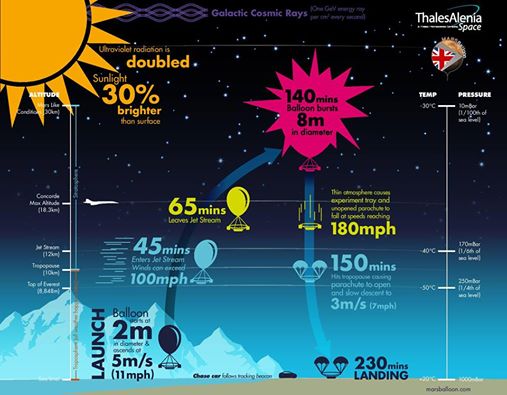
Radio amateurs Chris M6EDF and Steve G0TDJ will each be launching 434 MHz balloons from Essex for Jamboree On The Air (JOTA) this weekend.

The balloons should be launched from Kingston Ridge Campsite in Essex on the Saturday and Sunday, Lat/Lon: 51.559144, 0.435010 http://www.kingstonridgecampsite.co.uk/index2.html

Chris Stubbs M6EDF posted on the UKHAS Google Group:
I will be launching JOTA1 at about 12:30 on Saturday 18/10/2014.
Using either a foil or 100g pawan depending on the conditions.
434.300 MHz SSB,RTTY, 50 baud, 7n2, 450Hz shift.

Steve G0TDJ posted:
Callsign: JOTA2
Date-Time: 19/10/2014 – 12:30pm
Frequency: 434.450 MHz SSB
Mode: RTTY 50n7 with 450Hz shift.
My launch will be at around 12:30pm (+/- ish) Tracking stations will be appreciated. This time, I’m going to try for a float since I will hopefully have plenty of time to prepare. The payload will be running on a Maplin AAA Lithium so expected Tx time will be >24hrs.

The balloon’s FSK (SSB) 434 MHz signals should be receiveable across much of the UK but for those out of range or who lack 70 cm SSB the online SUWS WebSDR can be used instead, see https://amsat-uk.org/2014/08/15/suws-websdr-moves-to-new-site/

Useful links for tracking and receiving 434 MHz balloons https://amsat-uk.org/beginners/balloons/

UKSA announces CubeSat payload opportunity

UKSA - UK Space Agency LogoThe UK Space Agency (UKSA) has announced an opportunity to fly payloads on the 3U CubeSat AlSat-1N.

AlSat-Nano is primarily an education programme, its top level objective is to teach Algerian students how to design, build and operate a 3U CubeSat. The programme involves a number of Algerian graduate students who will be hosted at the Surrey Space Centre (University of Surrey) and focuses on the development of the CubeSat as a hands-on learning exercise for the students, to demonstrate the practical implementation of this type of low cost space technology.

As well as the practical element of the programme there will be a focus on research modules around the use of low cost nano-satellite technologies and applications in developing nations such as Algeria, which would help to create sustainable growth and have practical uses such as earthresource management (agriculture, water), atmospheric monitoring, and disaster management.

The design and build of the nano-satellite will take place at Surrey Space Centre. Final assembly, integration and verification will take place at the ASAL satellite development facility in Oran, Algeria. Operations will be carried out from Oran also.

The bus will be built using hardware sourced from UK suppliers and the CubeSat will also carry payloads which will be supplied by the UK CubeSat community. These payloads will be selected in a competitive process following an Announcement of Flight Opportunity which will be issued in December 2014.

The precise interface specifications will be developed during the first trimester of the project to be integrated in the Announcement of Opportunity, however it is foreseen that a maximum volume of 1U (10cm x 10cm x 10cm) and maximum mass of 1kg will be available for payloads. The selection of the payloads will be carried out in early 2015 via a selection panel.

Payloads must be ready for functional testing and integration by September 2015. Launch will be in Q2 2016. Because of the educational and collaborative nature of the programme there are two further specific points that should be noted:
• Payload providers must be actively engaged in all programme reviews and an active participant in the consortium
• Payload providers must be willing to share payload data with the programme for research purposes, and to receive interpreted payload data via the ASAL ground segment in Oran, Algeria

Submissions should be sent to Ryan King, UK Space Agency – ryan.king@ukspaceagency.bis.gsi.gov.uk with ‘AlSat-Nano RFI’ as the subject line. The deadline for responses is 12 noon, November 14th 2014. Submissions received after this time will not be read.

RFI PDF https://www.gov.uk/government/uploads/system/uploads/attachment_data/file/362794/AlSat-Nano_Request_for_Information.pdf

UK Space Agency Announcement
https://www.gov.uk/government/publications/request-for-information-alsat-nano-payload

Ham radio EME for JOTA

PI9CAM Dwingeloo 25 meter dish antenna

PI9CAM Dwingeloo 25 meter dish antenna

Geert Jan de Groot PE1HZG reports  that radio amateurs will be using the PI9CAM Dwingeloo 25 meter dish during Jamboree On The Air (JOTA) this weekend. On the AMSAT-BB he writes:

In the Netherlands, the CAMRAS foundation took over the large radio telescope of Dwingeloo. This year during upcoming JOTA weekend, several stations will try to make QSO’s using QRP EME via the moon using WSJT and the telescope (accessible via WebSDR) as Receiver With Large Ears.

Information, in Dutch alas, can be found at
http://www.camras.nl/index.php?option=com_content&view=category&layout=blog&id=85&Itemid=109&lang=nl

You should be able to listen in using the same WebSDR station.

Please join me to congratulate the volunteers of CAMRAS, and especially
Frans PE1RXJ, for organizing and facilitating this impressive feat.

Geert Jan PE1HZG

CAMRAS JOTA Moon in Google English http://tinyurl.com/CAMRAS-JOTA-2014

CAMRAS WebSDR Google English http://tinyurl.com/CAMRAS-WebSDR