
Delfi-n3Xt Satellite
On Saturday, September 28, 2013 the very first Amateur Radio Satellite User Day will be held.
Location
The event will take place at restaurant ”Binnenhof”, in the small town of Paasloo, in the North of the Netherlands, a 90 minute drive by car from Amsterdam.
Join us!
We invite everyone to come over and join us! For both newbies as well as experienced satellite operators it will be an exciting day with interesting presentations as well as exciting activities!
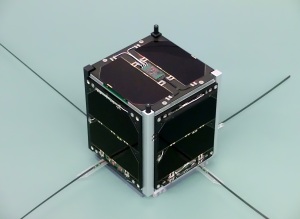
FUNcube-1 flight model – Image credit Wouter Weggelaar PA3WEG
Two Dutch satellite builders will talk about their latest satellites, that both will be launched in November: FUNcube-1 (Wouter Weggelaar – PA3WEG) and Delfi-n3Xt (Jasper Bouwmeester). Both projects will take along with them engineering models: a great opportunity to see yourself how small and advanced Cubesats look like!
Furthermore we have many hands-on sessions planned: take your own radio and antenna to Paasloo, we can help you get started or you can compare yours to that of the others!
Of course this is a fantastic opportunity to ‘meet and great’ each other in person. The OSCAR lunch has a lot of time reserved for that as well. The entire day is free of charge, including coffee and lunch. From those that want to stay for the Barbecue at the end of the day we ask a contribution of 17,50 euro.

HAMSAT VO-52
For those that cannot come over to the Netherlands: meet us during one of the on-air hands-on sessions (see the program details below).
Program
10:00 Arrival
Coffee and tea, registration
10:30 – 10:45 Hands-on session VO-52
Listen to, and maybe even make a QSO via, the strongest linear transponder currently in space. We do have a low elevation pass, need to check line-of-sight. 2m/70cm SSB transponder, maximum elevation 11 degrees
10:45 – 11:00 Welcome
Opening of both the “VHF-day” and the “Amateur Radio Satellite User Day”
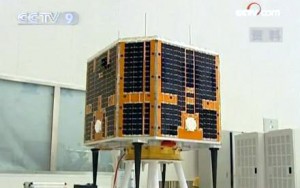
HO-68
10:43 – 11:02 Hands-on session HO-68
Listening to the CW downlink signals of this Chinese satellite. Its linear transponder is no longer functional, but its beacon is great fun to experiment with for reception of amateur radio satellites. Examples include testing and comparing different types of antennas. 70 cm CW beacon. Maximum elevation: 49 degrees
11:04 – 11:24 Hands-on session FO-29
Listening to, and maybe make a QSO via, the linear transponder of this satellite. A very distant satellite for portable equipment, but with a little bit of effort and luck we should be able to hear our own signals back on downlink. 2m/70cm SSB transponder. Maximum elevation: 73 degrees.
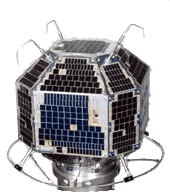
FO-29
11:30 – 11:35 Welcome Amateur Radio Satellite User Day
Opening of the very first Amateur Radio Satellite User Day in The Netherlands.
11:35 – 12:15 FUNcube-1 – A new satellite revealed (Wouter Weggelaar – PA3WEG)
A presentation by one of the builders, about the technology used in FUNcube-1, a project of a series of organizations, including AMSAT-UK. Due to the delayed launch (now planned for November) FUNcube-1 is not yet in space during the event, but very likely Wouter will bring along the functional engineering-model of FUNcube-1. A presentation you don’t want to miss!
12:15 – 13:00 Amateur Radio Satellites step-by-step, for newbies and experienced operators! (Ivo Klinkert – PA1IVO and Henk Hamoen – PA3GUO)
An introduction into orbits of LEO/HEO-satellites and how to predict their passes. We will also talk about which kind of equipment is needed to transmit via amateur radio satellites. So, a talk on TLE, AOS, LOS, TCA, Kepler and Doppler, RHCP, LHCP, PCs, Antennes, TRX, SDR and Cubesat CW beacons. While this session addresses the basics of satellite communications, we invite the more experienced operators to share their experiences during the presentation as well. For example which software they use, which satellites are favorite, which antennas and rotators are being used… and: which transceivers are most popular.
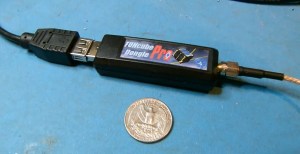
FUNcube Dongle Pro+ Software Defined Radio
13:00 – 13:45 Hands-on session FUNcube-1 Engineering model
Most likely it will be possible to make in Paasloo QSO’s via the transponder of the engineering-model of FUNcube-1. A fun exercise or simply a lot of fun with a satellite of which we really control when it is within reach! 2m/70cm SSB transponder.
13:00 – 14:00 OSCAR-lunch
Extended buffet lunch buffet, where the objective is to meet and great your fellow radio amateurs that share the same interest amateur radio satellites. At the same time a demonstration of the famous FUNcube Dongle and equipment like Arrow antennas, LVB-tracker, etc.
13:45 – 14:15 Hands-on session LO-19
Receiving the downlink signals of the satellite. Even though this satellite has gone through some rough situations up there in space, we can still hear a very strong (continues) carrier in the 70cm band. A great opportunity to observe the Doppler-effect and to experience how large this effect is at different stages of a pass. Or: compare again the performance of the different antennas that will be brought by visitors. 70 cm constant carrier. Maximum elevation: 59 degrees
14:15 – 15:00 Delfi-n3Xt (Jasper Bouwmeester – Program Manager TU/d)
An update on the status of the next Dutch satellite of the University of Delft (TU/d), which will be launched in November. Also here a lot of interesting hardware will be shown, including the engineering model of the S-band transmitter, the positioning system and the VHF/UHF antennas.
15:00 – 15:15 Radio Amateurs and scientific satellites (Henk Hamoen – PA3GUO)
How radio amateurs can contribute to scientific research in satellite projects. No QSOs therefore, but rather support of science in space.
15:15 – 15:35 A portable, multi-functional satellite station (Ivo Klinkert – PA1IVO)
A presentation on a portable satellite station for radio communications using low earth orbit (LEO) satellites, multi-mode, including S-band reception.
15:35 – 15:45 How to apply for an ARISS school contact (Bertus Hüsken – PE1KEH)
How to apply for a school contact with the International Space Station (ISS) via ARISS.
15:45 – 16:00 AMSAT-NL (Wouter Weggelaar – PA3WEG, Chairman AMSAT-NL)
How and why AMSAT-NL was founded.
16:00 – 16:15 Future of the “Amateur Radio Satellite User Day” (Ivo – PA1IVO en Henk – PA3GUO)
Evaluation and gathering of ideas for the event next year.
16:15 Closure
BBQ for those that upfront signed up.
18:23 – 18:35 Hands-on session VO-52
For those that can get enough of it! 2m/70cm SSB transponder. Maximum elevation: 30 degrees.
Much more information (for example regarding registration) is available on this website:
http://ivok.home.xs4all.nl/other/SatDay2013.html
See you all in Paasloo!
Ivo Klinkert – PA1IVO and Henk Hamoen – PA3GUO


You must be logged in to post a comment.