Amateur Radio CubeSat burns-up in atmosphere

Altitude of the five CubeSats - Image credit Masahiro Arai JN1GKZ

Altitude of the five CubeSats compared with ARISSat-1/Kedr – Image credit Masahiro Arai JN1GKZ

WE-WISH, one five CubeSats deployed from the International Space Station (ISS) on October 4, 2012. burnt up in the Earth’s atmosphere on Monday, March 11. On the AMSAT Bulletin Board Nico Janssen PA0DLO suggested it burnt up at 02:59 UT near 48 degrees North, 119 degrees East. He says TechEdSat is likely to be the next of the five to re-enter sometime in April.
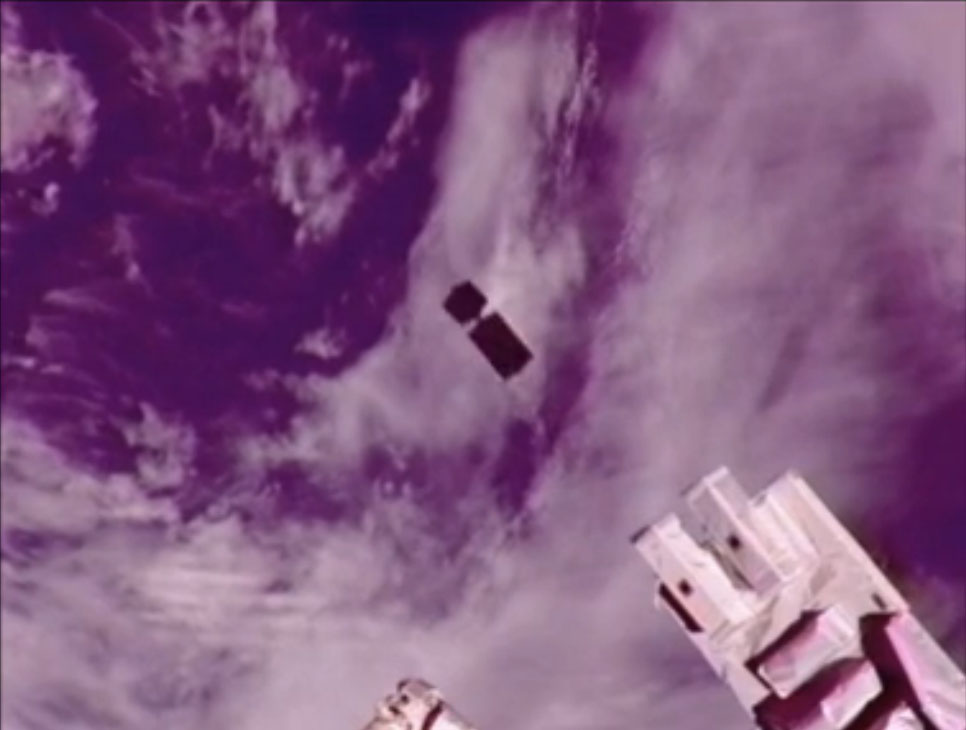
Deployment of CubeSats WE-WISH and RAIKO from the ISS

Deployment of CubeSats WE-WISH and RAIKO from the ISS – Image NASA

Built by members of the Meisei Amateur Radio Club WE-WISH carried an infrared camera for environmental studies. The 320 by 256 pixels images  of the Earth’s surface were transmitted in approx 110 secs using SSTV. The callsign was JQ1ZIJ and the 100mW downlink on 437.515 MHz operated on CW (A1A), AX.25 1200 bps packet radio (F2D) or SSTV (F3F).

Masahiro Arai JN1GKZ has produced a chart that shows the declining altitude of the five CubeSats since their deployment. RAIKO was the largest of the CubeSats at about 2 kg and 10 × 10 × 20 cm and the others being about 1 kg and 10 × 10 × 10 cm. The chart compares their orbital decay with that of ARISSat-1/Kedr (30 kg, 55 × 55 × 40 cm) which was deployed on August 3, 2011 and and re-entered Earth’s atmosphere on January 4, 2012, having spent 154 days in orbit.

Further information and some spectacular pictures of the CubeSats taken just after deployment can be seen at https://amsat-uk.org/satellites/techedsat-f-1-fitsat-1-we-wish/

Status of active satellites on amateur radio frequencies

Mike Rupprecht DK3WN 640

Mike Rupprecht DK3WN

One of the most frequently asked questions from newcomers to amateur satellites must be “Which satellites can I receive?”

Mike Rupprecht DK3WN has produced a summary of all active amateur radio satellites with frequencies and links to more detailed information. It is available at  http://www.dk3wn.info/p/?page_id=29535

5th European CubeSat Symposium June 3-5 Brussels

Royal Military Academy of Brussels in BelgiumThe 5th European CubeSat Symposium takes place on June 3-5, 2013 at the premises of Royal Military Academy in Brussels, Belgium.

Last year this event attracted more than 250 participants and industrial exhibits of 7 specialized companies. This year, they are expecting more participation. Applicants from all around the world are welcome.

The call for proposals and the online abstract submission system is available at http://www.CubeSatSymposium.eu/

Continue reading

Interorbital Systems CEO Randa Relich Milliron on The Space Show

Randa Relich Milliron CEO Interorbital Systems

Randa Relich Milliron CEO Interorbital Systems

In this edition of The Space Show Randa Relich Milliron CEO of Interorbital Systems talks about the latest developments at the company which is developing a low-cost satellite launch capability using the Neptune rocket. She indicated the first launches will be sub-orbital.

A number of amateur radio CubeSats and TubeSats are planning to be launched by Interorbital. A launch manifest can be seen at http://www.interorbital.com/Launch%20Manifest%20Page%20_1.htm

Wes Faler also appears on the show. He has been building an Ion powered TubeSat for an Interorbital launch. Wes plans to use a closed cell foam filled with pressurized nitrogen, vaporizing the supporting plastic and releasing the enclosed nitrogen using a spark system similar to that used by Pulsed Plasma Thrusters (PPTs).  PPTs create an arc across the face of a solid Teflon bar, turning a few micrograms of Teflon into plasma.  The plasma moves along the PPT’s cathode and anode by Lorentz forces, much the same way that a rail gun accelerates its conducting projectile.

Continue reading

IITMSat Satellite Project at AAS-AIAA Spaceflight Mechanics Meeting

Deepti Kannapan 23rd AAS-AIAA Spaceflight Mechanics Meeting 2013-02

Deepti Kannapan at the 23rd AAS-AIAA Spaceflight Mechanics Meeting

The 2013 Space Flight Mechanics Meeting, hosted by the American Astronautical Society (AAS) and co-hosted by American Institute of Aeronautics and Astronautics (AIAA) took place in Kauai, Hawaii, February 10-14, 2013.

At the meeting Deepti Kannapan presented her paper on a new attitude control algorithm developed as a part of her Dual Degree Project. This algorithm is being implemented in the IIT Madras Student Satellite (IITMSat) that is being developed by students at the Indian Institute of Technology Madras.

IITMSat Primary Mission Objectives:
• To design, fabricate, test and launch a small-satellite (15kg), that demonstrates all features of satellite functioning, and build a ground station for collection of data from the satellite
• To measure the energy spectrum of protons and electrons beneath the inner-Van Allen radiation belt boundary (600-800 km) to aid earthquake prediction studies
• Interpret the data received from the satellite and analyze the effects of solar flares, lightning storms and seismic activity on the radiation belts

23rd AAS-AIAA conference schedule http://www.space-flight.org/docs/2013_winter/FinalProgram.pdf

IITMSAT http://iitmsat.iitm.ac.in/

IITMSat on Facebook https://www.facebook.com/pages/iitmsat/372808989404716

Ion Propulsion: Euroluna Update on CubeSat HT Power Supply

Romit1 - Image Credit GomSpace ApS

Romit1 – Image Credit GomSpace ApS

In this video Palle Haastrup OZ1HIA, President of Euroluna (OZ9LUNA), describes their work towards a flight ready high tension power supply for the CubeSat Ion propulsion system.

Euroluna are a Danish amateur team participating in the $30 million Google Lunar X PRIZE contest to be the first privately funded team to land and drive a rover on the Moon.

Their first Amateur Radio CubeSat Romit-1 is a 2U CubeSat that will transmit on 437.505 MHz using 1200 bps AX.25 packet radio. It will be fitted with an Ion Motor and if everything goes well it should, after a year, be able to raise its orbit from 310 km to 700 km. It is planned to launch on an Interorbital Systems Neptune 30 rocket.

Continue reading