Tiny 'Firefly' Satellite Set To Flash Straight Into Lightning and Thunderstorms

Illustration showing Firefly, a mark-carton-sized satellite, gathering data on a gamma-ray burst.

Firefly, a milk-carton-sized satellite, will study gamma-ray bursts that accompany lightning.
Credit: Zina Deretsky, National Science Foundation

‘CubeSat’ will help solve mysteries of terrestrial gamma ray flashes, 1,000 times more powerful than ‘northern lights’

NSF’s Therese Moretto Jorgensen explains what CubeSats tell us about the atmosphere.
Credit: National Science Foundation

imagine a fully-instrumented satellite the size of a half-gallon milk carton.

Then imagine that milk carton whirling in space, catching never-before-seen glimpses of processes thought to be linked to lightning.

The little satellite that could is a CubeSat called Firefly, and it’s on a countdown to launch next year.
CubeSats, named for the roughly four-inch-cubed dimensions of their basic building elements, are stacked with modern, smartphone-like electronics and tiny scientific instruments.
Built mainly by students and hitching rides into orbit on NASA and U.S. Department of Defense launch vehicles, the small, low-cost satellites recently have been making history. Many herald their successes as a space revolution.
Several CubeSat projects funded by the National Science Foundation (NSF) are currently in orbit, making first-of-their-kind experiments in space and providing new measurements that help researchers understand Earth’s upper atmosphere.
Atmospheric scientist Allan Weatherwax of Siena College offers a glimpse inside a CubeSat.
Credit: National Science Foundation

Firefly is designed to help solve the mystery of a phenomenon that’s linked with lightning: terrestrial gamma rays, or TGFs.
Bursts of gamma rays usually occur far out in space, near black holes and other high-energy cosmic phenomena.  Scientists were surprised when, in the mid-1990s, they found powerful gamma-ray flashes happening in the skies over Earth.

Powerful natural particle accelerators in the atmosphere are behind the processes that create lightning. TGFs result from this particle acceleration.
Individual particles in a TGF contain a huge amount of energy, sometimes more than 20 mega-electron volts. The aurora borealis, for example, is powered by particles with less than one-thousandth as much energy as a TGF.

But what causes a TGF’s high-energy flashes? Does it trigger lightning–or does lightning trigger it? Could it be responsible for some of the high-energy particles in the Van Allen radiation belts, which can damage satellites?
Firefly soon will be on the job, finding out.

Illustration of Firefly orbiting high in the atmosphere above Earth.

Firefly, as it will look once launched high into the atmosphere above Earth.
Credit: NASA

The CubeSat will look specifically for gamma-ray flashes coming from the atmosphere, not space, conducting the first focused study of TGF activity.

The Firefly team is made up of scientists and students at Siena College in Loudonville, N.Y.; NASA Goddard Space Flight Center in Greenbelt, Md.; the Universities Space Research Association in Columbia, Md.; the Hawk Institute for Space Science, Pocomoke City, Md.; and the University of Maryland Eastern Shore, Princess Anne, Md.

Students are involved in all aspects of the mission, from design and development, through fabrication and testing, to operations and data analysis.

Illustration of Firefly gathering data on a terrestrial gamma ray originating from lightning.

Firefly ‘catching’ a terrestrial gamma ray, or TGF, in action.
Credit: NASA

Firefly will carry a gamma-ray detector along with a suite of instruments to detect lightning, says Therese Moretto Jorgensen, program director in NSF’s Division of Atmospheric and Geospace Sciences, which funds Firefly and its CubeSat companions in space.

The CubeSat will return the first simultaneous measurements of TGFs and lightning.
When thunderstorms happen, powerful electric fields stretch upward for miles, into the upper atmosphere. These electric fields accelerate free electrons, whirling them to speeds that are close to the speed of light.

When these ultra-high-speed electrons collide with molecules in the air, they release high-energy gamma rays as well as more electrons, starting a cascade of electrons and TGFs.”Gamma rays are thought to be emitted by electrons traveling at or near the speed of light when they’re slowed down by interactions with atoms in the upper atmosphere,” says Moretto Jorgensen. “TGFs are among our atmosphere’s most interesting phenomena.”

Atmospheric scientists think TGFs occur more often than anyone realized and are linked with the 60 lightning flashes per second that happen worldwide, says scientist Allan Weatherwax of Siena College, a lead scientist, along with Doug Rowland of NASA’s Goddard Space Flight Center, on the Firefly project.

Build-up of electric charges at the tops of thunderclouds from lightning discharges can create a large electric field between clouds and the ionosphere, the outer layer of Earth’s atmosphere. But how this might lead to TGFs is unknown.

“Firefly will provide the first direct evidence for a relationship between lightning and TGFs,” says Weatherwax. “Identifying the source of terrestrial gamma-ray flashes will be a huge step toward understanding the physics of lightning and its effect on Earth’s atmosphere.”
Unlike lightning, a TGF’s energy is released as invisible gamma rays, not visible light. TGFs therefore don’t produce colorful bursts of light like many lightning-related phenomena. But these unseen eruptions could help explain why brilliant lightning strikes happen.
Following Firefly is FireStation, a set of miniaturized detectors for optical, radio and other lightning measurements.FireStation will fly a bit higher than Firefly.
Its orbit is on the International Space Station.

Cheryl Dybas, NSF (703) 292-7734 cdybas@nsf.gov

South African CubeSat DynaCube

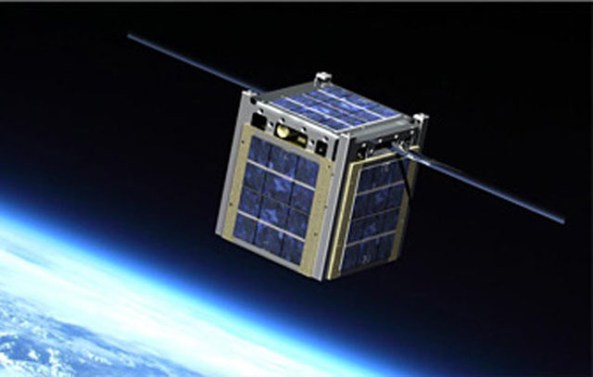
Image of a CubeSat in Space

DynaCube is a 1U CubeSat intended to take pictures of the earth that also carries temperature sensors and radiation detectors.

It plans to have a VHF CW beacon and a separate VHF 1200 bps GMSK telemetry downlink.

It is intended to launch from Baikonur into a Sun Synchronous Orbit (SSO).

Facebook https://www.facebook.com/permalink.php?id=162777567175347&story_fbid=216853691767734

Denel Dynamics http://www.deneldynamics.co.za/

IARU Satellite Frequency Coordination Panel status http://www.amsat.org.uk/iaru/


Aeneas CubeSat to Deploy 2.4 GHz Dish Antenna

Built by students at the University of Southern California (USC) Aeneas is a 3U CubeSat planned to launch August 2, 2012 from the Vandenburg Air Force Base on an Atlas-5 rocket into a 880 x 450 km 60.4 degree inclination orbit.

It aims to prove the concept of WiFi based tag tracking from Low Earth Orbit using the first ever 0.5 meter dish deployed from a CubeSat.

Small 1 watt asset tags will be on the ground and a similar transceiver is in feed piece of the deployed dish in the CubeSat. The satellite will surface track the position of the tag.

It plans to use a 436.00 MHz AX25 1200 bps beacon every 10 secs and a spread spectrum two-way link elsewhere in the 70cm band.

The WIFI transmitter will transmit on 2425.0 MHz with 1 watt of output power.

CP5, Cinema, CXBN, CSSWE, Horus, Re, ORSES and Aerocube-3 are expected to be deployed from the same launch.

More information at http://www.isi.edu/projects/serc/aeneas

Watch USC Aeneas Baseline Mission

SkyCube Camera Demonstration

SkyCube Camera

A successful demonstration of SkyCube’s 4D Systems JPEG UART camera talking to its computer processor board.

The processor controls the camera and converts its raw image data to ASCII (text). It then sends the ASCII out one of its serial ports. The ASCII image is captured with a logic analyzer and displayed on a PC laptop screen.

The camera is operating at its lowest possible resolution (80×60) for the purpose of the test. This is obviously not how it’ll be used it in space, but it does show that all the pieces are working, and that they can talk to each other. For more details on the project, go to http://www.skycube.org/

Watch SkyCube Camera Demo 2012 07 16

SkyCube satellite uses Kickstarter for Funding http://www.uk.amsat.org/8955

Live TV broadcast for launch of HTV-3 CubeSats

FSpace, the team of young engineers and students at the FPT University who developed the amateur radio F-1 CubeSat, report on the final launch preparations for the HTV-3 cargo vessel that will carry five CubeSats to the International Space Station (ISS).

FSpace say final inspection was performed on July 9, and from July 13-15, a rehearsal was conducted simulating the launch operation. Late access cargo loading will continue until July 19 then the hatch will be closed and the H-IIB launch vehicle with the HTV-3 will be moved to the launch pad. The launch is planned for July 21 at 02:18 UT.

FSpace report that live TV coverage will be available at these URL’s:

– NASA TV HD (HD resolution, for high speed connections) http://www.ustream.tv/nasahdtv

– NASA TV (standard resolution, for lower speed connections) http://www.nasa.gov/multimedia/nasatv/index.html

– Live webcam from Tanegashima launch pad (automatically updated once every few minutes)  http://space.jaxa.jp/tnsc/webcam/index_e.shtml

Read the full FSpace report at http://fspace.edu.vn/?p=716&lang=en

It is planned that the CubeSats will be deployed from the space station in September by Japanese astronaut Akihiko Hoshide KE5DNI using the ISS Kibo robot arm. The five CubeSats are:

+ F-1
http://fspace.edu.vn/?page_id=10
On-board camera for earth observation mission
Yaesu VX-3R 1, 437.485 MHz FM downlink:
o Solar cell power only, operates in sunlight only
o Output power: between 0.1W and 0.3W depending on illumination, half-wave dipole antenna
o Morse code beacon (10 chars) using FM CW every 30 seconds, listen here

Yaesu VX-3R 2, 145.980 MHz FM downlink:
o Rechargeable battery, operates in dark and sunlight
o Output power: max 1.0W, half-wave dipole antenna
o AFSK 1200bps, half duplex, one AX.25 packet every 60 seconds

+ We Wish
http://www.meisei.co.jp/news/2011/0617_622.html
Infrared camera for environmental studies
Downlink on 437.505 MHz

+ FITSat 1
http://www.fit.ac.jp/~tanaka/fitsat.shtml
High-speed data test, high power LED visual tracking
CW Beacon 437.250 MHz,
FM Data   437.445 MHz,
High speed data 5840.00 MHz.

+ TechEdSat
http://ncasst.org/techedsat.html
http://www.uk.amsat.org/5018
Downlink on 437.465 MHz

+ Raiko – the only non-amateur radio CubeSat
http://tinyurl.com/RAIKO-CubeSat (Google English)
2U CubeSat, photography, Ku-band beacon

A video depicting the planned deployment of the F-1 CubeSat, callsign XV1VN, from the ISS can be seen at http://www.uk.amsat.org/?p=8446

F-1 CubeSat Blog on Facebook https://www.facebook.com/groups/116436068290/

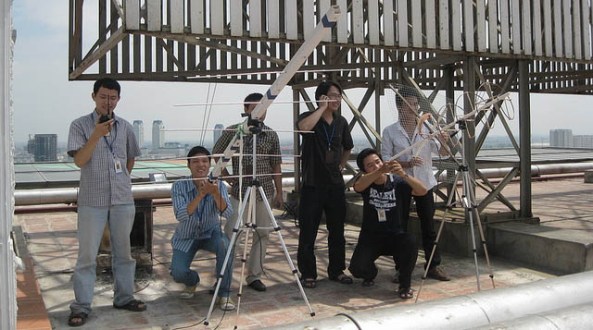
FSpace Team with home made antennas for NOAA weather satellite reception

PongSats – 1000 Student Projects to the Edge of Space

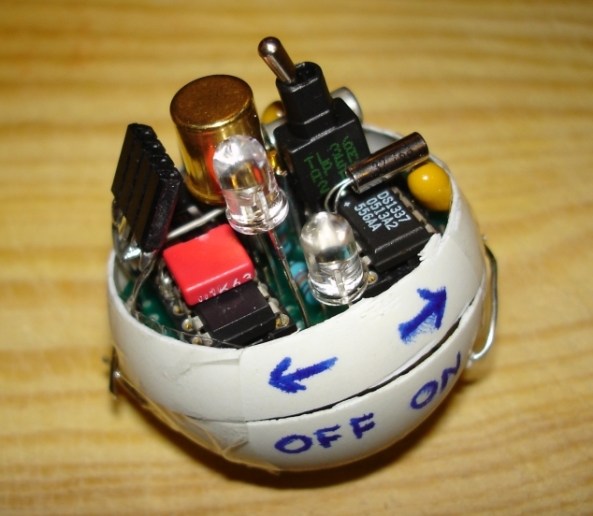
A PongSat

On September 22 it’s planned to send 1000 student projects built into PongSats (ping pong balls) to the edge of space.

These experiments and projects are made by those in kindergarten, university professors, high school science classes and home schools kids.

PongSats on the Edge of Space – Image credit JP Aerospace

Projects range from plant seeds to filling a PongSat with a marshmallow. At 100,000 feet (30 km) the marshmallow puffs up completely filling the ball. Then it freeze dries. The student gets to hold in her hand the direct results of traveling the top of the atmosphere.

The launch of the PongSats will take place from the Black Rock desert in Nevada. The vehicles that carry them are called High Rack. They are made of foam and carbon fiber. There are four separate telemetry links to the High Rack tracking it during the flight. At the end of the flight the balloon is released and the High Rack descends by parachute.

It will take four High Racks, each with its own balloon to carry the thousand ping pong balls.

Watch PongSats

This project is using Kickstarter to raise donations http://www.kickstarter.com/projects/1569698176/1000-student-projects-to-the-edge-of-space

More on PongSats and MiniCubes at JP Aerospace, a volunteer-based DIY Space Program http://www.jpaerospace.com/

Kickstarter is also being used by the satellite project SkyCube http://www.uk.amsat.org/8955