South African CubeSat DynaCube

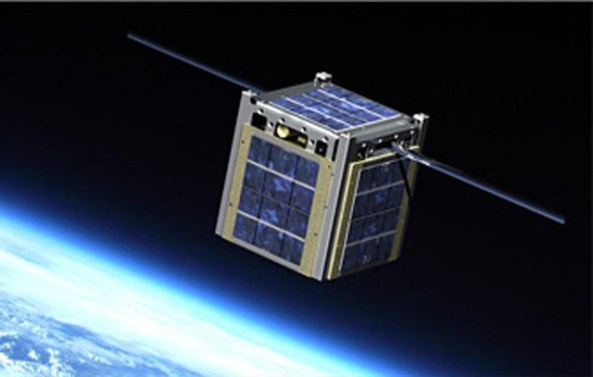
Image of a CubeSat in Space

DynaCube is a 1U CubeSat intended to take pictures of the earth that also carries temperature sensors and radiation detectors.

It plans to have a VHF CW beacon and a separate VHF 1200 bps GMSK telemetry downlink.

It is intended to launch from Baikonur into a Sun Synchronous Orbit (SSO).

Facebook https://www.facebook.com/permalink.php?id=162777567175347&story_fbid=216853691767734

Denel Dynamics http://www.deneldynamics.co.za/

IARU Satellite Frequency Coordination Panel status http://www.amsat.org.uk/iaru/


Aeneas CubeSat to Deploy 2.4 GHz Dish Antenna

Built by students at the University of Southern California (USC) Aeneas is a 3U CubeSat planned to launch August 2, 2012 from the Vandenburg Air Force Base on an Atlas-5 rocket into a 880 x 450 km 60.4 degree inclination orbit.

It aims to prove the concept of WiFi based tag tracking from Low Earth Orbit using the first ever 0.5 meter dish deployed from a CubeSat.

Small 1 watt asset tags will be on the ground and a similar transceiver is in feed piece of the deployed dish in the CubeSat. The satellite will surface track the position of the tag.

It plans to use a 436.00 MHz AX25 1200 bps beacon every 10 secs and a spread spectrum two-way link elsewhere in the 70cm band.

The WIFI transmitter will transmit on 2425.0 MHz with 1 watt of output power.

CP5, Cinema, CXBN, CSSWE, Horus, Re, ORSES and Aerocube-3 are expected to be deployed from the same launch.

More information at http://www.isi.edu/projects/serc/aeneas

Watch USC Aeneas Baseline Mission

SkyCube Camera Demonstration

SkyCube Camera

A successful demonstration of SkyCube’s 4D Systems JPEG UART camera talking to its computer processor board.

The processor controls the camera and converts its raw image data to ASCII (text). It then sends the ASCII out one of its serial ports. The ASCII image is captured with a logic analyzer and displayed on a PC laptop screen.

The camera is operating at its lowest possible resolution (80×60) for the purpose of the test. This is obviously not how it’ll be used it in space, but it does show that all the pieces are working, and that they can talk to each other. For more details on the project, go to http://www.skycube.org/

Watch SkyCube Camera Demo 2012 07 16

SkyCube satellite uses Kickstarter for Funding http://www.uk.amsat.org/8955

Live TV broadcast for launch of HTV-3 CubeSats

FSpace, the team of young engineers and students at the FPT University who developed the amateur radio F-1 CubeSat, report on the final launch preparations for the HTV-3 cargo vessel that will carry five CubeSats to the International Space Station (ISS).

FSpace say final inspection was performed on July 9, and from July 13-15, a rehearsal was conducted simulating the launch operation. Late access cargo loading will continue until July 19 then the hatch will be closed and the H-IIB launch vehicle with the HTV-3 will be moved to the launch pad. The launch is planned for July 21 at 02:18 UT.

FSpace report that live TV coverage will be available at these URL’s:

– NASA TV HD (HD resolution, for high speed connections) http://www.ustream.tv/nasahdtv

– NASA TV (standard resolution, for lower speed connections) http://www.nasa.gov/multimedia/nasatv/index.html

– Live webcam from Tanegashima launch pad (automatically updated once every few minutes)  http://space.jaxa.jp/tnsc/webcam/index_e.shtml

Read the full FSpace report at http://fspace.edu.vn/?p=716&lang=en

It is planned that the CubeSats will be deployed from the space station in September by Japanese astronaut Akihiko Hoshide KE5DNI using the ISS Kibo robot arm. The five CubeSats are:

+ F-1
http://fspace.edu.vn/?page_id=10
On-board camera for earth observation mission
Yaesu VX-3R 1, 437.485 MHz FM downlink:
o Solar cell power only, operates in sunlight only
o Output power: between 0.1W and 0.3W depending on illumination, half-wave dipole antenna
o Morse code beacon (10 chars) using FM CW every 30 seconds, listen here

Yaesu VX-3R 2, 145.980 MHz FM downlink:
o Rechargeable battery, operates in dark and sunlight
o Output power: max 1.0W, half-wave dipole antenna
o AFSK 1200bps, half duplex, one AX.25 packet every 60 seconds

+ We Wish
http://www.meisei.co.jp/news/2011/0617_622.html
Infrared camera for environmental studies
Downlink on 437.505 MHz

+ FITSat 1
http://www.fit.ac.jp/~tanaka/fitsat.shtml
High-speed data test, high power LED visual tracking
CW Beacon 437.250 MHz,
FM Data   437.445 MHz,
High speed data 5840.00 MHz.

+ TechEdSat
http://ncasst.org/techedsat.html
http://www.uk.amsat.org/5018
Downlink on 437.465 MHz

+ Raiko – the only non-amateur radio CubeSat
http://tinyurl.com/RAIKO-CubeSat (Google English)
2U CubeSat, photography, Ku-band beacon

A video depicting the planned deployment of the F-1 CubeSat, callsign XV1VN, from the ISS can be seen at http://www.uk.amsat.org/?p=8446

F-1 CubeSat Blog on Facebook https://www.facebook.com/groups/116436068290/

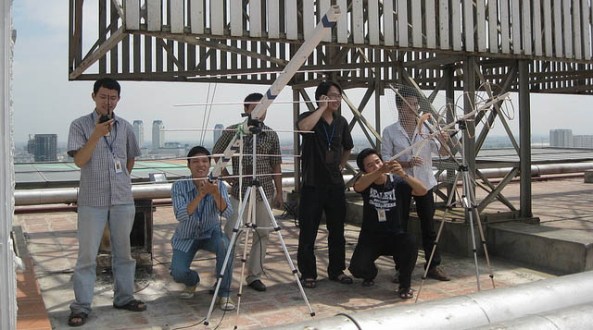
FSpace Team with home made antennas for NOAA weather satellite reception

PongSats – 1000 Student Projects to the Edge of Space

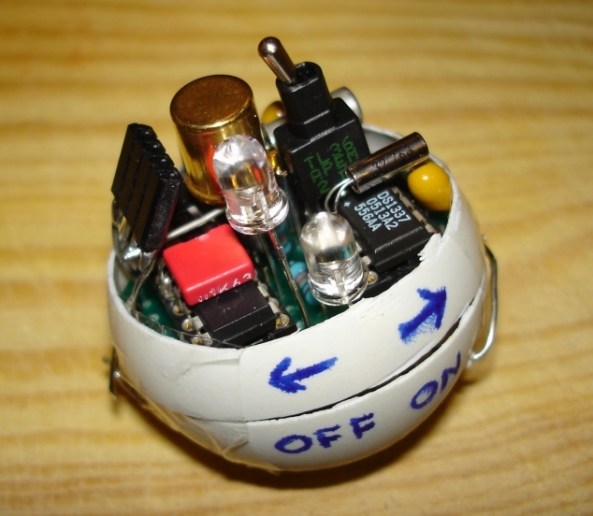
A PongSat

On September 22 it’s planned to send 1000 student projects built into PongSats (ping pong balls) to the edge of space.

These experiments and projects are made by those in kindergarten, university professors, high school science classes and home schools kids.

PongSats on the Edge of Space – Image credit JP Aerospace

Projects range from plant seeds to filling a PongSat with a marshmallow. At 100,000 feet (30 km) the marshmallow puffs up completely filling the ball. Then it freeze dries. The student gets to hold in her hand the direct results of traveling the top of the atmosphere.

The launch of the PongSats will take place from the Black Rock desert in Nevada. The vehicles that carry them are called High Rack. They are made of foam and carbon fiber. There are four separate telemetry links to the High Rack tracking it during the flight. At the end of the flight the balloon is released and the High Rack descends by parachute.

It will take four High Racks, each with its own balloon to carry the thousand ping pong balls.

Watch PongSats

This project is using Kickstarter to raise donations http://www.kickstarter.com/projects/1569698176/1000-student-projects-to-the-edge-of-space

More on PongSats and MiniCubes at JP Aerospace, a volunteer-based DIY Space Program http://www.jpaerospace.com/

Kickstarter is also being used by the satellite project SkyCube http://www.uk.amsat.org/8955

SkyCube: a social space mission

skycube.

Southern Stars Group LLC, the company responsible for the popular SkySafari apps for iOS, Android and Mac OS X, is thinking a little bigger with its next project. The publicly funded SkyCube is a miniature CubeSat satellite that will orbit the planet, transmitting low-resolution images of the Earth while broadcasting short messages from sponsors in the form of data pings. In short, it’s the world’s first social space mission.

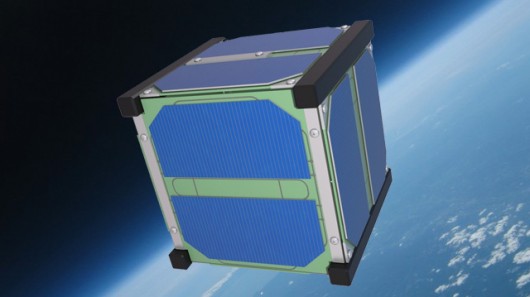
The hardware involved in the project isn’t anything we haven’t seen before. The satellite itself is a 10x10x10 cm (3.9 cubic-inch) “1U” CubeSat, which is the current leading picosatellite standard with nearly 100 of the devices built and launched to date. The SkyCube will be the second payload on a SpaceX Falcon 9 rocket, set to launch sometime in 2013.

Once deployed, it will orbit more than 300 miles (483 km) up, taking low-resolution pictures and broadcasting short, simple messages from the project’s sponsors as it crosses over most of the world’s inhabited regions. At the end of the mission, the SkyCube will deploy its 10 ft (3 m) diameter balloon, making it visible from the Earth, with a brightness akin to that of the Hubble Space Telescope. If everything goes to plan, the miniature satellite will eventually return to Earth, brought down by atmospheric drag.

So if you want to broadcast your own short message from space, the Southern Stars Group has got your back, with pledges starting at just US$1. This base option gives you a ten-second time slot on the mission, in which you can broadcast a single 120-character message. The sponsorship options go all the way up to $10k, for which the company will fly two people out to Cape Canaveral from anywhere in the continental US. From there, sponsors can watch the satellite lift off and once it’s successfully in orbit, they can control the SkyCube for an entire day to take pictures, send messages, or just sit back and contemplate the balance of their bank accounts.

The company is also making use of its app-making skills, creating applications for both iOS and Android. These will allow users to track the satellite, send messages and request images.

The SkyCube marks the next step in a series of initiatives and projects that are making space programs far more accessible to the general public. Rocket and spacecraft construction company Interorbital Systems recently announced its project to make space available to all. For $8,000, customers receive both a TubeSat Personal Satellite Kit and launch to low Earth orbit. That’s significantly cheaper than the SkyCube’s CubeSat miniature satellite, which costs around $100k to put in orbit.

So, have something important to say? Well, in 2013 you’ll be able to say it from space. The SkyCube has 57 days to go on Kickstarter, meaning that you’ve got until Wednesday September 12 to secure your chance to “tweet from space.”

Source: Southern Stars