HO-68 CW beacon with Funcube Dongle and Arrow antenna

Reception of the HO-68 (XW-1) satellite beacon using the Funcube Dongle receiver and an Arrow II hand-held yagi antenna. Quisk software defined radio receiver running on Ubuntu Linux 10.10 64bit.
I was located indoors pointing the Arrow out through the window (and Doppler tuning with left hand, hence the high pitch 😉
The peak was around 52 deg elevation, range 1400 km. The CW beacon transmitter is 200mW RF.

The Funcube Dongle is a USB stick SDR receiver for 64 MHz – 1.7 GHz by Howard Long G6LVB, see http://www.funcubedongle.com/

Video recorded by Alexandru Csete OZ9AEC

13cm Band Rules Expanded to Allow MedRadio Adjacent to Satellites

The ARRL is reporting in a First Report and Order and a Further Notice of Proposed Rulemaking (ET 08-59) released on May 24, the FCC decided to expand the Part 95 Personal Radio Service rules to allow medical devices to operate on a secondary basis in the 2360-2400 MHz band. International amateur satellite operations are allocated between 2400-2450 MHz, adjacent to the new devices.

The new allocation is  Medical Body Area Networks (MBAN) which provide a way for health care facilities to monitor their patients via wireless networks. Because use of these frequencies will be on a secondary basis, MBAN stations will not be allowed to cause interference to, and must accept interference from, primary services, including US radio amateurs who operate on a terrestrial primary basis in the 2390-2395 MHz and 2395-2400 MHz bands.

The ARRL has posted their full analysis and report at:
http://tinyurl.com/13cm-Medical-Allocation (arrl.org)

Source AMSAT News Service (ANS)

Satellite Link Budget Information and Lunar Beacons

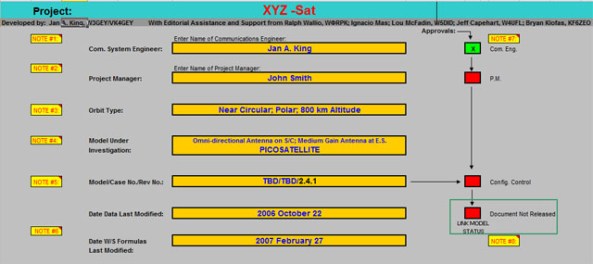
Download the spread sheet here (1.2 MB) (ver 2.4.1 – updated 11/4/2007)

Download Basic Analog Transponder Spread sheet here and its notes here

Lunar Beacons – The Earth Moved by James Miller G3RUH http://www.amsat.org/amsat/articles/g3ruh/110.html

Lunar Transponder Calculations by Domenico I8CVS http://www.uk.amsat.org/wp-content/uploads/2012/06/Lunar-Transponder-Calculations-by-I8CVS.txt

23cm band covered by GNSS

An article in the May 2012 edition of the free publication Microwave Journal shows that all of 1240-1300 MHz except for two narrow gaps will be used by global navigation satellite systems (GNSS).

The article by Rachid El Assir, Rohde & Schwarz, conatin a chart that graphically illustrates where the GNSS systems will operate in 1240-1300 MHz band.

A gap of about 3 MHz occurs at 1240 and one of about a MHz at 1259 MHz.

Read Global Navigation Satellite Systems and Their Applications
http://www.microwavejournal.com/articles/17568-global-navigation-
satellite-systems-and-their-applications

Microwave Journal http://www.microwavejournal.com/publications/1

6U CubeSat Low Cost Space Missions Workshop

6U CubeSat Low Cost Space Missions Workshop

17th – 18th July 2012

Click here to register to attend the Workshop

Workshop Details

Title: 6U CubeSat Low Cost Space Missions Workshop
Date: 17th – 18th July 2012
Abstracts Due: 26th June 2012
Time:
Venue: Advanced Instrumentation and Technology Centre, Mt Stromlo Observatory, Canberra Australia
Cost: Free

Download the workshop poster here.

Masat-1 captured the first Hungarian satellite photographs from space

Masat-1, the First Hungarian Satellite made history again when it captured the first satellite space photographs on 8 March 2012 This first photo shows the southern section of the African continent. The next photos were made of Australia and Antarctica, in a quality and quantity unprecedented in the CubeSat realm.

Masat-1 - Flight Model

The Flight Model of Masat-1

The on-board camera of Masat-1 has a mass of about two Euro coins. The maximal resolution is 640×480 pixels. A width of 1 pixel corresponds to a distance of 1 to 10 kilometres on the photos recorded.

The flawless operation of the passive attitude control system made it possible to capture photographs ahead of schedule, but with this passive system only the Southern Hemisphere of the Earth may be targeted by the camera. As the first month of the mission passed, almost every mission objective was fulfilled. The flawless run of the satellite opens a new scientific and technological horizon for experiments which we plan to perform in the coming months.

There is an increasing demand for Eath observation satellites worldwide both from the public and the private sector, as such spacecraft can capture on-demand, high resolution, up to date images of a specific area of the Earth’s surface. The captured images might be used for disaster relief operations,weather forecast services, crop yield estimation and tracking of agricultural operations, civil transport and cartography applications and also defence purposes.

As part of the ESA Education programme, seven CubeSats designed and built by European universities were placed into orbit by Europe’s new Vega launch vehicle on 13th February 2012.
For more information please visit ESA’s Education CubeSat pages.