AMSAT Demonstration Station at 2012 Dayton Hamvention

The AMSAT demonstration station at the 2012 Dayton Hamvention in Ohio (grid EM79ut) working the SSB/CW satellite VO-52 on Friday, May 18, 2012. This video starts at approximately 1418 UTC (10.18am EDT) on a pass to the west that covered much of North America.

Working the microphone is Keith Pugh W5IU. Assisting Keith is Doug Papay KD8CAO, and Roger Ley WA9PZL is taking care of the antenna. Keith’s equipment is used for the demonstration station – two Yaesu FT-817s, two homebrew antennas (3-element 2m Yagi, 6-element 70cm Yagi), and a laptop running SatPC32 to control the radios. The radios and laptop are powered from a large 12V battery.

As the video starts, Keith is working Angelo N5UXT in New Orleans, Louisiana. Other stations are heard later in the video, as the satellite is moving away and toward the horizon.

This video was recorded by Patrick Stoddard WD9EWK/VA7EWK using a Sony DSC-H70 camera at 720p.

See a video by Simon 2E0HTS describing how to work the SSB amateur radio satellites such as VO-52 http://www.uk.amsat.org/2712

John Heath G7HIA wrote about operating through VO-52 in his article ‘Getting started on amateur radio satellites’ that was published by the Radio Society of Great Britain in the March 2007 edition of RadCom. Download the article at https://amsat-uk.org/wp-content/uploads/2011/05/satellites_radcom_mar07.pdf
Copyright 2007 Radio Society of Great Britain. For personal use only – no copying, reprinting or distribution without written permission from the RSGB.

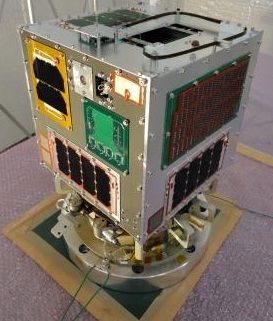
HORYU-2 Commencing AX.25 FSK Operation

On May 22 the amateur radio satellite HORYU-2 carried out tests using the 1200 bps AX.25 FSK downlink on 437.375 MHz.

It is understood that signals were received by JA1GDE, JA5BLZ, JA6PL and JA2MJA.

On May 23 Mineo Wakita JE9PEL decoded the AX.25 telemetry data and made available this recording:
http://www.ne.jp/asahi/hamradio/je9pel/20523ho2.wav
http://www.ne.jp/asahi/hamradio/je9pel/20523ho2.png

The AX.25 transmissions are being made when HORYU-2 is within range of Japan. In the rest of the world it is transmitting a CW beacon on 437.375 MHz as shown in this video by Luciano PY5LF.

Watch HORYU-2 Over Brazil in 22 May 2012

Listen to HORYU-2 on the web http://www.uk.amsat.org/7594

HORYU-2 Telemetry Software and Competition http://www.uk.amsat.org/7474

HORYU-2 Separation Video http://www.uk.amsat.org/7540

More information about HORYU-2 http://www.uk.amsat.org/7404

HORYU-2 Japanese Operating Schedule http://tinyurl.com/HORYU-2-Schedule

Keplerian Two Line Elements (TLEs / KEPS) for new satellites launched in past 30 days
http://celestrak.com/NORAD/elements/tle-new.txt

Amateur satellite Keplerian Two Line Elements (TLEs / KEPS) http://celestrak.com/NORAD/elements/amateur.txt

Listen to HORYU-2 on the Web

Andrei YO8SSQ and Cezar YO8TLC have made available a web based receiver to enable listeners to hear the new amateur radio satellite HORYU-2 when it’s within range of Romania.

The WebSDR receiver is located at the Astronomical Observatory Department of “Stefan cel Mare” University in Suceava, Romania, latitude 47.6417N longitude 26.2453E, grid locator KN37cp. The height ASL is 350m.

The hardware consists of two SDR receivers which are fed into 48 kHz sound cards on an AMD Sempron 2600+ computer running Vector Linux.

The web page displays a track showing the current position of HORYU-2 and also provides coverage of the 3.5 MHz (80m) band.

Listen to the HORYU-2 and 80m WebSDR at http://sdr.opt.ro:8901/

More information about HORYU-2 437.375 MHz (+/- 9 kHz Doppler shift) at
http://www.uk.amsat.org/7404

HORYU-2 Telemetry Software and Competition http://www.uk.amsat.org/7474

HORYU-2 CW Telemetry Decoder by DK3WN http://tinyurl.com/SatSoftwareDK3WN/

HORYU-2 Separation Video http://www.uk.amsat.org/7540

Keplerian Two Line Elements (TLEs / KEPS) for new satellites launched in past 30 days
http://celestrak.com/NORAD/elements/tle-new.txt

Amateur satellite Keplerian Two Line Elements (TLEs / KEPS) http://celestrak.com/NORAD/elements/amateur.txt

More information about the WebSDR project can be found at http://www.websdr.org/

Columbus Ham Radio Powered-On

Joe_Acaba_KE5DAR

Joe Acaba KE5DAR

NASA Flight Engineer Joe Acaba, KE5DAR, and his two Russian crewmates, Soyuz Commander Gennady Padalka, RN3DT, and Flight Engineer Sergei Revin, RN3BS, arrived on the International Space Station (ISS) this week.

They joined the three other radio amateurs on the ISS – Expedition 31 Commander Oleg Kononenko, RN3DX, of the Russian Federal Space Agency, Flight Engineer Don Pettit, KD5MDT, of NASA and Flight Engineer Andrei Kuipers, PI9ISS, of the European Space Agency.

A status report video released by NASA for May 14-18 notes that Joe Acaba, KE5DAR, powered on the ham radio in the ESA Columbus module. The ham radio reference occurs 09:05 into the video.


Watch ISS Update: Weekly Recap for May 14-18, 2012

The NASA ISS daily status report for May 18 notes that Joe KE5DAR also powered on the ham radio station in the Russian Service Module.
http://www.nasa.gov/directorates/heo/reports/iss_reports/2012/05182012.html

Listening to the International Space Station http://www.uk.amsat.org/3491

SpaceX Dragon to Blast-Off to ISS

Classroom preperation for the student spaceflight experiments program SSEP

On Tuesday, May 22 at 07:44 UT SpaceX’s Dragon hopes to transport the student payload Aquarius on SSEP Mission 1 to the International Space Station (ISS).

The set of SSEP Mission 1 experiments, called Aquarius, was originally slated to fly aboard the Soyuz 30. But in an interesting twist of fate, the experiments were re-manifested on the maiden voyage of the SpaceX Dragon to the ISS. Aquarius not only becomes part of a historic first but also allows the space station to remain an out-of-this-world platform to engage students in STEM — science, technology, engineering and mathematics.

The SpaceX Dragon launch will be broadcast live on the Internet details at
http://www.nasa.gov/nasatv

NASA – Space Station — Here We Come!
http://www.nasa.gov/audience/foreducators/station-here-we-come.html

HORYU-II heard over Africa

The HORYU-2 Team

Nader Omer ST2NH, in grid square KK65gp, has made available a video of HORYU-2 recorded at 2:25 AM Friday Sudan time. The signal received on 437.375 MHz (+/- Doppler shift) was very strong.

In this video the beacon is sending CW and Nader is using manual tracking and manual Doppler correction.

Nader says: Congratulations to the HORYU-2 team

Watch HORYU-II heard over Africa .wmv

AMSAT-UK member Ken Eaton GW1FKY said “The satellite CW was loud and clear with just an Elk Antenna feeding my  Kenwood TS-2000. Congratulations to all concerned with the project and its success”

HORYU-2 Separation Video http://www.uk.amsat.org/7540

HORYU-2 Telemetry Software and Competition http://www.uk.amsat.org/7474

Further information on HORYU-2 is at http://www.uk.amsat.org/7404

Reception by DK3WN in Germany http://www.dk3wn.info/p/?p=27516