The Japan Aerospace Exploration Agency (JAXA) would like to announce that the Small Demonstration Satellite-4 (SDS-4) completed its critical phase operations and moved to the initial phase. The SDS-4 was launched by the H-IIA F21 at 1:39 a.m. on May 18, 2012 (Japan Standard Time) as a secondary payload with the Global Change Observation Satellite 1st – Water “SHIZUKU” (GCOM-1.)
The satellite is currently in good health.
The initial functional verification operations will continue for about one month.
The 2012 Bay Area Maker Faire in San Mateo took place May 19-20 and among the stands was one displaying the PhoneSat amateur radio satellites.
There are two types of of these satellites both of which run the Android operating system and will be enclosed in a standard 1U CubeSat structure.
PhoneSat 1.0 cost about $3500 and is built around the Nexus One smartphone, it operates on battery power only with a mission lifetime of approx 1 week.
PhoneSat 2.0 is more expensive at $8000. It is built around the Nexus S smartphone and has solar panels on each face and a mission lifetime until de-orbit of approximately 2 weeks.
The IARU has coordinated a frequency of 437.425 MHz for the AX.25 AFSK downlink.
The first launch is scheduled for the third quarter of 2012 on Antares-110. It will carry two PhoneSat 1.0 satellites and one PhoneSat 2.0. A second PhoneSat launch is expected to occur in 2013.
Watch NANOSATHTC smart Phone-Satellite OS Android in a 10cm cube
Phonesat was also at the 2011 Maker Faire. In this video Ben explains the concept of a Phonesat.
Watch Android Phone as Autonomous Micro-Satellite: PhoneSat
Abubakr S. Eltayeb ST2AB is an Electrical Engineer specializing in communications systems. He is currently a member of the Cube Satellite Project which belongs to the Faculty of Engineering at University of Khartoum.
The team includes his colleagues Hala M. Othman, Mustafa Atta Mohamed and Yasir M. Osman ST2YM, and together they constructed the first satellite in Sudan with the help of Dr. Tahani Abdalla, their project manager and Dr. Nader Abdelhameed, the team manager. They designed, tested and experimentally launched a fully functional Cube Satellite prototype named KN-SAT1.
The team is now developing the Flight Model of the KN-SAT1, in preparation for its launch into outer space.
This TEDxKhartoum presentation is not in English, however, the segment from 09:12 until 13:25 contains video showing the development of the KN-SAT1 CubeSat including a test of the deployment of the antennas.
Watch TEDxKhartoum 2012: Abubakr S. Eltayeb, A Sudanese Satellite
The Uncertainly Principle 1.1 litre Fiat Panda with AMSAT-UK Logo
Helen Woolnough and Neil Melville PA9N are setting off on a honeymoon with a difference, and they aim to make a difference by raising money for charity.
They are taking part in the Mongol Rally where participants drive, in no more than six weeks, from the UK to Ulaanbaatar in Mongolia, using a thoroughly unsuitable car of 1.2 litres or less.
Helen and Neil’s entry is called The Uncertainty Principle. They will be driving a 9 year old 1.1 litre Fiat Panda on their epic journey which starts July 14.
The challenging route will take them through the Gobi desert and over the Pamir Highway (the second highest road in the world). They aim to cover more than 10,000 miles through 19 countries, with no support, no mechanic, and no clue.
They’ll be raising money for the Lotus Children’s Centre Charitable Trust and UNICEF.
One AMSAT-UK member who sponsored Neil, asked for the AMSAT-UK Logo, together with the caption which reads “You can have even more FUN in space”, to be displayed on the underside of the bonnet for maximum exposure!
W0ORE STS-51-F QSL Card - Image Credit John Magliacane KD2BD
The second ham radio transmissions by an amateur radio operator in space were made by Tony England W0ORE during the Challenger shuttle mission STS 51-F in 1985.
He achieved the first ever two-way Slow Scan TV (SSTV) space contact during the flight when he contacted GB3RS the headquaters station of the Radio Society of Great Britain (RSGB).
Tony W0ORE was running a Motorola model MX-340 handheld 2-meter transceiver and a Robot Research model 1200C slow-scan television scan converter with an antenna fitted on the inside of one of Challengers windows.
Narrated by the Commander and crew, these videos contains footage selected by the astronauts, as well as their comments on the mission. Footage includes launch, onboard crew activities, and landing. The Shuttle Amateur Radio Experiment (SAREX) is mentioned 11:40 into the video.
Space Shuttle STS-51-F Challenger Spacelab 2 Post Flight Press Conference Film 1985 Part 1 of 2
STS-51-F (also known as Spacelab 2) was the nineteenth flight of NASA’s Space Shuttle program, and the eighth flight of Space Shuttle Challenger. It launched from Kennedy Space Center, Florida, on 29 July 1985, and landed at Edwards Air Force Base, California, just under eight days later on 6 August 1985, at 12:45:26 pm PDT.
UKube-1, the programme to launch the UK Space Agency’s first Cubesat mission, has reached an important milestone. Two payloads have now undergone pre-integration testing at Clyde Space’s facilities in Glasgow.
UKube-1. Credit: Clyde Space.
Miniature satellite UKube-1, is a collaboration between the UK Space Agency, industry and academia. Open University payload C3D and University of Bath payload TOPCAT were the first of the four payloads selected to be tested. These workshops provided the first opportunity to carry out physical and functional testing between the protoflight payloadsand platform subsystems. (JPG, 2.7 Mb)
The tests confirmed physical, electrical and operational interfaces between the subsystems. The tests represent the successful handover to flight integration and delivery from the interface emulator (supplied to payload teams by Clyde Space at the start of the program to facilitate rapid parallel development of subsystems).
C3D is a small imager which will take pictures of the earth and investigate radiation damage effects in space. It uses new sensor technology developed for space conditions.
TOPCAT (Topside Ionosphere Computer Assisted Tomography) will measure space weather conditions to inform users of the Global Positioning System (GPS) users using a dual-frequency GPS receiver designed especially for use in space.
With the remaining payloads due to be tested over the coming few weeks, the program continues confidently towards full integration in July.
UKube-1 will also take an educational subsystem called FUNcube, developed by the voluntary organisation AMSAT-UK, to encourage young people to learn about radio, space, physics and electronics. It contains a 1200 bps BPSK telemetry beacon and a 435/145 MHz linear transponder.
 The Japan Aerospace Exploration Agency (JAXA) would like to announce that the Small Demonstration Satellite-4 (SDS-4) completed its critical phase operations and moved to the initial phase. The SDS-4 was launched by the H-IIA F21 at 1:39 a.m. on May 18, 2012 (Japan Standard Time) as a secondary payload with the Global Change Observation Satellite 1st – Water “SHIZUKU” (GCOM-1.)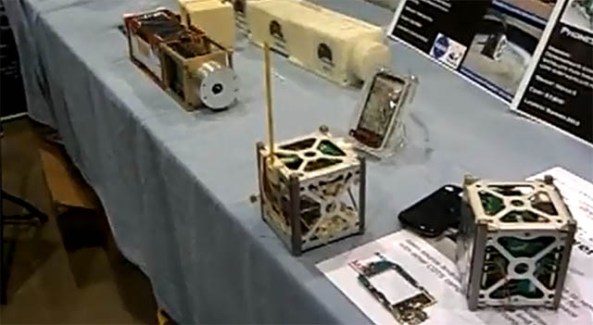


 (JPG, 2.7 Mb)
 AMSAT-UK
You must be logged in to post a comment.