ISS contact planned for Bampton School in Devon

ISS contact with Bampton SchoolAn International Space Station ARISS school contact has been planned between astronaut Drew Morgan KI5AAA and participants at Bampton School, Bampton, United Kingdom on Tuesday, October 8, 2019 at 12:51 GMT, which is 1:51 PM BST.

The contact between GB4BPS at the school and Drew Morgan KI5AAA operating NA1SS on the ISS will be audible across the British Isles and North Western Europe on 145.800 MHz FM.

The live stream of the event will be at https://live.ariss.org/

You can listen to the 145.800 MHz FM radio signal online from anywhere in the world by using a UK-based WebSDR such as:
SUWS Farnham WebSDR http://farnham-sdr.com/
Goonhilly https://vhf-goonhilly.batc.org.uk/

International Space Station - Image Credit NASA

International Space Station – Image Credit NASA

School information

Bampton Church of England Primary School, part of the Alumnis Multi Academy Trust is a is a vibrant, friendly and nurturing school, located on the edge of Exmoor National park, serving the small agricultural town of Bampton and surrounding areas of East Devon. We are part of a supportive and friendly community with strong links to our local church, ‘St Michael and All Angels.’

As a church school, our vision, ‘Believe, Belong, Become’ is embedded throughout our school and curriculum. Through core Christian values, we teach children to be able to understand and articulate their views about what they ‘believe’ and to respect the beliefs of others around them. We encourage them to understand how they ‘belong’ to family, school and the local and wider community, and how they fit into, and can impact the wider world around them. We encourage children to think about how and what they are aiming to ‘become’ as they grow, and how they are able to shape their world.

Through Christian values, together we inspire individuals to celebrate their uniqueness and empower them to become confident, aspirational, inquisitive and flourish in the modern world. We celebrate our school values of; Joy, Aiming High, Friendship, Kindness, Respect, Trust and Honesty, and Forgiveness and Compassion, and embed these values into everyday school life.

We offer an exciting, broad and balanced curriculum in a happy, stimulating environment, supported by a wide range of after school clubs and high quality, offsite residential visits. We are always seeking ways to enhance the teaching and learning experience for our children, with a breadth of experiences that develop the whole child and create a genuine love of learning. We are passionate about bringing STEM subjects to life and encouraging children to see how these subjects translate into the world beyond school.

Questions:

1. Corey (Age 7): Has the International Space Station ever suffered any damage from a meteor strike?

2. Thea (Age 9): How can space be made accessible to people with disabilities?

3. Sophie (Age 10): How long will it take you to get used to gravity again when you get home?

4. Jesse (Age 6): What would happen if I took a snowball into space?

5. Rufus (Age 8): How do you get to and from the International Space Station?

6. Alfie (Age 10): If you cut yourself in space, who acts as the doctor to fix it for you?

7. Willow (Age 10): Do you dream differently in space or dream of anything in particular?

8. Jacob (Age 10): If I kick a football in space, how far would it travel?

9. Maya (Age 9): When you were a child did you want to go to space and is there anything that disappointed you about it?

10. Hetty (Age 8): What does it feel like when you are in a rocket and you are about to get shot into space?

11. Corey asking Oliver’s question (Age 9): If you could make one improvement to the International Space Station, what would it be?

12. Thea asking Nancy’s question (Age 5): The International Space Station travels at 5 miles per second, can you feel it moving when travelling fast like you can on earth?

13. Sophie asking Eban’s question (Age 6): The International Space Station is so fast, how does it not crash into the other satellites that are also in orbit?

14. Jesse asking Sorrel’s question (Age 9): Did you have any concerns looking back at Earth for the first time?

15. Rufus asking Macy’s question (Age 9): How many planets have you seen from the International Space Station?

16. Alfie asking Ellie’s question (Age 10): If you could grow any plant in the International Space Station what would it be?

17. Willow asking Eve’s question (Age 10): How long have you been on the International Space Station and how long do you think you could stay there for?

18. Jacob asking Johnny’s question (Age 6): What time goes your clock show on the Space Station? Is it USA, UK, Russian or Japan time?

19. Maya asking Ruan’s question (Age 9): Do you get to keep your customised seat or anything else as a souvenir of your trip?

20. Hetty asking William’s question (Age 8): We are getting aware about the amount of rubbish on earth, are you worried about the amount of space junk and can you see it?

About ARISS:

Amateur Radio on the International Space Station (ARISS) is a cooperative venture of international amateur radio societies and the space agencies that support the International Space Station: NASA, Russian Space Agency, ESA, JAXA, and CSA. The US Center for the Advancement of Science in Space (CASIS) and the National Aeronautics and Space Administration (NASA) provide ARISS special support.

ARISS offers an opportunity for students to experience the excitement of Amateur Radio by talking directly with crewmembers on board the International Space Station. Teachers, parents and communities see, first hand, how Amateur Radio and crewmembers on ISS can energize youngsters’ interest in science, technology, and learning.

The primary goal of ARISS is to promote exploration of science, technology, engineering, and mathematics (STEM) topics by organizing scheduled contacts via amateur radio between crew members aboard the ISS and students in classrooms or informal education venues.  With the help of experienced amateur radio volunteers, ISS crews speak directly with large audiences in a variety of public forums.  Before and during these radio contacts, students, teachers, parents, and communities learn about space, space technologies, and amateur radio.

73 Gaston Bertels – ON4WF

For more information on ARISS, see http://www.ariss.org/

How to hear the ISS https://amsat-uk.org/beginners/how-to-hear-the-iss/

Bampton School
https://bamptonschool.org/the-news-weve-all-been-waiting-for/
https://twitter.com/BamptonSCH/

Exmoor Magazine – Eyes to the Skies in Devon
https://www.exmoormagazine.co.uk/eyes-to-the-skies-in-devon/

Devon school students to contact ISS

ISS contact with Bampton SchoolYoung people at Bampton School in Devon will get an opportunity to use amateur radio to talk to an astronaut on the International Space Station on Tuesday, October 8.

The school has tweeted:
“The news we’ve all been waiting for: @BamptonSCH contact with @Space_Station will take place Tues 8th October at 13:51:26. Children will be asking questions to astronaut @AstroDrewMorgan KI5AAA. Questions are with NASA & we’ll let you know who’ll be asking them very soon!”
https://twitter.com/BamptonSCH/status/1178754952233132032

The ISS contact with GB4BPS at the school should be receiveable across the British Isles and North West Europe on 145.800 MHz FM (Note ISS uses 5 kHz FM deviation so wider RX filter for 25 kHz channel spacing is better).

The contact with Drew Morgan KI5AAA operating NA1SS is currently planned for Tuesday, October 8 at 12:51:26 GMT (1:51 PM BST) but as with all ISS contacts last minute changes can take place.

It should be possible to receive the 145.800 MHz signal online from anywhere in the world by using a UK-based WebSDR such as:
SUWS Farnham WebSDR http://farnham-sdr.com/
Goonhilly https://vhf-goonhilly.batc.org.uk/

The contact is planned to be streamed live at https://live.ariss.org/

Bampton School
https://bamptonschool.org/the-news-weve-all-been-waiting-for/
https://twitter.com/BamptonSCH/

Exmoor Magazine – Eyes to the Skies in Devon https://www.exmoormagazine.co.uk/eyes-to-the-skies-in-devon/

Hurricane Lorenzo: Amateur satellite AO-92 will be available in U/v mode

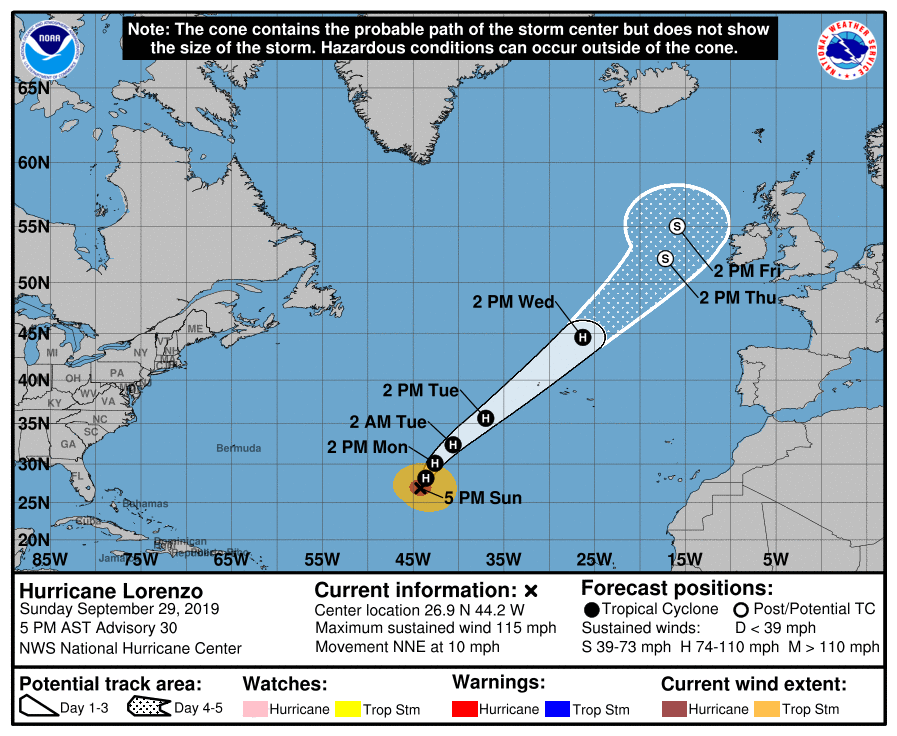
Hurricane Lorenzo estimated track

Hurricane Lorenzo estimated track

Drew Glasbrenner, KO4MA, AMSAT VP Operations has received a request from amateurs involved with emergency communications in the Azores, requesting we forego L/v operation on AO-92 this week.

AO-92 / Fox-1D CubeSat

AO-92 / Fox-1D CubeSat

AMSAT News Service reports:

Hurricane Lorenzo is expected to pass through the Azores as a Category 4 storm Tuesday and Wednesday, and they are requesting AO-92 remain in U/v for potential emergency traffic.

Please be aware of and yield to any emergency traffic, on any satellite, coming from the area during this time. Passes covering the Azores and Portugal are the most critical.

We realize that there have been a few moves and cancellations for this mode recently, and I ask for understanding and cooperation.

Emergency use is always first priority, and AMSAT is happy to assist in any way we can.

[ANS thanks Drew Glasbrenner, KO4MA, AMSAT VP Operations for the above information]

Source AMSAT News Service https://www.amsat.org/pipermail/ans/2019/001134.html

Autumn issue of OSCAR News now available for download

Oscar News Issue 227 Front CoverE-members of AMSAT-UK can now download the Autumn 2019 edition of OSCAR News, issue 227, here.

The paper edition should be sent to postal members in 2-3 weeks.

In this issue:
• From the Secretary’s Keyboard
• Editors welcome
• 2019 Meetings & Events Calendar
• Colloquium Programme
• AMSAT-UK Statement of Accounts 2019
• Supporting Comments for Accounts
• ARISS Next Generation Radio System
• ARISS Radio Upgrade on ISS for Student Outreach needs your help!
• Work FM Satellites with your HT!
• Notice of the 2019 Annual General Meeting of AMSAT-UK
• The Story of WUSAT Part 2
• The Easy-100 No-tune uplink converter for QO-100
• STP2 – MISSION
• Donation to ARISS
• Apogee view
• CAS-7B (BP-1B)
• Some activities at the forthcoming AMSAT-UK Colloquium
• AMSAT-UK QO-100 Competition

AMSAT-UK FUNcube Mission Patch

AMSAT-UK FUNcube Mission Patch

Membership of AMSAT-UK is open to anyone who has an interest in amateur radio satellites or space activities, including the International Space Station (ISS).

E-members of AMSAT-UK are able to download OSCAR News as a convenient PDF that can be read on laptops, tablets or smartphones anytime, anyplace, anywhere. Join as an E-member at Electronic (PDF) E-membership

PDF sample copy of “Oscar News” here.

Join AMSAT-UK using PayPal, Debit or Credit card at
http://shop.amsat-uk.org/

E-members can download their copies of OSCAR News here.

QO-100 satellite, GNU Radio and SDR talks released

BT Adastral Park, Martlesham - credit BT

BT Adastral Park, Martlesham – credit BT

Mark M5BOP reports the complete set of amateur radio technical talks from this year’s Martlesham Microwave Round Table is now available to watch on YouTube.

Videos of these MMRT 2019 talks are available:
• Practical GNUradio – Heather Lomond M0HMO
• From Death Rays to Dinner – William Eustace M0WJE
• Equipment for Es’hail-2 / QO-100 Narrowband – David Bowman G0MRF
• DATV on Es’hail-2 / QO100 – Noel Matthews G8GTZ
• Low-pass Harmonic Filter for 23cm – John Quarmby G3XDY
• UKuG SDR Voice Transceiver Project Discussion

Watch the videos on the Martlesham Microwave YouTube channel at
https://www.youtube.com/channel/UCHV7cC7ZMehKjAM81QxUS9w/videos

Source UK Microwaves on Groups IO
https://groups.io/g/UKMicrowaves/message/51753

UK Microwave Group
https://www.microwavers.org/
https://twitter.com/UKGHZ

AMSAT-UK: https://amsat-uk.org/
Twitter: https://twitter.com/AmsatUK
Facebook: https://facebook.com/AmsatUK
YouTube: https://youtube.com/AmsatUK

University CubeSat Club members get ham radio licenses

Dawson Duckworth KC3NNB, Lauren Hurley KD2RHC, Kaixuan Ji AC3EN and Dr. Alan Johnston KU2Y staffed the AMSAT / Villanova CubeSat Club table at the Robotstock/STEM event in August

Dawson Duckworth KC3NNB, Lauren Hurley KD2RHC, Kaixuan Ji AC3EN and Dr. Alan Johnston KU2Y staffed the AMSAT / Villanova CubeSat Club table at the Robotstock/STEM event in August

Students at the Villanova University College of Engineering started a CubeSat Club in the fall of 2018 and have since got their amateur radio licenses.

The university website reports:

A CubeSat is a nanosatellite—a small, lightweight satellite that is cheaper to build than a conventional satellite. They can be launched from rockets, or occasionally from the International Space Station by astronauts. CubeSats send telemetry information—measurements communicated at remote points by automated processes—over radio signals received on earth by a ground station.

The CubeSat club’s 2018-2019 year was packed with a variety of workshops and projects, including:

• Setting up temporary ground stations called SatNOGS (Satellite Network Operators Group)
• Building Yagi-Uda antennas from tape measurers and scrap wood and using them to track low earth orbit satellites as they flew over Villanova
• Building an AMSAT CubeSat Simulator, a functional satellite model
• Assisting with the freshman CubeSat mini-design projects
• Earning amateur radio licenses and ham radio callsigns
• Assembling and selling electronic transceiver boards used in CubeSats as a fundraiser
• Attending the 2019 Hamvention conference and running the AMSAT education table
• Received and decoded a special message sent from the AO-73 FUNcube Satellite especially for Villanova

Read the full story at
https://www1.villanova.edu/villanova/engineering/newsevents/newsarchives/2019/community/CubeSat-Club.html

The students emailed a request to the FUNcube Operations Team to get their special message transmitted from space by the AO-73 satellite. Further information on these ‘Fitter’ messages is available at https://funcube.org.uk/ground-segment/fitter-messages/