ARISS contact planned for girls’ school in UK

RMS students study for their Amateur Radio Foundation licence - Image Credit RMS

RMS students study for their Amateur Radio Foundation licence – Image Credit RMS

On Thursday, February 11, 2016, at approximately 18:09 UT, an ARISS contact is planned for the Royal Masonic School for Girls, Rickmansworth,, United Kingdom. The contact between Tim Peake GB1SS and GB1RMS will be receivable in the British Isles and Europe on 145.800 MHz FM and will be streamed live on the web.

UK astronaut Tim Peake KG5BVI / GB1SS

UK astronaut Tim Peake KG5BVI / GB1SS

The Royal Masonic School for Girls is an independent girl’s day and boarding school in Rickmansworth, Hertfordshire, with an exceptional, unusual and distinguished history. Founded in 1788 with the purpose of educating the daughters of Freemasons who were unable to support their families, it is one of the oldest girls’ schools in the country. The school attracts girls aged 4-18 from across Hertfordshire, Buckinghamshire and North London and boarders from all over the world. They also have a Pre School for boys and girls aged 2 to 4. The ethos is both aspirational and nurturing and the girls strive to be the very best they can be, academically, morally and creatively. The public examination results are consistently impressive and each year around 90% of girls leave RMS to take up places at University. Life at RMS is centred on much more than “just” academic success and the School is well known for its exceptional pastoral care, and the wealth of extra-curricular opportunities it offers – including Astronomy as they are one of very few schools in the UK to have their own planetarium and observatory!

This contact will be webcast on the ARISS Principia website.

Students will ask as many of the following questions as time allows.

1. Jana (Year 6): If you have hiccups in space do you bounce around?
2. Eva (Year 7): I watched your video on water and why it turned into a sphere. Would you get the same reaction with a fizzy drink like lemonade?
3. Isabella (Year 3): I’m 7 years old – when I am your age, what do you think space travel will look like?
4. Rosa and Millie (Year 9): We have heard you had to breathe o2 before your brilliant spacewalk.  Are there any precautions you had to take after returning inside the ISS?
5. Saira (Year 9): What was the first word that came into your head when you saw the Earth from Space?
6. Amelia (Year 8): What was the hardest thing to adjust to when you arrived at the ISS?
7. Elizabeth (Year 8): Which of your muscles has been affected the most by the zero gravity?
8. Jasmine (Year 8): Who was your biggest inspiration to travel into space?
9. Tallulah (Year 9): How is being an astronaut different from being an aquanaut, apart from the sea and the air?
10. Kitty (Year 9): What is the best advice that you have been given and wish to pass on to future astronauts before travelling to the ISS??
11. Yasmin (Year 9): Your blog says that you are doing research into new space age metals using a levitation furnace. Why is zero gravity better for this type of experiment?
12. Miranda (Year 8): Aside from plants, how do you produce oxygen on the ISS?
13. Tallulah (Year 10): What is the difference between flying a helicopter and being in a rocket going to the ISS?
14. Aaliya (Year 10): Did your training prepare you for the actual experience of space jet lag given you have said you adjusted so quickly?
15. Evie (Year 8): How is the ISS helping us deal with the challenges of deep space voyages?
16. Laura (Year 12): Is there an ‘up’ on the space station when conducting a spacewalk for navigational /orientating purposes?
17. Sophie (Year 3): What is your favourite experiment that you have carried out in space, and why?
18. Jane (Year 8): What has been the most surprising everyday object on the ISS that you did not expect to find?
19. Diana (Year 10): How often do you see Solar wind?
20. Evie (Year 8): When Chris Hadfield recently visited us he said your guitar skills were good but needed more practice Do you have time to practice the guitar in space?

ARISS offers an opportunity for students to experience the excitement of Amateur Radio by talking directly with crew members onboard the International Space Station. Teachers, parents and communities see, first hand, how Amateur Radio and crewmembers on ISS can energize youngsters’ interest in science, technology and learning.

Story Source: Gaston Bertels, ON4WF, ARISS mentor

ARISS Principia site https://principia.ariss.org/

Listen online to Tim Peake’s radio transmission on 145.800 MHz FM at http://websdr.suws.org.uk/

Listening to the ISS on a handheld radio https://amsat-uk.org/2016/01/10/listening-iss-on-handheld/

What is Amateur Radio? http://www.essexham.co.uk/what-is-amateur-radio

Find an amateur radio training course near you https://thersgb.org/services/coursefinder/

A free booklet is available aimed at introducing newcomers to the hobby that can also be used as a handy reference while getting started, see
http://rsgb.org/main/get-started-in-amateur-radio/alex-discovers-amateur-radio-2/

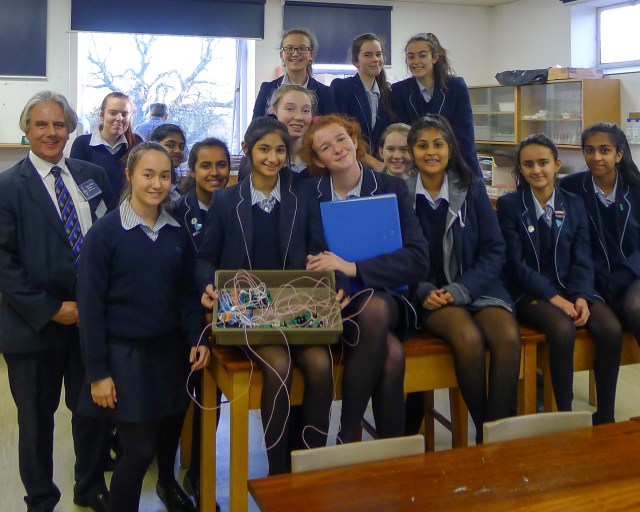
RSGB Board Member Steve Hartley G0FUW with some of the 80 students at the Royal Masonic School for Girls who participated in an Amateur Radio Electronics Buildathon

RSGB Board Member Steve Hartley G0FUW with some of the 80 students at the Royal Masonic School for Girls who participated in an Amateur Radio Electronics Buildathon

All UK ARISS shortlisted schools are now scheduled

Tim Peake KG5BVI preparing for his spacewalk in January

Tim Peake KG5BVI preparing for his spacewalk in January

After the original competition to find schools that could demonstrate a commitment to Space, STEM and outreach was launched by ARISS in the UK and the UK Space Agency, we announced that ten schools had been shortlisted but that not all of those school would have an opportunity to talk to Tim Peake on the ISS.  In fact Tim himself announced at the UK Space Conference in July 2015 that there would be at least three such contacts and that he was hopeful of more.

The ARISS UK team, working with the ARISS International community, are now pleased to announce that after a number of discussions, all ten schools selected for the UK shortlist have now been scheduled. The proposed scheduled is as follows:-

Jan 8 at 0847 GMT : Sandringham School GB1SAN, St. Albans, Herts
Feb 11 at 1811 GMT : Royal Masonic School for Girls GB1RMS, Rickmansworth, Herts
Feb 19 at 1420 GMT : Oasis Academy Brightstowe GB1OAB, Bristol
Feb 26 at 1440 GMT : City Norwich School GB2CNS, Norwich
Mar 5 at 1053 GMT : Powys Combined Schools GB4PCS, Powys, Wales
Apr 18 at 1456 GMT (3:56 pm BST) : St Richards Catholic College GB4SRC, Bexhill on Sea
Apr 23 at 1210 GMT (1:10 pm BST) : Wellesley House School GB1WHS, Broadstairs,  Kent
Apr 25 at 1202 GMT (1:02 pm BST) : The Derby High School GB1DHS, Bury Lancashire
May 5 at 0808 GMT (9:08 am BST) : Ashfield Primary School GB1APS, Otley, West Yorkshire
May 9 at 0926 GMT (10:26 am BST) : The Kings School GB1OSM, Ottery St Mary, Devon

These dates correspond to the predicted orbits of the International Space Station visible during the school day (typically 08:00 – 18:00hrs) and when it is orbiting over the UK.  A significant amount of planning remains to be carried out to turn these proposals into confirmed events – Tim’s on-orbit work schedule also has to be such that he is able to carry out the contact at the same time as the ISS is orbiting over the UK and the schools are available to make the call.  Not a simple task!

We will update the ARISS Principia site with more information as it becomes available so make sure you keep checking there, on Twitter (@m0xtd) or on the UK Space Agency website.

73s

Ciaran – M0XTD
ARISS Operations Lead in the UK

ARISS Principia site https://principia.ariss.org/

July 2015 – School shortlist announced https://amsat-uk.org/2015/07/14/school-shortlist-tim-peake-iss/

Video of Tim Peake ham radio contact with Sandringham School on January 8, 2016
https://amsat-uk.org/2016/01/09/video-tim-peake-sandringham/

Listening to the ISS on a handheld radio https://amsat-uk.org/2016/01/10/listening-iss-on-handheld/

Get press publicity by receiving ISS school contacts
https://amsat-uk.org/2016/03/10/press-publicity-receiving-iss/

What is Amateur Radio? http://www.essexham.co.uk/what-is-amateur-radio

Find an amateur radio training course near you https://thersgb.org/services/coursefinder/

A free booklet is available aimed at introducing newcomers to the hobby that can also be used as a handy reference while getting started, see
http://rsgb.org/main/get-started-in-amateur-radio/alex-discovers-amateur-radio-2/

Primary school students tune in to Tim Peake

St Mildred’s Primary Infant school students listen to Tim Peake using amateur radio

St Mildred’s Primary Infant school students listen to Tim Peake using amateur radio

The amazing interest in Tim Peake’s mission on the International Space Station (ISS) is keeping the Hilderstone Amateur Radio and Electronics Club busy with enquiries from schools.

The pupils of Monkton C of E Primary school were thrilled to receive a message from space when they picked up the signal from a passing amateur radio satellite. They calculated the orbital period from the variations in the satellite’s temperature as it passed from sunlight into the Earth’s shadow, taking 97 minutes to orbit compared to Tim’s 93 minutes. They learned how Isaac Newton explained the orbit of objects around the Earth nearly 300 years before Sputnik was launched!

The year 2 pupils of St Mildred’s Primary Infant school were very excited to hear Tim’s voice live when he answered the pupils’ questions from Sandringham school. They were using 3 handheld amateur radio receivers provided by the club and heard Tim’s reply to the question about the mission being named after Newton’s book Principia.

If you would like to learn about amateur radio and electronics you will be made most welcome at the club. Alternatively you can send them an email to hilderstoneclub<at>gmail.com or visit the club website.

Hilderstone Amateur Radio and Electronics Club
http://g0hrs.org/
https://twitter.com/G0HRS

What is Amateur Radio? http://www.essexham.co.uk/what-is-amateur-radio

Find an amateur radio training course near you https://thersgb.org/services/coursefinder/

A free booklet is available aimed at introducing newcomers to the hobby that can also be used as a handy reference while getting started, see
http://rsgb.org/main/get-started-in-amateur-radio/alex-discovers-amateur-radio-2/

An Unlikely Pair of Satellites

Students working on AggieSat4 and Bevo-2 satellites - Credit Texas A&M University / Dexter Becklund

Students working on the AggieSat4 and Bevo-2 satellites – Credit Texas A&M University / Dexter Becklund

Dr Helen Reed KD7GPX is interviewed in a NASA story about the AggieSat4 and Bevo-2 satellites which were deployed from the International Space Station (ISS) on January 29, 2016.

Students from Texas A&M University and The University of Texas came together for the LONESTAR investigation.

This collaborative effort sent a pair of satellites, AggieSat4 and Bevo-2, to the International Space Station. The satellites were deployed from the space station on January 29, and AggieSat4 will eject Bevo-2 as part of a demonstration of technology with applications for future space exploration.

The two satellites will demonstrate communication protocols between them and with ground stations, as well as systems that allow the satellites to navigate through space and relative to each other and to orient themselves in three dimensions. Flight demonstration of these abilities, necessary for unmanned craft to be able to rendezvous and dock in space without direct human intervention, will contribute to future satellite missions as well.

“The overall objective is to find ways for small spacecraft to join together autonomously in space,” said Dr. Helen Reed, KD7GPX, professor of aerospace engineering and director of the AggieSat Lab at Texas A&M. “We need simple systems that will allow rendezvous and docking with little to no help from a human, which will become especially important as we venture farther out into space. Applications could include in-space assembly or reconfiguration of larger structures or systems as well as servicing and repair.”

Small satellites are less expensive to build and investigators can more easily find space on rocket launches to send them into orbit, but it does take creative thinking to design a functioning satellite with smaller volume and less power. Bevo-2 is 13.3 inches long, 5.3 inches high and 5.3 inches wide, about the size of a loaf of bread. AggieSat4 measures 24 by 24 by 12 inches, slightly larger than a piece of carry-on luggage. Together the satellites weigh 114 pounds.

Read the full story at
http://www.nasa.gov/mission_pages/station/research/unlikely-pair-of-satellites.html

Watch The deployment of AggieSat4

The IARU has coordinated these frequencies for the amateur radio payloads:
• AggieSat4 436.250 MHz 9k6 FSK telemetry (also 153.6 kbps FSK)
• Bevo-2 437.325 MHz CW and 38k4 FSK

The AggieSat4 team request that any amateur radio enthusiasts receiving the beacons sends any data to aggiesat@tamu.edu it would be much appreciated!

AggieSat4 information
https://twitter.com/aggiesat
https://www.facebook.com/AggieSatLab
http://aggiesatweb.tamu.edu/index.php/projects/lab_projects/aggiesat4
https://www.dropbox.com/sh/v8razh1evcabt7a/jrGSjbOJb4

Bevo-2 information
https://www.facebook.com/UTSatLab
https://www.ae.utexas.edu/news/features/bevo-2-satellite-sdl

AggieSat4 reception reports http://www.dk3wn.info/p/?cat=313

AggieSat4 deployment from ISS

UK astronaut Tim Peake KG5BVI preparing AggieSat4 for deployment

UK astronaut Tim Peake KG5BVI preparing AggieSat4 for deployment

The deployment activities scheduled for Friday, January 29, 2016 include capturing CYCLOPS with the JEM Remote Manipulator System, maneuvering CYCLOPS to the deployment location, and final deployment of AggieSat4 from CYCLOPS

An example of the deployment mechanism can be seen below.

There are four switches, embedded on the CYCLOPS EAF, that inhibit AGS4 from turning. The first event that will occur after deployment will be the release of these inhibits. Once these inhibits are removed, the Electronic Power System (EPS) starts and initiates a 10 minute timer. After the timer ends the Command and Data Handling System starts and initiates a checkout of every system on AGS4. When complete, AGS4 will begin sending a signal to Earth with its Low Data Rate (LDR) radio, indicating that it is alive and well. The team expects to start receiving signals from AGS4 on Friday evening.

This animation shows how the Cyclops Deployment System launches satellites in the 50 to 100 kg class from the International Space Station.

Watch Animation of Station’s Cyclops Satellite Deployer

Thanks to Jan van Gils PE0SAT for this item.

ISS AggieSat4 Satellite Deployment – Amateur Radio Frequencies and Links
https://amsat-uk.org/2016/01/27/iss-satellite-deployment/

Sandringham School presentation

Handheld transceivers being presented to Sandringham School students

Handheld transceivers being presented to Sandringham School students

On Monday, January  26, 2016, Tony Wiltshire, M0TNY/ZB2TY – from Martin Lynch & Sons Ltd and Mark Haynes, M0DXR – from Kenwood UK visited Sandringham School in St Albans.

A presentation and demonstration was made to Polly, M6POG, Emma, M6GJQ and Jessica, M6LPJ, the school’s newly licenced amateurs who previously had made the initial contact with Tim Peake GB1SS aboard the ISS.

The girls had placed orders for Kenwood’s TH-K20E VHF handies with ML&S and have been looking forward to being active on the bands with their own equipment. ML&S hope the demonstration will get them the air very soon and they also thank headmaster Alan Gray, G4DJX, for his hospitality and wish Sandringham School Radio Hams the best for the future!

Rumour has it that 15 more students from the school will be taking their licence exams as a result of the interest from the ISS contact.

ML&S website http://www.MLandS.co.uk/

Video of Tim Peake ham radio contact with Sandringham School
https://amsat-uk.org/2016/01/09/video-tim-peake-sandringham/

TV News: Sandringham school amateur radio ISS contact
https://amsat-uk.org/2016/01/08/bbc-tv-sandringham-school-amateur-radio-iss-contact/

Local newspaper reports reception of Tim Peake KG5BVI / GB1SS from the ISS
https://amsat-uk.org/2016/01/13/local-paper-tim-peake-iss/

Listening to the ISS on a handheld radio
https://amsat-uk.org/2016/01/10/listening-iss-on-handheld/

What is Amateur Radio? http://www.essexham.co.uk/what-is-amateur-radio

Find an amateur radio training course near you https://thersgb.org/services/coursefinder/

A free booklet is available aimed at introducing newcomers to the hobby that can also be used as a handy reference while getting started, see
http://rsgb.org/main/get-started-in-amateur-radio/alex-discovers-amateur-radio-2/