15-year-old radio ham receives ISS Apollo-Soyuz SSTV Award

ISS SSTV Apollo-Soyuz Award #0289 received by Sakshi Vagadia VU3EXP

ISS SSTV Apollo-Soyuz Award #0289 received by Sakshi Vagadia VU3EXP

Rajesh Vagadia VU2EXP reports that he and his15 year old daughter, Sakshi Vagadia VU3EXP, have each received ISS Apollo-Soyuz SSTV Awards for their reception of Slow Scan Television images transmitted using amateur radio from the International Space Station (ISS).

Sakshi Vagadia VU3EXP

Sakshi Vagadia VU3EXP

These special transmissions from the ISS during July 18-19, 2015 were made to commemorate the 40th anniversary of the Apollo-Soyuz mission, which was the first joint collaboration in space between the United States and the Soviet Union. The ARISS organisation has issued a special limited edition diploma to award those who received one of the SSTV images.

Rajesh writes: After getting ticket [amateur radio licence] few months back, It was first successful attempt by Sakshi VU3EXP to receive SSTV Image from International Space Station and get such memorable & precious Wallpaper (award). She received ISS SSTV image on July 18, 2015 @ 19:36:44 (UTC).

My ISS SSTV Image was received on July 19 @ 05:24:27 (UTC). It was my 5th successful attempt.

I highly appreciate ARISS International, Russian Cosmonauts, various Radio Clubs and ARISS SSTV Award Managers (incl. SQ3OOK) joint efforts to give such wonderful opportunity to we Ham community.

73 VU2EXP
Rajesh P. Vagadia
Rajkot – Gujarat

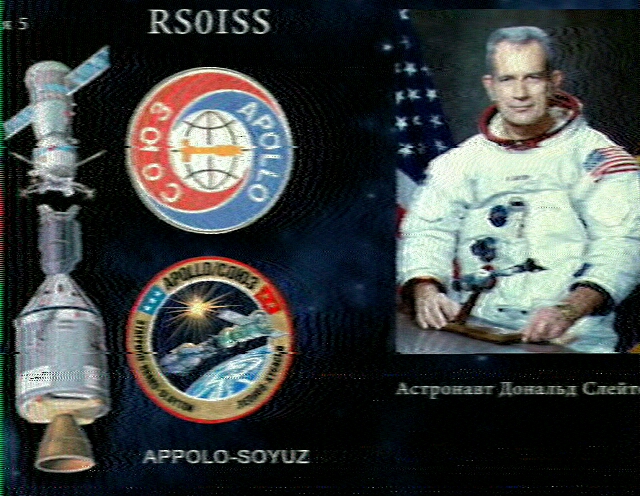
Image received by Sakshi Vagadia VU3EXP on July 18, 2015 at 1936 GMT

Image received by Sakshi Vagadia VU3EXP on July 18, 2015 at 1936 GMT

Amateur Radio on the International Space Station (ARISS) – Contact the ISS
http://www.ariss.org/contact-the-iss.html

ISS Slow Scan TV https://amsat-uk.org/beginners/iss-sstv/

Youngest radio ham in Gujarat state
https://amsat-uk.org/2015/05/04/youngest-radio-ham-in-gujarat-state/

What is Amateur Radio ? http://www.essexham.co.uk/what-is-amateur-radio

OSCAR News Issue 211

oscar-news-211-front-coverIssue 211 of the AMSAT-UK amateur radio satellite publication OSCAR News was released on September 15, 2015. E-members can download it here.

The paper edition is usually posted 2-3 weeks after publication of the electronic issue.

In this issue:
• Metallurgy for the Radio Amateur Dave Malley, K1NYK
• ARISS International Annual Meeting 2015 – Tokyo, Japan
• Colloquium Report – G3WGM
• AMSAT-NA, AMSAT-DL, and Virginia Tech Announce Potential Phase-3E Opportunity
• A FUNcube STEM Activity David Bowman G0MRF
• FUNcube Certificate of Achievement
• FUNcube-1 spin period
• Getting ready for Phase 4 David Bowman G0MRF
• AGM Minutes
• Science Museum London announce a new exhibition
• The UK Space Agency CUBESAT Review
• Nayif-1 Progress report
• Some FUNcube STEM reports

AMSAT-UK FUNcube Mission Patch

AMSAT-UK FUNcube Mission Patch

Membership of AMSAT-UK is open to anyone who has an interest in amateur radio satellites or space activities, including the International Space Station (ISS).

E-members of AMSAT-UK are able to download OSCAR News as a convenient PDF that can be read on laptops, tablets or smartphones anytime, anyplace, anywhere. Join as an E-member at Electronic (PDF) E-membership

There are two rates for the paper edition to cover the extra postage costs:
UK
Rest of the World (Overseas)

PDF sample copy of “Oscar News” here.

Join AMSAT-UK using PayPal, Debit or Credit card at
http://shop.amsat.org.uk/shop/category_9/Join-Amsat-UK.html

E-members can download their copies of OSCAR News here.

Fox-1C and Fox-1D FM transponder CubeSats will fly on SHERPA

SHERPA in Orbit - Credit Spaceflight Inc

SHERPA in Orbit – Credit Spaceflight Inc

In response to a breaking opportunity, AMSAT and Spaceflight, Inc. have arranged for Fox-1D to accompany Fox-1C on the maiden flight of the SHERPA system on a SpaceX Falcon 9.

AMSAT FOXAs a Fox-1 series, Fox-1D is identical to Fox-1C, but with different frequencies and carrying the University of Iowa HERCI (High Energy Radiation CubeSat Instrument) radiation mapping experiment as a hosted payload. Fox-1D will provide additional selectable U/V or L/V repeater capabilities once in orbit, and will be capable of downlinking Earth images from the Virginia Tech camera experiment.

Launch is currently planned for the first quarter of 2016. Additional donor support is needed to offset the costs associated with the launch of Fox-1D in addition to Fox-1C. Please visit http://www.amsat.org/ to donate support this launch, and help keep amateur radio in space.

Fox-1C has been renamed Fox-1Cliff in honor of Cliff Buttschardt, K7RR, who was a benefactor and long time supporter
for AMSAT as well as an adviser/mentor for students building CubeSats at Cal Poly.

Meet the Fox Project http://www.amsat.org/?page_id=1113

Fox-1C Update Video https://amsat-uk.org/2015/06/07/fox-1c-update-video/

US launch schedule discussion forum
http://forum.nasaspaceflight.com/index.php?PHPSESSID=q67qup1a0d3e7vloo0p9isl1u6&topic=8184.960

KLETSKOUS CubeSat Update

KLETSkous LogoThe KLETSKOUS satellite team is making good progress. SA AMSAT reports that the KLETSKOUS team made some major progress during the past few weeks.

Currently the team is researching a new type of battery. It was planned to use Lithium Ion but one of the negatives about Lithium Ion is that it may suffer thermal runaway, which increases the risk of fire. Companies, like NEC, have developed a Lithium-Iron battery using lithium Iron phosphate (LiFePO4) as the cathode material. Generally, anodes of most batteries are made of carbon. As safety and reliability is the first concern for any battery being used on a satellite, it should not get overheated or catch fire in case of overcharging. The Lithium-Iron battery has superior chemical and thermal stability.

The team is in the process of acquiring Lithium Iron batteries to run tests. If the decision is to switch to Lithium Iron Phosphate, some modifications will have to be made to the charging circuit in the power unit but Fritz Sutherland, ZS6FSJ, says that it is not a major problem and will not delay the construction of the next prototype of the power unit.

Frik Wolff, ZS6FZ, has finalised the layout of the solar panels and Hannes Coetzee, ZS6BZP, will now proceed to mount the solar cells on a test board, which has to be carried out in a vacuum chamber. Work has also commenced on the magnetic stabilisation of Kletskous, which will be achieved by the use of orthogonal rod magnets. ZS6FZ is current working on this and reported good progress with a prototype ready for testing.

Work on the On Board Controller (OBC) is also progressing well. The first two prototypes have been completed. Brain McKenzie, ZS6BNM, is now working closely with team members to establish their telemetry point requirements and interfaces.

Nico van Rensburg,  ZS6QL, has  been working on the specifications and configuration management  and has put a first draft on the table. The team meets via Skype on a fortnightly basis to discuss progress and plan the next steps.

Funding remains a major challenge. Radio Amateurs are urged to support the local CubeSat programme by donating to the SA AMSAT CubeSat building fund. Donors are acknowledged on the SA AMSAT web at http://www.amasatsa.org.za/

Source South African Radio League (SARL) http://www.sarl.org.za/

KLETSKOUS Linear Transponder Demonstration
https://amsat-uk.org/2014/05/29/kletskous-linear-transponder-demonstration/

ISS CubeSat Deployment

Kibo Robot Arm CubeSat Deployment

Kibo Robot Arm CubeSat Deployment

Masahiro Arai JN1GKZ reports CubeSats may be deployed from the International Space Station (ISS) on September 17.

On the AMSAT Bulletin Board he writes:

ISS Kibo Japanese Experiment Module (JEM)

ISS Kibo Japanese Experiment Module (JEM)

JAXA has announced CubeSats will deploy from the ISS via the J-SSOD on 17th September but the CubeSat name is not shown in the announcement. However, NASA’s ISS On-Orbit Status Report 09/09/15 shows the following:

JAXA-Small Satellite Orbital Deployer (SSOD) #4 Install: Kelly installed the J-SSOD#4 on the Slide Table with the Multi-Purpose Experiment Platform (MPEP) attached.  The J-SSOD #4 has two satellites that will be deployed next week.  The first satellite is designed to observe the Ultraviolet (UV) spectrum during the Orionid meteor shower in October.  The second satellite, sponsored by the University of Brasilia and the Brazilian government focuses on meteorological data collection.

So, the first one must be S-CUBE and the second is SERPENS.

SERPENS operates in the amateur band. The SERPENS Amateur Radio page shows these downlink frequencies:
145.980 MHz using GFSK modulation at 9600 bps and AX.25 protocol
and
437.365 MHz using CW/MSK modulation at 1200 bps and CSP protocol

S-CUBE seems not to operate in an amateur band.

SERPENS Amateur Radio page http://www.aerospace.unb.br/serpens_radioamateurs

United Nations – ISS CubeSat Deployment

Amateur Radio CubeSats TechEdSat, F-1 and FITSAT-1 pass the ISS solar panels

Amateur Radio CubeSats TechEdSat, F-1 and FITSAT-1 pass the ISS solar panels

The United Nations Office for Outer Space affairs has announced the United Nations/Japan Cooperation Programme on CubeSat Deployment from the ISS Kibo module “KiboCUBE”.

The first of the Planet Lab Dove CubeSats were deployed from the ISS on February 11, 2014 about 0831 UT

The first of the Planet Lab Dove CubeSats were deployed from the ISS on February 11, 2014 about 0831 UT

The United Nations Office for Outer Space Affairs (UNOOSA) and the Japan Aerospace Exploration Agency (JAXA) are pleased to announce the United Nations/Japan Cooperation Programme on CubeSat Deployment from the International Space Station (ISS) Japanese Experiment Module (Kibo) “KiboCUBE”.

KiboCUBE is the dedicated collaboration between UNOOSA and JAXA in utilizing the ISS Kibo for the world. KiboCUBE aims to provide educational or research institutions from developing countries of United Nations membership with opportunities to deploy, from the ISS Kibo, cube satellites (CubeSats) which they develop and manufacture.

Currently, the only way to deploy CubeSats from the ISS is from Kibo. Kibo’s unique capability is comprised of an airlock system and a robotic arm. The first orbital deployment of CubeSats from Kibo was successfully conducted in October 2012 through the Small Satellite Orbital Deployer developed by JAXA. Since then, nano-satellites and CubeSats from various countries around the world have been deployed from Kibo.

The deployment of CubeSats from ISS is easier than the direct deployment by a launch vehicle thanks to the lower vibration environment during launch. With this comparatively less demanding interface requirements, UNOOSA and JAXA believe that KiboCUBE will lower the threshold of space activities and will contribute to build national capacity in spacecraft engineering, design and construction.

UNOOSA and JAXA are looking forward to many applications!!

How to Apply information is at http://www.unoosa.org/oosa/en/ourwork/psa/hsti/kibocube.html