The AMSAT-UK International Space Colloquium in Guildford starts at 3:30pm on Friday, July 24 with a special session for newcomers to the amateur satellite world.
Newcomers will be helped through the complexities by three amateurs, Dave G4DPZ, Carlos G3VHF and Drew KO4MA, who, between them, have thousands of hours of experience.
They will explain the theories and talk about the practice of listening to and having satellite contacts through the ever increasing number of satellites in orbit.
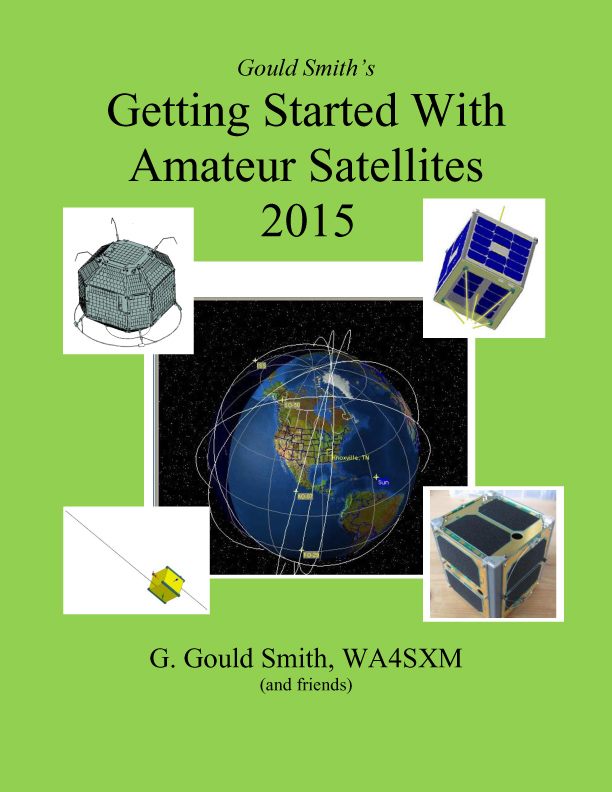
This year, there will be copies available of the very recently updated AMSAT-NA publication “Getting started with Amateur Satellites 2015″ in full colour available for sale from the shop at a special show price of £15.
A special full colour edition of the book Getting Started with Amateur Satellites 2015 will be available for just £15 at the AMSAT-UK International Space Colloquium, Guildford, July 24-26. The price after the event will be higher.
This definitive reference is written for the new satellite operator by Gould Smith, WA4SXM, but includes discussions for the experienced operator who wishes to review the features of amateur satellite communications. The new operator will be introduced to the basic concepts and terminology unique to this mode. Additionally, there are many practical tips and tricks to ensure making contacts, and to sound like an experienced satellite operator in the process.
Newly revised in May 2015 with new information on, AO-73, UKube-1, the upcoming Fox-1A, Fox-1B, Fox-1C, Fox-1D, and Fox-1E, plus many other updates of general interest. It also include information on several satellites of interest to hams expected to be launched in the coming year.
AMSAT-UK thanks AMSAT-NA for permission to print the book in the UK.
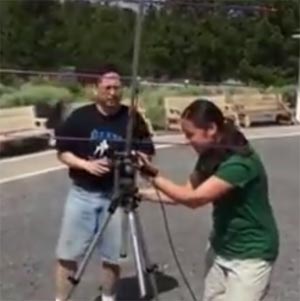
David Haworth WA9ONY showed students how to receive the FUNcube-1 amateur radio CubeSat during a workshop at Pine Mountain Observatory, Oregon.
Satellite Antenna
FUNcube-1 (AO-73), launched on November 21, 2013 is an educational satellite built by volunteers from AMSAT-UK and AMSAT-NL with the goal of enthusing and educating young people about radio, space, physics and electronics.
The satellite carries a BPSK telemetry beacon on 145.935 MHz for students to receive and a linear transponder for two-way amateur radio communications. In addition there is a materials science experiment, from which the school students can receive telemetry data which they can compare to the results they obtained from similar reference experiments in the classroom.
First Week Update by Project Manager, Chiara Massimiani:
Friday, Successful launch at PSLV from FLP, SDSC SHAR, India. Click for PSLV-C28 Mission page & Youtube Launch Video. Antennas successfully deployed and beacon switched on.
First packets received by Surrey Space Centre’s Satellite Operations Centre at 22:21:51 which confirmed satellite state. The DOS Team declare the satellite healthy from downlinked telemetry.
Saturday, first telemetry uplink requests set and successfully received back in the operations centre.
Communication tests activated to confirm satellite mode operations.
Monday, communications tests complete. The team declare the uplink and downlink as sufficient to facilitate the full mission operations.
Thursday, Transition from Launch & Early Operations (LEOP) Communication Mode to Nominal Communication Mode after further uplink tests.
Friday, Begin early ADCS commissioning.
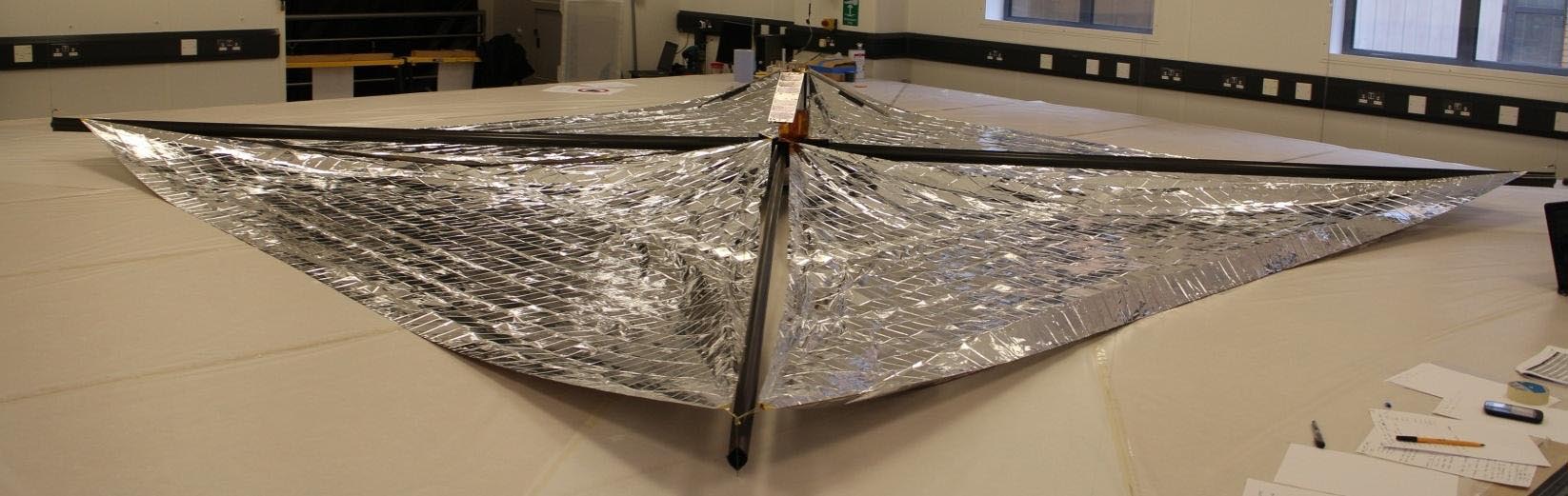
DeorbitSail CubeSat with Sail deployed
Expected operations in the coming month:
Week commencing 20th July: Attitude Determination & Control System (ADCS) Commissioning phase to obtain attitude data.
After three or four weeks: End ADCS Commissioning phase with a stable attitude.
In one month: Payload commissioning phase – solar panel and sail deployment which completes all major operations before deorbiting.
In commemoration of the Apollo Soyuz SSTV event, ARISS will be distributing a limited edition diploma to those who received one of the SSTV images transmitted from the International Space Station on July 18-19, 2015.
You must be logged in to post a comment.