President tests LituanicaSAT-1 FM transponder

Lithuanian President Dalia Grybauskaitė - Image Augustas Didzgalvis

Lithuanian President Dalia Grybauskaitė – Image Augustas Didzgalvis

In 2013 the President of the Republic of Lithuania, Dalia Grybauskaitė visited the Science Communication and Information Center (SCIC ) at Vilnius University. There she saw the amateur radio CubeSat LituanicaSAT-1 and tested the satellite’s FM voice transponder with a handheld radio using the call sign LY5N.

LituanicaSAT-1 was launched to the International Space Station (ISS) on January 9, 2014 and was deployed with other amateur radio satellites on February 28.

The tiny satellite is just 10x10x10 cm with a mass of 1.090 kg yet it has a VGA camera and a 145/435 MHz FM voice transponder, designed and built by Lithuanian radio amateurs.

The prototype of the FM repeater has been operating in the home of its designer Žilvinas Batisa LY3H in Elektrėnai, Lithuania. Further information at http://ly3h.epalete.com/?p=303

Watch this video of President Dalia Grybauskaitė and LituanicaSAT-1

LituanicaSAT-1 Lithuanian CubeSat https://amsat-uk.org/2014/02/27/lituanicasat-1-cubesat/

Ofcom Consultation: 146-147 MHz for Amateur Radio use in UK

AMSAT-UK Logo

AMSAT-UK Logo

Ofcom has published a consultation on the release of around 6 MHz of very high frequency (VHF) spectrum in the 143 to 169 MHz band, which has been returned for civil use.

The consultation says:

1.7 As demand for both operational and potential future services in the short to medium term is likely to be low we are also proposing to permit temporary access to 1 MHz of this spectrum (146 to 147 MHz) for Amateur Radio use, until such a time as it is needed by Business Radio or other services. Should additional spectrum be needed to meet operational requirements, we will remove the temporary allocation. Amateur Radio use of this frequency will be on a non-protection/ non-interference basis and will be subject to some geographical restrictions to ensure that there is no interference to neighbouring countries. We propose that the authorisation will be implemented by an individual Notice of Variation (NoV) to the Amateur Radio licence.

The consultation summarises responses to an earlier Call for Input on the release of spectrum in England, Wales and Northern Ireland between 143 and 156 MHz spectrum. Today’s document also encompasses spectrum that has been returned for civil use between 168 MHz and 169 MHz. Since the Call for Input was published, this spectrum is now available on a UK-wide basis.

The consultation explains Ofcom’s proposed approach to allocating the released spectrum, including a proposal that spectrum be made available on a first-come-first-served basis through Ofcom’s current Business Radio licence products.

Responses to the proposals are invited by 26 May 26, 2014, make your response at
http://stakeholders.ofcom.org.uk/consultations/vhf-143-169mhz/howtorespond/

Consultation document
http://stakeholders.ofcom.org.uk/binaries/consultations/vhf-143-169mhz/summary/VHF_consultation.pdf

Consultation: Responses to the Call for Input and Consultation on next steps of the release of spectrum within the frequency ranges 143 MHz to 169 MHz
http://stakeholders.ofcom.org.%20uk/consultations/vhf-143-%20169mhz/

PRN codes for KickSat Sprites released

Cornell KickSat Antenna

Cornell KickSat Antenna

Zac Manchester KD2BHC has posted another update on the KickSat CubeSat which will carry 104 tiny Sprite satellites into a 325×315 km 51.5 degree inclination orbit. The launch will be broadcast live on NASA TV, which will also be streaming on Ustream.

UPDATE: The launch has been postponed, see http://spaceflightnow.com/falcon9/009/140327delay/ For latest date check http://spaceflightnow.com/tracking/

SpaceX Falcon-9 CRS-3 Mission Patch

SpaceX Falcon-9 CRS-3 Mission Patch

The primary launch date for the SpaceX Falcon 9 CRS 3 mission from the Kennedy Space Center will be March 31 at 0250 GMT. There is also a backup date of April 4 at 0140 GMT.

Zac says “Since a laptop can only decode one or two Sprite signals at a time, I’ve also been busy getting our radio upload page set up so that you can record a pass without having to decode it in real-time, upload the .wav file, and have all 104 Sprite signals decoded on our server with the results emailed back to you. This will also help our team collect as much data as possible from around the world. The page will be live before launch.”

All of the 104 Sprite satellites transmit on the same frequency. Each Sprite has a unique pair of Pseudo-Random Number (PRN) codes that it encodes its transmissions with, allowing a receiver to tell the Sprites apart (this is known as CDMA). A list of all Sprite PRN codes codes is available at https://docs.google.com/spreadsheet/ccc?key=0ArAGbHISj5okdEhBbkZiWGxBSjNmcEs4ZkgwMmNsUEE&usp=sharing

KickSat Sprite satellites deployed - Image by Ben Bishop VK2FBRB

KickSat Sprite satellites deployed – Image by Ben Bishop VK2FBRB

Read KickSat Update 62

KickSat Google Group https://groups.google.com/forum/#!forum

KickSat Sprite Ground Station by Andy Thomas G0SFJ http://kicksat.wordpress.com/support/kicksat-ground-station/

British Interplanetary Society: Sprite Technical Summary http://www.bis-space.com/2013/03/09/9301/kicksat-technical-summary

KickSat Amateur Radio Information
https://github.com/zacinaction/kicksat/wiki/Radio-Info

Setting up a ground station
https://github.com/zacinaction/kicksat/wiki/Setting-Up-A-Ground-Station

Watch a video of the planned deployment at
https://amsat-uk.org/2014/03/03/mass-launch-of-437-mhz-satellites/

New frequency for Ukrainian PolyITAN-1 CubeSat

PolyITAN-1 1 – Girder; 2 – Honeycomb panels of solar battery 5 units; 3 – Base (bottom plate); 4 – Solar cells; 5 – PCB units of the platform; 6 – Accumulators unit; 7 – GPS antenna; 8 – X-band antenna; 9 – S- band antenna.

PolyITAN-1
1 – Girder;
2 – Honeycomb panels of solar battery 5 units;
3 – Base (bottom plate);
4 – Solar cells;
5 – PCB units of the platform;
6 – Accumulators unit;
7 – GPS antenna;
8 – X-band antenna;
9 – S- band antenna.

The IARU Satellite Frequency Coordination Panel have announced a new frequency for the Ukrainian amateur radio CubeSat PolyITAN-1, planned to launch from Yasny in Russia.

IARU say the new frequency of 437.675 MHz was needed to avoid interference occurring with another spacecraft on the same launch.

PolyITAN-1 was built by students at the Kiev National University “KPI” in cooperation with the Ukrainian ham radio community.

The mission is to launch Ukrainian educational satellite build by KPI students and space exploration enthusiasts. Specific mission targets are:
• Develop, build, test, launch and operate a Ukrainian small satellite platform based on the CubeSat standard.
• Conduct mission experiments with following payloads:
.  o Sun sensor
.  o Attitude position and orientation system including system software
.  o Test on-board GLONASS/GPS navigation subsystem
• Build ground segment infrastructure for satellite communication
• Develop and test onboard and ground telecommunication software, implement telecommunication protocols
• Establish cooperation between educational institute, space agency(s) and various government authorities, Ham radio community

PolyITAN-1 is a 1U CubeSat which will have a 1200 bps AFSK AX25 600 mW downlink on 437.675 MHz. It will also have a CW beacon (EM0UKPI).

Architecture Design of PolyITAN-1
http://congress.cimne.com/eucass2013/admin/files/fileabstract/a272.pdf

PolyITAN-1 in Google English http://tinyurl.com/PolyITAN-1
Original text http://amsat.at.ua/

UY2RA Blog Post http://tinyurl.com/UY2RA-Blog-Post

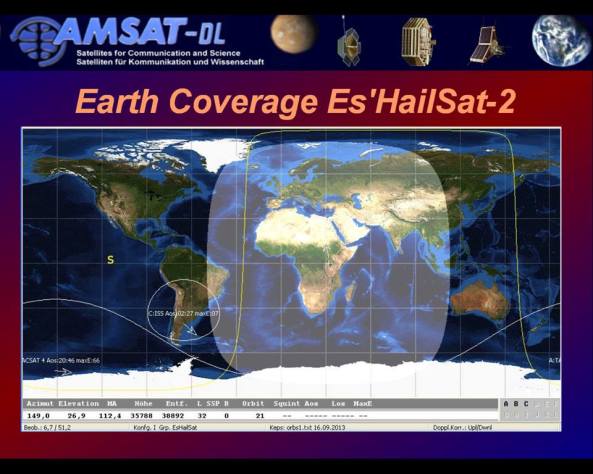
Two Geostationary Amateur Radio Transponders on Es’hail 2


Coverage area of Es'hail 2

Qatar’s Es’hail 2 satellite will provide the first amateur radio geostationary communications that could link amateurs from Brazil to India. The satellite is expected to launch by the end of 2016 and will be positioned at 25.5 degrees East.

AMSAT-DL President Peter Guelzow DB2OS at the Qatar National Day Station A71QND

AMSAT-DL President Peter Guelzow DB2OS at the Qatar National Day Station A71QND

AMSAT-DL President, Peter Guelzow DB2OS, has provided the following information:

Es’HailSat-2 will carry two geostationary “Phase 4” amateur radio transponders !!

As a result of a concept proposed by the Qatar Amateur Radio Society, Es’ Hailsat, the Qatar Satellite Company, have announced that their new, geostationary, Es’HailSat-2 communications spacecraft will provide transponders for use by radio amateurs. The spacecraft is expected to be ready for launch by the end of 2016.

Es’HailSat-2 will provide a 250 kHz linear transponder intended for conventional analogue operations in addition to another transponder which will have an 8 MHz bandwidth. The latter transponder is intended for experimental digital modulation schemes and DVB amateur television.
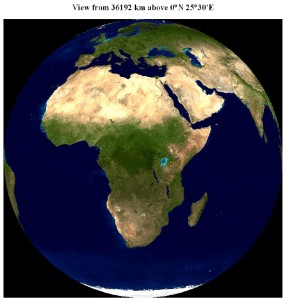
Es'hail-2 coverage areaPrecise uplink and downlink frequencies remain to be finalized but the uplinks will be in the 2.400-2.450 GHz and the downlinks in the 10.450-10.500 GHz amateur satellite service allocations.

Both transponders will have broad beam antennas to provide full coverage over about 1/3rd of the earth’s surface. Precise operational plans will be finalised over the coming months but it is anticipated that only quite simple ground equipment will be required to use this satellite.

A team of amateurs, led by Peter Guelzow DB2OS (President of AMSAT-DL) are providing technical support to this ground breaking project which is expected to provide an exciting new phase of activity for radio amateurs for the 21st century.

Es’hailSat announces tender process for Es’hail 2
http://www.qatarchronicle.com/science-and-technolgy/49977/eshailsat-announces-tender-process-for-eshail-2/

Es’hailSat – the Qatar Satellite Company https://www.facebook.com/EshailSat

Presentation by Peter Guelzow DB2OS, President of AMSAT-DL, at the 2013 AMSAT-UK Colloquium
http://www.batc.tv/streams/amsat1306

AMSAT Deutschland https://www.facebook.com/amsat.deutschland

ISS Ham Video 2395 MHz Blank Transmissions

Front panel of the HamTV transmitter

Front panel of the HamTV transmitter

Presently, the Ham Video equipment on the International Space Station (ISS) is permanently transmitting a “blank” image and no audio.

It is in configuration 3:
• ARISS antenna 43
• Frequency 2395 MHz
• Symbol rate 1.3 Ms/s

Transmission will continue in this configuration till the end of the week.

BATC Webstream of ISS HamTV by Stefan VE4NSA March 8, 2014

BATC Webstream of ISS HamTV by Stefan VE4NSA March 8, 2014

On Sunday, March 23, Ham Video will start transmitting in configuration 4, i.e. 2395 MHz and 2.0 Ms/s.

Due to SpaceX docking and related operations, Ham Video blank transmissions will come to an end March 31.

The last commissioning step will be planned in April or in May 2014. We will keep you informed on the precise date and time.

Reports on reception of blank transmissions are very welcome. Reports can be filed via this webpage: http://www.spaceflightsoftware.com/ARISS_FSTV/submit.php

Participants using the Tutioune receiving software can record as well as stream detailed parameters of the received signal. Please see: http://www.vivadatv.org/

On Thursday, March 20, three ground stations tested chained reception of Ham Video signals. Jean Pierre Courjaud reported on this experiment on his website. The report is available at
http://www.vivadatv.org/viewtopic.php?f=66&t=294&p=785#p785

Thank you for your participation to the Ham Video testing campaign.
73,
Gaston Bertels, ON4WF
ARISS Europe chair

Read the HamTV overview http://tinyurl.com/HamTVoverview

Join the ISS HamTV Yahoo Group http://groups.yahoo.com/group/HamTV

Webstream of the TV transmissions http://batc.tv/ch_live.php?ch=4

ISS HamTV Multi-Viewer http://www.noelandsally.net/iss/

ARISS-EU HamTV Bulletins http://www.ariss-eu.org/

HamTV on Facebook https://www.facebook.com/Hamtvproject