FUNcube-1 Transponder Test March 22

FUNcube-1 (AO-73) - Image credit Wouter Weggelaar PA3WEG

FUNcube-1 (AO-73) – Image credit Wouter Weggelaar PA3WEG

When in sunlight FUNcube-1 is normally in “Educational Mode” (transponder off with high power beacon) but on Saturday, March 22, 2014 at approximately 0930 UT the FUNcube team are planning to switch to “Amateur Mode” (transponder on with low power beacon) for at least one whole orbit.

The aim of the switch on March 22 is to check the effect on the satellite of continuous “Amateur Mode”, especially battery temperature.

FUNcube website http://www.funcube.org.uk/

FUNcube Yahoo Group https://amsat-uk.org/funcube/yahoo-group/

FUNcube Forum http://forum.funcube.org.uk/

Satellite changes in French License

REF LogoThe minutes of the March 7 meeting between the French National Society REF and the communications regulator ARCEP have been published.

435-438 MHz is now allocated to the Amateur-satellite service for both Earth-to-Space and Space-to-Earth in Region 1 and territories in Region 2. Due to a previous error in the national frequency table French amateurs did not have Space-to-Earth for this band in their license.

The 2400-2415 MHz band is now allocated to radio stations in the Amateur-satellite service in French territories in Region 2.

Regarding the 1.2 GHz band the REF wondered if the Galileo GPS satellites, which broadcast across 1260 to 1300 MHz, may call into question the allocation of this portion of the band to the Amateur Services. The ARCEP said they would review this matter and provide a response.

The future of 2.4 and 5.7 GHz bands were also discussed. ARCEP said the 2300-2400 MHz band is subject to the European Commission harmonization work for the mobile service and the bands 5350-5470 MHz and 5725-5925 MHz are designed to future expansion of wireless internet. However, no decision has been taken to date. Compatibility studies on these frequencies are underway in the CEPT.

The REF report the ARCEP had shown an interest in the ARISS school contacts which have a high educational value.

French radio amateurs have gained access to 472-479 kHz with 1 watt output in Region 1 and territories in Region 2. Discussions also covered the possibility of an amateur allocation across the whole of 1.8-2.0 MHz and possible future allocations at 5.5 MHz and 70 MHz.

Minutes of the meeting between ARCEP and REF March 7, 2014 in Google English
http://tinyurl.com/REF-ARCEP-Minutes-2014-03-07

REF in Google English http://tinyurl.com/FranceREF

A 2006 Galileo GPS article by Peter Blair G3LTF highlighted the problems this system could cause, see http://www.southgatearc.org/articles/galileo.htm

LituanicaSAT-1 CubeSat Update

LituanicaSAT-1 Camera and FM Voice Transponder

LituanicaSAT-1 Camera and FM Voice Transponder

Laurynas Maciulis LY1LM provides this update on the Lithuanian CubeSat LituanicaSAT-1 which was deployed from the International Space Station (ISS) on February 28, 2014.

LituanicaSAT-1

LituanicaSAT-1

Thanks to numerous beacon reports from W7KKE and DK3WN we established that periodic brown outs of our satellite that started to appear early last week are most probably caused by EPS falling to critical mode after battery voltage falls down to 6.5 V. This is most probably associated to some technical problem of solar panels, consequently generating less power than we planned. The satellite returns to safe mode when battery charges again to 7.2 V. This is indicated by appearance of the strong FM beacon signal at 437.275 MHz.

We are trying to turn off the beacon temporarily to charge battery to nominal level and resume nominal operations. During today’s 05:00 UTC pass over Lithuania we seem to have succeeded in switching off the beacon so You might not hear it for some time. If everything goes according to plan, system should resume to nominal mode when 7.4 V battery voltage is reached. You will notice that when You can hear periodic 9k6 FSK packets at 437.550 MHz.

LituanicaSAT-1 Stack

LituanicaSAT-1 Stack

Your further reports will be very appreciated.

We still have strong hopes to turn on the FM transponder when things get better, for all you guys to try it.

73!
Laurynas Maciulis LY1LM
LituanicaSAT-1 systems engineer

The tiny satellite is just 10x10x10 cm with a mass of 1.090 kg yet it has a VGA camera and a 145/435 MHz FM voice transponder, designed and built by Lithuanian radio amateurs.

The prototype of the FM repeater has been operating in the home of its designer Žilvinas Batisa LY3H in Elektrėnai, Lithuania. Further information at
http://ly3h.epalete.com/?p=303

The communications payload comprises:
• FM Morse Code Beacon 437.275 MHz LY5N
• FM Voice Repeater 145.950 MHz uplink (PL 67 Hz CTCSS) 435.180 MHz downlink
• AX.25 Packet Radio 145.850 MHz uplink 437.550 MHz downlink 9600 baud FSK, FM

Links
• Submit reports at http://www.kosmonautai.lt/en/data-submission/
• Web Google English http://tinyurl.com/KosmonautaiLituanicaSAT-1
• Wiki Google English http://tinyurl.com/WikiLituanicaSAT-1
• Facebook https://www.facebook.com/Lituanicasat1

KickSat Sprites set for launch March 30

KickSat Sprite satellites deployed - Image by Ben Bishop VK2FBRB

KickSat Sprite satellites deployed – Image by Ben Bishop VK2FBRB

Zac Manchester KD2BHC has released this update on KickSat which will carry 104 tiny Sprite satellites into a 325×315 km 51.5 degree inclination orbit. The launch of the SpaceX Falcon 9 CRS 3 mission is planned for somewhere between March 30 and April 2.

KickSat 437 MHz Sprite Satellite

KickSat 437 MHz Sprite Satellite

The launch will be from Kennedy Space Center in Florida and you can watch it live on NASA TV, which will also be streaming online on Ustream.

Here’s a rough sequence of events:

  • Falcon 9 launch (0:00)
  • Falcon 9 upper stage separation (+0:03)
  • Dragon capsule separation (+0:10)
  • KickSat deployment from Falcon 9 upper stage (+0:16)
  • KickSat powers on and begins transmitting telemetry (+1:06)
  • Sprite deployment (+16 days and 16 minutes after launch)

The Sprites will be deployed by a timer exactly 16 days after KickSat is deployed from the launch vehicle. The timing was arranged with NASA to avoid interference with ISS operations.

Once KickSat turns on its radio, you should be able to pick it up with very basic Ham radio gear. It will be transmitting telemetry packets in AX.25 format on 437.505 MHz with 1200 baud AFSK modulation. I’ll post KickSat’s orbital elements here and on the project wiki, which will also have more information on setting up a receiving station. As always, don’t hesitate to contact me if you have any questions.

Thanks for your support!

Zac Manchester KD2BHC

This video by Ben Bishop VK2FBRB shows the Sprite deployment

Each Sprite has a microcontroller, radio, and solar cells and is capable of carrying single-chip sensors, such as thermometers, magnetometers, gyroscopes, and accelerometers.

CRS-3 Dragon spacecraft is mounted on the Falcon 9 rocket

CRS-3 Dragon spacecraft is mounted on the Falcon 9 rocket

All the Sprites satellites operate on a single frequency of 437.240 MHz and use Code Division Multiple Access (CDMA). The transmitter runs 10 mW output of Minimum Shift Keying (MSK) modulated binary data with each data bit modulated as a 511 bit Pseudo-Random Number (PRN) sequence. The ITU emission designator is 50K0G1D. The KickSat CubeSat has downlinks on 437.505 MHz and 2401-2436.2 MHz.

Mass Launch of 437 MHz Satellites https://amsat-uk.org/2014/03/03/mass-launch-of-437-mhz-satellites/

KickSat Sprite Ground Station by Andy Thomas G0SFJ
http://kicksat.wordpress.com/support/kicksat-ground-station/

British Interplanetary Society: Sprite Technical Summary
http://www.bis-space.com/2013/03/09/9301/kicksat-technical-summary

KickSat on KickStarter
https://www.kickstarter.com/projects/zacinaction/kicksat-your-personal-spacecraft-in-space/

New Satellite Telemetry Decoder Apps Released

LitSat-1 Telemetry Decoder

LitSat-1 Telemetry Decoder

Mike Rupprecht DK3WN has released four new satellite telemetry decoders Apps.

They are for:
• LitSat-1, 145.845 MHz, 9k6 FSK, beacon, KISS file
• LituanicaSat-1, 437.550 MHz, 9k6 FSK, KISS file
• STARS-2, 437.245 MHz, CW as text
• TeikyoSat-3, 437.450 MHz, CW as text

The download page in Google English is at http://tinyurl.com/SatSoftwareDK3WN/

In German http://www.dk3wn.info/software.shtml

Amateur radio satellite operation from Isle of Lewis

GS3PYE/P

GS3PYE/P

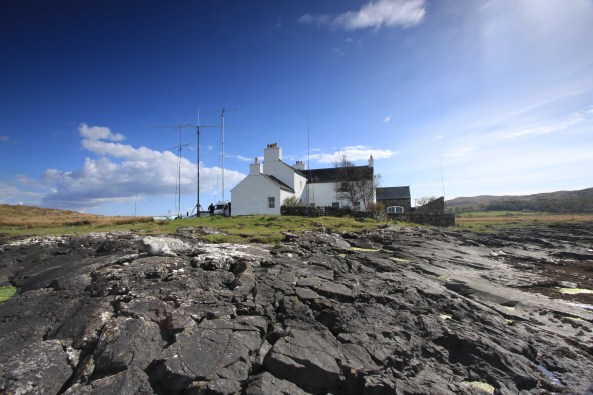
Camb-Hams will be operating on the amateur radio satellites using the call sign GS3PYE/P from the Isle of Lewis (Grid Square IO68UL, IOTA EU-010) on April 26 to May 3, 2014.
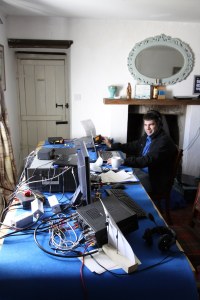
GS3PYE StationThe Camb-Hams have been activating the Scottish Isles each year since 2008 and will be travelling to the Isle of Lewis in the Scottish Outer Hebrides in 2014. Thirteen operators will be active on all bands and many modes from 4m to 80m, 2m & 70cm for Satellites and 2m & 23cm for EME.

The HF bands will be covered by five simultaneous stations, while the 6m & 4m stations will have a great take-off towards the UK and Europe from the island’s northern tip in IO68 square. 2m and 23cm EME will be available with a portable low-ERP Yagi system, mainly focussed on JT modes. 2m and 70cm will be available for portable satellite operations.

Contest operations will take place in the RSGB 70MHz UKAC on April 29.

The group will be active on the major social networks before, during and after the trip. You can check on progress or interact with the operators via their blog at dx.camb-hams.com or through Twitter, Facebook and YouTube [links below]. Previous trips have generated some great audio and video recordings of the GS3PYE/P signal from around the world.

GS3PYE MapPlease email skeds-2014@camb-hams.com to arrange skeds on the more challenging bands and modes. VHF and EME skeds will also be made via ON4KST and N0UK’s EME Chat.

The Camb-Hams were formed in early 2006 as the social and public-facing side of the Cambridgeshire Repeater Group (CRG), which was formed out of the PyeTelecommunications Radio Club.

The Camb-Hams are made up of people from many of, but not exclusively, the various Cambridgeshire radio groups including CUWS (Cambridge University Wireless Society), CDARC (Cambridge and District Amateur Radio Club) and Cambridgeshire RAYNET. It provides a common forum for us all to work together and has been very successful in increasing the activity in the Cambridgeshire area.

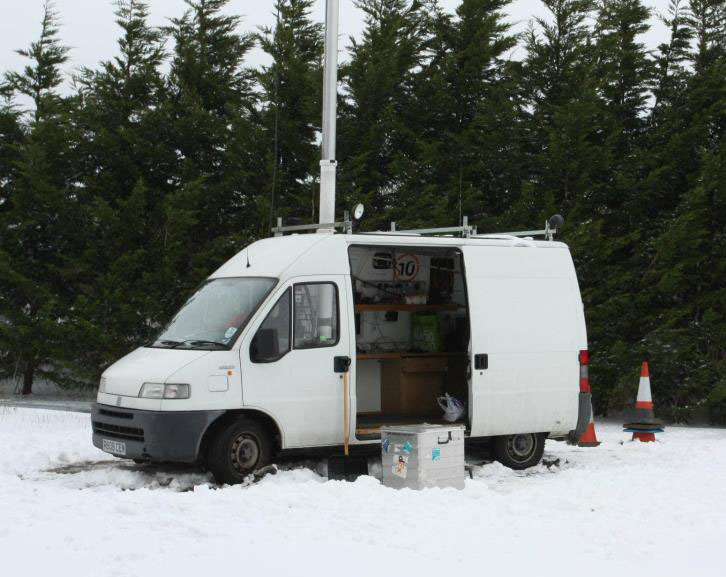
Camb-Hams Amateur Radio Van

Camb-Hams Amateur Radio Van

We meet on-air via the CRG’s VHF and UHF FM Voice repeaters, and at regular monthly Pye and Pint nights held from 19:00-22:00 on the 1st Wednesday of each month at the White Horse, Barton http://www.thewhitehorseinnbarton.co.uk

Our contesting side, using the CRG callsigns G3PYE & G6PYE, aims to provide an opportunity for non-contest operators to have a go, whilst putting a concerted effort into entering a particular contest.

Camb-Hams frequently travel and have ‘DXpeditioned’ to the Scottish Isles of Mull, Harris, Monachs, Arran, Lunga, Staffa and Iona, as well as organising social trips to many of the major European rallies. Since 2010, the Camb-Hams have been active and increasingly successful in the RSGB UKAC, Field Day and AFS contests.

Web http://dx.camb-hams.com/
Twitter http://twitter.com/g3pye
Facebook http://facebook.com/CambHams
YouTube http://youtube.com/CambHams

Attracting newcomers to Ham Radio
http://www.southgatearc.org/news/december2012/attracting_newcomers_to_ham_radio.htm

Keeping New Radio Hams
http://www.southgatearc.org/news/january2013/keeping_new_radio_hams.htm