New Satellite Telemetry Decoder Apps Released

LitSat-1 Telemetry Decoder

LitSat-1 Telemetry Decoder

Mike Rupprecht DK3WN has released four new satellite telemetry decoders Apps.

They are for:
• LitSat-1, 145.845 MHz, 9k6 FSK, beacon, KISS file
• LituanicaSat-1, 437.550 MHz, 9k6 FSK, KISS file
• STARS-2, 437.245 MHz, CW as text
• TeikyoSat-3, 437.450 MHz, CW as text

The download page in Google English is at http://tinyurl.com/SatSoftwareDK3WN/

In German http://www.dk3wn.info/software.shtml

Amateur radio satellite operation from Isle of Lewis

GS3PYE/P

GS3PYE/P

Camb-Hams will be operating on the amateur radio satellites using the call sign GS3PYE/P from the Isle of Lewis (Grid Square IO68UL, IOTA EU-010) on April 26 to May 3, 2014.

GS3PYE StationThe Camb-Hams have been activating the Scottish Isles each year since 2008 and will be travelling to the Isle of Lewis in the Scottish Outer Hebrides in 2014. Thirteen operators will be active on all bands and many modes from 4m to 80m, 2m & 70cm for Satellites and 2m & 23cm for EME.

The HF bands will be covered by five simultaneous stations, while the 6m & 4m stations will have a great take-off towards the UK and Europe from the island’s northern tip in IO68 square. 2m and 23cm EME will be available with a portable low-ERP Yagi system, mainly focussed on JT modes. 2m and 70cm will be available for portable satellite operations.

Contest operations will take place in the RSGB 70MHz UKAC on April 29.

The group will be active on the major social networks before, during and after the trip. You can check on progress or interact with the operators via their blog at dx.camb-hams.com or through Twitter, Facebook and YouTube [links below]. Previous trips have generated some great audio and video recordings of the GS3PYE/P signal from around the world.

GS3PYE MapPlease email skeds-2014@camb-hams.com to arrange skeds on the more challenging bands and modes. VHF and EME skeds will also be made via ON4KST and N0UK’s EME Chat.

The Camb-Hams were formed in early 2006 as the social and public-facing side of the Cambridgeshire Repeater Group (CRG), which was formed out of the PyeTelecommunications Radio Club.

The Camb-Hams are made up of people from many of, but not exclusively, the various Cambridgeshire radio groups including CUWS (Cambridge University Wireless Society), CDARC (Cambridge and District Amateur Radio Club) and Cambridgeshire RAYNET. It provides a common forum for us all to work together and has been very successful in increasing the activity in the Cambridgeshire area.

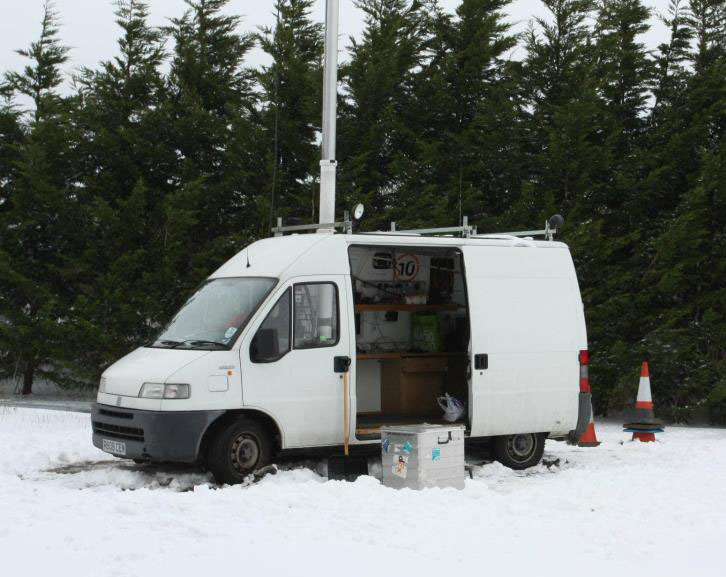
Camb-Hams Amateur Radio Van

Camb-Hams Amateur Radio Van

We meet on-air via the CRG’s VHF and UHF FM Voice repeaters, and at regular monthly Pye and Pint nights held from 19:00-22:00 on the 1st Wednesday of each month at the White Horse, Barton http://www.thewhitehorseinnbarton.co.uk

Our contesting side, using the CRG callsigns G3PYE & G6PYE, aims to provide an opportunity for non-contest operators to have a go, whilst putting a concerted effort into entering a particular contest.

Camb-Hams frequently travel and have ‘DXpeditioned’ to the Scottish Isles of Mull, Harris, Monachs, Arran, Lunga, Staffa and Iona, as well as organising social trips to many of the major European rallies. Since 2010, the Camb-Hams have been active and increasingly successful in the RSGB UKAC, Field Day and AFS contests.

Web http://dx.camb-hams.com/
Twitter http://twitter.com/g3pye
Facebook http://facebook.com/CambHams
YouTube http://youtube.com/CambHams

Attracting newcomers to Ham Radio
http://www.southgatearc.org/news/december2012/attracting_newcomers_to_ham_radio.htm

Keeping New Radio Hams
http://www.southgatearc.org/news/january2013/keeping_new_radio_hams.htm

ISS HamTV to switch to 2395 MHz on March 15/16

Front panel of the HamTV transmitter

Front panel of the HamTV transmitter

The Digital HamTV transmitter on the International Space Station will change frequency to 2395 MHz on the weekend of March 15/16.

HamTV Antennas at ARISS Telebridge Station IK1SLD in Casale Monferrato, Italy

HamTV Antennas at ARISS Telebridge Station IK1SLD in Casale Monferrato, Italy

HamTV Bulletin 9:

The Ham Video transmitter commissioning steps 1 and 2 were performed as planned. Working together  with ESA / B.USOC, the ARISS team in Matera did an excellent job.

Saturday April 8, four configurations tested with antenna 41.
Sunday April 9, six configurations tested with antenna 43.

Both ARISS L/S-band antennas are operational in S-band. Reports from ground stations during blank transmissions will allow further analysis of their performance and radiation characteristics in space.

Recordings of signals received during commissioning steps at Matera ground station will be made available on the BATC server.

In Livorno, Ham Video manufacturer Kayser Italia received excellent signals with a 1.2m dish. In Casale Monferrato, the ARISS telebridge station also received good signals with the same type of antenna.

A basic amateur radio station that should be able to receive HamTV from ISS - Image AMSAT-Italia

A basic amateur radio station that should be able to receive HamTV from ISS – Image AMSAT-Italia

Recordings can be viewed with VLC software. Please select 16/9 image format.

Presently, Ham Video is transmitting permanently a “blank” image and no audio in configuration 1:
* ARISS antenna 43
* Frequency 2422 MHz
* Symbol rate 1.3 Ms/s
This blank transmission will continue till the end of the week.

Next week blank transmission is planned with antenna 43 on 2395 MHz and 1.3 Ms/s. The frequency changeover will be done Saturday 15 or Sunday 16 March. All Ham Video frequencies have been notified to ITU as ISS – ARISS.

BATC Webstream of ISS HamTV by Stefan VE4NSA March 8, 2014

BATC Webstream of ISS HamTV by Stefan VE4NSA March 8, 2014

Reports on reception of blank transmissions are very welcome. Reports can be filed via this webpage: http://www.spaceflightsoftware.com/ARISS_FSTV/submit.php

Participants using the Tutioune receiving software can record as well as stream detailed parameters of the received signal. Please see: http://www.vivadatv.org/

Blank transmissions will continue till the next commissioning step, which is planned April 12, 2014. We will announce configurations in due time.

Thank you for your participation to the Ham Video testing campaign.

73,
Gaston Bertels, ON4WF
ARISS Europe chair

Read the HamTV overview by Gaston Bertels ON4WF http://tinyurl.com/HamTVoverview

Join the ISS HamTV Yahoo Group http://groups.yahoo.com/group/HamTV

Webstream of the TV transmissions http://batc.tv/ch_live.php?ch=4

ARISS-EU HamTV Bulletins http://www.ariss-eu.org/

HamTV on Facebook https://www.facebook.com/Hamtvproject

434 MHz XABEN and other balloon launches go ahead today

High altitude balloon 434 MHz trackers made by Chris M6EDF

High altitude balloon 434 MHz trackers made by Chris M6EDF

Steve G8KHW planned to launch five balloons XABEN64-68 carrying 434 MHz payloads from Elsworth on Wednesday, March 12. The permit for them arrived at the last minute on Wednesday morning. Technically the flights need a permit despite being 100g balloons as they are on a line rather than mounted in the neck.

The balloons may have a range of 200-500 km so should be receivable on a SSB (USB) radio over much of the UK or can be received World-Wide using the SUWS WebSDR

Steve says: The plan is to launch 5 identical payloads on 5 identical 100g balloons as near identically filled as I can manage in order to see the sort of spread of burst altitudes. The balloons will be launched as quick as I can fill them and launch them – so its likely that all 5 balloons will be in the air at the same time.

With all those flights I’m going to need some help tracking them – so lots of listeners would be appreciated. Callsigns and Frequencies to follow on the UKHAS Mailing List – but all will be on 434 MHz with standard 50 Baud 470 Hz 7N1 RTTY.

SSDV picture from a PIE balloon - Image credit Dave Akerman M6RPI

SSDV picture from a PIE balloon – Image credit Dave Akerman M6RPI

XABEN64-68 Callsigns and Frequencies (USB):
– uX3 434.250
– uX0 434.350
– uX1 434.400
– uX2 434.450
// skipping 434.500 to avoid BALYOLO
– uX5 435.550

There should be a launch from Westcott, Buckinghamshire on Wednesday at 12.00 Callsign: BALYOLO Frequency 434.500 MHz.

Project Ascend are launching Wednesday at 0900 from Cockermouth,Cumbria. They say please listen out for us on 434.450 MHz USB,  Callsign HAB55331. Further information at http://projectascend.co.uk/

Dave Akerman M6RPI/M0RPI says he’s planning to launch at around 2pm on Thursday, it’ll be a regular payload up-burst-down, probably with 2 trackers. The launch will take place from the field behind Dave’s new house just north of Ross-On-Wye, so receivers in the west of England will be particularly welcome. No SSDV just 50 baud RTTY telemetry. There will be live video streaming of the launch and chase at http://www.batc.tv/streams/m0rpi_chase

The two payloads are BUZZ and ZURG.  Both 50 baud 7 bits no parity 2 stop bits, 480Hz shift. BUZZ is on 434.600 MHz and ZURG on 434.650 MHz.  Former is an rfm22b and latter an NTX2 so they will drift somewhat.

On Thursday, March 13 Adam Cudworth will be launching HABE 12 from Worcestershire on 434.200 MHz.

James Coxon M6JCX launching a PICO balloon on 434.301 MHz USB

James Coxon M6JCX launching a PICO balloon on 434.301 MHz USB

Check the IRC channel for chat about the launches on irc.freenode.net #highaltitude
A web client is available at http://webchat.freenode.net/?channels=highaltitude

Online real-time tracking of balloons
http://spacenear.us/tracker/

Listen to the balloons online using the Southampton University Wireless Society (SUWS) 434 MHz WebSDR located near Basingstoke (51.294N, 1.131W)
https://amsat-uk.org/2013/12/28/websdr-for-434-and-1296-mhz/

Beginners Guide to Tracking using dl-fldigi software
http://ukhas.org.uk/guides:tracking_guide

To get up-to-date information on balloon flights subscribe to the UKHAS Mailing List by sending a blank email to this address: ukhas+subscribe@googlegroups.com

CubeSat Propulsion at George Washington University

First firing of synchronized 3-channel Micro-Cathode Arc Thruster subsystem at NASA Ames Research Center Spaceshop, August 2013

First firing of synchronized 3-channel Micro-Cathode Arc Thruster subsystem at NASA Ames Research Center Spaceshop, August 2013

Samudra Haque N3RDX is involved in developing a Micro-Cathode Arc Thruster (μCAT) propulsion system for CubeSats.

The Micropropulsion and Nanotechnology Laboratory (MpNL, http://www.mpnl.seas.gwu.edu/), of the Department of Mechanical and Aerospace Engineering, of George Washington University (Washington, DC), announced at the 2014 IEEE Aerospace Conference (Big Sky, MT), a ground breaking electric propulsion application opportunity for the global Small Satellite community: the On-orbit Micro-propulsion eXperiment Program (OMXP) started on March 1, 2014.

The program is initially targeted to educational institutions with pico/nano/micro-satellites who are seeking propulsion systems for their space missions. The MpNL has ongoing research activity in scalable, small, efficient and safer electric propulsion systems, and is preparing flight hardware for the first on-orbit demonstration mission, of a 4-channel Micro-Cathode Arc Thruster (μCAT) subsystem, in 2015 onboard a 1.5U CubeSat that is fully funded. μCAT subsystems were tested and evaluated at Technology Readiness Level (TRL) 5 in August, 2013.

GWU-ARC Mapers Micro-Cathode Arc Thruster PhoneSat Experiment

GWU-ARC Mapers Micro-Cathode Arc Thruster PhoneSat Experiment

The OMXP program is intended to support further technology readiness level raising exercises of the current subsystem and its more capable next generation derivatives that will continue to be researched and prototyped at MpNL, by partnering with experimental spacecraft designers, as early adopters, seeking to add capabilities to their space missions such as: station keeping, orbit maintenance, orbit adjustment, attitude control, orbit transfer, in-space propulsion, deorbit system and proximity operations, or other uses. The program will actively support the co-development of microthruster subsystems compatible with the emerging 3U-6U CubeSat standards, and where practical, for larger bus designs up to 50 Kg mass.

Academic institutions/affiliated groups are invited to propose, as Joint Research Partner, collaborative projects where μCAT or its next generation derivatives can be utilized on a Space mission, in lieu of an affordable cost-recovery agreement for parts, and through the execution of collaborative joint agreements for intellectual property rights, data collection, reporting, publication, and any other issues of mutual interest.

1-ch uCAT subsystem by Micropropulsion and Nanotechnology Lab (c) 2013 Samudra Haque N3RDX

1-ch uCAT subsystem by Micropropulsion and Nanotechnology Lab (c) 2013 Samudra Haque N3RDX

All academic institutions/affiliated groups are welcome to apply. International institutions may be subject to compliance with requirements of applicable U.S. export laws.

The MpNL sincerely appreciates support by industry partners for the On-orbit Micro-propulsion eXperiment Program, and welcomes interested participants, subject to compliance with University regulations on sponsorship.

Samudra Haque N3RDX
Ph.D Candidate
Department of Mechanical and Aerospace Engineering
The George Washington University
samudra@gwu.edu
(202) 812-3325

UK CubeSat Weekend: March 29-30, 2014

A  Typical CubeSat

A Typical CubeSat

The UK CubeSat Weekend, taking place at Satellite Applications Catapult in Harwell Didcot, will allow members of the public to work together to design, build and balloon launch a flight ready CubeSat engineering model, and a flight model suitable for launch into low earth orbit.

The purpose of the weekend is to demonstrate that amateur groups with no experience of spacecraft design or assembly can design, build and fly. Participants are invited to register teams of two to five members each, to build and test the CubeSat.

Objectives:
– Assemble and program a PocketSpacecraft.com ScoutArray
– Test and optionally improve its functionality on the bench
– Integrate into a CubeSat
– Test the functionality on a tethered balloon

The event takes place at the Satellite Applications Catapult, Electron Building, Fermi Avenue, Harwell Didcot, Oxfordshire, OX11 0QR. Registration details at https://sa.catapult.org.uk/cubesat-weekend