WRAPS Antenna Rotor System Introduction

WRAPS Portable Satellite Antenna Rotator System - Copyright ARRL

WRAPS Portable Satellite Antenna Rotator System – Copyright ARRL

In the first of four videos, Mark Spencer, WA8SME, explains the operation of the amateur radio WRAPS antenna rotor system.

The WRAPS system points a lightweight antenna towards a passing amateur radio satellite (or weather or other satellite), facilitating the capture of telemetry or participation in conversations via satellite.

The remaining three WRAPS videos demonstrate the operation of WRAPS to capture telemetry from the FUNcube satellite using the SatPC32 software and the FUNcube Dashboard.

Watch WRAPS Antenna Rotor System Introduction Video 1

Watch WRAPS Setup for a Pass Video 2

WRAPS FUNCube Pass Video 3

WRAPS FUNCube Telemetry Overview Video 4

Thanks to the ARRL and WA8SME a PDF of the QST article on the WRAPS antenna rotor system can be downloaded from
https://amsat-uk.org/2013/12/12/wraps-a-portable-satellite-antenna-rotator-system/

Other satellite videos are available on the AMSAT-NA YouTube channel at
http://www.youtube.com/user/AMSATNA/videos

HamTV received on 2395 MHz

Tetsurou Satou JA0CAW reports receiving the blank test Digital TV transmission from the HamTV equipment on the International Space Station (ISS) on its new frequency of 2395 MHz. He was using a 65cm dish antenna with a low noise amplifier (LNA) and down-convertor.

Watch a short video of reception at an elevation of 76 degrees on March 17, 2014 at 0139 UT

Read the HamTV overview by Gaston Bertels ON4WF http://tinyurl.com/HamTVoverview

Front panel of the HamTV transmitter

Front panel of the HamTV transmitter

Join the ISS HamTV Yahoo Group http://groups.yahoo.com/group/HamTV

Webstream of the TV transmissions http://batc.tv/ch_live.php?ch=4

ARISS-EU HamTV Bulletins http://www.ariss-eu.org/

HamTV on Facebook https://www.facebook.com/Hamtvproject

FCC Invites Public Comment on 10-10.5 GHz Petition

FCC SealThe ARRL report the FCC has invited public comment on a Petition for Rule Making (RM-11715) that would make a significant portion of the 10.0 to 10.5 GHz band available for wireless broadband services.

The Petition by Mimosa Networks Inc proposes a band plan for 10.0 to 10.5 GHz that, it says, would protect frequencies most often used by radio amateurs. The petition hinges on FCC adoption of rule changes that would put the 10 GHz band under Subpart Z of the Commission’s Part 90 rules. Subpart Z currently sets out regulations governing wireless licensing, technical standards, and operational standards in the 3650 to 3700 MHz band.

“The application of the coordination procedures and requirements provided in Subpart Z will ensure that Amateur Radio operations in the band will not be disrupted,” Mimosa told the FCC. “In addition, as a further safeguard, Mimosa proposes a band plan for the 10.0-10.5 GHz band that would protect frequencies in the band that are most often used by Amateur Radio operators.” The proposed band plan would specify 10.350 to 10.370 GHz as an “Amateur Calling Band,” and 10.450 to 10.500 GHz for Amateur-Satellite operations in the midst of 21 wireless broadband channels and a small guard band.

ARRL Chief Executive Officer David Sumner, K1ZZ, is quoted as saying “Mimosa’s proposed power limit of 55 dBW EIRP is very high, particularly for point-to-multipoint operations, and no mechanism has been proposed for ensuring that harmful interference to amateur operations does not occur.”

Read the full ARRL story at
http://www.arrl.org/news/fcc-invites-public-comment-on-petition-affecting-10-10-5-ghz-band

Petition for Rule Making RM-11715
http://apps.fcc.gov/ecfs/document/view?id=7022310834

Interested parties may comment on RM-11715 using the FCC’s Electronic Comment Filing System (ECFS).
http://apps.fcc.gov/ecfs/hotdocket/list

FUNcube-1 Transponder Test March 22

FUNcube-1 (AO-73) - Image credit Wouter Weggelaar PA3WEG

FUNcube-1 (AO-73) – Image credit Wouter Weggelaar PA3WEG

When in sunlight FUNcube-1 is normally in “Educational Mode” (transponder off with high power beacon) but on Saturday, March 22, 2014 at approximately 0930 UT the FUNcube team are planning to switch to “Amateur Mode” (transponder on with low power beacon) for at least one whole orbit.

The aim of the switch on March 22 is to check the effect on the satellite of continuous “Amateur Mode”, especially battery temperature.

FUNcube website http://www.funcube.org.uk/

FUNcube Yahoo Group https://amsat-uk.org/funcube/yahoo-group/

FUNcube Forum http://forum.funcube.org.uk/

Satellite changes in French License

REF LogoThe minutes of the March 7 meeting between the French National Society REF and the communications regulator ARCEP have been published.

435-438 MHz is now allocated to the Amateur-satellite service for both Earth-to-Space and Space-to-Earth in Region 1 and territories in Region 2. Due to a previous error in the national frequency table French amateurs did not have Space-to-Earth for this band in their license.

The 2400-2415 MHz band is now allocated to radio stations in the Amateur-satellite service in French territories in Region 2.

Regarding the 1.2 GHz band the REF wondered if the Galileo GPS satellites, which broadcast across 1260 to 1300 MHz, may call into question the allocation of this portion of the band to the Amateur Services. The ARCEP said they would review this matter and provide a response.

The future of 2.4 and 5.7 GHz bands were also discussed. ARCEP said the 2300-2400 MHz band is subject to the European Commission harmonization work for the mobile service and the bands 5350-5470 MHz and 5725-5925 MHz are designed to future expansion of wireless internet. However, no decision has been taken to date. Compatibility studies on these frequencies are underway in the CEPT.

The REF report the ARCEP had shown an interest in the ARISS school contacts which have a high educational value.

French radio amateurs have gained access to 472-479 kHz with 1 watt output in Region 1 and territories in Region 2. Discussions also covered the possibility of an amateur allocation across the whole of 1.8-2.0 MHz and possible future allocations at 5.5 MHz and 70 MHz.

Minutes of the meeting between ARCEP and REF March 7, 2014 in Google English
http://tinyurl.com/REF-ARCEP-Minutes-2014-03-07

REF in Google English http://tinyurl.com/FranceREF

A 2006 Galileo GPS article by Peter Blair G3LTF highlighted the problems this system could cause, see http://www.southgatearc.org/articles/galileo.htm

LituanicaSAT-1 CubeSat Update

LituanicaSAT-1 Camera and FM Voice Transponder

LituanicaSAT-1 Camera and FM Voice Transponder

Laurynas Maciulis LY1LM provides this update on the Lithuanian CubeSat LituanicaSAT-1 which was deployed from the International Space Station (ISS) on February 28, 2014.

LituanicaSAT-1

LituanicaSAT-1

Thanks to numerous beacon reports from W7KKE and DK3WN we established that periodic brown outs of our satellite that started to appear early last week are most probably caused by EPS falling to critical mode after battery voltage falls down to 6.5 V. This is most probably associated to some technical problem of solar panels, consequently generating less power than we planned. The satellite returns to safe mode when battery charges again to 7.2 V. This is indicated by appearance of the strong FM beacon signal at 437.275 MHz.

We are trying to turn off the beacon temporarily to charge battery to nominal level and resume nominal operations. During today’s 05:00 UTC pass over Lithuania we seem to have succeeded in switching off the beacon so You might not hear it for some time. If everything goes according to plan, system should resume to nominal mode when 7.4 V battery voltage is reached. You will notice that when You can hear periodic 9k6 FSK packets at 437.550 MHz.
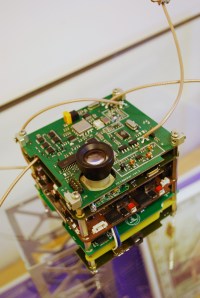
LituanicaSAT-1 Stack

LituanicaSAT-1 Stack

Your further reports will be very appreciated.

We still have strong hopes to turn on the FM transponder when things get better, for all you guys to try it.

73!
Laurynas Maciulis LY1LM
LituanicaSAT-1 systems engineer

The tiny satellite is just 10x10x10 cm with a mass of 1.090 kg yet it has a VGA camera and a 145/435 MHz FM voice transponder, designed and built by Lithuanian radio amateurs.

The prototype of the FM repeater has been operating in the home of its designer Žilvinas Batisa LY3H in Elektrėnai, Lithuania. Further information at
http://ly3h.epalete.com/?p=303

The communications payload comprises:
• FM Morse Code Beacon 437.275 MHz LY5N
• FM Voice Repeater 145.950 MHz uplink (PL 67 Hz CTCSS) 435.180 MHz downlink
• AX.25 Packet Radio 145.850 MHz uplink 437.550 MHz downlink 9600 baud FSK, FM

Links
• Submit reports at http://www.kosmonautai.lt/en/data-submission/
• Web Google English http://tinyurl.com/KosmonautaiLituanicaSAT-1
• Wiki Google English http://tinyurl.com/WikiLituanicaSAT-1
• Facebook https://www.facebook.com/Lituanicasat1