FUNcube-1 has arrived in Russia

The vital FUNcube-1 Add Before Flight (ABF) plug

The vital FUNcube-1 Add Before Flight (ABF) plug

The amateur radio FUNcube-1 CubeSat has arrived in Russia and is now en-route to the Dombarovsky launch site near Yasny.

A few small CubeSats in a large case being loaded into a special cargo hold

A few small CubeSats in a large case being loaded into a special cargo hold

It was flown on a special flight from Rotterdam on Wednesday, October 16 and cleared Russian customs on Thursday,, October 17. Another flight took it to Orsk from where it had a road trip of several hours before arriving at the launch integration facility at Yasny.

The only work that still needs to be completed before launch is a final battery charge up to 7.68 volts,  this is the best storage voltage this type of battery, and the final ABF “Add Before Flight” plug needs to be installed and glued in place.

This work will be done on site by Gerard Aalbers who has been a member of the FUNcube team from the beginning of the project.

FUNcube-1 communication subsystem:
• 300 mW Inverting linear transponder for SSB and CW
– Uplink      435.150 – 435.130 MHz
– Downlink  145.950 – 145.970 MHz
• 300 mW BPSK Telemetry  145.935 MHz (30 mW output when transponder active)

AMSAT-UK FUNcube Mission Patch Rev4 20100609

AMSAT-UK FUNcube Mission Patch

The Yasny Dnepr launch will carry more than ten spacecraft using the amateur satellite service and one of them, UniSat-5, will, itself, later deploy up to nine CubeSats and PocketQubes so there should be plenty of new signals to listen for after this launch.

Italian Microsat to Deploy Amateur Radio Satellites
https://amsat-uk.org/2012/05/25/italian-microsat-to-deploy-six-amateur-radio-satellites/

Battery Charger for FUNcube-1 https://amsat-uk.org/2012/05/25/italian-microsat-to-deploy-amateur-radio-satellites/

FUNcube Yahoo Group https://amsat-uk.org/funcube/yahoo-group/

FUNcube-1 has left the cleanroom

FUNcube-1 flight model - Image credit Wouter Weggelaar PA3WEG

FUNcube-1 flight model – Image credit Wouter Weggelaar PA3WEG

The exciting news is that FUNcube-1 CubeSat is now en-route to the Yasny launch site.

It was flown on a special flight from Rotterdam yesterday and it cleared through Russian customs this morning.

Well before the launch date, Dashboard software, to decode and display the telemetry, will be made available for download, this will function on any windows pc or laptop using either a Dongle or a 2 metre SSB capable receiver. Additionally a set of pre-launch keps will also be distributed.

This launch is expected to carry more than ten spacecraft using the amateur satellite service and one of them will, itself, later deploy up to nine CubeSats and PocketQubes so there should be plenty of new signals to listen for after this launch.

More info about FUNcube and some pictures can be seen here www.funcube.org.uk

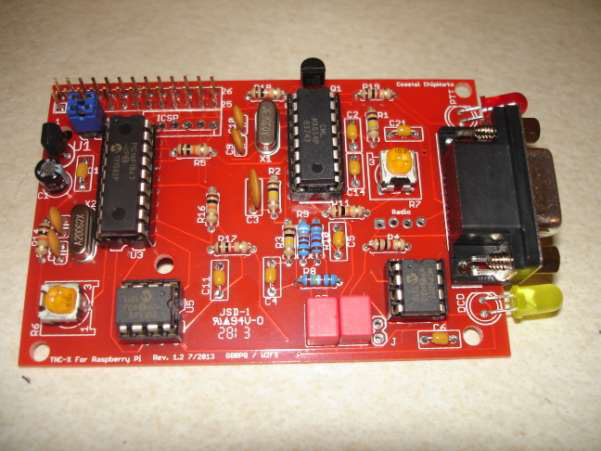
TNC-Pi Raspberry Pi Packet Radio Board

TNC-Pi kit built by Nick Bown 2E0CGW

TNC-Pi kit built by Nick Bown 2E0CGW

The TNC-Pi is a £22 ($40) KISS TNC board which is designed to connect to the GPIO port of the £25 ($35) Raspberry Pi computer board.

It provides a low cost means of using amateur radio AX.25 Packet Radio and APRS.

Nick Bown 2E0CGW has written a well illustrated review of the board. You can download the PDF from TNC-Pi by Nick Bown 2E0CGW

The TNC-Pi kit is available from http://tnc-x.com/TNCPi.htm

50DollarSat PocketQube Satellite

A Dnepr launch

A Dnepr launch

50DollarSat (A.K.A. $50SAT or Eagle-2) is a PocketQube micro satellite made from commercial electronic components and designed to fit in a 50 mm cube.

The primary purpose of the project was to create a cost effective platform for engineering and science students to use for developing real world skills. The PocketQube form factor has no precision mechanical parts and can be built from locally obtained sheet metal.

50DollarSat is comprised of two 40 mm x 40 mm circuit boards. The first is the processor/radio board which contains the PICaxe 40X2 processor programmed in PICaxe basic, the Hope RFM22B single chip radio and some peripheral devices. The PICaxe 40X2 is an easy to use micro controller popular in the education sector.

The second board is the power control and monitor board. This board contains four maximum power point controllers, one for each solar array on each side of the spacecraft as well as current monitors for the battery and summed solar power. The battery is a common 3.7V lithium ion camera battery.

The satellite will transmit data telemetry about the satellites operation, a sequence of call signs in slow FM Morse and some key data as fast FM Morse (120 WPM). The main data payload will also be transmitted as FSK RTTY which should be readily heard on the ground with basic amateur radio equipment.

50DollarSat (Eagle-2) has been a collaborative education project between Professor Bob Twiggs, KE6QMD,  Morehead State University and three other radio amateurs, Howie DeFelice, AB2S, Michael Kirkhart, KD8QBA, and Stuart Robinson, GW7HPW.

50DollarSat will be one of PocketQubes and CubeSats which will be carried by the UniSat-5 microsatellite. It is due to launch in November from a Russian Dnepr silo launched rocket at Dombarovsky near Yasny. UniSat-5 will be released into a sun synchronous 700km orbit. After deployment UniSat-5 will then release its CubeSats and PocketQubes.

50DollarSat http://www.50dollarsat.info/

HOPE RFM22B FSK transceiver http://www.hoperf.com/rf/module/fsk/RFM22B.htm

PICAXE-40X2 microcontroller http://www.picaxe.com/Hardware/PICAXE-Chips/PICAXE-40X2-microcontroller/

Italian Microsat to Deploy Amateur Radio Satellites
https://amsat-uk.org/2012/05/25/italian-microsat-to-deploy-six-amateur-radio-satellites/

CAMSAT DX Party October 19-28

CAMSAT CAS-2 at Friedrichshafen Ham Radio 2012 Event

CAMSAT CAS-2 at Friedrichshafen Ham Radio 2012 Event

CAMSAT developed the linear transponder amateur radio payload on the CAS-1 (aka XW-1, HO-68) satellite which proved very popular with radio amateurs world-wide. Since then they have been working with students at the Qian Youth Space Academy on the next satellites CAS-2 A1 and A2.

Operators BA1EO, BA1DU, BA4TA, BA4TB, BA4RN, BA4WI, BA4ALC, BH4RQU, BH4REQ, BD5RV, BA7CK, BA9GA, BA9TX, BD9GQ, and BG0GE will operate in the contest of the CAMSAT DX Party from the 19th to the 28th as BJ9TA (VHF, including the ARRL EME Contest (Oct. 26/27)) and as BY9GA/9 (HF, CQ WW DX SSB Contest).

Fan Shaomin BA1EO with CAS-2 A1

Fan Shaomin BA1EO with CAS-2 A1

QTH is Dunhuang, in the north-west (CQ zone 23).

QRV on 160m-70cm with 4 stations.

QSLs via Gong Wancong BA1DU

Gong Wancong BA1DU led the CAMSAT delegation to Ham Radio 2012 in Friedrichshafen.

A group picture taken at the CAMSAT and AMSAT-DL stands and a picture of the engraved glass plaque that CAMSAT presented to AMSAT-DL can be seen on the AMSAT Deutschland Facebook page at https://www.facebook.com/media/set/?set=a.420116544697800.90571.168177559891701&type=3

CAS-2A1 and CAS-2A2 Linear Transponder Amateur Radio Satellites
https://amsat-uk.org/2012/10/18/cas-2a1-and-cas-2a2-linear-transponder-amateur-radio-satellites/

Randy Hall K7AGE visited Beijing in March 2008. Among the people he met was Fan Shaomin BA1EO.

Watch Randy’s video which provides an insight into amateur radio in Beijing. BA1EO visit is at 12:55

Read more about Ham Radio in that part of the world from Larry’s, KH6ITY, article at ARRL – http://www.arrl.org/news/cq-china

High Altitude Balloon launch at BATC Convention

BATC Logo SmallThe British Amateur Television Club (BATC) convention takes place on the weekend of October 26-27 at the Finningley Amateur Radio Club facilities near Robin Hood airport in Yorkshire.

On the Saturday at 16:00 BST if the weather is suitable Philip Crump M0DNY will be giving a live demonstration of a High Altitude Balloon launch. There should be 3G Streaming Video at up to 1000 metres and possibly Slow Scan Digital Video (SSDV) images on 434 MHz above that altitude if the hardware is available in time.

Other highlights of the program include:

• 10 GHz ATV equipment and operation.
• Ku band LNB developments and the use of PLL LNBs on 10 GHz.
• How to get going on 437 MHz and 3.4 GHz DATV and experiences to date.
• HAMTV on ISS – introduction and how to receive it.
• Digital update – including the latest from the Digilite and DATV express teams.
• Narrow band modes below 432 MHz – presentation and discussion.
• Talk and demo of DTX1 transmitter system.

As well as the talks program, there will be plenty of time for meeting other ATVers from across the country and visit the other activities on site including:

• SMD soldering workshop where you can buy, build and test equipment – we will be selling kits for the G4DDK PGA103 amplifier (see CQ-TV 241).
• Demonstration area – featuring member’s demo including M0DTS showing his integrated MK808 Digilite system.
• Comprehensive RF test and measurement equipment up to 10 GHz.
• Selected RF and video suppliers.
• Members bring and buy area.
• Antenna test range (Sunday only & weather permitting).
• BATC shop with stock of all items currently on sale

The talks program and  agenda for the weekend has now been published see http://www.batc.org.uk/forum/viewtopic.php?f=74&t=3178

If you are coming to CAT13, please register on the Finningley Radio Club site see http://www.batc.org.uk/forum/viewtopic.php?f=74&t=3292

There will be a group dinner on Saturday night but you do need to book ahead with the hotel – so far no-one has emailed a menu request so the hotel are asking if they should cancel the booking!

See http://www.batc.org.uk/forum/viewtopic.php?f=74&t=3293 for details and also details on nearby hotels.

We look forward to seeing you all in 2 weeks time

Regards

Noel G8GTZ
On behalf of the BATC committee