UK radio ham’s Lunar CubeSat to go ahead

Pocket Spacecraft

Pocket Spacecraft

Michael Johnson M0MJJ gave a presentation on his Pocket Spacecraft: Mission to the Moon project to the AMSAT-UK International Space Colloquium held in July at Guildford.

Michael - Founder

Michael – Founder

He aimed to raise funding for the project by using the Kickstarter crowd-funding website.

The 60 fund raising period ended on August 26, 2013 and it fell short of target raising pledges for £69,079 ($107,735) out of the £290,000 ($452,284) goal. However, it appears that thanks to donations from other sources, the Pocket Spacecraft: Mission to the Moon is still going ahead.

Update #6 on the Kickstarter page says:

“More than 350 private individuals, universities and companies have backed the project via Kickstarter so far, but what we weren’t expecting are the amazing direct offers of financial support and support in kind that are too big or unable to be pledged via Kickstarter. Thanks to this support from private individuals, companies, government bodies, non-profits and others, we’re excited to be able to confirm that Pocket Spacecraft: Mission to the Moon will go ahead!”

Melania - Microgravity Experiment Lead

Melania – Microgravity Experiment Lead

The plan is that a 3U CubeSat will carry Pocket Spacecraft known as ‘Scouts’ to the Moon. A ‘Scout’ is a disk with flexible electronics, smaller than a CD, containing a transceiver, antenna and solar cells. The CubeSat should first release a batch of the wafer thin Scout satellites into Earth orbit and then deploy another batch of the Scout satellites into Lunar orbit.

It is understood the mission plans to use the 435 MHz and 2400 MHz bands.

The Kickstarter page says “If you are, or would like to be, a radio amateur, we’ll show you how to communicate directly with your spacecraft in space when it is nearby using inexpensive UHF and S-band equipment. Communication at (cis-)lunar distances is more expensive (typically requiring 5-24m+ steerable dishes), but available to some clubs and enthusiasts.”
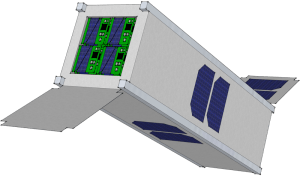
KickSat

KickSat

Pocket Spacecraft is believed to be the first UK satellite project to have used Kickstarter. Several USA satellite projects have already successfully raised money on Kickstarter:

Radio ham Zac Manchester KD2BHC used Kickstarter to raise $74,586 in donations to fund the development and deployment of 200 amateur radio KickSat sprite satellites expected to take place later this year.

Radio amateurs Jeroen Cappaert KK6BLQ, Joel Spark KK6ANB and Jonathan Oxer VK3FADO are on the team of the ham radio satellite project ArduSat. They managed to raise donations of $106,330 in just 30 days.
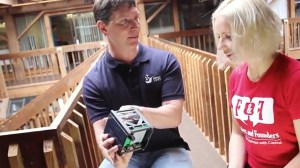
Tim DeBenedictis and Anna Vital with the SkyCube satellite

Tim DeBenedictis and Anna Vital with the SkyCube satellite

SkyCube which will transmit on 915 MHz in the 902-928 MHz amateur radio band raised $116,890.

Kickstarter is not just about raising large sums of money, for example Sandy Antunes used Kickstarter to raise $2,780 to buy a ham radio transceiver and antennas to create an amateur radio satellite ground station Calliope.

Read Pocket Spacecraft Update #6 at
http://www.kickstarter.com/projects/1677943140/send-your-own-pocket-spacecraft-on-a-mission-to-th/posts/576993

Kickstarter page http://www.kickstarter.com/projects/1677943140/send-your-own-pocket-spacecraft-on-a-mission-to-th/

Daily Mail article http://www.dailymail.co.uk/sciencetech/article-2352652/Now-send-personalised-spacecraft-moon-just-99–monitor-it-travels-space.html

UK stations wanted for FO-29 contacts with Cuba

Hector CO6CBF working Joe EI5EV on FO-29  2013-04-03 1440z

Hector CO6CBF working Joe EI5EV on FO-29 2013-04-03 1440z

Hector CO6CBF is looking for stations in UK to try contacts on the amateur radio satellite FO-29.

Currently when the satellite in apogee it has a big footprint which covers UK and Cuba for a few minutes.

Anyone wanting to try a contact with Cuba should email Hector on: co6cbf<at>frcuba.co.cu

FO-29 frequency information https://amsat-uk.org/satellites/fuji-oscar-29-jas-2/

Good News for CubeBug-1

CubeBug-1

CubeBug-1

The amateur radio satellite CubeBug-1, also known as El Capitán Beto, launched April 26, 2013, is recovering from the power budget issue that caused the transmitter to be turned off for several days.

This was achieved after one of the AMSAT-LU stations in coordination and in conjunction with Satellogic team, send a command to reconfigure onboard software to turn off attitude control circuits feeding magnetorquers this last weekend .

Telemetry text mode command taken before change can be seen at
http://www.amsat.org.ar/images/cubebug130818.txt

CubeBug - command sent shown top and satellite response below

CubeBug – command sent shown top and satellite response below

Operation was with a RTL SDR dongle, connected directly to antenna, using HDSDR recording software as IF mode only, that helped not to record big amount of data from Orbitron connected to DDE, also automatically compensating Doppler.

After reset, Cubebug-1 went to ‘mission state’, batteries showing adequate level of charge.

Good reports were received from several amateurs from different parts of the globe.

This activity is performed as part of the agreement of mutual collaboration that Satellogic and AMSAT-LU signed on July 2013.

The satellite transmits 1200 bps AFSK, on 437.438 MHz, packets are sent every 30 seconds. The signal is at a low level and a directional antenna and preamp are needed for adequate reception.

Cubebug-1 telemetry information at http://1.cubebug.org/coms/telemetry

73, LU7AA, AMSAT-LU
email: info at amsat.org.ar/
http://www.cetra.org.ar/
http://www.amsat.org.ar/
http://facebook.com/AMSAT.LU

CubeBug-1 carries a packet radio digipeater which it is hoped will be activated for amateur radio use when the primary mission has been completed. Further information at https://amsat-uk.org/satellites/cubebug-1/

APRS destination address for ham radio satellites

APRS LogoAPRS has standardized an ID series for amateur radio OSCAR spacecraft – APOxxx

At the request of Juan Carlos, LU9DO, AMSAT-LU wanted a series of APRS designators for uniquely identifying AMSAT APRS applications.  He suggested those beginning with the letter O for OSCARS.

ALL APRS applications include this identifier in their packets so that the source of APRS data can be known.  See the list at

http://aprs.org/aprs11/tocalls.txt

Bob, WB4APR

APRS UK Yahoo Group http://groups.yahoo.com/group/APRSUK

IARU-R1 release new VHF Handbook

IARU_Region_1_logoIARU Region 1 have released edition 6.12 of the free VHF Managers Handbook.

The handbook has chapters on Band Planning, Contests, Propagation Research, Operating Procedures and Satellites. It even defines a standard for the use of circular polarization defining which way helical beam antennas should be threaded.

Download the handbook – VHF_Handbook_V6_12.

Successful Dnepr launch from Yasny – amateur radio satellite launch to follow

Dnepr_rocket_lift-off

A DNEPR Lift-Off

On Thursday, August 22, 2013 at 14:39 UT Korea’s satellite KOMPSAT-5 launched on a Dnepr from Dombarovsky near Yasny. This marked the first flight of the Dnepr launcher since August 2011.

This successful Dnepr launch should clear the way for the launch in November of another Dnepr from Yasny believed to be carrying up to 23 satellites from 13 nations.

Most of the satellites will carry amateur radio payloads and it should be the largest single deployment of amateur radio satellites since the ill-fated Dnepr launch of July 26, 2006. http://www.southgatearc.org/news/july2006/dnepr_failure.htm

The launch had originally been planned for September 2012 but was postponed while the future of the Dnepr launch program was discussed.

ZACUBE-1 ready to be shipped to the Netherlands and from there to Yasny

ZACUBE-1 ready to be shipped to the Netherlands and from there to Yasny

Among the satellites carrying payloads operating in amateur radio bands that may be on the November launch are:
UniSat-5 microsat which will deploy Eagle-1, Eagle-2, QB-Scout, Wren and PUCP-SAT-1 which it turn should release a further satellite Pocket-PUCP
Delfi-n3Xt
• Triton-1
• Triton-2
• GOMX-1
FUNcube-1
• UWE-3
CubeBug-2
• BRITE-PL1
• Humsat-D
CPUT ZAcube-1
• HinCube
• BeakerSat
NEE-02 KRYSAOR (980 MHz)