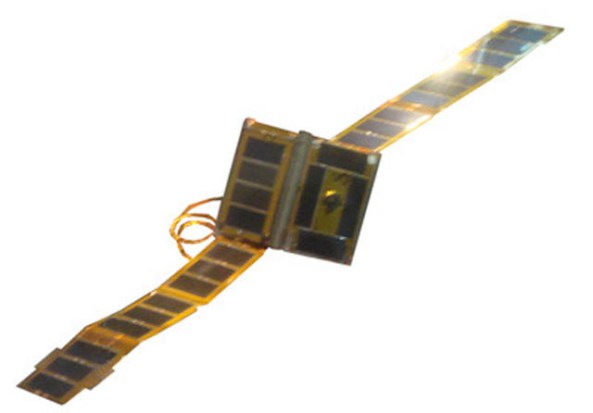
ESTCube-1 Tether Satellite hopes for Spring launch

Artists impression of ESTCube-1 in space - Image credit University of Tartu

Artists impression of ESTCube-1 in space – Image credit University of Tartu

Estonia’s first CubeSat ESTCube-1, amateur radio callsign ES5E/S, is planning to launch from Kourou in the Caribbean in the Spring on an ESA VEGA rocket.

Built by students at the University of Tartu ESTCube-1 the main mission of the satellite is to test electric solar wind sail technology, a novel space propulsion technology that could revolutionalize transportation within the solar system. It will deploy a 10 meter conductive electrodynamic tether and the force interacting with the tether will be measured.

The technology is based on the electrostatic interaction between the electric field generated by the satellite and the high-speed particles being ejected from the Sun.  A spacecraft utilizing this method would first deploy a set of electrically charged wires, which allow to generate an electric field over a large area. This area effectively forms a “sail” that can be pushed by the charged particles by being diverted by it and therefore transferring momentum to the craft.

The team also aim to capture images of Estonia for outreach purposes.

Continue reading

TeikyoSat-3 – Slime Mold from Space

Dictyostelium discoideum - Slime Mold - Image credit Freien Universität Berlin

Dictyostelium discoideum – Slime Mold – Image credit Freien Universität Berlin

Never before have images of Slime Mold growth been transmitted from space using amateur radio but students from Teikyo University plan to do just that with their TeikyoSat-3 satellite.

The TeikyoSat-3 team say “A slime mold is a microbe without a brain, its ecology has been studied by many research institutions with the expectation of applying the behavior of slime molds to network traffic and information technology. Our micro satellite, TeikyoSat-3, takes a picture of the growth process of the slime mold, dictyostelium discoideum, in space, and then transmits the pictures to Earth using amateur radio.”

Closer to the launch date they hope to release information to enable radio amateurs to receive the pictures of the slime mold directly from the satellite.

Pictures will also be released via the web which will enable people to identify the difference in motion of the slime mold in space and on the ground.

TeikyoSat-3 plans to have a 100 mW CW telemetry beacon and a 800 mW 1200 bps AFSK image data downlink on 437.450 MHz. More information is available from http://club.uccl.teikyo-u.ac.jp/~space_system_society/

It is planned to launch TeikyoSat-3 into a 400km 65 degree orbit on a Japanese H-IIA launch vehicle. While the TeikyoSat-3 website appears to indicate a 2013 launch the Wiki page 2014_in_spaceflight lists it as being on the same H-IIA flight as GPM-Core, STARS-II, KSAT2, OPUSAT, Invader and ITF-1 in June 2014.

TeikyoSat-3 site in Google English http://tinyurl.com/TeikyoSat

For further information on Japanese satellites with amateur radio payloads that are being built see
http://www.ne.jp/asahi/hamradio/je9pel/jaxa_gpm.htm
http://www.ne.jp/asahi/hamradio/je9pel/jaxalos2.htm

AMSAT-LU to launch amateur radio FM repeater to an altitude of 30 km

AMSAT-LU SSTV and GPS Payload

View of communications experiment: Below is the plate of the repeater. Top left is the SSTV camera and top right is the GPS receiver module. Image credit LU7AA

On Saturday, March 23 at 1400 UT AMSAT-LU plan to launch a High Altitude Balloon (HAB) carrying a 435.950/145.950 MHz FM repeater, a SSTV transmitter on 145.850 MHz and an APRS transmitter on 144.930 MHz.

The 145.850 MHz SSTV ROBOT-36 mode images will be transmitted in real time showing the view from the balloon. The images can be displayed by using free software such as MMSSTV.

Since 145.850 MHz is the input frequency for the amateur radio satellite SO-50, part of the experiment will be a link between the balloon and the satellite with SO-50 retransmitting the SSTV images on 436.7950 MHz over a far wider area.

At an altitude of 30 km the FM repeater, which uses a 123 Hz CTCSS tone, could have a range of up to 750 km.

AMSAT-LU have issued the following announcement:

Continue reading

Ecuadorian TV CubeSats pass qualification tests in the Netherlands

CubeSat NEE-01 Pegasus

CubeSat NEE-01 Pegasus – Image credit EXA

EXA Announcement: Guayaquil, March 13, 2013. – The Ecuadorian satellites NEE-01 PEGASUS and NEE-02 KRYSAOR passed all qualification tests for space flight and launch vehicle integration for the Chinese and Russian rockets and are now ready to take off the Ecuadorian Civilian Space Agency – EXA reported.

In February a joint team from the Ecuadorian government and EXA traveled to the Netherlands laboratories of spaceflight company ISIS / ISL who are managing the launch of the two CubeSats. NEE-01 and NEE-02 underwent qualification tests and passed these demanding tests smoothly.

Ronnie Nader with Elisse Nader and CubeSat

Ronnie Nader with Elisse Nader and CubeSat

A certificate was issued regarding acceptance and qualification of the satellites.

The EXA announcement said NEE-01 PEGASUS and NEE-02 KRYSAOR are the first CubeSats designed and developed entirely in Latin America, without help or support from abroad.

“This is a major milestone in our history and the history of the region, now our space technology is qualified for Russian and Chinese launch vehicles and to survive the space environment. The satellites passed the tests without any problems and now we await the launch of the first, the NEE-01 PEGASUS in the first half of May and the second in the latter half of July” said Ronnie Nader, Director of Space Operations EXA and leader of the team that designed and built the satellite.

Both satellites were designed and built by EXA engineers who donated their work voluntarily, the Ecuadorian Government financed the launch and testing.

EXA and the Ecuadorian government are engaging in ​​joint projects to ensure full utilization of the satellites, for both scientific and educational purposes.

NEE-02 Krysaor - Image credit EXA

NEE-02 Krysaor – Image credit EXA

The launch of the NEE-01 had been scheduled for November last year aboard a Russian Dnepr rocket, but the launch was postponed to July this year, and it was decided to launch NEE-01 on a Chinese Long March CZ-2D rocket The satellites had to meet the launch requirements of both vehicles, which was a skill level higher than previously achieved by the Ecuadorian engineers.

Source of text above: http://www.exa.ec/bp46/ translated by Google.

Each CubeSat is just 10x10x10 cm (1U) and they have fold-out solar panels which give a total span of 70 cm. They will each carry a 0.9 watt output 720p HD TV transmitter and a beacon which will send a Morse Code ID, a SSTV image and Ecuador’s national anthem. It is understood that NEE-01 will operate on 910 MHz in the 33cm band, an amateur radio allocation in a number of countries, while NEE-02 will be on 980 MHz.

Educational outreach is an important part of the project. The satellite signals will be received and decoded by the EXA HERMES-A ground station in Guayaquil and then uploaded live to the Internet using Facebook and Twitter; the first signal will contain text book questions and the second will contain an image related to the question. If the students are able to answer the question correctly they will be granted access to the video camera on board the spacecraft and will be able to see Earth from space as the astronauts see it in their space missions. More advanced students will have access to the pure radio signal so they can try decoding it by themselves.

EXA indicate NEE-01 Pegasus is expected to launch on a Long March CZ-2D rocket from the Jiuquan Space Center on April 26 at 0413 UT and NEE-02 KRYSAOR on a Dnepr rocket from Dombarovsky near Yasny in the second half of July 2013.

Two TV CubeSats from Ecuador https://amsat-uk.org/2013/02/14/two-tv-cubesats-from-ecuador/

New Swiss Small Satellite Launch System

Swiss Space Systems S3

Swiss Space Systems S3

Swiss Space Systems – S3 a new Swiss aerospace company, was officially inaugurated in Payerne on Thursday, March 14, in the presence of representatives of the national authorities and of prestigious Swiss and international partners such as the ESA, Dassault Aviation, the Von Karman Institute, Sonaca, Meggitt and Stanford University. S3 aims to develop, build, certify and operate suborbital space shuttles dedicated to launching small satellites, enabling space access to be made more democratic thanks to an original system with launching costs reduced to a quarter of the present cost. The first test launches are planned to be carried out by the end of 2017.

The Swiss Space Systems launch model uses an Airbus A300, an aircraft already certified for zero gravity flights, to take the shuttle up to 10,000m on its back; the shuttle will then be launched from there. Combining the internal architecture developed by the French company Dassault for Hermes with the external architecture developed by the Belgian companies Sonaca and Space Application Services will develop the shuttle. Discussions are at an advanced stage concerning the engine supplier. The shuttle-drone will take care of the next part of the ascent up to an altitude of 80km, the height at which the upper stage will be launched in order to put the satellites into orbit. Once this operation has been completed, the shuttle will return to earth by gliding towards its launch airport, where it will be taken care of by the maintenance teams who will prepare it for a new launch.

S3 say agreements have already been signed for four launches for the Von Karman Institute.

How will the in-orbit delivery of small satellites work ? Video at http://www.s-3.ch/home/2013/03/13/how-will-the-in-orbit-delivery-of-small-satellites-work

Swiss Space Systems – S3 http://www.s-3.ch/

Gathering of Female Astronauts and Former Johnson Space Center Director

Gathering of some Female Astronauts in memory of Sally Ride

Gathering of some Female Astronauts in memory of Sally Ride. Image credit NASA
Seated (from left): Carolyn Huntoon, Ellen Baker KB5SIX, Mary Cleave, Rhea Seddon, Anna Fisher, Shannon Lucid R0MIR, Ellen Ochoa KB5TZZ, Sandy Magnus KE5FYE.
Standing (from left): Jeanette Epps, Mary Ellen Weber, Marsha Ivins, Tracy Caldwell Dyson KF5DBF, Bonnie Dunbar KD5DCB, Tammy Jernigan KC5MGF, Cady Coleman KC5ZTH, Janet Kavandi, Serena Aunon, Kate Rubins, Stephanie Wilson KD5DZE, Dottie Metcalf-Lindenburger KE5DAT, Megan McArthur, Karen Nyberg, Lisa Nowak KC5ZTB
Photographer: Lauren Harnett

On September 17, 2012, 22 female astronauts, a number of them radio amateurs, along with Johnson Space Center’s first female director, Carolyn Huntoon, met to honor Sally Ride and her legacy.

Sally Ride - Image Credit NASA

Sally Ride – Image Credit NASA

Sally Kristen Ride was one of 8,000 people to answer an advertisement in a newspaper seeking applicants for the space program. As a result, she joined NASA in 1978. On June 18, 1983, she became the first American woman in space as a crew member on Space Shuttle Challenger for STS-7.

She was the president and CEO of Sally Ride Science, a company she co-founded in 2001 that creates entertaining science programs and publications for upper elementary and middle school students, with a particular focus on young women. The science books, student programs and professional development programs place a strong emphasis on gender and racial equality in the classroom and provide role models of working scientists, engineers and mathematicians who exemplify this diversity in their respective fields

Sally Ride wrote or co-wrote five books on space aimed at children, with the goal of encouraging children to study science.

She died on July 23, 2012, aged 61, seventeen months after being diagnosed with pancreatic cancer.

Wiki – Sally Ride http://en.wikipedia.org/wiki/Sally_Ride

Astronuat Sally Ride - Image Credit NASA

Astronuat Sally Ride – Image Credit NASA