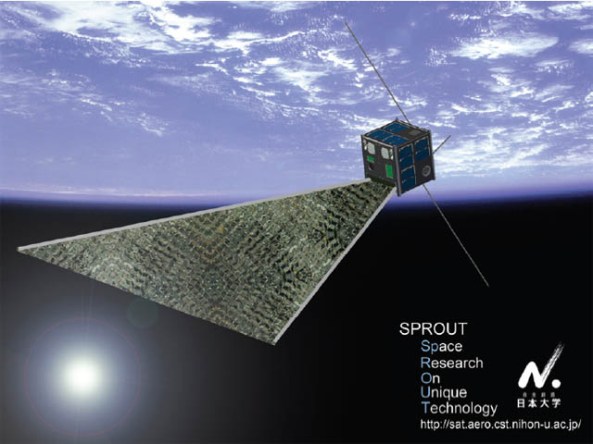
SPROUT Amateur Radio SSTV Satellite
SPROUT, a 20 x 20 x 22 cm amateur radio nano-satellite with a mass of 7.1 kg, plans to launch with the L-band (1236.5 MHz/1257.5 MHz/1278.5 MHz) Synthetic Aperture Radar (SAR) satellite ALOS-2 on May 24, 2014. [Updated May 19, 2014]
SPROUT (Space Research On Unique Technology) was built by students from Nihon University and its objectives are:
1. Operation of satellite by radio amateurs. SPROUT downlinks the digi-talker sound recorded preliminary in the satellite, the digi-peater voice and packet uploaded by radio amateurs, Slow Scan TV (SSTV) and FM packet of the picture of the Earth taken by the satellite camera, which can be received by radio amateurs. SPROUT has two downlink frequencies and two uplink frequencies, and one uplink frequency and one downlink frequency will be open for radio amateurs. They can use the digipeater and packet and use one camera mounted on SPROUT and take the pictures by themselves, and downlink the pictures by SSTV.
2. Demonstration of the deployment of the combined membrane structure and verification of the design method of the structure SPROUT has a triangular membrane supported by two tubes like framework. They are folded and stored in the satellite before the launch. After the launch, the nitrogen gas is injected into the tubes in space, and they extend, so that the membrane deploys (called “combined membrane structure”).
3. Demonstration of attitude determination and control of a nanosatellite Will conduct the attitude determination experiment on orbit by using the sun sensors, gyros, and geomagnetic sensor, and conduct the attitude control experiment by using the magnetic torquers.
It carries two UHF/VHF radio systems – one for Telemetry, Tracking & Control (TTC) using CW, 1200 bps AFSK and 9600 bps GMSK AX.25 packet and one for amateur operations using 1200 bps AFSK AX.25 packet.
SPROUT plans to launch from the Tanegashima Space Center into a 628 km Sun Synchronous Orbit (SSO) on May 24, 2014.
Callsign: JQ1ZJQ
Size: 214x210x220 mm
Weight: 7.1 kg
Mode: 1200bps AFSK, 9600bps GMSK
CW downlink 437.525 MHz
FM packet downlink 437.525 MHz
Digi-peater uplink 437.600 MHz
Digi-talker downlink 437.600 MHz
SSTV downlink 437.600 MHz
Sprout Satellite English website http://sat.aero.cst.nihon-u.ac.jp/sprout-e/
Sprout Satellite Japanese website http://sat.aero.cst.nihon-u.ac.jp/sprout/
Nihon-Univ. Miyazaki Laboratory on Facebook
https://www.facebook.com/pages/Nihon-Univ-Miyazaki-Laboratory/406566642818860
JE9PEL website http://www.ne.jp/asahi/hamradio/je9pel/jaxalos2.htm
Read the Overview of the L-band SAR Onboard ALOS-2 here.


 AMSAT-UK
You must be logged in to post a comment.