Rocket Science – Helen Sharman Interview

Helen Sharman GB1MIR was the first UK astronaut. On May 18, 1991, she flew to the Mir Space Station on board Soyuz-TM12, aged 27.

Before flying, Helen spent 18 months in intensive flight training in Star City on the outskirts of Moscow. The Soyuz TM-12 mission, which included Soviet cosmonauts Anatoly Artsebarsky and Sergei Krikalev, lasted eight days, most of that time spent at the Mir space station. Helen’s tasks included medical and agricultural scientific experiments, photographing the British Isles, and participating in an amateur radio hookup with UK schoolchildren.

Watch Rocket Science – Helen Sharman Interview

Since her return, Helen has become one of the UK’s leading ambassadors for science. She was awarded the OBE in 1992 and is a fellow of the Royal Society of Chemistry, the Royal Geographical Society, the Royal Aeronautical Society and the British Interplanetary Society. Helen has won numerous awards including the Medal “For Merit in Space Exploration” in 2012 from the Russian Federation government. Helen is currently Group Leader of Surface and Nanoanalysis at the National Physical Laboratory.

Summer OSCAR News in the Post

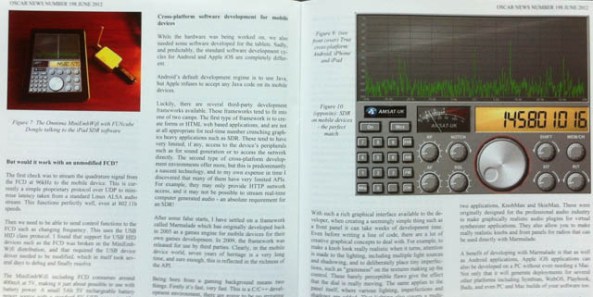
The 40 page Summer edition of the AMSAT-UK publication OSCAR News is being posted to members.

In this issue:

  • Development of High Voltage Technology Demonstration Satellite, HORYU-2
  • A Multi-purpose Portable Set-up: Working Low Earth Orbit Satellites from any place
  • AMSAT-UK International Space Colloquium Guildford Sept 15-16
  • Increase in ISS Debris Avoidance Manoeuvres
  • G3CVI column “Haven’t got a callsign?”
  • The FUNcube Dongle and the next generation
  • FUNcube Report June 2012
  • AMSAT-FOX
  • Listening to the ISS
  • ITAR – International Traffic in Arms Regulations
  • ESMO – European Student Moon Orbiter

You can get OSCAR News by joining AMSAT-UK online at http://tinyurl.com/JoinAMSAT-UK

AMSAT-UK is a voluntary organisation that supports the design and building of equipment for amateur radio satellites.

Reform of the Outer Space Act 1986: Consultation

The UK Space Agency has issued a public consultation seeking views of stakeholders on proposed changes to the Outer Space Act 1986.

This is in response to the Government Growth Review published in March 2011, in which the Government set out its wish to reform the Outer Space Act 1986 by introducing an upper limit on liability for UK operators.

The Outer Space Act covers all UK satellites irrespective of size, from tiny low cost educational CubeSats up to large commercial £500 million satellites.

The key aspects of the consultation are the proposals to waive the capped liability and insurance requirement for in-orbit operation of any satellite that meets the criteria of a CubeSat and to remove the requirement for unlimited indemnity from satellite operators.

The existing Outer Space Act imposes heavy additional costs (>£50,000 per annum) on those wishing to launch small educational CubeSats. The additional costs act as a major deterrent and to-date no such UK CubeSat has been launched.

The public consultation closes August 31, 2012.

Further information at
http://www.bis.gov.uk/ukspaceagency/news-and-events/2012/May/
reform-of-the-outer-space-act-1986-consultation

Satellite contact between Cuba and Alaska

Hector Martinez CO6CBF - 640

Hector Martinez CO6CBF

After many attempts, Hector Martinez CO6CBF in Cuba and Dale Pelzer KL7R in Alaska have achieved a contact between Grid Squares EL92sd and BP54xt using the amateur radio satellite FO-29.

Hector CO6CBF posted this report on the AMSAT Bulletin Board

Cubans cannot operate on AO-7 mode B, So FO-29 is our only opportunity for long contacts.

I cannot say how much time we tried but I am sure that it was more than 10 attempts. Dale did all the hard work, he drove around 4 miles from his home to a nearby hill. Majority of times he drove very late in the night.

All the SSB attempts failed. Today [Sunday, July 8] at 1920z was our first attempt on CW and it was successful!

Dale’s working conditions are a Yaesu FT-817 (only 5W semi-duplex) and ARROW antenna with  preamplifier. My working conditions are a majority homebrew setup, 10 elements Yagi on 2m and 18 elements Yagi for 70cm with a homebrew preamplifier.

Thanks very much to Dale for his constancy and effort!

PS: I continue looking for new grids and long contacts on satellite, if you are into any footprint with EL92sd and wan to try, please drop me an email [address at qrz.com]

73!
Hector, CO6CBF
EL92sd

New Cuban Amateur Radio Satellite Group formed http://www.uk.amsat.org/5454

FO-29 Information http://www.amsat.org/amsat-new/satellites/satInfo.php?satID=5

Download the article ‘Getting started on amateur radio satellites’ by John Heath G7HIA at https://amsat-uk.org/wp-content/uploads/2011/05/satellites_radcom_mar07.pdf
Copyright 2007 Radio Society of Great Britain. For personal use only – no copying, reprinting or distribution without written permission from the RSGB.

HORYU-2 Telemetry Operational

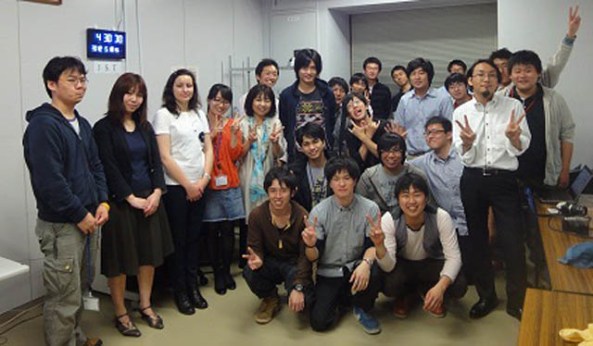
The HORYU-2 Team

On Tuesday, July 3, the amateur radio satellite HORYU-2 (call sign JG6YBW) recovered from the problems affecting the 437.375 MHz telemetry and the Blog indicates the team are now attempting to take pictures using the on-board camera.

Read the KIT HORYU Blog in Google English http://tinyurl.com/HORYU-Blog

HORYU-2 Japanese Operating Schedule in Google English http://tinyurl.com/HORYU-2-Schedule

Nano-Satellite “HORYU2”, built by students from the Kyushu Institute of Technology, was launched by JAXA from Tanegashima Space Center on May 18 with the Observation Mission “SHIZUKU” (GCOM-W1). The SHIZUKU observation images acquired by AMSR2 have been released.

JAXA press release
http://www.jaxa.jp/press/2012/07/20120704_shizuku_j.html (Japanese)
http://www.jaxa.jp/press/2012/07/20120704_shizuku_e.html (English)

HORYU2 operational status
http://kitsat.ele.kyutech.ac.jp/operation_schedule_japanese.html (Japanese)
http://kitsat.ele.kyutech.ac.jp/index_e_new.html (English)

UNISEC http://www.unisec.jp

OSCAR-7 DX Record Broken Again

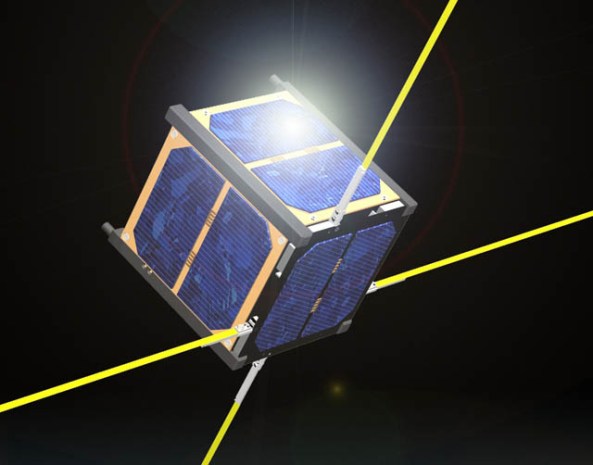
Artists impression of OSCAR 7 in Space

Artists impression of OSCAR 7 in Space

Independence Day, July 4, saw AC0RA and OM3BD set another world distance record using the amateur radio satellite AMSAT-OSCAR-7 breaking their own record set just 48 hours earlier.

OSCAR 7 amateur radio satelliteThe new distance record was 7903.55km comfortably exceeding the previous record of 7849km.

Bill OM3BD in Grid Square JN88mf reports that Wyatt AC0RA once again woke up early and this time drove 150 miles to EN41ad. They had a 30 second contact at 0949Z to extend the record to 7903.55km.

Bill’s equipment comprised an FT847, 2 x 10 element yagi on 2m with SP2000 preamp, and an 8 element Yagi for 70cm while Wyatt had an FT-847, a 7 element Yagi on 2 meters and a 12 element Yagi on 70cm.

Recordings, pictures, and further info at http://qsl.net/nz5n/AO7record.htm

The article “Guide To OSCAR Operating” that was published in “The Best of OSCAR News” Volume 1 in 1980 notes that the maximum theoretic range of AO-7 without propagation enhancements was expected to be about 7900 km. In some ways it’s surprising that it’s taken 37 years since the launch of AO-7 before the extremes of range were tested to their limits.

Previous OSCAR-7 DX record http://www.uk.amsat.org/8728

10th Anniversary of OSCAR 7′s Return To Life http://www.uk.amsat.org/8524

Oscar 7 Information https://amsat-uk.org/satellites/communications/oscar-7/

Video of 2E0HTS Working the OSCAR-7 Satellite
https://amsat-uk.org/2012/01/26/2e0hts-working-the-oscar-7-satellite/