CPUT satellite HF beacon – a new tool for radio amateurs.

In this monthly feature, Hans van de Groenendaal ZS6AKV, executive chairman of the South African Amateur Radio Development Trust (SAARDT), looks at various technologies and activities that drive amateur radio. SAARDT is dedicated to the development of amateur radio in South Africa with a special interest in the youth. The organisation is funded by donations and supports the South African Radio League and SA AMSAT.

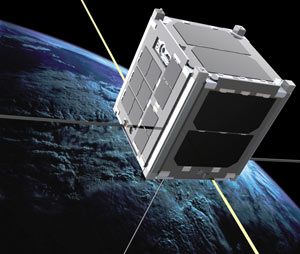
The two satellites being built by students of the Cape Peninsula University of Technology (CPUT) include a beacon operating in the 20 m amateur band. The first of the two is a single CubeSat 10 x 10 x 10 cm with a mass of one kilogramme.

While the single CubeSat will be dedicated to the Hermanus Magnetic Observatory science payload supporting the HMO operations in Antarctica, it will provide interesting antenna characterisation opportunities for radio amateurs.

The beacon operating on 14 099 kHz will be used for optimising the SuperDarn HF radar system operated by the National Space Agency Space Science (previously the Hermanus Magnetic observatory).

The electrically conductive upper layer of the Earth’s atmosphere (known as the ionosphere) sometimes connect directly to the solar wind. If there is a strong coupling then there is an increased chance that the space environment immediately surrounding our planet will be disrupted – the fast-moving solar wind blowing past the Earth can drag the polar ionosphere with it. Scientists use the SuperDARN radar system to measure how the ionosphere is moving above the polar cap by detecting echoes reflected by patches of electrically charged particles.

In our increasingly high-tech society, space research is becoming an important research area because some modern technologies, both in space and on the ground, are vulnerable to rapid changes in the space environment known as “space weather”.

Why satellite signals?

As with all radio systems phase characteristics change with time. The phase path through the system needs to be calibrated on a regular basis and this can be achieved by introducing another signal into the system and then measure the phase coming out.

As the CubeSat passes over the Antarctic it will be in full view of the radar antennas. Scientists will then measure the signal and determine what the phase difference is.

Ean Retief ZS1PR, a Cape Town radio amateur with a special interest in radio propagation, suggested that the signal be used for determining the coverage (beam) pattern of 20 m antennas. Currently obtaining a reasonable coverage pattern for an antenna takes a long time as testing with other radio amateurs introduces a number of variables such as variation in ionospheric propagation conditions (day to day, seasonal, time of the day and the stage of the sunspot cycle), different power levels of the distant stations and different antennas being used by the distant stations.

The CubeSat HF beacon will be a known unchanging (same output and same antenna) source and with a known flight path the angle and range of the cube-sat will be known for the entire traverse. Therefore the observer simply needs to note time and received signal strength every few moments.

A “lobe pattern” can be drawn for the particular path followed by the CubeSat during a pass. With three to six passes available daily a rough estimate of the antenna pattern can be estimated after only one day of monitoring.

After a week of observation it should be possible to draw quite a good “in situ” coverage pattern, as not only will the lobes of the antenna be recorded but also any local screening effects of mountains, hills and nearby buildings.

If the antenna is then modified in any way, the effects of such modifications will be easily detectable after observing a few passes.

Propagation research

The beacon signal can also be used for the study of various modes of propagation. Questions such as “how does an HF signal above the ionosphere behave during various times of the day and sunspot cycle” can be answered. Will it penetrate through the ionosphere as the layers change or will it travel along the upper layer before penetrating?

As monitoring of the CubeSat signal will only require a receiver with a “S” meter and an accurate clock, the possibility also exists for constructing simple antenna configurations at youth camps or schools. By re-orienting the antenna in direction or configuration (i.e. “straight” dipole versus “inverted-V”) the effect should be noticeable during the next pass of the CubeSat and will give quick “hands on” learning. Varying the height above ground will also show the change in pattern.

The beacon signal can also be used to demonstrate the different effects of different antennas. For instance it will show the difference in signal strength during different parts of a satellite pass between different antennas (i.e. dipole giving better results at higher elevation while vertical gives better result at lower elevation). Coupled with modern antenna modelling software it will give participants the “proof of the pudding” of what they saw on a computer screen.

A simple satellite beacon can be used for so many interesting experiments and activities and add new interest to amateur radio.

http://www.amsatsa.org.za/


Jay Leno – SAREX – Shuttle Amateur Radio Experiment 1992

In 1992 Southern California Amateur Radio operators uplinked a video of  stand-up comedian Jay Leno, host of NBC’s The Tonight Show, to the Space Shuttle Columbia through Jim Steffen, KC6A’s station in Long Beach, California.

Watch Jay Leno – SAREX Shuttle Amateur Radio Experiment 1992

Past SAREX Missions
http://www.arrl.org/files/file/ARISS/ARRLWeb_%2520Past%2520SAREX%2520Missions.pdf

Radio Amateur VK5ZAI on TV Show

Tony Hutchison VK5ZAI

Tony Hutchison VK5ZAI

This video shows Tony Hutchison VK5ZAI on the Channel 7 Today Tonight TV show talking about amateur radio and the ARISS schools program.

Tony Hutchison, VK5ZAI's ARISS Satellite Ground Station in Kingston SE. South Australia

The show provides some great insights as to how Amateur Radio can provide support for NASA as well as raise public awareness through the ARISS schools program.

Tony VK5ZAI has provided many Telebridge links for the International Space Station (ISS) to schools around the world. An ISS Telebridge contact is where a dedicated ARISS amateur radio ground station, located somewhere in the world, establishes the radio link with the ISS. Voice communications between the students and the astronauts are then patched over regular telephone lines.

Watch ARISS Tony VK5ZAI on Today Tonight

ARISS co-ordinator VK5ZAI receives NASA award http://www.southgatearc.org/news/march2008/vk5zai.htm

ARISS and Ham Radio Opportunities video http://www.uk.amsat.org/8099

Amateur Radio on the International Space Station ARISS http://ariss.rac.ca/

Auburn Students Successfully Command AubieSat-1

Reception of AubieSat-1 at K5QXJ

John Klingelhoeffer, WB4LNM, AubieSat-1 Technical Mentor at Auburn University Alabama reports that the satellite has been successfully commanded to change the transmission mode.

John says “A short message was received Saturday evening indicating that uplink commands sent to AubieSat-1 were properly received, decoded, and initiated additional telemetry downlink data.  AS-1 has been in orbit for about 9 months.  Stations are asked to continue to monitor the downlink and pass any received telemetry to the group here for dissemination.”

Watch Reception of AubieSat-1 at K5QXJ

AubieSat-1 was launched from Vandenberg AFB, California in October,  2011. The CubeSat is an undergraduate built satellite developed by Auburn University. Over the weekend of June 9-11 the AubieSat-1 controllers changed the transmission mode of the satellite to increase the quantity of telemetry. The increased telemetry rate will provide data to indicate how well solar cell protection is working. It should also provide additional onboard housekeeping information.

AubieSat-1 transmits with a power of about 800 milliwatts on a frequency of 437.475 MHz. The beacon signal, along with telemetry, is sent using A1A continuous wave Morse code at 20 words per minute.  Additional telemetry from the onboard science experiment will use CW transmissions up to 60 WPM.

Auburn University video about the AubieSat-1 project http://www.uk.amsat.org/2256

Auburn University AubieSat-1 http://space.auburn.edu/

Source ANS and AMSAT-BB

Status of ISS Ham Radio Operations

ISS Amateur Radio Project Engineer Kenneth Ransom, N5VHO reports the ARISS AX.25 digipeater has changed frequency from 145.825 MHz (up/down) to 437.550 MHz (up/down). The same digi alias ARISS is still used.

This change was started with the docking of the ESA Automated Transfer Vehicle (ATV). The ATV is an expendable, unmanned resupply spacecraft delivering propellant, water, air, payloads and experimental supplies to the International Space Station (ISS).

International Space Station

International Space Station

Packet radio operations were moved to the Columbus Module UHF radio when the Kenwood D700 radio was recently powered off due to needing an  additional air purifier to support the ATV. Normally the air purifier is located in the ATV but recent power support issues related to the ATV and ISS necessitated the system be relocated to the Service Module.

The purifier is now using the power outlet that the Kenwood radio normally uses. The Russian team has agreed to briefly power the purifier off for the scheduled ARISS school events but then will re-activate the purifier right afterwards. This appears to be a long term impact as ATV is currently scheduled to depart from ISS in September.

ARISS and Ham Radio Opportunities Video http://www.uk.amsat.org/8099

Amateur Radio on the International Space Station ARISS http://ariss.rac.ca/

SO-67 Recovery Work Continues

SA AMSAT say there is still a recovery opportunity for the amateur radio satellite SumbandilaSat (SO-67).

The team at SunSpace are still incrementally reading back the program code from the nine power modules in an effort to determine the extent of the corruption. With SumbandilaSat going through eclipses, the satellite is not as much available as the team would like. SumbandilaSat’s batteries failed which means that the satellite is only active when the solar panels are illuminated.

“We need the information to confirm that the changes we made to stop repeated corruption were effective.” Johann Lochner ZR6CBC who spends a considerable amount of his free time on recovery of SumbandilaSat said. “It is our aim to ultimately reprogram one of the power modules to automatically switch the amateur radio transponder on and off.”

Because of the shorter illumination of the solar panels in the Southern hemisphere and most likely poor orientation of the satellite with respect to the sun, progress is much slower than originally anticipated. “Where we had three passes to work with in January we currently have one”, Johann said.

In early June 2011 for an unknown reason (but probably related to a major radiation event on 7 June) the primary controller on the power distribution unit (PDU) powering the On-Board Computer (OBC) stopped responding to commands from the ground station.

It later appeared that the battery had failed and nothing was heard  from the satellite for some time. The ground stations at SANSA Space operations at Hartbeeshoek and the Electronic Systems Laboratory at Stellenbosch University are receiving telemetry when the satellite’s solar panels are illuminated by the sun.

Johann said with SumbandilaSat responding when it is in full sunlight the team is confident that some operations will be restored even to the point where it may be possible to do some imaging and have the amateur radio transponder back in operation.

Source AMSAT News Service ANS

Southern African Amateur Radio Satellite Association SA AMSAT http://www.amsatsa.org.za/