Radio Amateur Encourages Engineering as a Career

Ali Guarneros Luna KJ6TVO has been involved in the development of the amateur radio CubeSat TechEdSat. In this video she talks to teenagers at a Careers Night about her aspiration to become an engineer.

Watch Career Night – Ali Luna

Ali Guarneros Luna KJ6TVO was born in Mexico City and now lives in San Jose, California. She received her BS in Aerospace Engineering at San Jose State University in 2010 and will complete her MS in Aerospace Engineering from San Jose State University in 2012.

She currently works with the Edison Program, Small Spacecraft Payload and Technologies (SSPT) and SPHERES National Lab at NASA Ames Research Center. Under the Edison Program, Ali works on development of CubeSat projects, including TechEdSat, as the System Engineering, Mission And Ground Operations, and Launch Vehicle Service expert.

Under the Small Spacecraft Payload and Technologies Program, Ali works as Engineering Support for different missions, most currently in NLAS. At SPHERES National Lab, Ali works as Engineer support for Ground Lab and Operation Support.

RAX-2 Success – Anomaly Detected

RAX-2 Detects Comms-Disrupting Anomaly

RAX-2 Detects Communication-Disrupting Anomaly http://rax.sri.com/

Matt Bennett KF6RTB reports that the amateur radio CubeSat, Radio Auroral Explorer 2 (RAX-2), has detected the communication-disrupting anomaly in the upper atmosphere it was searching for. The team have expressed their thanks to the amateur radio community.

RAX-2 was built by students at the University of Michigan. The primary objective of the mission is to use the onboard radar receiver in conjunction with a powerful radar station in Alaska to study the formation of a plasma anomaly known for causing the scintillation of radio signals in the UHF and higher bands. This scintillation effect is known to inhibit our space radar tracking capabilities and ground-space communications. Studying this anomaly in this bi-static radar configuration (ground based transmitter, space-base receiver) will provide scientists with a better understanding of these anomalies that has not been achievable with ground radars alone.

Late on Friday, March 9, Matt KF6RTB announced the news:

This is unbelievable!! After more than three years of hard work and dedication by my team and professor at Michigan, our chief scientist confirmed today that the RAX-2 spacecraft we designed, built, and launched into space has detected the communication-disrupting anomaly in the upper atmosphere that we’ve been looking for!! Cheers guys, we did it!!! GO guys, we did it!!! GO BLUE!!!! [Michigan Athletics battle cry]

The RAX Team would like to acknowledge and say thank you to the amateur radio satellite community for all of their support on this mission. We’ve really enjoyed interacting with fellow operators while collecting and analyzing telemetry. We’ve also learned a great deal about satellite operations from each other.

RAX-2: 437.345 MHz, 9600 bps GMSK http://rax.engin.umich.edu/

Mission Science Operations http://rax.sri.com/

RAX on Facebook http://www.facebook.com/RadioAuroraExplorer

2010 – RAX-1 CubeSat launch announcement http://www.southgatearc.org/news/november2010/rax_launch.htm

2011 – RAX-2 CubeSat Launch http://www.southgatearc.org/news/october2011/successful_amateur_cubesat_launch.htm

ISS Symposium 2012 “Research in space for the benefit of humankind”

Radio amateur Andy Thomas G0SFJ has been invited to the ESA ISS Symposium 2012 to be held in Berlin, May 2-4.

The Symposium aims to review and discuss the key accomplishments in research made to date, looking at case-studies in fundamental and applied research and the actual or potential spin-offs for the benefit of humankind, as well as to discuss the future path and priorities for research on ISS.

The Symposium will take place at the Hilton Hotel in Berlin, Germany, starting at 13h00 (after lunch) on Wednesday, May 2, and will run until around 13h00 on Friday, May 4, 2012. Attendance will be free of charge for all invited and registered guests.

ESA ISS Symposium http://www.isssymposium2012.com/

The Hindu – Hams Engineering Success

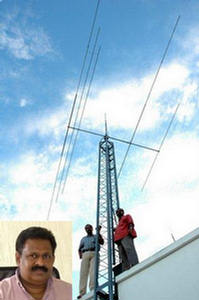
The Hindu newspaper reports on K. G. Girish Babu VU2KGB who uses computerised antenna design for VHF and UHF wireless communication. He helped his son Rahul make an antenna, the largest in India, which can track amateur radio satellites.

He says he also designed and manufactured the entire ground station antenna and structures for the experiments jointly conducted by the German Aerospace (DLR) and Indian Space Research Organisation (ISRO).

Wireless communication always fascinated him. He made a wireless transmitter while studying in class eight, for the science exhibition. “Thanks to my teacher Rajan and the wonderful chemisty and physics lab at our school (Government HS, Chavakkad). He always encouraged my experiments and brought me copies of Science Today magazine.”

While in college, (St Albert’s, Kochi), “I, along with a friend, rigged up a wireless transmitter. We didn’t know that it was illegal. When some issues came up, we hid the equipment,” he remembers.

In 1979, he cleared the examination to obtain his Grade I amateur radio operator licence with the call sign VU2KGB. His wife, A. Maya Shankar, is licenced at VU2CIA.

Read the full The Hindu story at http://www.thehindu.com/life-and-style/money-and-careers/article2974047.ece

Connecting Students with Space

The GENSO project features in an article in the February 2012 edition of the free magazine ESA Bulletin.

GENSO is a worldwide network of education and amateur radio ground stations linked together via the internet.

Student satellite teams can normally only gather around 20 minutes of data per day from their satellite using their own ground station. GENSO will give them free access to potentially hundreds of stations around the globe and increase their data return to many hours per day. It will also allow them to command their spacecraft from the other side of the world.

A team from AMSAT-UK supported this project by developing a standard ground station specification together with a full set of software drivers for the different hardware items.

The software development was carried out in a cooperative effort of students and radio amateurs worldwide.

The 2008 AMSAT-UK International Space Colloquium featured a demonstration and presentations on GENSO.

The five page article starts on page 39 and the amateur radio stations of Graham Shirville G3VZV, Dave Johnson G4DPZ and David Mynatt KA0SWT get a brief mention on page 43. Read the ESA Bulletin online at

http://esamultimedia.esa.int/multimedia/publications/ESA-Bulletin-149/

AMSAT-UK and ESA co-operation on GENSO
http://www.southgatearc.org/news/november2007/amsat_esa_genso_cooperation.htm

GENSO http://www.genso.org/

Astronaut's Flashing Success

Blue Laser Flash seen from ISS

Light (top center) flashed from the Lozano Observatory, about 40 miles north of San Antonio, was easily visible from orbit. Click on the image to see it full-sized.

Radio amateur and ISS astronaut Don Pettit KD5MDT describes how he succeeded in receiving signals on a frequency of 650 THz.

Flashing the International Space Station with beams of light as it passes overhead had never been successfully done—until now.

It sounds deceptively easy. In an earlier post I wrote about the technical requirements. But like so many other tasks, it becomes much more involved in the execution than in the planning.

Early Sunday morning, at 01:27 our time, the San Antonio Astronomical Association, an amateur astronomy group, succeeded in flashing space station with a one-watt blue laser and a white spot light as we passed overhead. This took a number of engineering calculations. Projected beam diameters (assuming the propagation of a Gaussian wave for the laser) and intensity at the target had to be calculated. Tracking space station’s path as it streaked across the sky was another challenge. I used email to communicate with Robert Reeves, one of the association’s members. Considering that it takes a day, maybe more, for a simple exchange of messages (on space station we receive email drops two to three times a day), the whole event took weeks to plan.

I was ready with cameras for the early morning San Antonio pass and can report that it was a flashing success. Here’s one of the pictures to prove it.

Don Pettit KD5MDT