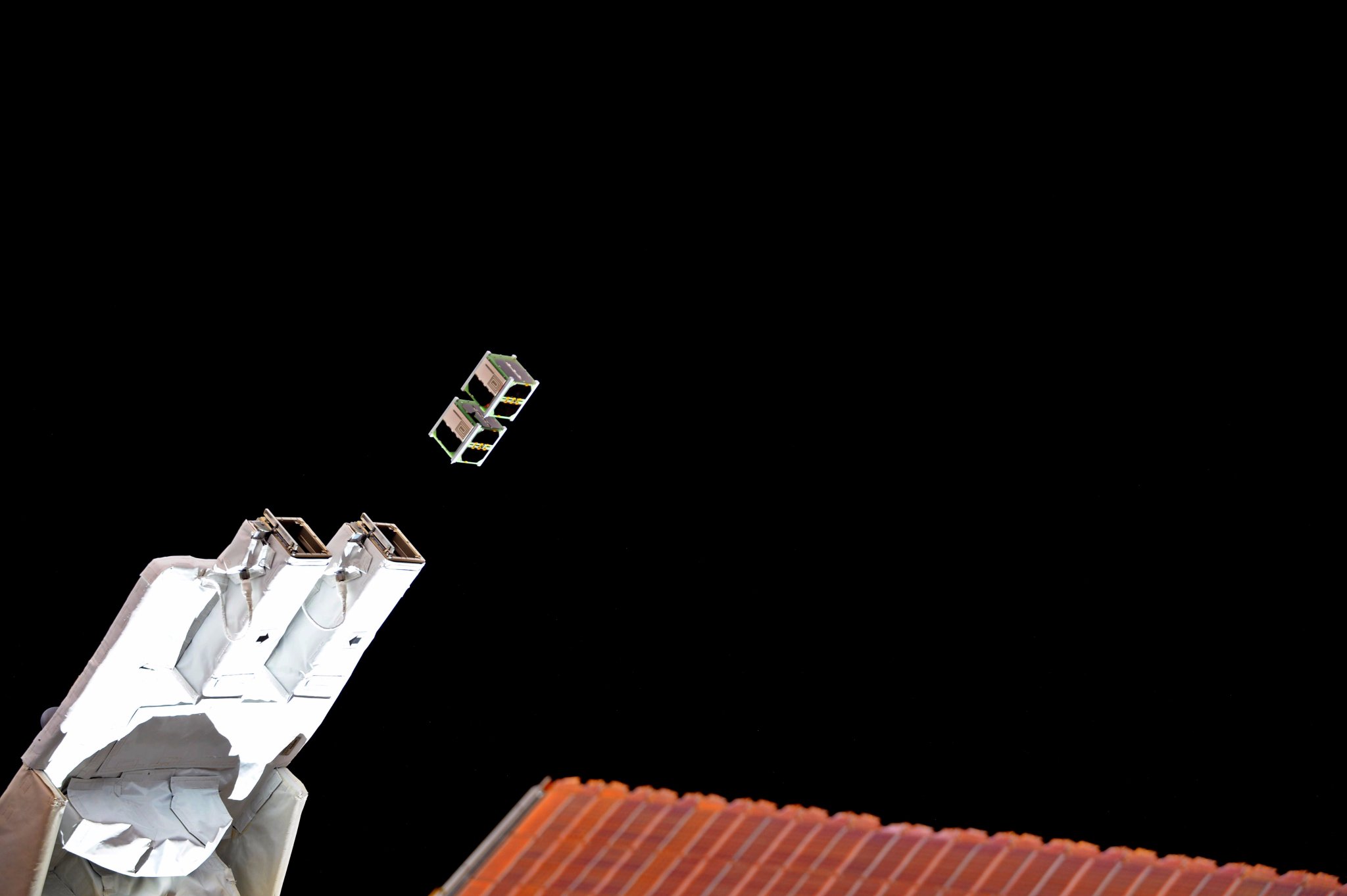
BIRDS-1 constellation of five CubeSats deployed

BIRDS-1 CubeSat Constellation Deployment

BIRDS-1 CubeSat Constellation Deployment

On Friday, July 7, 2017 five CubeSats carrying amateur radio payloads were deployed from the Japanese Kibo module on the International Space Station.

ISS astronaut Jack Fischer KG5FYH @Astro2fish tweeted:
Another great example of International Cooperation today on @Space_Station –launched 5 micro-satellites from 5 countries off the JAXA arm!

The BIRDS-1 constellation consists of five 1U CubeSats (BIRD-B, BIRD-J, BIRD-G, BIRD-M and BIRD-N). They launched to the ISS on a SpaceX Falcon 9 CRS-11 on June 3, 2017. The satellites are made of the exactly same design and use the same amateur radio frequency.

The main mission of the constellation is to do experiments on radio communication with a CubeSat constellation via a network of UHF/VHF amateur radio ground stations all over the world.

BIRDS CubeSat NationsThe challenge is to distinguish each satellite from the others sharing the same transmit frequency, hand over operation of a satellite from one ground station to another and assemble the satellite data, such as housekeeping telemetry, music and the Earth images, obtained at different ground stations.

Amateur radio enthusiasts are asked to join the network to assist in the data downlink and reconstruction of the patchy satellite data into one meaningful data. Orbit information and operational plan of each satellite will be made available to the amateur radio community in the world. Software to decode the satellite data will be also made available.

The respective amateur ground stations that can successfully decode the telemetry data, music and the Earth images, shall receive a QSL card from the BIRDS team.

The data reconstructed by the effort of the amateur ground station network will be made public to share the sense of satisfaction and achievement.

BIRDS CubeSat Project LogoA particularly interesting mission of BIRDS project is the SNG mission that exchanges music via a digi-singer. It is an outreach-oriented mission. First, music in MIDI format is uploaded from ground. Then the MIDI file is processed on-board using a vocal synthesizer. Finally, the processed music is sent back to Earth using UHF antenna as voice FM data.

During organized events on space utilization with schools or general public, music could be heard using a common hand-held receiver and hand-made Yagi antenna positioned to track the satellite at each given pass over the region. This has a tremendous effect on awareness of radio communication among school children and general public, especially in the countries participating in the BIRDS project, Japan, Ghana, Mongolia, Nigeria and Bangladesh.

The satellites transmit CW on 437.372 MHz and 9k6 FSK, 1k2 AFSK FM, audio FM and 9k6 GMSK downlinks on 437.375 MHz.

A QSL is issued for a reception report. Please check the BIRDS web site.
http://birds.ele.kyutech.ac.jp/amateur.html

BBC News has a story about one of the satellites GhanaSat-1 (BIRDS-G, ANUSAT-1)
http://www.bbc.co.uk/news/world-africa-40538471

BIRDS-1 CubeSat Constellation
https://amsat-uk.org/2017/07/01/birds-1-cubesat-constellation-deployment/
https://amsat-uk.org/2016/08/11/ham-radio-birds-constellation/

BIRDS-1 CubeSat Constellation Deployment

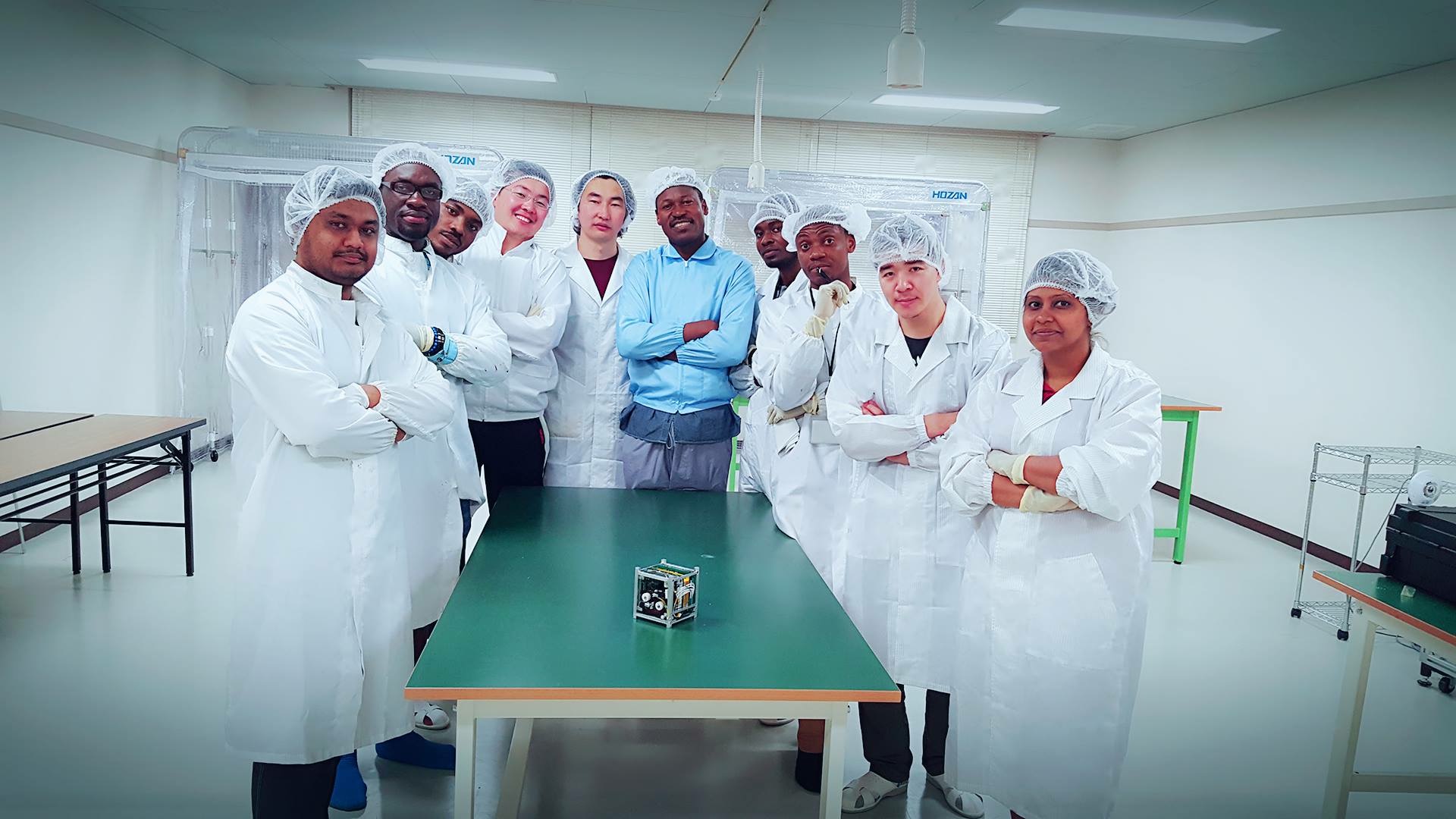
BIRDS CubeSat Engineering Model integration test

Masahiro Arai JN1GKZ reports the BIRDS Project Newsletter Issue No. 17 shows the deployment of five amateur radio BIRDS-1 CubeSats from ISS is planned for July 7, 2017.

The IARU reports the satellites will be using CW, 1k2 AFSK FM, audio FM and 9k6 GMSK downlinks on a coordinated downlink frequency of 437.375 MHz.

On the AMSAT Bulletin Board Masa JN1GKZ writes:

The schedule is:
Time        Satellites                       Location
#1 0900z BIRD-J, BIRD-G, BIRD-M over Fance
#2 0930z BIRD-N, BIRD-B              over the south Indian ocean

BIRD-B (BRAC Onnesha) :Bangladesh
BIRD-G (GhanaSat-1, ANUSAT-1):Ghana
BIRD-J (Toki) :Japan
BIRD-M (Mazaalai, NUMSAT-1) :Mongolia
BIRD-N (EduSat-1) :Nigeria

A QSL is issued for a reception report. Please check the BIRDS web site.
http://birds.ele.kyutech.ac.jp/amateur.html

Live broadcast of the deployment is planned by JAXA.
https://www.youtube.com/watch?v=sP5YZi5usHc

BIRDS Project Newsletter Issue No.17
http://birds.ele.kyutech.ac.jp/files/BIRDS_Newsletter_Issue_No_17.pdf

73 Masa JN1GKZ Tokyo Japan

Amateur Radio BIRDS-1 CubeSat Constellation
https://amsat-uk.org/2016/08/11/ham-radio-birds-constellation/

Russian Satellites Tanusha 1 and 2 set for Activation

A Tanusha CubeSat

Two Russian satellites are planned to be activated inside the International Space Station (ISS) Russian Segment as part of a verification test from July 4-8.

International Space Station – Image Credit NASA

The satellites will eventually be deployed by hand from the ISS during a Russian space walk tentatively scheduled for August 17, 2017.

The satellites Tanusha 1 and Tanusha 2 [спутники Тануша 1/2] FM transmissions on 437.050 MHz, will be downlinked at 145.800 MHz FM. Transmissions from Tanusha 1 should begin around 18:30 UT on July 4. Transmissions will cease on July 6 from 08:20 till 18:00 UT to allow the satellites to be swapped out. Tanusha 2 will then be activated beginning on July 6 around 18:00 UT and continue until July 8 at 10:30 UT.

The satellites will broadcast greeting messages in Russian, English, Spanish and Chinese. More details will be made available on the Southwest Western State University site at https://www.swsu.ru/

Source ARISS

Greeting messages recorded from Tanusha-1 from inside the ISS
https://chertseyradioclub.blogspot.co.uk/2017/07/thersgb-hamradio-amsat-pic.html

Greetings messages from Tanusha-2 from inside the ISS
https://chertseyradioclub.blogspot.co.uk/2017/07/greetings-messages-from-tanusha-2-from.html

The satellites are also referred to as Tanyusha-SWSU 1 & 2, or Tanyusha-YuZGU 1 & 2, or Танюша-ЮЗГУ 1 & 2, or Radioskaf 6 & 7 (RS6S, RS7S) http://space.skyrocket.de/doc_sdat/tanyusha-yuzgu-1.htm

Tomsk-TPU-120 was launched to the ISS in 2016. It is reportedly very similar to Tanusha-1 and there is a possibility it may be deployed with the Tanusha CubeSats during the Russian spacewalk (EVA) around August 17 https://amsat-uk.org/2016/12/29/tomsk-tpu-120-eva-deployment/

Southwest Western State University SWSU in Google English http://tinyurl.com/RussiaSWSU

Listen to the ISS using an Online Radio – Select Frequency of 145800.0 kHz and Mode FM
• SUWS WebSDR when ISS in range of London http://websdr.suws.org.uk/
• R4UAB WebSDR when ISS is over Russia

How to hear the ISS https://amsat-uk.org/beginners/how-to-hear-the-iss/

IARU Aligns Satellite Coordination Guidelines with ITU WRC-15 Decisions

As the global federation of national associations of radio amateurs in more than 150 countries, the International Amateur Radio Union (IARU) for many years has provided frequency coordination services for amateur satellites free of charge.

Often these satellites are constructed by students at universities and other institutions as a part of their educational experience. In general, they have been licensed to operate in the amateur-satellite service, which is defined by the Radio Regulations of the International Telecommunication Union (ITU) as having the “…purpose of self-training, intercommunication and technical investigations carried out by amateurs, that is, by duly authorized persons interested in radio technique solely with a personal aim and without pecuniary interest.”

Some administrations have issued experimental licenses for such satellites operating in amateur-satellite frequency bands. The IARU has coordinated these satellites as well, to reduce the possibility of harmful interference that might result from uncoordinated operation. Since 1 July 2014 it has not been possible to coordinate experimental satellites in the 144-146 MHz band because of the high probability of harmful interference in this heavily used band.

Educational satellite projects have grown in popularity as launch opportunities have increased. In 2012 the ITU World Radiocommunication Conference took note of the proliferation of what in Resolution 757 (WRC-12) it called “nanosatellites and picosatellites” and invited WRC-18 (now scheduled for 2019) to consider steps to facilitate their deployment and operation. Two Reports, ITU-R SA.2312 (09/2014) and ITU-R SA.2348 (05/2015), are instructive regarding the characteristics, definitions, spectrum requirements, and notification procedures of and for such satellites, which generally must use spectrum below 1 GHz for operational reasons.

At the following WRC in 2015, in place of Resolution 757 the Member States of the ITU adopted Resolution 659 (WRC-15) in which it was noted that the use of 144-146 MHz and 435-438 MHz by non-amateur satellites is not in accordance with the definition of the amateur-satellite service in the Radio Regulations. Resolution 659 cites the two reports mentioned above and makes it clear that the spectrum needs of what are now called “non-geostationary satellites with short duration missions” should be met either within the service in which the space station is operating or within the space operation service. Further, if new or upgraded allocations to the space operation service are required, studies should be limited to the frequency ranges 150.05-174 MHz and 400.15-420 MHz.

Accordingly, effective 1 August 2017 the IARU will be following revised guidelines for satellite frequency coordination.

The strong preference is for all satellites using spectrum allocated to the amateur and amateur-satellite services to operate under amateur licenses and within the definition of the amateur-satellite service and the service-specific Article 25 of the Radio Regulations. The IARU believes the definition is sufficiently broad to encompass nearly all educational satellite projects that include giving students hands-on experience with radiocommunication and are conducted under an amateur license.

The IARU will only coordinate a non-amateur satellite if an administration directs in writing that it be operated in an amateur-satellite band under an experimental or other non-amateur license.

Satellites with combined amateur and non-amateur missions will continue to be coordinated.

IARU Satellite Frequency Coordination http://www.iaru.org/satellite.html

IARU Satellite Coordination Status pages http://www.amsat.org.uk/iaru/

UBSEDS25 balloon has Slow Scan Digital Video

UBSEDS18 Solar Powered Balloon

Bristol students plan to transmit 434 MHz Slow Scan Digital Video (SSDV) from the UBSEDS25 solar powered high altitude balloon planned to launch on Saturday, July 1.

On the UKHAS Google Group Richard Meadows M0SBU from University of Bristol Students for the Exploration and Development of Space (UBSEDS) writes:

We’re planning a launch from Bristol this Saturday, July 1 between 0500 and 0530 BST. This is weather permitting, but the forecast currently looks okay.

This flight is similar to the previous UBSEDS24, except with some bug fixes and adjustments. It’s using a 1.9m envelope and longer payload train, and so there’s a NOTAM in place. This tracker has a Raspberry Pi Zero V1.3 attached, which transmits images when solar power is available. It’s a different design to our launch last August; in this case the tracker will continue to operate even if the pi fails. For the curious the ‘pi status’ telemetry values are: 0 = off, 1 = on, 2 = PITS started, 3 = SSDV started).

There will hopefully be a cutdown mounted between the balloon and the tracker. We’ll be testing the 434MHz uplink whilst it’s still in range of Bristol; if it returns over the UK at a convenient time and place we will attempt to trigger the cutdown.

The tracker has a variety of transmissions:

• 434.635 MHz USB Telemetry:
– Contestia 16/1000 with pips and RSID, transmitting telemetry. Once per minute below 8km altitude and every two minutes otherwise.

• 434.637.5 MHz SSDV:
– Usually 300 baud RTTY, 850Hz shift, 8N2.
– GMSK within 100km of Bristol and Farnham as marked on the attached map:
– GMSK at 12 ksymbol/s. 4×4 interleaved, R=1/2 convolutional K=5, HDLC framing, whitened etc as per the AX5043 manual. Concatenated with RS(255,223) to mop up some burst errors.

If you are listening to the RTTY, remember to turn off the ‘RxID’ button on the top right of dl-fldigi.

Rather than the usual JPEG SSDV, this is transmitting Better Portable Graphics (BPG) images. This is experimental, and ssdv.habhub.org doesn’t support it just yet. Hence receivers should instead upload to
http://ssdv.bristol-seds.co.uk/

Please read the instructions on this site. You’ll need dl-fldigi release 3.2, as explained on the site. The dl-fldigi release can be found here:
https://github.com/jamescoxon/dl-fldigi/releases/tag/3.2

The flight is expected to head south-east towards France. Many thanks to everyone who attempts to track this.

Richard Meadows M0SBU
Bristol SEDS http://www.bristol-seds.co.uk/

Launch date/times are always subject to last-minute changes, check the UKHAS Google Group for updates.

Useful High Altitude Balloon links for tracking etc https://amsat-uk.org/beginners/balloons/

Join New Zealand’s Most Exciting Amateur Radio Project – KiwiSAT

KiwiSat - AMSAT-ZLYes, we’re going into space and you can be part of it!

AMSAT-ZL has reached a staging point in the development of their satellite project, KiwiSAT.
We’re ready to go, ready to get up there!

The exciting KiwiSAT project, to create and launch a New Zealand produced satellite, started
several years back. Yes, it has suffered innumerable set-backs, relying heavily on assistance
from our American brothers and sisters, a reliance cut off mid-stream by USA moves on ITAR
(International Traffic in Arms Regulations). Right then the work was well advanced but based
on the USA standards and criteria. Suddenly the development was back to square one,
requiring redesign of almost everything.

The KiwiSAT Team met that challenge and has produced a fine unit ready to launch. Then
came another set-back. Our critically important Leader of the KiwiSAT Engineering Team,
Fred Kennedy ZL1BYP, was struck down and driven to endure many months of medical
procedures which not all went well, so this have to contact some Medical Negligence Experts. This has have left him unable to continue his important work.

It’s time for renewal.

Over time the support team has aged, drifting from their positions of youth and ability. Much
has been achieved but all to no avail if KiwiSAT sits on a shelf.

Can you help?

AMSAT-ZL is looking both to its members and to the general New Zealand amateur radio
population for a coordinator to join the team and lead the project through this final stage. We’re
making history. We’re going into space!

We need a volunteer “Orbit Insertion Team” consisting of a Launch Co-ordinator and as many
assistants as he/she requires to undertake the task of securing a launch for KiwiSAT. This new
team will also take over Fred Kennedy’s leadership responsibilities. In parallel, the established
KiwiSAT engineering team will continue their involvement, giving support along the way.

Much of the new team’s work will be organisational rather than hands-on engineering.
Involved is arranging final environmental testing of KiwiSAT, identifying and negotiating a
launch, attending the launch and attending to funding for this final phase. Basic planning is
complete, we need action.

Other tasks will undoubtedly be crop up however it is envisaged that the current team will
ensure the preparation of KiwiSAT to full flight status is completed.

Offers need to be received by June 30, 2017. The AMSAT-ZL Committee will then appoint a
team and leader. Offers can be advised to the AMSAT-ZL Secretary, 894 Ponga Road, RD 4,
Auckland 2584 or by Email to iana@kcbbs.gen.nz or to myself tdcarrell@gmail.com. Email either
of us for more details.

Financial assistance is available to enable the successful applicant to meet for a briefing with
Fred in Auckland, July this year.

Thank you, Terry, ZL3QL, President AMSAT-ZL.

KiwiSAT http://www.kiwisat.org.nz/

AMSAT-ZL http://www.amsat-zl.org.nz/

Source: NZART InfoLine 356