Nexø II Rocket – Onboard Video

The rocket Nexø II is planned to launch this summer. Radio amateur Alexandru Csete OZ9AEC describes the video system which uses the Raspberry Pi.

The long-term aim of the project is to launch a human into space, and bringing them safely back to Earth. Nexø II will be launched from a floating platform in the Baltic Sea east of Denmark.

This second vlog is a status on the video system of the Nexø II rocket planned for launch this summer. The Nexø II is a progression on the Nexø I now with a DPR system. One more addition is a new camera system containing three cameras. Here Alex Csete OZ9AEC (the designer) tells more about the setup and design.

Copenhagen Suborbitals is the world’s only crewed, amateur space program, 100% crowdfunded and nonprofit. In the future, one of us will fly to space on a home built rocket.

If you like the video please go to https://copenhagensuborbitals.com/ and support our project. Your donations is our rocket fuel

Watch Current affairs: The onboard video on Nexø II

Twitter: https://twitter.com/CopSub
Facebook: https://www.facebook.com/CopenhagenSuborbitals/
Instagram: https://www.instagram.com/copsub/

The Nexø I rocket with 1240 MHz amateur radio band DATV downlink, 432 MHz band command uplink and 144 MHz APRS was launched in July 2016
http://www.southgatearc.org/news/2016/july/nex0-launch-from-the-baltic-sea.htm

JY1SAT applies for frequency coordination

JY1SAT LogoThe JY1SAT CubeSat is planned to launch early in 2018 and will carry a FUNcube 435/145 MHz SSB/CW transponder and Slow Scan Digital Video (SSDV) system.

The team have submitted an application to the IARU Satellite Frequency Coordination Panel which says:

JY1SAT is an educational 1U CubeSat project with the goal of providing an actual space project for Jordanian University students. Additionally it is intended to enthuse and educate young people about radio, space, physics and electronics.

The spacecraft will only require simple groundstation antennas and an SDR dongle receiver. This will make it uncomplicated for schools and colleges to use with their students. It is anticipated JY1SAT will be launched into a Sun Synchronous Low Earth Orbit about 450-600km. In such an orbit the satellite passes over Jordan at least twice a day.

The student team will develop and operate a special groundstation for this spacecraft. As well as having BPSK telemetry, JYISAT will be able to transmit pre-stored images of the Kingdom which will be selected by national competition. These images will be downlinked using a novel digital format based upon the existing SSDV system.

It will additionally carry a FUNcube UHF to VHF linear transponder that will have up to 0.5 watt output and which can be used by Radio Amateurs worldwide for SSB and CW communications.

Requesting a telemetry downlink on 145.840 MHz and transponder downlink passband on 145.855-145.875 MHz with an inverting uplink on 435.100 – 435.120 MHz.

Planning a launch in Q1 2018 from Vandenberg on a SpaceX flight.

Facebook https://www.facebook.com/JY1SAT/

IARU Satellite Frequency Coordination Panel status pages
http://www.amsat.org.uk/iaru/

QB50 CubeSats to deploy from ISS

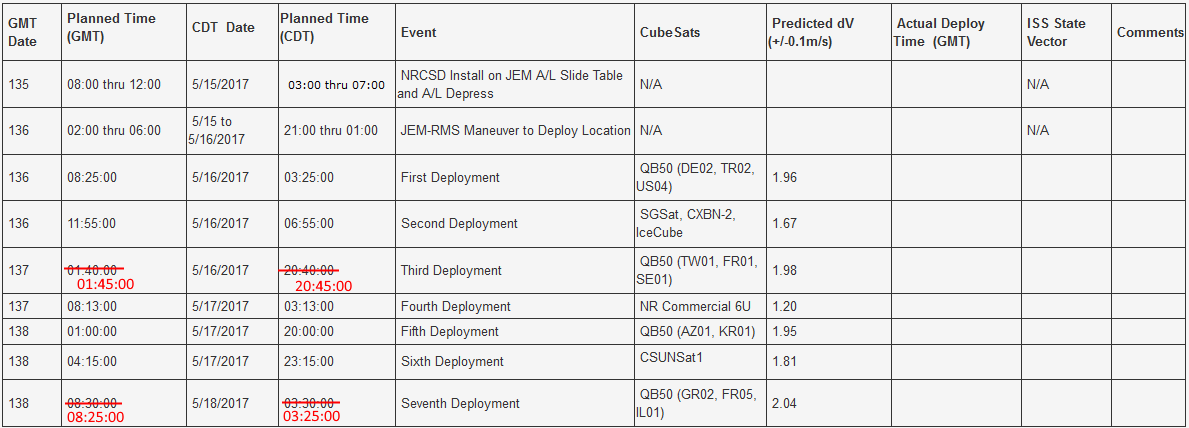
QB50 ISS LogoThe first phase of QB50 CubeSats should be deployed from the International Space Station over three days May 16-18, 2017.

Download QB50 ISS CubeSats Deployment and Radio Information PDF

Update May 16: 
3rd deployment 0145 GMT May 17
7th deployment 0825 GMT May 18

Built by university students and research organisations from 23 countries around the world, the QB50 constellation aims to study the lower thermosphere 200-380 km above the Earth.

There are 28 QB50 CubeSats on the ISS awaiting deployment and it is understood that 11 will be deployed in this first phase. The beacons should be activated about 30 minutes after deployment.

The QB50 CubeSats have downlinks between 435.8 and 438 MHz and reports from radio amateurs are most welcome. Beacon data received can be uploaded to a dedicated QB50 webpage at
https://upload.qb50.eu/

Two of the ISS QB50 CubeSats, ON01FR 437.020 MHz and ON05FR 436.880 MHz, carry V/U FM transponders. The uplink frequency for both is 145.860 MHz with 210.7 Hz CTCSS, see http://site.amsat-f.org/2017/05/12/qb50-document-de-description-des-telemesures-des-satellites-on01fr-on05fr/

QB50 Revised Deployment TimesList of QB50 CubeSats with Beacon format and frequency information
https://upload.qb50.eu/listCubeSat/

Keplerian Two Line Elements (TLEs) ‘Keps’ for new satellites launched in past 30 days
http://celestrak.com/NORAD/elements/tle-new.txt
QB50 project https://www.qb50.eu/
https://twitter.com/QB50Mission

On the deployment days radio amateurs and QB50 teams will be on the #CubeSat IRC channel. Join the deployment chat at http://irc.lc/freenode/cubesat

Don’t have a suitable 435-438 MHz receiver? Try listening online with the SUWS WebSDR located near London http://websdr.suws.org.uk/

On June 19, 2014 two precursor QB50 CubeSats were launched, QB50p1 and QB50p2, which carried amateur radio transponders
https://amsat-uk.org/2014/06/19/successful-launch-of-amateur-radio-satellite-payloads/

UBSEDS24 Balloon with SSDV Successfully Launched

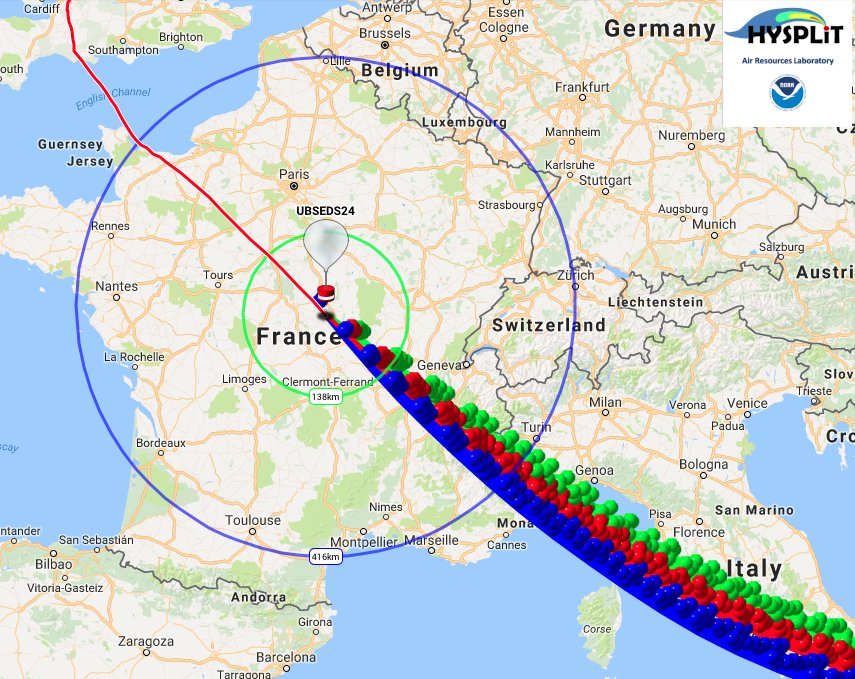
UBSED24 flight path May 8, 2017

UBSED24 flight path May 8, 2017

Richard Meadows M0SBU reports there will be a second attempt to launch the Raspberry Pi Zero equipped 434 MHz balloon UBSEDS24 early Monday morning.

Update: At 1700 GMT May 8 the team reported “Our Raspberry Pi Zero balloon #UBSEDS24 is over France”.

On the UKHAS Google Group Richard writes:

There’s going to be another attempt to launch this flight from Bristol this Monday, May 8 between 0500 and 0530 BST [0400-0430 GMT]. This is weather permitting, but the forecast looks okay at the moment.

This launch is using a 1.9m envelope and longer payload train, and so there’s a NOTAM in place. This tracker has a Raspberry Pi Zero V1.3 attached, which transmits images when solar power is available. It’s a different design to our launch last August; in this case the tracker will continue to operate even if the pi fails. For the curious the ‘pi status’ telemetry values are: 0 = off, 1 = on, 2 = PITS started, 3 = SSDV started).

SSDV picture taken by from UBSEDS24 on May 8, 2017

SSDV picture taken by from UBSEDS24 on May 8, 2017

There will hopefully be a cutdown mounted between the balloon and the tracker. We’ll be testing the 434 MHz uplink to this whilst it’s still in range of Bristol; if it returns over the UK at a convenient time and place we will attempt to trigger the cutdown.

The tracker has several transmissions:

– 434.635 MHz USB Telemetry – Contestia 16/1000 with pips and RSID, transmitting telemetry. Once per minute below 8km altitude and every two minutes otherwise.

– 434.637.5 MHz SSDV – Two modes:
(1) While balloon over UK and English channel GMSK at 12 ksymbol/s. 4×4 interleaved, R=1/2 convolutional K=5, HDLC framing, whitened etc. as per the AX5043 manual. Concatenated with RS(255,223) to mop up some burst errors.
(2) Outside UK 300 baud RTTY, 850 Hz shift, 8N2.

If you are listening to the RTTY, remember to turn off the ‘RxID’ button on the top right of dl-fldigi.

Rather than the usual JPEG SSDV, this is transmitting Better Portable Graphics (BPG) images. This is experimental, and ssdv.habhub.org doesn’t support it just yet. Hence receivers should upload to http://ssdv.bristol-seds.co.uk instead, please read the instructions on this site. You’ll need dl-fldigi release 3.2, as explained on the site. James Coxon M6JCX has made the dl-fldigi release available at: https://github.com/jamescoxon/dl-fldigi/releases/tag/3.2

The flight is expected to head south towards France. Many thanks to everyone who attempts to track this.

Track the balloon online at https://tracker.habhub.org/

Listen to the balloon online with the SUWS WebSDR link at https://amsat-uk.org/beginners/balloons/

UBSEDS https://twitter.com/bristolseds
http://www.bristol-seds.co.uk/hab/flight/2017/05/08/ubseds24.html

Richard M0SBU who is involved in the UBSEDS project took the amateur radio training courses run by the Chelmsford Amateur Radio Society (CARS) at Danbury in Essex. Further information on the courses is available from the CARS Training Coordinator, Christopher G0IPU
Tel: 07908-107951
Email: training2017 at g0mwt.org.uk
Web: http://g0mwt.org.uk/training

What is Amateur Radio? http://www.essexham.co.uk/what-is-amateur-radio

Find an amateur radio training course near you https://thersgb.org/services/coursefinder/

Amateur Radio Satellite Operation in Algeria

Abdel Mesbah M0NPT reports on what is believed to be the first amateur satellite operation from Algeria since the 7X0DX activation in 2002.

An introductory training course on amateur satellite traffic which was organized on April 14-15, 2017 at the 7X3WPL radio club in Laghouat (400 km south of Algiers).

This course was held under the auspices of the Laghouat Youth and Sports Directorate, Laghouat’s League of Cultural and Scientific Activities for Youth (LACS), the National Association of Algerian Radio Amateurs (ARA) and The El Manar youth hostel which houses the radio club 7X3WPL.

Satellite Doppler Management by Professor Bouzouad Mouloud

Satellite Doppler Management by Professor Bouzouad Mouloud

A total of about 25 students took part in this event, mainly students in master telecommunications and other enthusiasts of the world of radio telecommunications. While communication and demonstrations on amateur satellite traffic were carried out by Abdel Mesbah M0NPT, a member of AMSAT-UK and Chairman of the Hucknall Rolls-Royce Amateur Radio Club (UK), the Doppler management in satellite traffic was discussed by the Professor researcher, M. Bouzouad Mouloud of the laboratory of telecommunications of the signals and systems of the University of Laghouat.

The radio club 7X3WPL is in the process of installing a satellite station using a Kenwood TS2000, Yaesu G5500 Trackers and Wimo cross Yagis, please keep your ears open on Satellites as you may hear them soon.

I am delighted to be the first person to have activated Algeria (7X2ARA in JM16MS & 7X3WPL in JM13KT) on the SO-50 satellite and I am looking forward to going back again.

The first contact from Algeria on the SO-50 satellite was with my friend Peter 2E0SQL [now 2M0SQL], followed by Adam MU0WLV, Fran EA1JM, Olivier F5RRO, Jerome F4DXV, George MI6GTY, Peter G0ABI, Neven 9A5YY, Colin MU0FAL and many others.

I am also looking forward to install my own station in Algiers once I get my Algerian callsign 7X2TT sorted Inchallah

Abdel Mesbah M0NPT

How to work FM satellites https://amsat-uk.org/beginners/how-to-work-fm-satellites/

HamRadioNow: Look! Up in the Sky!

Look! Up in the Sky!The bulk of this episode is an on-location interview with two Raleigh NC area hams who gave a couple of live demonstrations of operating through satellites at the Raleigh Hamfest, April 15,  2017.

There’s some banter between hosts David Goldenberg W0DHG and Gary Pearce KN4AQ back in the studio. And toward the end Gary announces a Viewer Challenge that we’ll detail down below.

The satellite hams are John Brier KG4AKV and Tucker McGuire W4FS. At 18 years old, Tucker is a relatively new ham who first started operating satellites last summer, and quickly jumped into the deep end. John’s been around longer, but ham radio satellites and space operation captured his focus, too. He produces videos about it on his YouTube channel, Space Comms. Links below.

Gary talked to John and Tucker after they completed their second demo, and he edited a little of each demo into the interview.

There’s video of all of both demonstrations on YouTube. John shot himself operating through ‘Saudi-Sat’ SO-50, a “Mode J” FM crossband repeater (145.850 MHz uplink and 436.795 MHz downlink). John used three cameras (including a GoPro on a headband for a unique view). Gary edited the video and put it on the HamRadioNow YouTube channel as an extra bit if video.

Gary added two more cameras to the mix to shoot Tucker operating through FO-29, a Japanese satellite that uses a 100 kHz wide ‘linear transponder’ for mostly SSB and CW (and NO FM, please) between two meters and 70 cm. There’s a few minutes of that demo in this episode, and the whole thing is on John’s Space Comms channel.

Watch HRN 316: Look! Up in the Sky! Ham Radio Now

Space Comms http://youtube.com/SpaceComms1

KG4AKV’s SO-50 FM operation https://www.youtube.com/watch?v=7dhJsfh6fYA

W4FS’s FO-29 SSB operation https://www.youtube.com/watch?v=kEvsKN9ZSyw

John KG4AKV https://twitter.com/johnbrier
Tucker W4FS https://twitter.com/Whiskey4FoSho