South African QB50 CubeSats

CubeSats being deployed from the ISS on February 11, 2014

CubeSats being deployed from the ISS on February 11, 2014

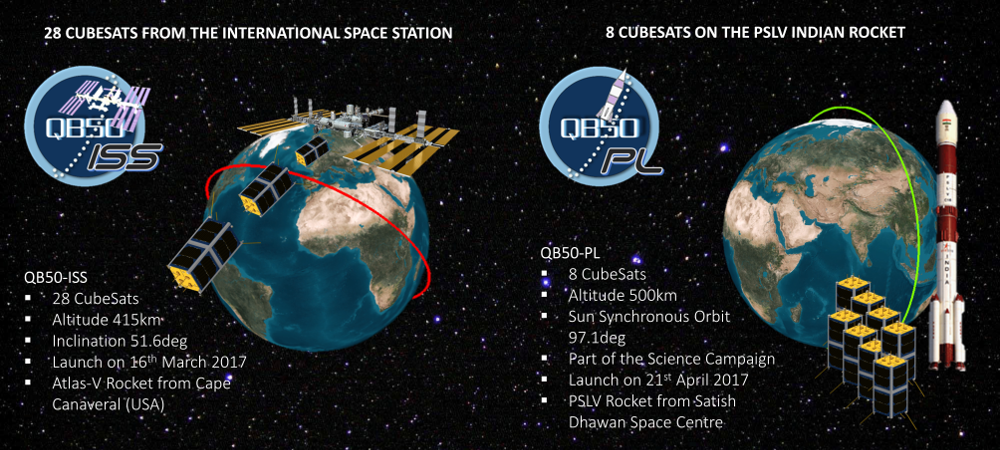
Two South African built satellites are about to be launched to the International Space Station as part of the QB50 project.

SARL News reports:

The South African satellite industry is taking another step forward as a player in the international space arena with the launch of two South African built nanosatellites from Cape Canaveral in Florida USA.

Two CubeSats, ‘nSight1’ (QB50 AZ02) designed and manufactured by Cape Town-based SCS Space, a member of the SCS Aerospace Group and ‘ZA-Aerosat’ (QB50 AZ01) designed and manufactured by CubeSpace of the Stellenbosch University, are to be launched as part of a batch totaling 28 CubeSats from 23 different countries

The launch is set for April 18, 2017 at 15:11 GMT. Their initial destination is the International Space Station (ISS), where they will be unloaded by the ISS crew with the help of robotic arms. The satellites will eventually be deployed into low-earth orbit over a period of 30 to 60 days as the ISS orbits the Earth.

Both the South African satellites are part of the QB50 project funded by the European Union and managed by the von Karman Institute to conduct research in the lower thermosphere between 200 to 380 km altitude. The data collected from this experiment over a period of 18 months will be used to complement current atmospheric models especially applicable to re-entry trajectories of spacecraft. All CubeSats will eventually burn up at the end of their operational lifetimes.

All the CubeSats in the QB50 project will mainly operate on frequencies in the 2 m and 70 cm amateur bands. To avoid interference to terrestrial amateur radio activity the frequency was coordinated by the IARU Satellite Adviser and his advisory panel http://amsat.org.uk/iaru

QB50 project https://www.qb50.eu/

JE9PEL QB50 CubeSat Frequency Spreadsheet
https://amsat-uk.org/2015/11/08/je9pel-qb50-cubesat-spreadsheet/

ISS Packet Digipeater Back On 145.825 MHz FM

International Space Station – Image Credit NASA

ARISS is pleased to announce that Packet Radio from the International Space Station is back on 145.825 MHz FM.

A few months back, the ARISS Team did the foot work and paperwork to launch the final copy of the Ericsson VHF handheld radio to the ISS.  This work was began in October after the unit onboard the ISS failed.  ARISS has been using the Ericssons for 16 years. In the last days of February, the launch vehicle, SpaceX 10’s Dragon, flew to the ISS.  Then the ISS crew had the odious job of unloading and unpacking 5,500 pounds of cargo along with the Ericsson HT.

ARISS got word this morning that we now have VHF capability back in the Columbus module.  Followers of ISS Fan Club have already posted that they’ve heard and used packet, and are thrilled.

In 2015, ARISS began its first fundraising campaigns.  It relies on NASA, ARRL, AMSAT and individual donors, along with ARISS volunteers to pay the day-to-day operations expenses and everything related to the hardware, testing, and certification.  Donors can go to http://www.amsat.org and http://www.ariss.org to support the program.

EMike McCardel, AA8EM
Rotating Editor AMSAT News Service

Almost any 144 MHz FM rig will receive the ISS, you can even use a general coverage VHF scanner with an external antenna. As far as the antenna is concerned the simpler the better. A ¼ wave ground plane has a high angle of radiation and works well. Large 144 MHz colinears are not as good because the radiation pattern is concentrated at the horizon while the ISS is above 15 degrees elevation for most of a pass.

You can receive the ISS outdoors using a 144 MHz hand-held with its helical antenna but a 1/4 wave whip will give far better results.

In the UK we use narrow 2.5 kHz deviation FM but the ISS transmits using the wider 5 kHz deviation used in much of the world. Most rigs can be switched been wide and narrow deviation filters so select the wider deviation. Hand-held rigs all seem to have a single wide filter fitted as standard.

How to work the ISS using APRS Packet Radio
https://amsat-uk.org/beginners/how-to-work-the-iss-on-aprs-packet-radio/

5 GHz – RSGB respond to Ofcom

The RSGB has published its response to the Ofcom statement on increasing the amount of the 5 GHz band that can be used for WiFi. The Amateur Satellite Service has a Space-to-Earth allocation at 5830-5850 MHz.

Annex 6 of the Ofcom 5 GHz statement says regarding Fixed Satellite Service (FSS) operation in 5725-5850 MHz:

“…once it becomes clear that this band will become used for Wi-Fi worldwide it will become less attractive for new satellites.”

“In Table 2 below we show the impact that different regulatory regimes for Wi-Fi might have on the exceedance of the protection criteria of the most sensitive satellites in 5.8 GHz assuming a comprehensive Wi-Fi roll-out across Europe and Africa.”

“As discussed previously, the risk of interference is an aggregate of all Wi-Fi use and so will rise slowly over a number of years rather than appearing suddenly.”

“The UK cannot cause interference to 5.8 GHz satellites on its own but it is fairly likely that Europe and Africa will follow our lead. This is likely to be driven by the potential for 5.8 GHz to become a worldwide Wi-Fi band.”

Response of RSGB to the Ofcom 5 GHz Statement
http://rsgb.org/main/files/2016/08/170411_RSGB_5GHz-WT-Regs-2017.pdf
http://rsgb.org/main/blog/spectrum-forum-posts-overview/spectrum-forum-papers-consultations/2016/08/01/5ghz-wi-fi/

Ofcom 5 GHz consultation and statement page
https://www.ofcom.org.uk/consultations-and-statements/category-1/5-GHz-Wi-Fi

Direct link to Ofcom statement PDF
https://www.ofcom.org.uk/__data/assets/pdf_file/0032/98159/5p8-Regs.pdf

Argentine balloon to fly to South Africa and beyond

Picoglobo Amateur Radio WSPR Balloon

Picoglobo Amateur Radio WSPR Balloon

On Saturday, April 8 at 08:00 GMT, weather permitting, Amsat Argentina plans to launch the amateur radio HF WSPR Leila PicoBalloon from the East Argentina coast.

This 24 gram PicoBalloon, with micro Atmel328, of long duration (circumnavigator) would flight around 13,500 meters height, possibly heading to South Africa and beyond.

Its tracker is powered by solar panels and a small supercapacitor, only emits during its day.

It will transmit every 10 minutes its WSPR 25mW beacon in 20m, dial in 14095.6 kHz USB, now active as test from Castelar, Buenos Aires.

The WSPR mode of K1JT is used to send and receive weak signals. It can receive up to 28dB below noise.

The 1st 2-minute broadcast transmits LU7AA, Locator and power in dBm, 2nd, height, temperature and voltage.

WSPR can be downloaded from http://amsat.org.ar/wspr.exe or http://physics.princeton.edu/pulsar/K1JT/WSPR2_r1714.EXE

To operate connect PC audio output and input to the transceiver, it can also be coupled acoustically.

If running WSPR mark UPLOAD SPOTS, your reception reports via Internet will be uploaded  in wsprnet.

Each report uploaded to http://wsprnet.org/ will allow to see where is the picoballoon, heading, height, voltages, temp, and so on.

It is important to have the largest number of receiving stations, which will help track Leila.

There is a Spanish presentation available at http://amsat.org.ar/wspr.ppt

You could track Leila and see your own reports at: http://lu7aa.org/wspr.asp and / or http://aprs.fi?call=lu7aa-15

Thank you for being part of this experience and if possible disseminate this information.

73, LU7AA, Amsat Argentina
http://amsat.org.ar/
https://facebook.com/Amsat.LU

ARISS Closer to Launching New Radio System

International Space Station – Image Credit NASA

The ARISS team took a giant step closer to flying the new ARISS Interoperable Radio System to the International Space Station, having met a major milestone.

Lou McFadin, W5DID, and Kerry Banke, N6IZW, travelled to the NASA Johnson Space Center (JSC) in Houston, Texas, in mid-February for preliminary testing of Banke’s breadboard version of the ARISS Multi-voltage Power Supply. The two worked alongside JSC engineers and JSC EMC lab personnel, putting the specially built power supply through its paces, checking against US and Russian space specifications for Power Quality and Electromagnetic Compatibility (EMC) preliminary tests.

The result:  Outstanding news-the ARISS Team can move on to the next step, fabrication of prototype and flight units.  The JSC engineers disclosed that the ARISS breadboard power supply was the first hardware to have passed all of the space agencies’ tests!  They said the very professional ARISS Team certainly knew hardware development and design.

Amateur Radio on the International Space Station (ARISS) logoARISS-International Chair Frank Bauer thanked Banke and McFadin for the multiple days spent putting the unit through the serious battery of NASA and Russian preliminary electrical tests.  Banke expressed pleasure with the results: “I was looking to come away with what we needed to move forward. We achieved that.”  He was impressed with the support he and McFadin received from the testing group, and said key players on those teams who are also ham radio operators, commented that they find equipment brought in that is supported by ham radio operators, to earn particularly good marks.  McFadin asserted that the Multi-voltage Power Supply’s fine test results are due to ARISS’s team working very well together and being very experienced.

The completed testing of the breadboard unit means McFadin can now purchase expensive space-certified parts so the final prototype/flight power supplies can be fabricated.  He and Banke now know that when the final, even more rigorous tests are done, the units will pass with flying colors.

Watch for more news stories on the hardware and the fundraising campaign to help support the costs associated with designing, building, and testing the new ARISS radio system-the Kenwood D710GA and Multi-voltage Power Supply. Those wishing to contribute toward the final fabrication and flight tests are highly appreciated and asked to go to the AMSAT website,  www.amsat.org to click on the “ARISS Donate” button.  Or visit the donation page on the ARISS website, http://www.ariss.org/donate.html

Contributions are tax deductible. Those who contribute $100 or more will receive the handsome ARISS Challenge Coin.  If you or your ham club or place of employment wish to make a highly substantial contribution, contact Frank Bauer, KA3HDO, at ka3hdo@verizon.net.

Source ARISS News Release 17-04

Frank Bauer, KA3HDO was on the Ham Talk Live podcast discussing ARISS and
the gear aboard the ISS. The link to the podcast is:
http://www.spreaker.com/user/hamtalklive/episode-55-ham-radio-on-the-iss-with-fra

CAS-4A and CAS-4B Linear Transponder Satellite Payloads

XW-2A satellite launched September 19, 2015

XW-2A satellite was launched September 19, 2015

Nico PA0DLO reports the CAS-4A and CAS-4B amateur radio linear transponder payloads were carried on the Earth imaging microsatellites OVS 1A and OVS 1B which were launched at 0300 UT on Thursday, June 15, 2017.

CAMSAT News Release CAS-4A and CAS-4B Satellites from CAMSAT Launched Download PDF Here

CAMSAT worked closely with a Beijing Government aerospace contractor to build two satellites with amateur radio linear transponder payloads. The launch from the Jiuquan Space Center was planned to put the satellites into a 524 km orbit with an inclination of 43 degrees.

Both carry a 435/145 (U/V) 20 dBm (100 milliwatt) SSB/CW linear transponder, a 2m CW 17 dBm (50 mW) telemetry beacon and an AX.25 4.8 kbps GMSK 20 dBm (100 mW) telemetry downlink.

The two micro-satellites will also carry optical remote sensing missions. Planned to be 494x499x630 mm dimension regular square shape and approximately 50 kg mass with three-axis stabilization system.

These frequencies have been coordinated by the IARU Satellite Frequency Coordination Panel:

CAS-4A
• Linear transponder downlink 145.870 MHz, emission designator 20K0V8WWF, output power 20 dBm
• Linear transponder uplink 435.220 MHz
• CW telemetry beacon 145.855 MHz, emission designator 100HA1AAN, output power 17 dBm
• GMSK telemetry 145.835 MHz, emission designator 16K0F1DCN, output power 20 dBm

CAS-4B
• Linear transponder downlink 145.925 MHz, emission designator 20K0V8WWF, output power 20 dBm
• Linear transponder uplink 435.280 MHz
• CW telemetry beacon 145.910 MHz, emission designator 100HA1AAN, output power 17 dBm
• GMSK telemetry 145.890 MHz, emission designator 16K0F1DCN, output power 20 dBm

IARU Satellite Frequency Coordination pages http://www.amsat.org.uk/iaru/