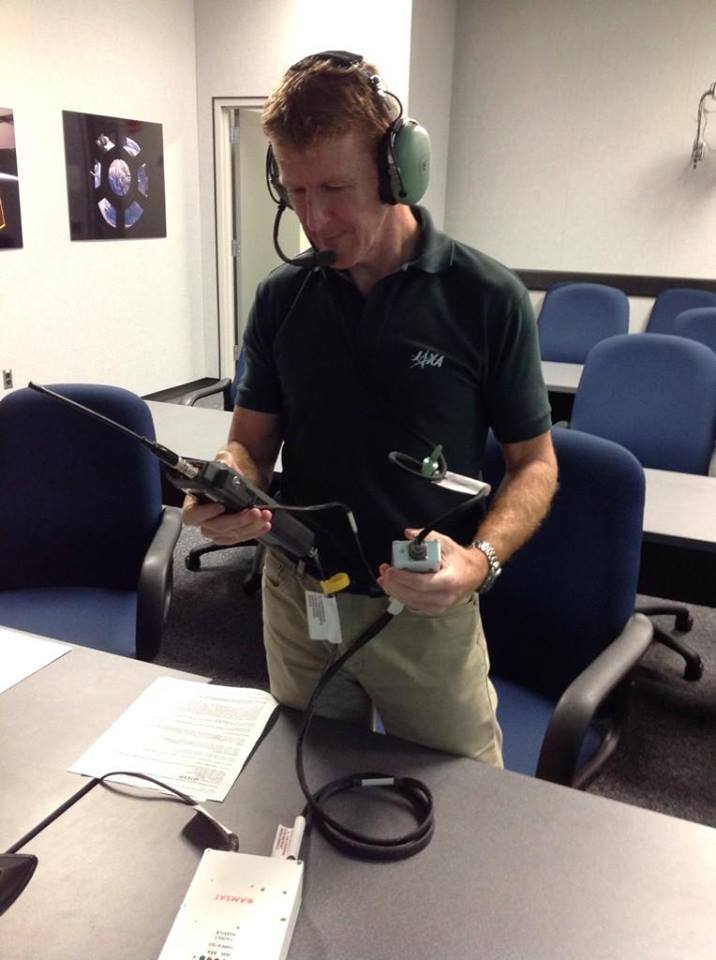
UK astronaut Tim Peake KG5BVI / GB1SS trained to use the Ericsson VHF transceiver for his ISS mission
The CRS-10 mission carrying vital amateur radio equipment to the International Space Station launched on a SpaceX Falcon 9 rocket at 1439 UT on Sunday, February 19, 2017.
Frank Bauer KA3HDO, ARISS International Chair and AMSAT-NA V.P. for Human Spaceflight Programs writes:
Included as part of the successful launch of the SpaceX Dragon vehicle to ISS is an ARISS Ericsson 2 meter VHF radio. This radio will replace the Ericsson radio that failed a few months ago. The VHF radio is used for school group contacts and amateur packet radio in the Columbus module. Once the Dragon vehicle is berthed to ISS, the Ericsson will be unstowed and, at some point, installed in Columbus, replacing the UHF radio that is now supporting APRS packet and some school contacts.
Our thanks to SpaceX on an outstanding and historic flight from Kennedy Space Center’s Launch Pad 39A, where many Space Shuttle missions and nearly all the Apollo moon missions were launched. We also would like to thank our ARISS benefactors-NASA and CASIS, the Center for the Advancement of Science in Space. And, of course, our amateur radio long-time sponsors-our national amateur radio organizations around the world, including the American Radio Relay League (ARRL) in the US, and our international AMSAT organizations, including AMSAT-NA.
Before closing, I want to let you know that ARISS is making great progress on the development of the new interoperable radio system that we hope to use to replace our aging radio infrastructure in the Columbus module and the Service module. The hard (and expensive) part of this effort is just beginning, with testing and human certification on the horizon. We thank all that have donated to the cause thus far. We hope you continue to help ARISS move forward through your support, including your volunteer time and talent and, of course, financial contributions through the AMSAT web site donate button http://www.amsat.org/
Amateur Radio on the International Space Station ARISS http://ariss.org/
Two satellites with Amateur Radio transponder payloads have been selected for future NASA launches.
AMSAT-NA reports TJREVERB is a CubeSat from Thomas Jefferson High School for Science and Technology, in Alexandria, Virginia with a 435/145 MHz FM transponder.
HuskySat-1 has a 145/435 MHz SSB/CW transponder and was developed by students at the University of Washington in Seattle.
It is expected the launches will take place in the 2018-2020 time frame.
Steve M1ACB, Rob M0VFC and John M0IDA will be active on the FM and SSB amateur radio satellites from Berry Islands in the Bahamas.
The trio plan to operate from March 4-10 and will be using hand-held antennas. Since the FM satellites will only cover part of the USA they’ll also be using SSB on FO-29 to reach the British Isles and Europe.
They will be operating from Little Harbour Cay in the Berry Islands, IOTA NA-054, Grid Square FL15do.
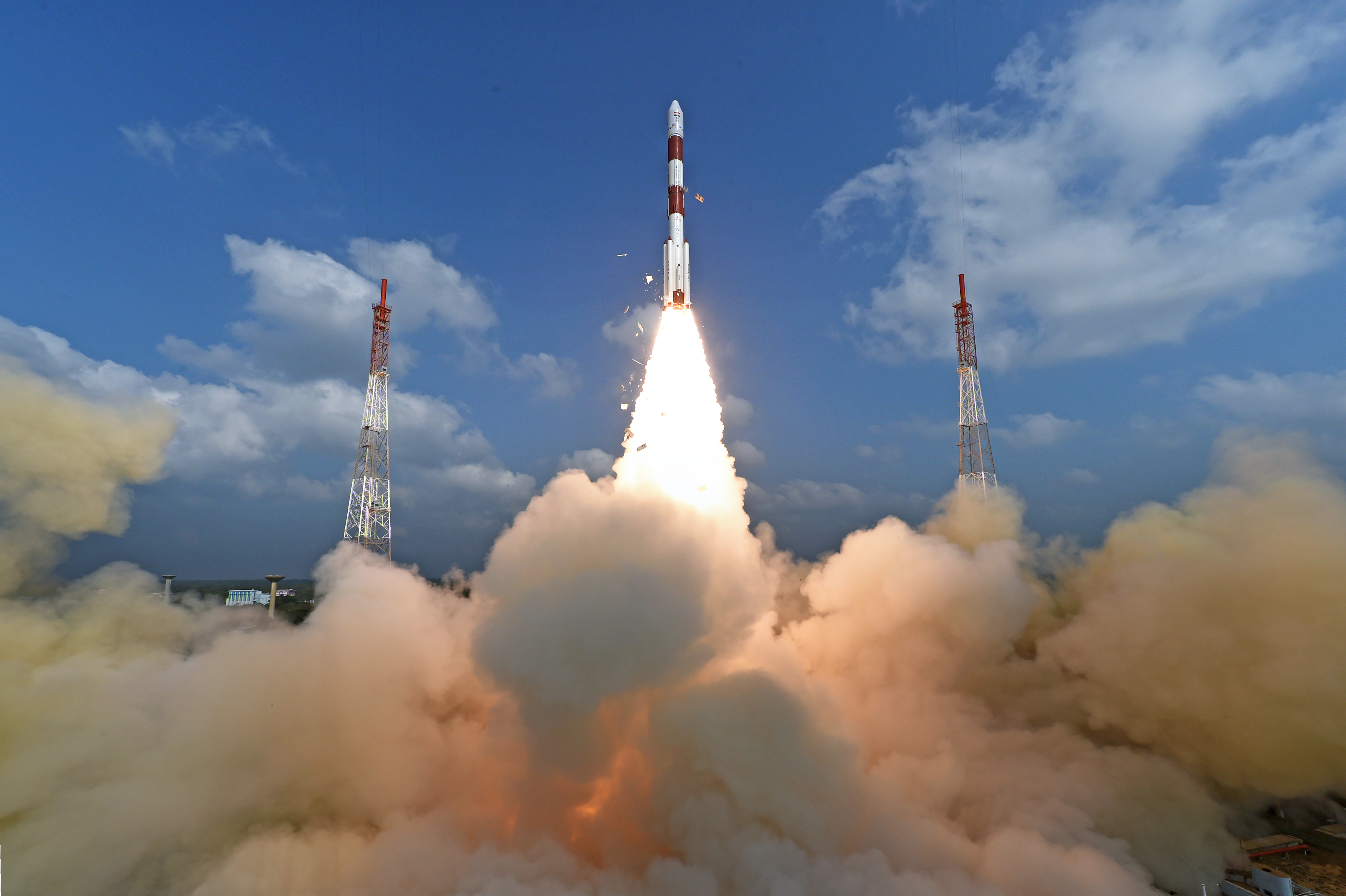
The Indian Space Agency ISRO successfully launched the amateur radio satellite Nayif-1 along with 103 other satellites, a record for a single launch. The PSLV-C37 lifted off from the Satish Dhawan Space Centre, Sriharikota, Andhra Pradesh at 03:58 UT on Wednesday, February 15, 2017.
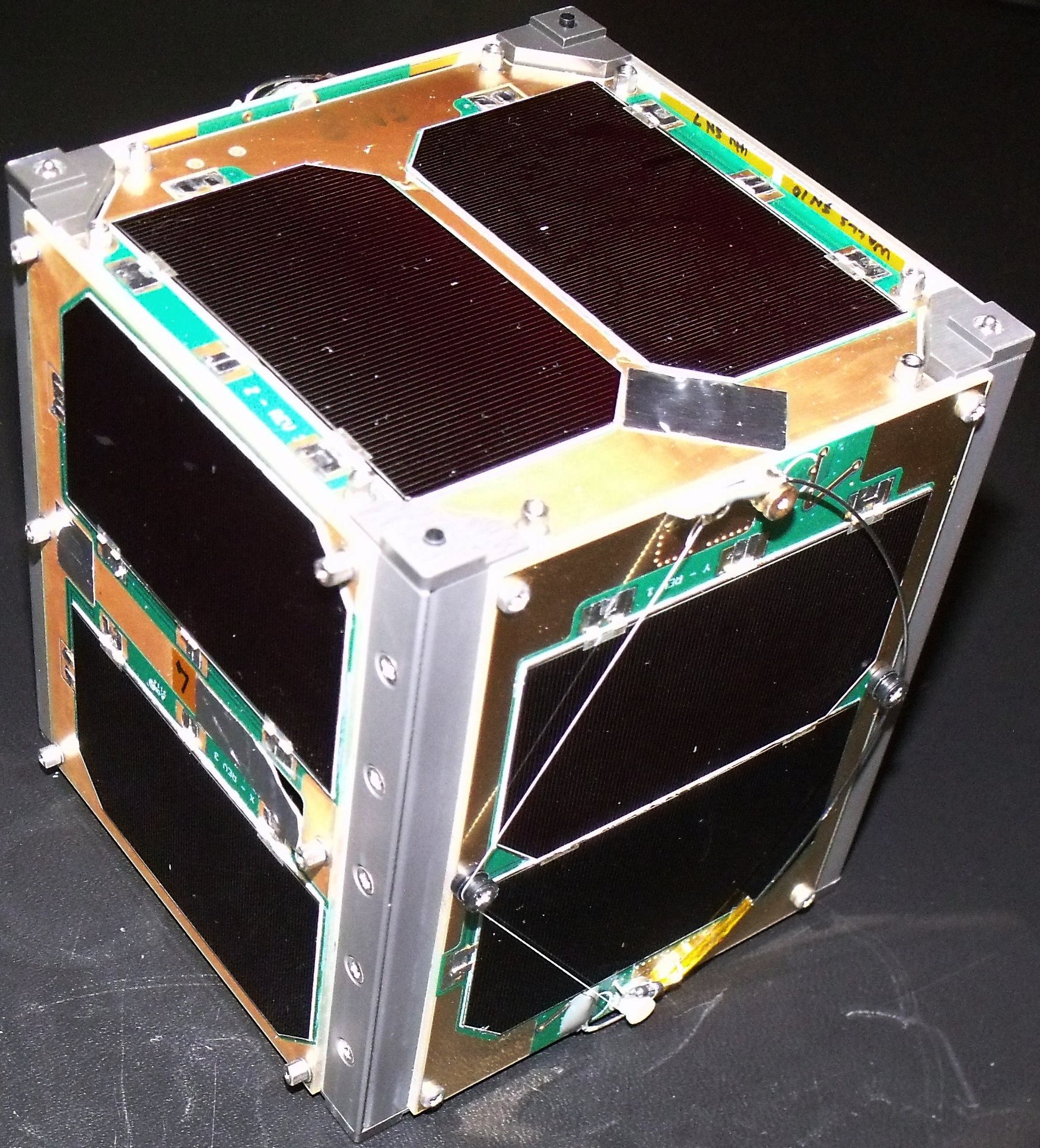
Nayif-1 was developed by UAE students – Image credit The Mohammed bin Rashid Space Centre
Nayif-1 started transmitting about an hour after launch and radio amateurs in the west of the USA reported the first signals. The first frame of data received at the Data Warehouse was from Christy Hunter KB6LTY. Telemetry data was also received by WA6FWF, KA7FVV, WC7V, NC7V, K6FW, KE7QPV, WA9ONY, W5PFG, KK6AYK.
Ken Eaton GW1FKY reports he received his first frames of data when the satellite came in range of the UK at 10:07 UT.
The satellite looks to be in perfect health and it was placed in autonomous mode before the end of the first day in orbit. Just like FUNcube-1, this mode has the spacecraft sending high power telemetry when in sunlight and with the SSB/CW transponder active when in eclipse. Already many contacts have been made through the transponder. As expected, the frequency stability of this spacecraft is much better than its predecessors.
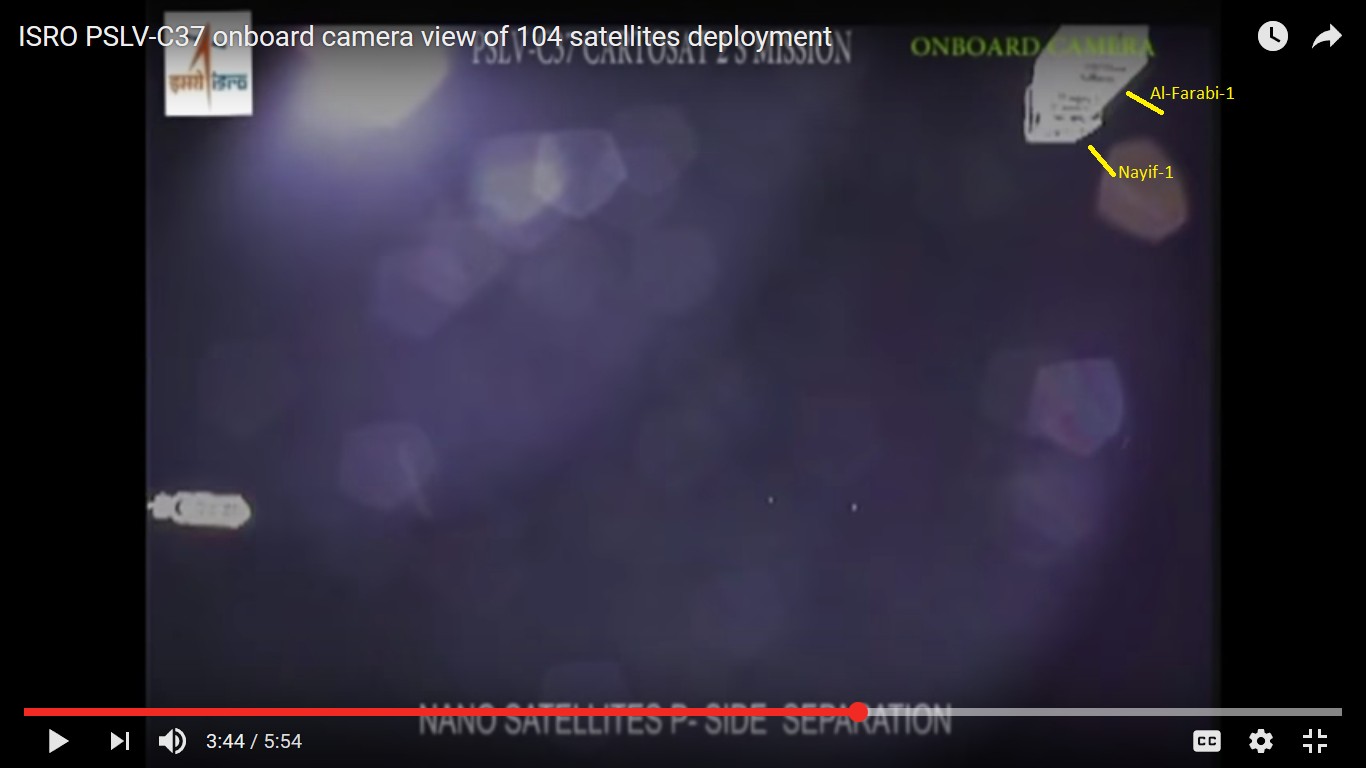
The launch provider has published a video of the deployment of the 104 satellites
Please note that these numbers are not based on JSpOC observations so we do not yet have a valid catalog number.
On February 24, Nico Janssen PA0DLO reported that detailed Doppler measurements show that Nayif-1 is object 42017, 2017-008BX
During the Launch and Early Operation phase (LEOP) of the mission, the Nayif-1 command team have been headquartered at the American University of Sharjah Ground station in the United Arab Emirates. They have been very grateful for all the telemetry received from around the world. It has proven to be immensely useful to the team in checking that the spacecraft is functioning correctly.
Nayif-1 Deployment
Our world-wide network has greatly impressed the many professionals that have been watching our activities. Already more than 100 ground stations are submitting data to the Nayif Data Warehouse. Please continue uploading the data as this will further enhance our knowledge about the spacecraft and the space environment through which it is traveling at 7.6 km/s.
The Nayif-1 Data Warehouse has been updated and now includes the Whole Orbit, High Resolution graphs and the upload ranking. It also includes telemetry details from the ADCS sub-system – this is called the iMTQ and is capable of actively magnetorquing. Over the coming days, we will be further tweaking the warehouse, so bear with us if it is unavailable for short periods of time.
Background
Nayif-1 has been developed by the Mohammed bin Rashid Space Centre (MBRSC) and American University of Sharjah (AUS). The UAE’s first Nanosatellite was developed by Emirati engineering students from AUS under the supervision of a team of engineers and specialists from MBRSC within the framework of a partnership between the two entities, aiming to provide hands-on experience to engineering students on satellite manufacturing.
The spacecraft includes a U/V linear transponder and telemetry transmitter. It employs enhanced oscillator circuitry and includes an active attitude determination and control system.
The operating frequencies for the spacecraft are:
Telemetry
145.940 MHz using 1k2 BPSK to the FUNcube standard.
SSB/CW Transponder
Uplink on 435.045 – 435.015 MHz
Downlink on 145.960 – 145.990 MHz
Nayif-1 team members after completion of the assembly and integration of the CubeSat
AMSAT-UK and AMSAT-NL are delighted to now be able to confirm that the Nayif-1 1U CubeSat, which has a full FUNcube payload, is now scheduled for launch on an Indian PSLV launch vehicle at 03:58 UT on February 15, 2017. The flight, PSLV-C37, will be carry a total of 104 satellites into orbit.
The 145.940 MHz 1k2 BPSK telemetry beacon, running 50mW output, should activate at approximately 04:54 UT on Wednesday, February 15 when the spacecraft is heading north over Mexico and the western parts of the US and Canada.
Nayif-1 was developed by UAE students – Image credit The Mohammed bin Rashid Space Centre
During the Launch and Early Operation Phase (LEOP) of the mission, the Nayif-1 command team will be headquartered at the American University of Sharjah Ground station in the United Arab Emirates. They will obviously be especially keen to have all possible reports of signal reception during this first orbit!
To encourage everyone to take part, there will be a small prize for the stations that submit the first data to the Nayif-1 Data Warehouse. Please help the team if you can.
Nayif-1 has been developed by the Mohammed bin Rashid Space Centre (MBRSC) and American University of Sharjah (AUS). The UAE’s first Nanosatellite was developed by Emirati engineering students from AUS under the supervision of a team of engineers and specialists from MBRSC within the framework of a partnership between the two entities, aiming to provide hands-on experience to engineering students on satellite manufacturing.
Hessa Ali and Maitha Al Shizawi verifying the Nayif-1 hardware as well as conducting electrical and functional tests
The spacecraft includes a U/V linear transponder and telemetry transmitter. It employs enhanced oscillator circuitry and includes an active attitude determination and control system.
As with previous missions carrying FUNcube payloads, AMSAT-UK would very much like to receive as many reports from stations around the world, especially during the first few minutes and hours after launch.
There is a mission specific Telemetry Dashboard for this project and this can be downloaded from http://download.funcube.org.uk/Nayif-1_Dashboard_1038_installer.msi and, in a similar way to the FUNcube-1 Dashboard, this will be capable of uploading the telemetry received to a central Data Warehouse.
Please note that if you are already a registered user of the FUNcube Dashboard then you do not need to re-register. Your existing details will transfer automatically to the new Dashboard when you run it for the first time.
The operating frequencies for the spacecraft will be:
Telemetry
145.940 MHz using 1k2 BPSK to the FUNcube standard.
SSB/CW Transponder
Uplink on 435.045 – 435.015 MHz
Downlink on 145.960 – 145.990 MHz
Initial operations of the spacecraft will be in a low power “safe” mode where only the telemetry transmitter is activated.
ISS SSTV image 2 received by Mike Rupprecht DK3WN April 12, 2016 at 1556 UT
Slow-scan television (SSTV) transmissions are planned from the International Space Station (ISS) on February 13-14, 2017.
The SSTV images will be transmitted as part of the MAI-75 Experiment on 145.800 MHz FM using the Kenwood TM-D710 transceiver located in the Russian ISS Service module. It is expected they will use the PD-180 SSTV format.
The MAI-75 activities have been scheduled for the Russian crew on Monday, February 13 from 09:25-18:00 GMT and Tuesday, February 14 from 11:25-16:30 GMT.
Note the ISS transmissions on 145.800 MHz FM use the 5 kHz deviation standard rather than the narrow 2.5 kHz used in Europe. If your transceiver has selectable FM filters try the wider filter.




You must be logged in to post a comment.