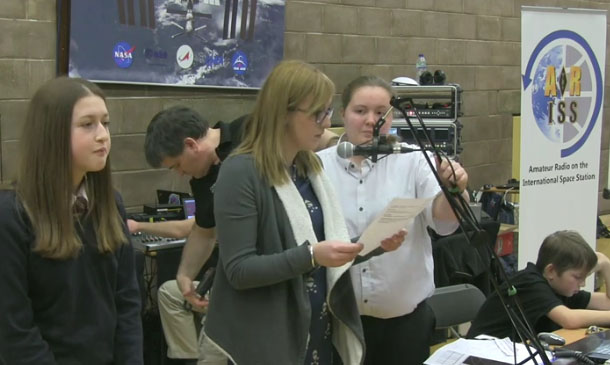
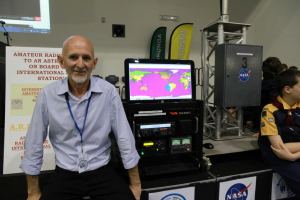
In this special edition, the TX Factor team of Nick Bennett 2E0FGQ, Bob McCreadie G0FGX and Mike Marsh G1IAR, follow the progress of The King’s School GB1OSM, Ottery St Mary, Devon in their attempt to be one of the ten lucky UK schools to use amateur radio to link up with Tim Peake GB1SS aboard the International Space Station.
The team go behind the scenes with the ARISS team to meet the members and see the technology that helped to make the UK schools’ link-ups such a great success.
ARISS is an international educational outreach program partnering the volunteer support and leadership from AMSAT and IARU societies around the world with the ISS space agencies partners: NASA, Russian Space Agency, ESA, CNES, JAXA, and CSA.
ARISS offers an opportunity for students to experience the excitement of Amateur Radio by talking directly with crew members on-board the International Space Station. Teachers, parents and communities see, first hand, how Amateur Radio and crew members on ISS can energize youngsters’ interest in science, technology, and learning.
ARISS-F and AMSAT-F have announced the 13 French schools that have been selected for amateur radio contacts with ISS astronaut Thomas Pesquet KG5FYG.
He is planned to launch to the International Space Station in November 2016. The 13 French schools selected represents 66% of planned ARISS contacts for Europe.
Sandringham student Jessica Leigh M6LPJ established radio contact with Tm Peake GB1SS
Pete M0PSX had the opportunity to talk about the ARISS school contacts and amateur radio during a radio show aired on Basildon Hospital Radio and community station Gateway FM.
The interview was broadcast on 1287 AM, 97.8 FM, via the patient bedside system at Basildon Hospital, and online via both station’s Internet streams.
In the interview, Pete discussed the perception of amateur radio, how the hobby has kept pace with technology, and some of the activities taking place in Essex. There was also some discussion of the various Tim Peake ARISS contacts, plus a short extract of the first ARISS Tim Peake contact, with Sandringham School in St Albans.
The interview was arranged by the Chair of Basildon Hospital Radio Jacqui James M3TWO. Jacqui took the amateur radio Foundation training course run by the Chelmsford Amateur Radio Society. To find out more the course contact the CARS Training Manager at:
Email: training2016 <at> g0mwt.org.uk
Web: http://g0mwt.org.uk/training
A huge team of volunteers worked flat out to make it happen. The project was initiated by ARISS (Amateur Radio on the International Space Station), enthusiasts who work with space agencies all over the world to inspire children about space and technology. Ciaran Morgan M0XTD, its UK leader, tells me how they approached the European Space Agency and persuaded them to let them do it and how the rest has been down to the volunteers. “All Tim has to do is put on his headphones and press a button. We do everything else.”
Ten people spent three days setting up the equipment, the audio feeds, the video feed and the satellite backup at Goonhilly, down the road in Cornwall. “All amateur means is ‘for the love of it’,” Morgan tells the audience. “As you see, the equipment we’re using is very, very professional.”
The King’s School amateur radio contact with Tim Peake featured HamTV
The final ARISS school contact of the Principia Mission took place on Monday, May 9 at 0926 GMT (10:26 am BST) between The King’s School GB1OSM in Ottery St Mary, Devon and Tim Peake GB1SS on the International Space Station.
The contact was receivable by radio amateurs across the British Isles and Western Europe and webcast on the ARISS Principia website. As well as the voice link on 145.800 MHz FM there was a Digital Amateur Television HamTV link on 2395 MHz.
The King’s School students Matt Ilsley and Hector Sethi obtained their Foundation amateur radio licences by taking a training course provided by the Sidmouth Amateur Radio Society.
Tim Peake KG5BVI / GB1SS preparing for his spacewalk in January
Ciaran Morgan [M0XTD], team lead UK ARISS coordinator, described the live link-up as ‘nothing more than a humongous experiment’ as he talked people through the equipment – especially the critical radio used to speak to Major Tim Peake.
Year 13 student Matt Ilsley [M6MTI] passed his foundation radio licence especially for the moment and held his cool as – after much anticipation – he made first contact with the British astronaut.
Summing up the event, head girl at The King’s School, Millie Perkins, said: “We have just experienced something amazing and to you younger years, this will be a highlight of your time here at King’s. I feel very privileged to have experienced it. This is something that we will remember about King’s for the rest of our lives.”
Science Technology Engineering and Maths (STEM) leader Alison Argent-Wenz … spear-headed the whole project and – along with a member of Sidmouth Amateur Radio Society, Mike Marsh [G1IAR] – put forward a proposal for a two-day Space-STEM event surrounding contact with the ISS.
The amateur radio contact generated plenty of media coverage which included:
Events at The King’s School in lead up to Tim Peake contact by year 13 student Matt Ilsley M6MTI
Video of the Tim Peake ARISS contact
Participant’s Presentation:
The King’s School is an 11-18 comprehensive school with approximately 1150 students of which 230 are in the Sixth Form. It has a long and proud history that can be traced back to a fourteenth century choir school which was replaced in 1545 by Henry VIII in 1545 with “The King’s School”.
Although The King’s School became an academy in 2011 we continue to work in close partnership with Devon County Council and our fellow secondary schools to ensure that we offer the best educational opportunities possible. Our inclusive philosophy of “Achievement for All” encapsulates our belief that every person who enters The King’s School has unique skills and potential which we believe we have the creativity and ability to unlock.
We were graded Outstanding by OfSTED in 2011, and in the latest 2014 OfSTED inspection we were again graded Outstanding but this time in every category. The report endorsed the school’s belief that its ethos has a hugely positive impact on student achievement.
We are extremely proud of our students and of the brilliant examination results they achieve year on year. However, we are also incredibly proud of the myriad of extra-curricular activities in which they are involved. This richness of opportunity is central to what we believe develops our students into well rounded young people. We are very much a community school, working very closely with our hugely supportive parents, Governors, excellent partner primary schools, local business representatives and a wide range of other agencies to provide opportunities for all.
The Kings School students – Credit Goonhilly GES Ltd
Participants questions:
1. Lara, aged 13 – You have missed Christmas and Easter with your family and friends – how have you celebrated big events in space?
2. Harry, aged 12 – We have seen videos of you playing about in microgravity on the ISS – what is your favourite thing to do when ‘weightless?’
3. Elizabeth, aged 18 – From your elevated advantage point, looking down on the Earth, has your perception of the events on our planet, such as conflicts and wars been altered? Does the change in perception give any insight that we could learn from?
4. Eleanor, aged 11 – Having spent many months looking at the Earth from afar, where is the first place you would go for a family holiday when you get home?
5. Freddie, aged 12 – Over 500 astronauts have been into space, but only 12 have set foot on the moon. Do you think that we will return people to the moon again in the future? How will your research on the ISS help us if we did?
Rehearsal at The Kings School for Tim Peake contact – Credit GES Ltd
6. Naomi, aged 13 – We have learned about your experiments on how the human body adapts to conditions in space. How will the research improve our quality of life on Earth?
7. Robert, aged 13 – Taking into account Einstein’s theory of relativity, do you think you are ageing slower because you are travelling faster then the Earth?
8. Ben, aged 11 – I often stare into the inky blackness of space and wonder.. if the universe is expanding, then what is it expanding into? Has your time in space given you any insight?
9. Robbie, aged 14 – Is the sunrise more spectacular from your perspective?
10. Emily, aged 13 – After 6 years of training to be an astronaut, I bet it’s all been worth it. The experiments you are doing are amazing, but did you ever struggle with Science at school? What would you say to anyone that finds it difficult?
11. Josh, aged 12 – How do you get your air in space? Do you bring it up in tanks, or do you make it in the space station, if so, how? Also, do you have a special ‘space mixture’ of air or is it the same as we have on earth?
12. Tristan, aged 12 – Do you and the other astronauts onboard control the space station, or is it controlled from Earth?
UK astronaut Tim Peake KG5BVI / GB1SS
13. Katie, aged 12 – Research shows that your sleeping position can affect the kind of dreams that you have. Have you noticed any difference in your sleep patterns or dreams during your time in space?
14. Chloe, aged 12 – I am reading ‘The Astronaut’s Handbook’ at the moment, which is fascinating. If you could take one thing into space to make life more comfortable, or easier, what would it be?
15. James, aged 12 – We have enjoyed listening to your music choices on ‘Space Rocks’ – what is your all-time favourite song to listen to in space?
16. Jessica, aged 12 – How do you keep the temperature constant inside the space station?
17. James, aged 12 – What would happen to a goldfish if you took it up to the ISS? Would it just float around in a bubble of water?
18. Josh, aged 12 – Do you have a special ‘space mixture’ of air or is it the same as we have on earth?
19. Freddie, aged 12 – How will your research on the ISS help us return people to the moon?
ARISS is an international educational outreach program partnering the volunteer support and leadership from AMSAT and IARU societies around the world with the ISS space agencies partners: NASA, Russian Space Agency, ESA, CNES, JAXA, and CSA.
ARISS offers an opportunity for students to experience the excitement of Amateur Radio by talking directly with crew members on-board the International Space Station. Teachers, parents and communities see, first hand, how Amateur Radio and crew members on ISS can energize youngsters’ interest in science, technology, and learning.
Four year old Esme Thorpe used amateur radio to talk to Tim Peake – Copyright ImageNorth 2016
The amateur radio contact between Ashfield Primary School GB1APS in Otley, West Yorkshire took place on Thursday, May 5 at 0808 GMT (9:08 am BST) with Tim Peake GB1SS on the International Space Station.
The contact was receivable on 145.800 MHz FM over the British Isles and Western Europe and webcast on the ARISS Principia website.
There was a collective gasp of excitement as the astronaut’s image became visible on a big screen and he waved to everyone on the planet below.
Ten lucky pupils got to put quick-fire questions to him during the time the ISS was passing nearby. The first was posed by four year old Esme Thorpe, who asked Major Peake if she could come and see him.
He replied: “Hi Esme, it’s great to talk to you this morning. “I wish you could come and see me, I’d love to show you around the International Space Station.” Noting the practical difficulties, though, he added: “It would probably be easier for me to come to see you” – which the school is hoping could mean a future visit.
The amateur radio contact generated plenty of media coverage which included:
Welcome to Yorkshire @Welcome2Yorks tweeted a video of the contact
First contact with the @Space_Station from @AshfieldOtley Yorkshire, incredible! pic.twitter.com/q9g1cWcUoZ
Participant’s Presentation:
Ashfield Primary School is in Otley, West Yorkshire, a historic market town to the north west of Leeds.
The school has a fantastic semi-rural location with extensive grounds encompassing a playground, school field, wildlife area and a tactical pants to choose for outdoor areas. The school is a community primary school with one form entry. We have 240 children aged 3 to 11.
Ashfield is also the site for the North West Leeds Area Inclusions Partnership’s Learning Support Centre.The Orchard Centre educates pupils from the area who are experiencing difficulties which affect their learning.
Our vision is that children, parents and carers, staff and governors work actively together to ensure children receive a rich inspiring and engaging education enabling each child to become lifelong learners, aspiring to high standards of achievement in all areas of their life. As part of this rich inspiring and engaging education, pupils run a stall at the annual Otley Science Festival and recently hosted a space themed Science, Technology, Engineering and Maths festival within the school.
All Ashfield classes ran stalls to inform, challenge and entertain each other. We had visitors from all seven local schools, who designed informative exhibitions to share. Exhibitors also came from Otley Amateur Radio Society, Leeds University, The Radio Society of Great Britain, Bradford Astronomy Society and Eureka Museum and worked with the children on STEM related topics. Dr Marty Jopson also created and presented a space related science show in the evening.
Tim Peake KG5BVI / GB1SS preparing for his spacewalk in January
Participants will ask as many of the following questions as time allows:
1. Esme (Reception): How can I come and see you?
2. Kitty (Year 4): If you blow a bubble in space what shape will it be and will it last long?
3. Olivia (Year 5): How do you communicate with people down below?
4. Amelie (Year 5): Are your space clothes itchy or soft?
5. Libby (Year 5): Although you are with other members up in the ISS do you ever get lonely?
6. Grace (Year 5): What would happen to a balloon in the ISS that isn’t attached to a string?
7. Zach (Year 6): Does helium work the same in space?
8. Ethan (Year 6): How tall are you now on the ISS?
9. Jack (Year 2): Is there space candy?
10. Dalton (Reception): How do you get home from the space station?
11. Ethan (Year 2): What are washing machines like in space and how do you clean your clothes?
12. Ruth (Year 2): What does the Earth look like at night from the ISS?
13. Millie (Year 2): What does space smell like?
14. Maizy (Year 5): How often do you look out of the window to see planet earth?
15. Olivia (Year 5): What is the best thing about the countdown and why?
16. Caitlin (Reception): How do you stop your food from floating?
17. Olivia (Year 5): What is the best thing about being in zero gravity?
18. Chloe (Year 2): What is it like in space at night time?
19. Mackenzie (Year 3): How many miles up are you and why?
20. Olivia (Year 5): What happens to your organs in space?
The Wharfedale Observer reports Otley school has been chosen for ‘out of this world’ talk using amateur radio to British astronaut.
Children in Otley are set to enjoy an ‘out of this world’ talk with British astronaut Tim Peake GB1SS.
Ashfield Primary School pupils will be put in direct contact with Major Peake, who is on a mission with the International Space Station, in May.
The event is a coup for the school which is the only one in Yorkshire to be selected for the Amateur Radio on ISS link-up.
Ashfield was chosen following a lengthy application process involving schools across the country. Its bid was led by staff member Michael Ross M6FFK, through his links with Otley Amateur Radio Society (OARS) and supported by BBC One Show scientist – and Otley resident – Dr Marty Jopson.
You must be logged in to post a comment.