Derby High School Tim Peake Contact

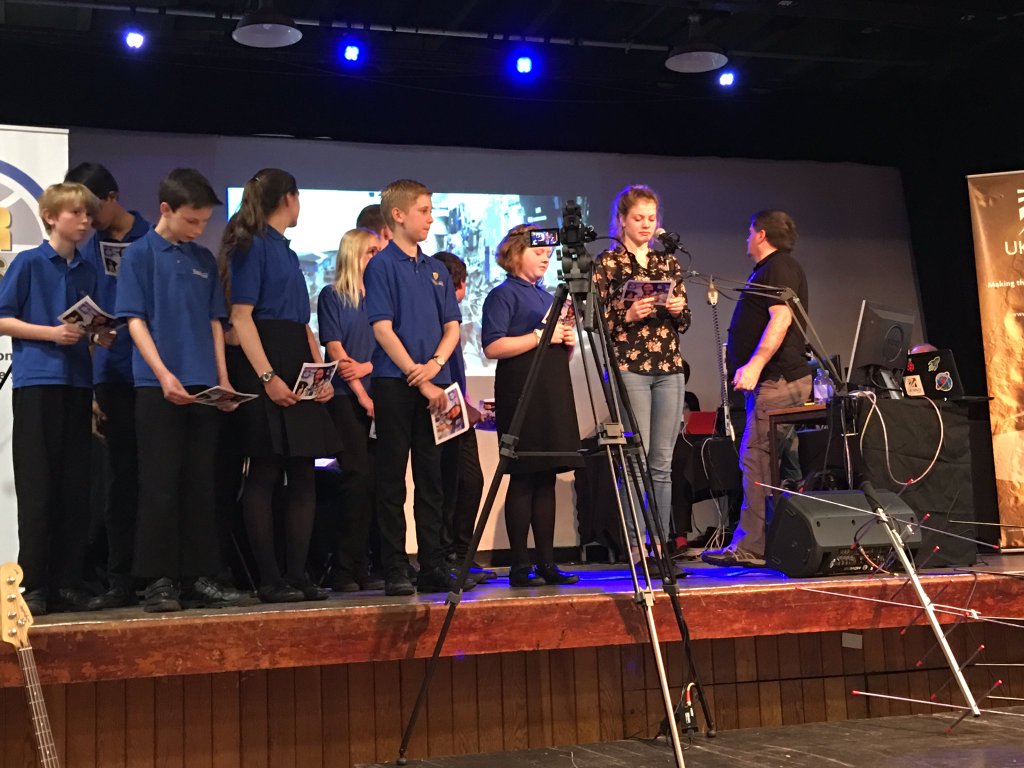
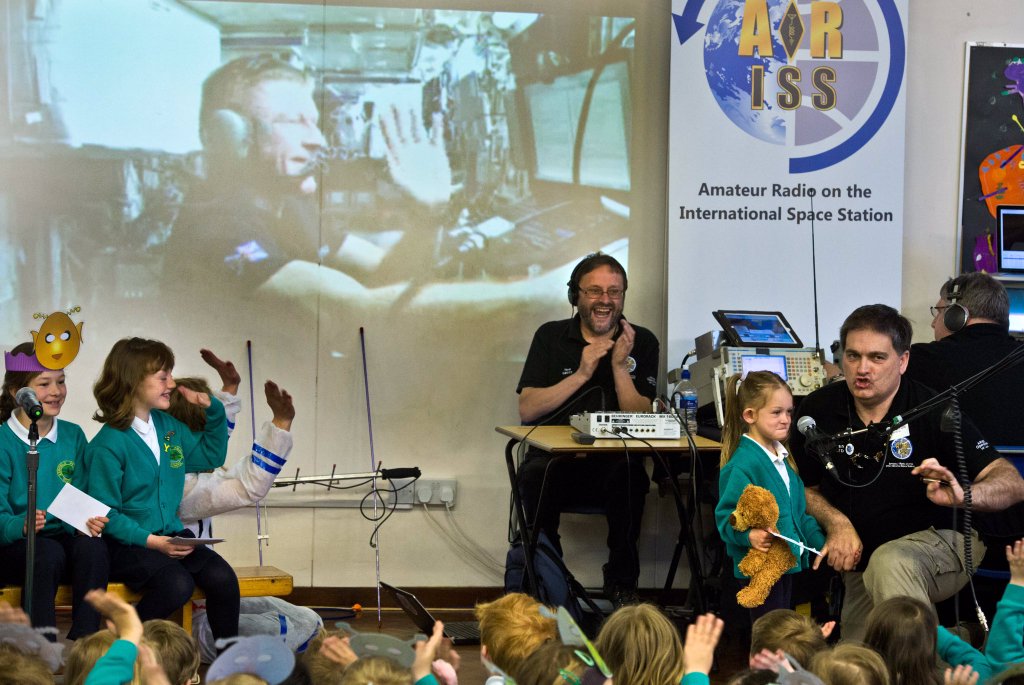
Students at Derby High School in Bury used amateur radio to link up with Tim Peake

Students at Derby High School in Bury used amateur radio to link up with Tim Peake

An ARISS contact between Derby High School GB1DHS in Bury and Tim Peake GB1SS on the International Space Station took place on Monday, April 25, 2016 at 1202 GMT (1:02 pm BST).

The contact was receivable on 145.800 MHz FM over the British Isles and Western Europe and webcast on the ARISS Principia website.

The Bury Times reported:

Year Nine pupils at The Derby High School were joined by others from Holy Trinity, Radcliffe Hall, St Peter’s and Wesley Methodist primary schools for the space extravaganza.

The event involved a presentations from actor Peter Joyce, who engaged the audience as Isaac Newton, The Derby band dancers, and Ciaran Morgan [M0XTD], the Radio Society of Great Britain lead for ARISS (Amateur Radio on the International Space Station).

An expert science panel consisting of Dr Helen Mason OBE from Cambridge University, Jeremy Curtis, the Head of Education and Skills at The UK Space Agency, and Milo Noblet [2E0ILO], Youth Committee of the Radio Society of Great Britain, also answered the amazed youngsters’ questions on space.

The amateur radio contact generated plenty of media coverage which included:

Bury Times:
http://www.burytimes.co.uk/news/14454406._Can_you_hear_me__Major_Tim___School_pupils_make_radio_call_to_International_Space_Station/

That’s Manchester TV News report https://www.youtube.com/watch?v=W7mx-wx2_sY

Watch TV News: Bury Students Speak to Tim Peake in Space

Watch Tim Peake link up – The Derby High School

Participants Presentation:

The Derby High School is a state comprehensive school (11-16 with 855 pupils 2015-16) situated in the town of Bury. The school is co-educational and is proud to be a community school supporting the diverse population of Bury and Radcliffe. 50% of students reside in an area within the top 20% of socio-economic deprivation nationally. The proportion of students who are disadvantaged and supported through the pupil premium is significantly high when compared with most schools. The proportion of students from minority ethnic backgrounds is well above average. The percentage of students who progress to post-16 studies is high.

Derby High School Bury LogoThe school opened in 1958 and in 2003 became the first Science and Arts Specialist College in the country.

The school motto: Excellence, Tradition and Imagination embodies all that we strive to achieve.

We are committed to offering a first class academic education with excellent vocational opportunities and preparation for the world of work. Sport is a strength and all our students learn how to ‘live well’; to cook, eat healthily and be physically active. Personal, moral, cultural and social education is crucial to the life of our school. Citizenship and ethical education take centre stage in our school.  We seek to equip our children and the wider community, not only to live in the future world, but to shape that future world and create a better tomorrow. We are proud to be the face of modern democratic Britain. Our values are enshrined in the 7 R’s: Respectful, Responsible, Reasonable, ready, Resourceful, Resilient and Right Impression

The enrichment and engagement opportunities on offer to pupils at The Derby would probably not be bettered anywhere. From humble beginnings in 2002, the program of events and activities has grown from a single educational visit to over 50 activities on offer year on year to all pupils regardless of ability.

The success of our program has in turn led to national recognition. In 2012 Mr Paul Kerr won an Institute of Physics Teacher Award for excellence in teaching and in recognition for the outstanding commitment to developing an extensive enrichment program. In 2013 the Science Department won the national TES Award for Educational Excellence in Science, and in 2014 was commended in the Science category at The Education Business Awards. In 2015 Mr Paul Kerr was also a finalist at The STEMNET Awards in the category of STEM Leadership.

Tim Peake KG5BVI / GB1SS preparing for his spacewalk in January

Tim Peake KG5BVI / GB1SS preparing for his spacewalk in January

Participants will ask as many of the following questions as time allows:

1. Leah (year 7):  Tim, You have become an inspiration to young people, how do you feel about this?
2. Lewis (year 7):  Is it be possible to detect dark matter whilst in space?
3. Aisha (year 8):  How do you get enough electricity to power everything we see on the ISS?
4. Paul (year 9):  Do you think you will get to go on another space mission, and what might it be?
5. Shahaan (year 10): Can disease, as we know it on earth, exist in space?
6. Leah (year 11): What everyday task has become more complicated in space?
7. Nathan (year 5):  The Sun looks yellow from Earth, does it look different from space?
8. Francesca (year 5):  If you could invite two guests, past or present to join you for dinner on the ISS who would they be and why?
9. Rosie – year 5):  Does your heart beat faster or slower in space?
10. Hamaad (year 5):  Would you encourage your children to become astronauts?
11. Leah (year 7):  Do molecules and atoms behave differently in space?
12. Lewis (year 7):  Is it easier to see other planets in the Solar System from the ISS?
13. Aisha (year 8):  If you could visit your younger self what would you say about your experience?
14. Paul (year 9):  What is your most important experiment and how will we benefit down here on Earth?
15. Shahaan (year 10):  Do movies like Gravity give a realistic picture of being in space?
16. Leah (year 11):  You are completing over 200 experiments. How will they benefit us here on Earth?
17. Nathan (year 5):  If you fired a bullet in space how far would it go?
18. Francesca (year 5):  Why do you wear a mission patch on your space suit?
19. Rosie – year 5):  Do seeds grow faster in space than on Earth?
20. Hamaad (year 5):  Will being back on Earth ever be the same for you?

Amateur Radio on the International Space Station (ARISS) logoARISS is an international educational outreach program partnering the volunteer support and leadership from AMSAT and IARU societies around the world with the ISS space agencies partners: NASA, Russian Space Agency, ESA, CNES, JAXA, and CSA.

ARISS offers an opportunity for students to experience the excitement of Amateur Radio by talking directly with crew members on-board the International Space Station. Teachers, parents and communities see, first hand, how Amateur Radio and crew members on ISS can energize youngsters’ interest in science, technology, and learning.

ARISS Principia https://principia.ariss.org/

The Derby High School to speak to ISS https://amsat-uk.org/2016/04/03/derby-high-tim-peake/

Derby High School, Bury, UK
http://www.derby.bury.sch.uk/
https://twitter.com/derbyhighbury

UK ARISS shortlisted schools https://amsat-uk.org/2016/02/03/all-uk-ariss-shortlisted-schools-are-now-scheduled/

Listening to the ISS on a handheld radio https://amsat-uk.org/2016/01/10/listening-iss-on-handheld/

Get press publicity by receiving ISS school contacts
https://amsat-uk.org/2016/03/10/press-publicity-receiving-iss/

What is Amateur Radio? http://www.essexham.co.uk/what-is-amateur-radio

Find an amateur radio training course near you https://thersgb.org/services/coursefinder/

A free booklet is available aimed at introducing newcomers to the hobby that can also be used as a handy reference while getting started, see
http://rsgb.org/main/get-started-in-amateur-radio/alex-discovers-amateur-radio-2/

Listen to Tim Peake on 2m FM

UK astronaut Tim Peake KG5BVI GB1SS in the ISS Jan 2016

UK astronaut Tim Peake KG5BVI / GB1SS

UK radio amateurs have the chance to listen to Tim Peake GB1SS transmitting on 145.800 MHz FM from the International Space Station (ISS).

The dates of Tim’s planned UK school contacts are at https://amsat-uk.org/2016/02/03/all-uk-ariss-shortlisted-schools-are-now-scheduled/

All you need to hear Tim is a 144 MHz handheld radio, such as the popular £16 BaoFeng UV-5R VHF/UHF transceiver. If used outdoors you should be able to hear Tim with just the tiny antenna supplied with the handheld. If you have a 1/4 wave whip you will get better results.

In the UK we use narrow 2.5 kHz deviation FM but the ISS transmits on 145.800 MHz with the wider 5 kHz deviation used in much of the world. Most base station and mobile radios can be switched been wide and narrow deviation FM filters and for best results you should select the wider filter. Handheld radios all seem to have a single wide filter fitted as standard.

As a result of Doppler shift the 145.800 MHz ISS signal may vary by +/- 3.5 kHz during a pass going from 145.835 to 145.7965 MHz. Many FM radios can only tune in steps of 5 kHz, with such equipment you may get best results by selecting 145.805 at start of pass, then 145.800 and finally 145.795 MHz.

Not got a VHF radio or not in the UK ? You can tune-in to Tim Peake online from anywhere in the world using the SUWS amateur radio WebSDR receiver located at Farnham near London http://websdr.suws.org.uk/

There will be a live video webstream of Tim Peake’s UK school contacts at
https://principia.ariss.org/Live/

Video – Listening to the ISS on a handheld radio
https://amsat-uk.org/2016/01/10/listening-iss-on-handheld/

How to hear the ISS https://amsat-uk.org/beginners/how-to-hear-the-iss/

Get press publicity by receiving ISS school contacts
https://amsat-uk.org/2016/03/10/press-publicity-receiving-iss/

Earth to Space via Amateur Radio

The story of the buildup, workshops and Live contact with Tim Peake on the ISS made using Amateur Radio by Norfolk Schools at the City of Norwich School on February 26, 2016.

1080 high resolution version – 720P version also available to download
©Abacus Television and Norfolk Amateur Radio Club 2016

Watch Earth to Space via Amateur Radio 1080 ©Abacus TV & NARC

UK schools scheduled for ISS contact
https://amsat-uk.org/2016/02/03/all-uk-ariss-shortlisted-schools-are-now-scheduled/

Listening to the ISS on a handheld radio https://amsat-uk.org/2016/01/10/listening-iss-on-handheld/

Get press publicity by receiving ISS school contacts
https://amsat-uk.org/2016/03/10/press-publicity-receiving-iss/

What is Amateur Radio? http://www.essexham.co.uk/what-is-amateur-radio

Find an amateur radio training course near you https://thersgb.org/services/coursefinder/

A free booklet is available aimed at introducing newcomers to the hobby that can also be used as a handy reference while getting started, see
http://rsgb.org/main/get-started-in-amateur-radio/alex-discovers-amateur-radio-2/

St Richard’s Catholic College Tim Peake Contact

Lucy Woolridge establishing communications with Tim Peake KG5BVI / GB1SS on the ISS

    Lucy Woolridge M6LGJ establishing communications with Tim Peake KG5BVI / GB1SS on the ISS

An International Space Station radio contact took place on Monday, April 18 1456 GMT between Timothy Peake GB1SS and participants at St Richard’s Catholic College, Bexhill-on-Sea, East Sussex using the call sign GB4SRC.

The contact was audible on 145.800 MHz FM over Western Europe and was streamed on the web at https://principia.ariss.org/Live/

The Bexhill Observer reported:

Star of the show and year nine pupil Lucy Woolridge M6LGJ initiated and ended the link expertly, using her recently-gained amateur radio license, and was lost for words.

“I feel relieved, it was amazing but we were very lucky to be able to speak to Tim at all,” she said.

There was some tension as it took five goes by Lucy before Tim replied saying, ‘I hear you loud and clear’.

The amateur radio contact generated plenty of media coverage which included:

The Bexhill-on-Sea Observer newspaper
http://www.bexhillobserver.net/news/local/students-speak-to-astronaut-tim-peake-in-bexhill-1-7335695

Shoreham Herald – St Richard’s students speak to astronaut Tim Peake
http://www.shorehamherald.co.uk/news/local/county-news-students-speak-to-astronaut-tim-peake-1-7336995

A video of the full contact is available from BBC TV South-East at
https://www.facebook.com/BBCSouthEastToday/videos/10154116229478648

BBC’s Chrissie Reidy interviewed Carlos Eavis G0AKI / G3VHF about the contact
https://twitter.com/BBC_CReidy/status/722094969767505920/video/1

St Richard's Catholic College

St Richard’s Catholic College

Participants Presentation:

St Richard’s Catholic College is a Science Specialist school tucked between the South Downs and the English Channel. We have 1000 pupils on roll between Years 7–11. We provide an inclusive education for Catholic and Christian pupils covering an extended catchment area covering approximately a 30 mile radius.

St Richard’s was awarded Teaching School status late in 2014 and we are the lead school in the Thrive Alliance, an association of primary schools, secondary schools and a sixth form college as well as lead in the Sussex Science Subject Hub. We are also a strategic partner in the Sussex Maths Hub. St Richards’ Science department enjoys a very strong relationship with the University of Sussex  (particularly Astronomy & Physics); University of Greenwich (Outreach) and we sit on the STEM Focus Group hosted by the University of Brighton’s STEM Sussex.

Audience listening to the ARISS contact at St Richard's Catholic College

Audience listening to the ARISS contact at St Richard’s Catholic College

We are a keen supporter of STEM events in our region, with particular success at the Annual STEM Fest event where we have won prizes at the National Science and Engineering Competition for the last four years, twice through to national competition. STEM Sussex have used St Richard’s STEM Clubs’ provision as an exemplar due to its success in engaging pupils of all abilities across all year groups. The department has also enjoyed a high quality Continuous Professional Development engagement in the STEM agenda with involvement in ‘Space as a context for teaching science’ courses and a future STEM project with the University of Reykjavik in Iceland.

We enjoy Space Camp UK, a residential trip with all things “spacy” at the National Space Centre and Duxford.

The coordinating teacher, Dr Joolz Durkin, is the curriculum enhancement for science and is also an enthusiastic “Space Ambassador” and has worked with the Tim Peake Primary Project at Parklands Infants Eastbourne, Dallington School in Dallington, Pebsham Primary in Bexhill on Sea and Vinehall School in Heathfield as part of this link up.

Participants will ask as many of the following questions as time allows:

UK astronaut Tim Peake KG5BVI GB1SS in the ISS Jan 2016

UK astronaut Tim Peake KG5BVI GB1SS in the ISS Jan 2016

1. (Lucy – Year 9) – You have mentioned in an earlier call that you have been sleeping very well on the Space Station. Is that still the case or have you found any cumulative effects after four months in space ?

2. (Aeden – Year 10) – As the ISS hosts astronauts from many different nationalities, what public holidays do the crew observe, if any, and how are they chosen?

3. (Anna – Year 11) – St Richards and two of our Primary Project Partner school, Dallington and Vinehall are taking part in the RHS ‘Rocket Science’ Experiment from the Principia Mission. How will the results from this experiment influence future planning for growing similar samples in another planet’s gravity?

4. (Andrew – Year 11) – We have seen the preparation with Heston Blumental of an exciting astronaut menu for the mission – does the food taste the same in space as it did on Earth?

5. (Shona – Year 11) – In a sealed spacecraft like the International Space Station, how is the air quality monitored and controlled?

6. (Luigi – Year 11) – We see the wonderful time lapse images of the ISS orbiting the Earth, but what I like looking at are the stars and making out the constellations. Do you do any astronomical research on the ISS?

7. (Moira – Year 11) – During the mission you yourself are part of experiments using the British designed MMS Cerebral and Cochlear Fluid Pressure Analyser to collect data for the NASA Fluid Shifts investigation. Which aspect of the self-experimentation has been the most interesting or challenging?

8. (Chris – Year 9) – Are there any experiments that rely on naked flames on the ISS? If so, how are they carried out and what low gravity precautions are employed?

9. (Ancy – Year 11) – If I oversleep my parents will wake me up – have you overslept on the ISS and had to be woken up by someone?”

10. (Will – Year 10) – The distance between Bexhill and Brighton is 31 miles with a journey time by car of nearly 50 minutes. How much time would it take for the ISS to do this trip?

11. (Vita – Year 11) – What are the greatest challenges of living in space and in retaining a permanent crew on board the ISS?

12. (Max – Year 10) – You have tweeted some amazing and beautiful images of the aurora. Have you been able to monitor solar flare or CME activity and correlate to the brightness of the aurora?

13. (Ben – Year 11) – How does it feel to be able to see all humanity?

14. (Lucy – Year 9) – Is the ISS affected by the Earth’s magnetic field?

15. (Aeden – Year 10) – On Sunday you will be joining thousands of others in taking part in the London Marathon. What special routines have you trained for this in space?

16. (Anna – Year 11)) – In the London marathon, runners will have natural cooling as the run – how do you regulate your body temperature in a sealed environment such as the IS?.

17. (Andrew – Year 11) – We understand you are taking part in the Skin B research on the ISS?  Can you share any interesting findings?

18. (Shona – Year 11) – You have tweeted that having a bacon sandwich and cup of tea on arrival at the ISS was the best welcome possible.  What food are you looking forward to on landing?

19. (Luigi – Year 11) – What is special about space suits that help you breathe in space when on an EVA?

20. (Moira – Year 11) – How smooth was the launch in December?

ARISS is an international educational outreach program partnering the volunteer support and leadership from AMSAT and IARU societies around the world with the ISS space agencies partners: NASA, Russian Space Agency, ESA, CNES, JAXA, and CSA.

ARISS offers an opportunity for students to experience the excitement of Amateur Radio by talking directly with crew members on-board the International Space Station. Teachers, parents and communities see, first hand, how Amateur Radio and crew members on ISS can energize youngsters’ interest in science, technology, and learning.

This contact will be webcast on the ARISS Principia website. Further details on the start time of the webcast will be made available in the coming days so be sure to check for further information at https://principia.ariss.org/

St Richard’s Catholic College
https://twitter.com/StRichardsCC
http://www.strichardscc.com/

St. Richard’s Catholic College Build-a-thon a success
http://www.southgatearc.org/news/2016/april/st_richards_college_buildathon_a_success.htm

UK ARISS shortlisted schools
https://amsat-uk.org/2016/02/03/all-uk-ariss-shortlisted-schools-are-now-scheduled/

Listening to the ISS on a handheld radio https://amsat-uk.org/2016/01/10/listening-iss-on-handheld/

Get press publicity by receiving ISS school contacts
https://amsat-uk.org/2016/03/10/press-publicity-receiving-iss/

What is Amateur Radio? http://www.essexham.co.uk/what-is-amateur-radio

Find an amateur radio training course near you https://thersgb.org/services/coursefinder/

A free booklet is available aimed at introducing newcomers to the hobby that can also be used as a handy reference while getting started, see
http://rsgb.org/main/get-started-in-amateur-radio/alex-discovers-amateur-radio-2/

Wellesley House School Tim Peake Contact

Amateur Radio was explained to Wellesley House School students by RSGB Youth Committee member Oscar Hall 2E0SWE and DRM Keith Bird G4JED - Credit RSGB

Amateur Radio was explained to Wellesley House School students by RSGB Youth Committee member Oscar Hall 2E0SWE and DRM Keith Bird G4JED – Credit RSGB

The ARISS contact between Wellesley House School GB1WHS in Broadstairs, Kent and Tim Peake GB1SS on the International Space Station took place on Saturday, April 23, 2016 at 1210 GMT (1:10 pm BST).

The contact was receivable on 145.800 MHz FM over the British Isles and Western Europe and webcast on the ARISS Principia website. The HamTV Digital Amateur Television system on 2395 MHz enabled the students to see Tim Peake as he flew overhead at 27,600 km/h.

Ethan M6GQK established contact with Tim Peake GB1SS

Ethan M6GQK established contact with Tim Peake GB1SS

Members of Hilderstone Amateur Radio and Electronics Club (HAREC) have been working with Wellesley House students and were present at the event along with the Radio Society of Great Britain (RGSB), the UK Space Agency (UKSA) and students representing 23 other schools in the area.

The RSGB announced the same day that HAREC are the Region 10 winners of the Club of the Year 2015 competition.

Kent Online reported:

Wellesley House School science teacher and lead organiser for the space extravaganza Kerry Sabin-Dawson masterminded the whole project.

She said: “This has been more than a year in the planning, we sent off an application thinking, if you’re not in it you won’t win it.”

“We got through to round two and we had a second application with far more detail, amazingly we got chosen as one of the 10 schools and we were mind blown by it.”

“There were very tense moments at the start and the problem was this is amateur radio, there’s no trickery, there was a problem but they dealt with it.”

Wellesley House School head Simon O’Malley said: “This is awesome. There has been an incredible buzz around the school since the launch in November.

“I genuinely hope it really inspires children who maybe didn’t think they were scientists, engineers, mathematicians but who now think they can be.”

The amateur radio contact generated plenty of media coverage which included:

Kent Online
http://www.thanetgazette.co.uk/Thanet-pupils-make-radio-contact-ISS-astronaut/story-29163570-detail/story.html

Thanet Gazette
http://www.thanetgazette.co.uk/Thanet-pupils-make-radio-contact-ISS-astronaut/story-29163570-detail/story.html

BBC News http://www.bbc.co.uk/news/uk-england-kent-36119790

Wellesley House School Logo

Wellesley House School

Participants Presentation:

Wellesley House is a prep school with approx. 140 pupils. Our aim is to open up a world of opportunity for girls and boys aged from 7 to 13. We are primarily a boarding school with about one third day pupils. Our catchment is vast, with international pupils as well as pupils from across the South East.

Our ethos is that success follows success, whether in or outside the classroom, and occurs naturally in pupils who are happy and motivated. All pupils are encouraged to push themselves and made to feel secure enough to take risks.

The school provided Space outreach for local schools in October 2014 following Science teacher Kerry Sabin-Dawson’s attendance at the ESERO-UK Space conference – the Primary Frontier in July 2014 in York. Inspired by the initiatives and resources available she held a Space training session for local primary teachers to encourage them to bring space education into the classroom.

Fourteen local schools attended and it was a great success. There was a representative from the Royal Greenwich Observatory, an education liaison officer from the local company Pfizer Ltd, Canterbury STEM ambassador Becky Vincer and John Hislop G7OHO of the Monkton Stargazers, a local astronomy group. The organiser of the theatre group Spacefund explained how she had written the Team Tim show with the cooperation of Tim Peake, which was promptly booked by some of the schools.

Wellesley House students Ethan M6GQK and Benny M6YZH passed their Amateur Radio Foundation exam for the contact - Credit Hilderstone Radio Club

Wellesley House students Ethan M6GQK and Benny M6YZH passed their Amateur Radio Foundation exam for the contact – Credit HAREC

Participants will ask as many of the following questions as time allows:

1. Benny (age 12): Today is International Marconi Day; how do you think Marconi would feel about this radio communication?
2. (Ruby (age 8): From space, what evidence can you see that humans are having a negative impact upon planet Earth?
3. Robert (age 12): We are planting seeds brought back by the Russian cosmonauts at Ursuline. How do you think they will grow?
4. Ellie (age 7): What happens to a compass in Space?
5. Scarlett (age 7): It is 400 years today since Shakespeare died. Which Shakespearean quote do you think best describes your mission?
6. Erica (age ): What is the biggest lesson you have learned whilst being in Space? (Chartfield)
7. Alica (age 10): How do you think being in space has changed you? (River)
8. Max (age 7): Do bacteria multiply at the same rate in a low gravity environment? (Pluckley)
9. Oliver (age 11): What do you need to do to acclimatise back to the Earth’s gravity on your return? (Garlinge)
10. Joe (age 9): Did you ever dream about becoming an astronaut when you were a child? (St L Junior Acad)
11. Ethan (age 12): What space exploration do you think we will be doing in 200 years? (Smarden)
12. Benny (age 12): Have you played any jokes on your colleagues on the ISS? Scarlett
13. Ruby (age 8): What is the first thing you are going to do when you get home? (St Lawrence)
14. Robert (age 12): What was your spacewalk like? Elsie Meades (St Mildreds)
15. Ellie (age 7): What’s your favourite experiment to conduct, and why? (Bromstone)
16. Scarlett (age 7): What do you do if there is a fire on the ISS?
17. Erica (age 10): Have you ever seen any other objects go past you in space such as comets or asteroids? (St George’s C of E)
18. Alisha (age 10): Will you be visiting schools when you return to Earth? And will you please visit Wellesley House? (again)
19. Max (age 7): How is time different in space?
20. Oliver (age 11): Do you get a proxy vote if you are in space?

Amateur Radio on the International Space Station (ARISS) logoARISS is an international educational outreach program partnering the volunteer support and leadership from AMSAT and IARU societies around the world with the ISS space agencies partners: NASA, Russian Space Agency, ESA, CNES, JAXA, and CSA.

ARISS offers an opportunity for students to experience the excitement of Amateur Radio by talking directly with crew members on-board the International Space Station. Teachers, parents and communities see, first hand, how Amateur Radio and crew members on ISS can energize youngsters’ interest in science, technology, and learning.

ARISS Principia https://principia.ariss.org/

Wellesley House School ready to host contact day with astronaut Tim Peake
http://www.thanetgazette.co.uk/Wellesley-House-School-ready-host-contact-day/story-29138443-detail/story.html

Wellesley House School
https://twitter.com/wellesleyschool
http://www.wellesleyhouse.org/
https://www.facebook.com/groups/151758731526337/

Hilderstone Amateur Radio and Electronics Club
http://g0hrs.org/
https://twitter.com/G0HRS
https://www.facebook.com/groups/151758731526337/

Primary school students tune in to Tim Peake thanks to Hilderstone AREC
https://amsat-uk.org/2016/02/02/primary-school-students-tune-in-to-tim-peake/

UK ARISS shortlisted schools https://amsat-uk.org/2016/02/03/all-uk-ariss-shortlisted-schools-are-now-scheduled/

Listening to the ISS on a handheld radio https://amsat-uk.org/2016/01/10/listening-iss-on-handheld/

Get press publicity by receiving ISS school contacts
https://amsat-uk.org/2016/03/10/press-publicity-receiving-iss/

What is Amateur Radio? http://www.essexham.co.uk/what-is-amateur-radio

Find an amateur radio training course near you https://thersgb.org/services/coursefinder/

A free booklet is available aimed at introducing newcomers to the hobby that can also be used as a handy reference while getting started, see
http://rsgb.org/main/get-started-in-amateur-radio/alex-discovers-amateur-radio-2/

Ten-year-old Lauren, M6HLR was presented with her Gold Award by RSGB DRM Keith Bird, G4JED and Wellesley House Head, Simon O'Malley - Credit RSGB

Ten-year-old Lauren, M6HLR was presented with her Gold Award by RSGB DRM Keith Bird, G4JED and Wellesley House Head, Simon O’Malley – Credit RSGB

UK Space Agency: Ham Radio in Top 10

Tim Peake HamTV at RMSforGirls - Credit Sian Cleaver

Tim Peake used HamTV to talk to students – Credit Sian Cleaver

On April 7 to celebrate the 44th birthday of astronaut Tim Peake the UK Space Agency published their 10 favourite moments from his Principia mission – Amateur Radio was number 7

The UKSA say “Five schools have held amateur radio call to Tim as he passes over the UK aboard the ISS. In a world first at a school, video was streamed over the radio airwaves which meant that the students could see as well as hear. We’re looking forward to the next five calls coming up over the coming weeks.”

Read UKSA Happy Birthday Tim! https://principia.org.uk/news/happy-birthday-tim/

Listening to the ISS on a handheld radio https://amsat-uk.org/2016/01/10/listening-iss-on-handheld/

Get press publicity by receiving ISS school contacts
https://amsat-uk.org/2016/03/10/press-publicity-receiving-iss/

What is Amateur Radio? http://www.essexham.co.uk/what-is-amateur-radio

Find an amateur radio training course near you https://thersgb.org/services/coursefinder/

A free booklet is available aimed at introducing newcomers to the hobby that can also be used as a handy reference while getting started, see
http://rsgb.org/main/get-started-in-amateur-radio/alex-discovers-amateur-radio-2/