ARISS International Meet This Week in Tokyo

ARISS LogoARISS International Delegates, its Board of Officers, and international team members will meet at Big Sight, Tokyo, Japan on August 20-23, 2015 for a critical meeting to discuss ARISS strategy, teamwork, hardware and operations.

Delegates are voting members of ARISS-I representating the 5 ISS member regions: United States, Russia, Japan, Canada and Europe.

The meeting will open with remarks from meeting host Keigo Komuro, JA1KAB from ARISS Japan and JARL.

Other agenda items will include:
• Welcome by the Japanese Space Agency JAXA & an Overview of the JAXA Innovative Satellite Technology Demonstration Program
• ARISS working group business discussions and reports, including: regional reports, ARISS Terms of Reference update, space agency coordination status, sustainability & fundraising and ARISS future endeavors
• Technical discussions on current and future hardware developments, including: Next Generation ARISS Radio Systems, the Astro-Pi Project, and an update on the Ham-TV system
• Operations discussions, including presentations on: Educational Activities, International Expansion & Planning of SSTV. School
Selection and Regional Scheduling Procedures and plans for the
upcoming Tim Peake Mission

Along with their ambitious schedule the delegates will begin each day with an opportunity for informal discussions and will have the opportunity to visit the Tsukuba Space Center.

[ANS thanks ARISS-I for the above information]

Amateur Radio on the International Space Station
• ARISS International organisation http://www.ariss-eu.org/international.htm
• ARISS-Europe Terms of Reference http://www.ariss-eu.org/tor.htm
• ISS Amateur Radio stations http://www.ariss.org/contact-the-iss.html

Frequencies Announced for Nayif-1 CubeSat

Deputy project manager of Nayif-1 Fatma Lootah

Deputy project manager of Nayif-1 Fatma Lootah

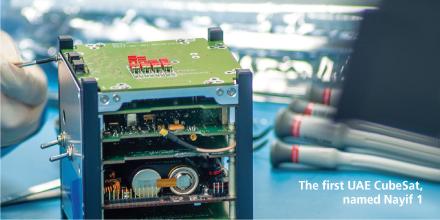
Nayif-1 is an educational single CubeSat project with the goal of providing an actual space project for Emirati University students. Additionally it is intended to enthuse and educate young people about radio, space physics and electronics.

The 1U CubeSat is a collaboration between the Mohammed Bin Rashid Space Center and the American University of Sharjah both in the United Arab Emirates.

Nayif-1 - Credit Mohammed bin Rashid Space Centre

Nayif-1 – Credit Mohammed bin Rashid Space Centre

The spacecraft will only require simple ground station antennas and an SDR dongle receiver. This will make it uncomplicated for schools and colleges to use with their students.

It is anticipated Nayif-1 will be launched into an elliptical, sun synchronous, Low Earth Orbit (LEO) about 400 by 750 km. In such an orbit the satellite passes over the Emirates at least twice a day. This would allow the morning passes to be used for educational purposes and the evening passes for Amateur Radio communications.

The student team will develop and operate a special ground station for this spacecraft. They will also be developing a unique “Dashboard” to display the received telemetry data and greetings messages in Arabic.

Nayif-1 will incorporate a novel autonomous attitude determination and control system. This will be the first flight of this system. Additionally it will carry a UHF to VHF linear transponder that will have up to 0.5 watt output and which can be used by Radio Amateurs worldwide for SSB and CW communications.

A launch is planned for late 2015 on a SpaceX Falcoln 9.

IARU coordinated frequencies for NAYIF-1:
• 145.940 MHz 1200 bps BPSK FUNcube beacon
• 500 mW inverting SSB/CW linear transponder
– 435.045-435.015 MHz Uplink
– 145.960-145.990 MHz Downlink

Follow Nayif-1 on Twitter https://twitter.com/Nayifone

Nayif-1 https://amsat-uk.org/satellites/communications/nayif-1/

ISS SSTV July 18-19 on 145.800 MHz FM

ISS SSTV image 1 received by Murray Hely ZL3MH January 31, 2015

ISS SSTV image received by Murray Hely ZL3MH January 31, 2015

ARISS SSTV images will be transmitted this weekend from the amateur radio station in the ISS Russian Service Module to commemorate the 40th Anniversary of the Apollo-Soyuz Mission.

40 years ago this week, the historic joint Apollo-Soyuz mission was conducted.  Apollo-Soyuz (or Soyuz-Apollo in Russia) represented the first joint USA-Soviet mission and set the stage for follow-on Russia-USA space collaboration on the Space Shuttle, Mir Space Station and the International Space Station.

The Soyuz and Apollo vehicles were docked from July 17-19, 1975, during which time joint experiments and activities were accomplished with the 3 USA astronauts and 2 Soviet Cosmonauts on-board.  Apollo-Soyuz was the final mission of the Apollo program and the last USA human spaceflight mission until the first space shuttle mission in 1981.

To commemorate the 40th anniversary of this historic international event, the ARISS team has developed a series of 12 Slow Scan Television (SSTV) images that will be sent down for reception by schools, educational organizations and ham radio operators, worldwide.  The SSTV images are planned to start sometime Saturday morning, July 18 and run through Sunday July 19.  These dates are tentative and are subject to change.  The SSTV images can be received on 145.800 MHz FM and displayed using several different SSTV computer programs that are available on the internet.

We encourage you to submit your best received SSTV images to:
http://spaceflightsoftware.com/ARISS_SSTV/submit.php

The ARISS SSTV image gallery will post the best SSTV images received from this event at:
http://spaceflightsoftware.com/ARISS_SSTV/index.php

Also, as a special treat, on Saturday July 18 the ISS Cosmonauts will take time out to conduct an ARISS contact with students attending the Moon Day/Frontiers of Flight Museum event in Dallas Texas.  This Russian Cosmonaut-USA Student contact is planned to start around 16:55 UTC through the W6SRJ ground station located in Santa Rosa, California.  ARISS will use the 145.800 MHz FM voice frequency downlink (same as the SSTV downlink) for the Moon Day contact.

For more information on ARISS, please go to our web site http://www.ariss.org/

The ARISS international team would like to thank our ARISS-Russia colleague, Sergey Samburov, RV3DR, for his leadership on this historic commemoration.

Frank H. Bauer, KA3HDO
ARISS International Chair

Previous ISS SSTV transmissions have used the SSTV mode PD180 with a 3-minute off time between each image.

ISS Slow Scan TV information and links for tracking the ISS at https://amsat-uk.org/beginners/iss-sstv/

You can receive the SSTV transmissions online using the SUWS WebSDR remote receiver located near London along with the MMSSTV software https://amsat-uk.org/2014/08/15/suws-websdr-moves-to-new-site/

School Shortlist for Tim Peake Space Station Contact

Major Tim Peake KG5BVI

Major Tim Peake KG5BVI

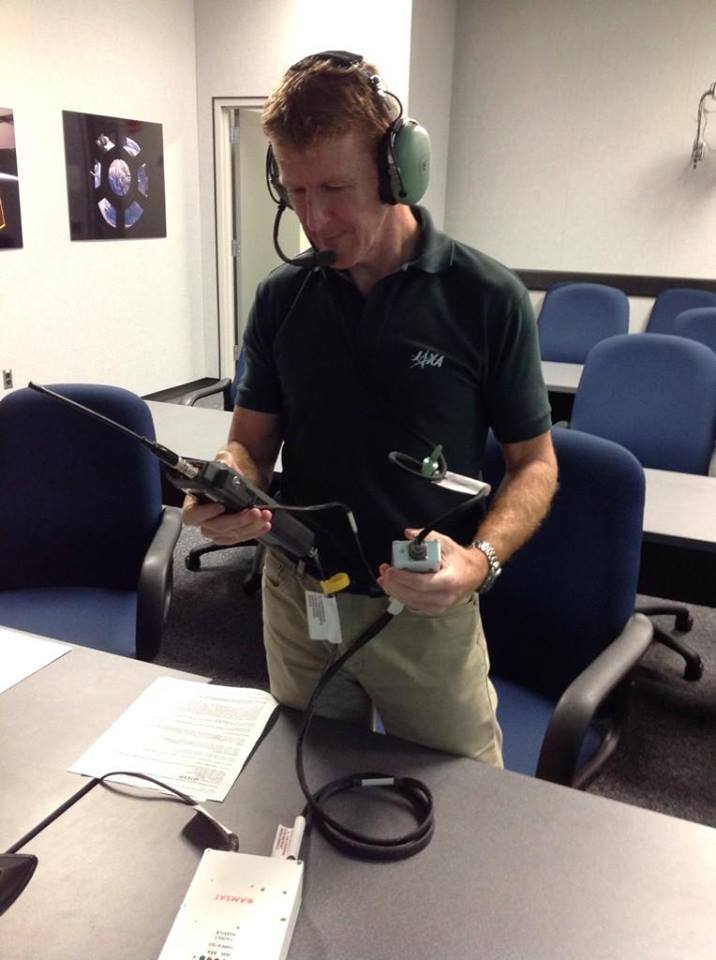
On Tuesday, July 14 at the UK Space Conference in Liverpool the names were announced of the UK schools which have won the opportunity to contact UK astronaut Tim Peake via amateur radio during his mission to the International Space Station. Tim holds the call sign KG5BVI and is expected to use the special call GB1SS from the amateur radio station in the Columbus module of the ISS.

Tim Peake KG5BVI training on ISS Amateur Radio Station Equipment

Tim Peake KG5BVI training on ISS Amateur Radio Station Equipment

Tim will launch to the ISS in December of this year and will spend 6 months working and living in space. The Amateur Radio competition is a collaboration between the UK Space Agency, the Radio Society of Great Britain (RSGB) and the European Space Agency (ESA).

Selected schools will host a direct link-up with the ISS during a two-day, space related STEM workshop which will be the culmination of a large range of learning activities using space as a context for teaching throughout the curriculum.

ARISS UK (Amateur Radio on the International Space Station) will provide and set up all necessary radio equipment such as low earth orbit satellite tracking antennas and radios, to establishing a fully functional, direct radio link with the ISS from the schools’ very own premises. In a ten-minute window when the ISS will be over the UK, an amateur radio contact will be established with Tim, and students will be able to ask him questions about his life and work on board the ISS.

Owing to the nature of scheduling the links, which is dependent on geography, the exact orbit of the ISS and the crew schedules, the exact dates and times for possible links will not be known until 2 weeks before the link up is scheduled. The shortlisted schools will all be prepared for such scheduling challenges and, by having a number of schools, we can ensure that all links are used.
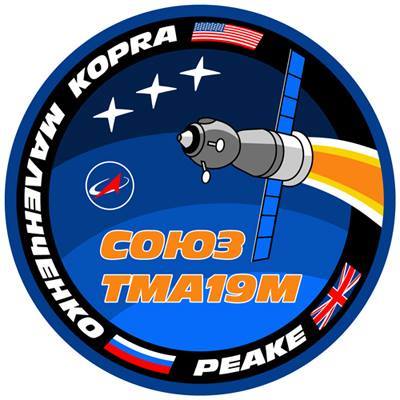
Soyuz TMA-19M Mission Patch

Soyuz TMA-19M Patch

Jeremy Curtis, Head of Education at the UK Space Agency, said:

We’re delighted with the amount of interest in this exciting project and look forward to working with the selected schools as they make a call into space.

Both Tim’s space mission and amateur radio have the power to inspire young people and encourage them into STEM subjects.

By bringing them together we can boost their reach and give young people around the UK the chance to be involved in a space mission and a hands-on project that will teach them new skills.

The following schools have been shortlisted for a possible ARISS call with Tim whilst he is in orbit on the ISS:
Principia Mission Patch

  • Ashfield Primary School, Otley, West Yorkshire
  • The Derby High School, Derby
  • The Kings School, Ottery St Mary
  • Norwich School, Norwich
  • Oasis Academy Brightstowe, Bristol
  • Powys Secondary Schools Joint, Powys
  • Royal Masonic School for Girls, Rickmansworth
  • Sandringham School, St Albans
  • St Richard’s Catholic College, Bexhill-on-Sea
  • Wellesley House School, Broadstairs

John Gould, G3WKL, President of the RSGB, said:

The Radio Society of Great Britain will be delighted to support shortlisted schools by teaching their pupils about amateur radio and helping them through their licence exams where appropriate. Members of our Youth Committee are based across the UK and will be keen to visit the chosen schools in their area and chat to the pupils.

The ARISS UK Operations team will now work with the shortlisted schools to prepare them for this exceptional opportunity during the mission of the first British ESA Astronaut.

ARISS Europe http://www.ariss-eu.org/

Ham Radio Field Day from Space

As part of the #askAstro program 16-year-old Brandon Martinez KF7RAO submitted a video question to astronaut Reid Wiseman KF5LKT about Amateur Radio on the International Space Station (ARISS)

On September 14, 2014 Brandon posted his question to YouTube and on October 10 Reid KF5LKT answered it from the space station. In his reply Reid describes his experience in June of Field Day from space.

Watch Brandon’s question and Reid’s reply

ARISS http://ariss.org/

NASA Astronaut’s ISS Field Day Operation Puts Smiles on Several Faces
http://www.arrl.org/news/nasa-astronaut-s-iss-field-day-operation-puts-smiles-on-several-faces

AMSAT 2015 Field Day – June 27-28
http://www.southgatearc.org/news/2015/june/amsat_2015_field_day.htm

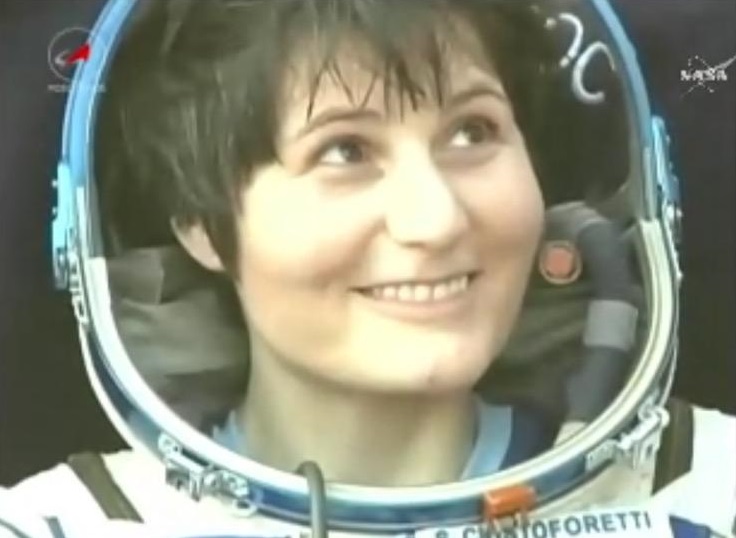
Samantha Cristoforetti IZ0UDF back on Earth

Samantha Cristoforetti, IZ0UDF back on Earth June 11, 2015

Samantha Cristoforetti, IZ0UDF back on Earth June 11, 2015

Astronaut Samantha Cristoforetti IZ0UDF along with Anton Shkaplerov and Terry Virts landed safely on Thursday, June 11 in Kazakhstan after a three-hour ride in their Soyuz spacecraft. They left the International Space Station (ISS) at 1020 UT in a Soyuz TMA-15M landing by parachute on the Kazakh steppe at 1344 UT.

Samantha Cristoforetti IZ0UDF with ISS HamTV Transmitter

Samantha Cristoforetti IZ0UDF with ISS HamTV Transmitter

Samantha is the seventh ESA astronaut and the first female ESA astronaut to complete a long-duration mission in space. She set new records for longest single time in space for an ESA astronaut and female astronauts in general.

She set a new record for single mission duration by a female astronaut with 199 days in space on her first flight, surpassing the previous record of 195 days set by Sunita Williams KD5PLB as a flight engineer on Expeditions 14 and 15 from December 2006 to June 2007.

Samantha carried out a number of ARISS amateur radio school contacts and was involved in the Blank Test Transmissions from the new ISS HamTV digital television system on 2395 MHz which were received by radio amateurs around the world.

Take a Panoramic Tour of the ISS Columbus Module, look out for the HamTV transmitter
http://www.esa.int/Our_Activities/Human_Spaceflight/International_Space_Station/Highlights/International_Space_Station_panoramic_tour

Anatoly Zak http://www.russianspaceweb.com/iss_soyuz_tma15m.html#landing
ESA http://www.esa.int/Our_Activities/Human_Spaceflight/Futura/ESA_astronaut_Samantha_Cristoforetti_back_on_Earth
NASA http://www.nasa.gov/press-release/expedition-43-crew-departs-space-station-lands-safely-in-kazakhstan

Amateur Radio on the International Space Station (ARISS) http://ariss.org/