ESTCube-1 Tether Satellite hopes for Spring launch

Artists impression of ESTCube-1 in space - Image credit University of Tartu

Artists impression of ESTCube-1 in space – Image credit University of Tartu

Estonia’s first CubeSat ESTCube-1, amateur radio callsign ES5E/S, is planning to launch from Kourou in the Caribbean in the Spring on an ESA VEGA rocket.

Built by students at the University of Tartu ESTCube-1 the main mission of the satellite is to test electric solar wind sail technology, a novel space propulsion technology that could revolutionalize transportation within the solar system. It will deploy a 10 meter conductive electrodynamic tether and the force interacting with the tether will be measured.

The technology is based on the electrostatic interaction between the electric field generated by the satellite and the high-speed particles being ejected from the Sun.  A spacecraft utilizing this method would first deploy a set of electrically charged wires, which allow to generate an electric field over a large area. This area effectively forms a “sail” that can be pushed by the charged particles by being diverted by it and therefore transferring momentum to the craft.

The team also aim to capture images of Estonia for outreach purposes.

Continue reading

New Swiss Small Satellite Launch System

Swiss Space Systems S3

Swiss Space Systems S3

Swiss Space Systems – S3 a new Swiss aerospace company, was officially inaugurated in Payerne on Thursday, March 14, in the presence of representatives of the national authorities and of prestigious Swiss and international partners such as the ESA, Dassault Aviation, the Von Karman Institute, Sonaca, Meggitt and Stanford University. S3 aims to develop, build, certify and operate suborbital space shuttles dedicated to launching small satellites, enabling space access to be made more democratic thanks to an original system with launching costs reduced to a quarter of the present cost. The first test launches are planned to be carried out by the end of 2017.

The Swiss Space Systems launch model uses an Airbus A300, an aircraft already certified for zero gravity flights, to take the shuttle up to 10,000m on its back; the shuttle will then be launched from there. Combining the internal architecture developed by the French company Dassault for Hermes with the external architecture developed by the Belgian companies Sonaca and Space Application Services will develop the shuttle. Discussions are at an advanced stage concerning the engine supplier. The shuttle-drone will take care of the next part of the ascent up to an altitude of 80km, the height at which the upper stage will be launched in order to put the satellites into orbit. Once this operation has been completed, the shuttle will return to earth by gliding towards its launch airport, where it will be taken care of by the maintenance teams who will prepare it for a new launch.

S3 say agreements have already been signed for four launches for the Von Karman Institute.

How will the in-orbit delivery of small satellites work ? Video at http://www.s-3.ch/home/2013/03/13/how-will-the-in-orbit-delivery-of-small-satellites-work

Swiss Space Systems – S3 http://www.s-3.ch/

Interplanetary CubeSats

In this video Rob Staehle discusses the communication and propulsion challenges involved in getting a CubeSat to the Moon.

The presentation was given to the 1st International Workshop on LunarCubes November 13, 2012 Palo Alto, California.

Continue reading

Amateur Radio CubeSat burns-up in atmosphere

Altitude of the five CubeSats - Image credit Masahiro Arai JN1GKZ

Altitude of the five CubeSats compared with ARISSat-1/Kedr – Image credit Masahiro Arai JN1GKZ

WE-WISH, one five CubeSats deployed from the International Space Station (ISS) on October 4, 2012. burnt up in the Earth’s atmosphere on Monday, March 11. On the AMSAT Bulletin Board Nico Janssen PA0DLO suggested it burnt up at 02:59 UT near 48 degrees North, 119 degrees East. He says TechEdSat is likely to be the next of the five to re-enter sometime in April.

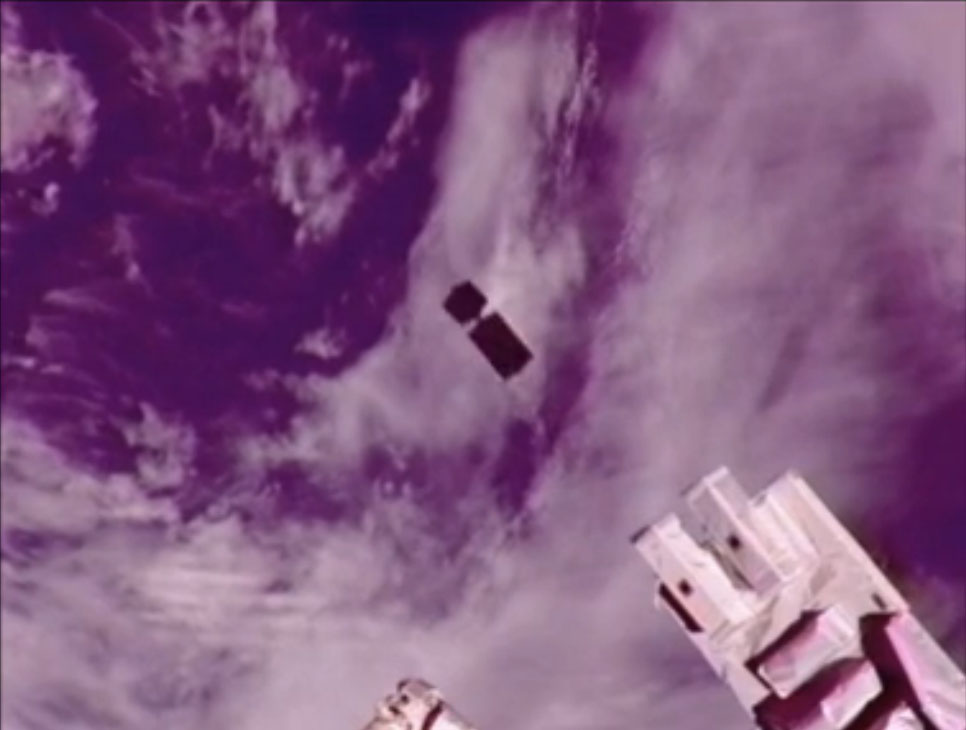
Deployment of CubeSats WE-WISH and RAIKO from the ISS

Deployment of CubeSats WE-WISH and RAIKO from the ISS – Image NASA

Built by members of the Meisei Amateur Radio Club WE-WISH carried an infrared camera for environmental studies. The 320 by 256 pixels images  of the Earth’s surface were transmitted in approx 110 secs using SSTV. The callsign was JQ1ZIJ and the 100mW downlink on 437.515 MHz operated on CW (A1A), AX.25 1200 bps packet radio (F2D) or SSTV (F3F).

Masahiro Arai JN1GKZ has produced a chart that shows the declining altitude of the five CubeSats since their deployment. RAIKO was the largest of the CubeSats at about 2 kg and 10 × 10 × 20 cm and the others being about 1 kg and 10 × 10 × 10 cm. The chart compares their orbital decay with that of ARISSat-1/Kedr (30 kg, 55 × 55 × 40 cm) which was deployed on August 3, 2011 and and re-entered Earth’s atmosphere on January 4, 2012, having spent 154 days in orbit.

Further information and some spectacular pictures of the CubeSats taken just after deployment can be seen at https://amsat-uk.org/satellites/techedsat-f-1-fitsat-1-we-wish/

5th European CubeSat Symposium June 3-5 Brussels

Royal Military Academy of Brussels in BelgiumThe 5th European CubeSat Symposium takes place on June 3-5, 2013 at the premises of Royal Military Academy in Brussels, Belgium.

Last year this event attracted more than 250 participants and industrial exhibits of 7 specialized companies. This year, they are expecting more participation. Applicants from all around the world are welcome.

The call for proposals and the online abstract submission system is available at http://www.CubeSatSymposium.eu/

Continue reading

Ion Propulsion: Euroluna Update on CubeSat HT Power Supply

Romit1 - Image Credit GomSpace ApS

Romit1 – Image Credit GomSpace ApS

In this video Palle Haastrup OZ1HIA, President of Euroluna (OZ9LUNA), describes their work towards a flight ready high tension power supply for the CubeSat Ion propulsion system.

Euroluna are a Danish amateur team participating in the $30 million Google Lunar X PRIZE contest to be the first privately funded team to land and drive a rover on the Moon.

Their first Amateur Radio CubeSat Romit-1 is a 2U CubeSat that will transmit on 437.505 MHz using 1200 bps AX.25 packet radio. It will be fitted with an Ion Motor and if everything goes well it should, after a year, be able to raise its orbit from 310 km to 700 km. It is planned to launch on an Interorbital Systems Neptune 30 rocket.

Continue reading