Data Format for Korean OSSI CubeSat

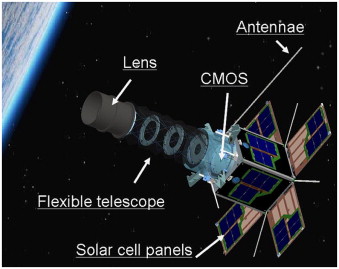
Open Source Satellite Initiative Korean CubeSat OSSI-1Information has been released on the data format to be used by the Open Source Satellite Initiative (OSSI) CubeSat developed by Hojun Song DS1SBO.

The OSSI Data Format spreadsheet can be seen at https://docs.google.com/spreadsheet/ccc?key=0AjtQ6cJ4QOqJdGpHNnRtUWZJV0w4TTFKRU9WYTZqc3c#gid=5

OSSI-1 is planned to launch April 19, 2013 into a 575 km 63° inclination orbit on a Soyuz-2-1b rocket from the Baikonur launch facility in Kazakhstan along with the Bion-M1 satellite and the SOMP, BEESAT 2, BEESAT 3 and Dove-2 CubeSats. The OSSI VHF beacon is understood to be using 12 WPM CW.

Open Source Satellite Initiative OSSI CubeSat Wiki http://www.uk.amsat.org/?p=12231

OSSI-1 CubeSat Morse Code Telemetry Data

OSSI-1 CubeSat Morse Code Telemetry Data

AMSAT-UK Attend UK Space Agency CubeSat Conference

Graham Shirville G3VZV on the AMSAT-UK Stand at the UKSA CubeSat Community Workshop

Graham Shirville G3VZV on the AMSAT-UK Stand at the UKSA CubeSat Community Workshop

AMSAT-UK attended the CubeSat Community Conference organized by the UK Space Agency (UKSA) which was held at the Open University.

Workshop sessions included:

• Update on UKube-1

• Plans for UKube-2

• Fostering a stronger and wider UK CubeSat Community
Identifying potential user groups who would benefit from using cubesat data (e.g. commercial applications such as utilities companies, telecoms, and government departments etc), and how to engage with them more effectively [note that the National Space Conference in July 2013 in Glasgow could consider hosting a session to facilitate this process]

• Overcoming Obstacles
Common obstacles associated with launching cubesats and how to clarify/streamline them: availability, cost, export controls, applicability of the Outer Space Act, licences, radio frequency allocation, issue of cubesats as space debris

• Developing Education/Outreach Benefits for the UK with the UKube X Program
STEM outreach and school education benefits and how to take this forward with a UKube X programme, including options for Harwell/other involvement to underpin academic/amateur missions with strong research/outreach/education benefits

• Accelerating Disruptive Technologies
Identifying key technology developments with implications for economic growth and possible sources of external co-funding. Defining a UKube x roadmap to tie in with the NSTP roadmaps. Possibilities for synergies and collaborations with international partners

PRISM CubeSat Photo Competition

PRISM satelliteProf. Nakasuka of the University of Tokyo is running a photo contest to commemorate the 4th anniversary of the nano-satellite “PRISM”, which was launched in January 2009.

Anyone can vote for the best photo, so please join the contest!

Further information is available at the contest site.

PRISM Photo Contest site
http://www.smaster.jp/Sheet.aspx?SheetID=72633 (English)
http://www.smaster.jp/Sheet.aspx?SheetID=72607 (Japanese)

PRISM Official site
http://www.space.t.u-tokyo.ac.jp/prism/en/main.html (English)
http://www.space.t.u-tokyo.ac.jp/prism/main.html (Japanese)

UNISEC http://www.unisec.jp/

Open Source Satellite Initiative OSSI CubeSat Wiki

Hojun Song DS1SBO with Professor Hien Vo and the OSSI CubeSat

Hojun Song DS1SBO with Professor Hien Vo and the OSSI CubeSat

Professor Hien Vo of the Inter American University, Puerto Rico, visited Korea and met Hojun Song DS1SBO who has developed the Open Source Satellite Initiative OSSI-1 CubeSat.

OSSI-1 is planned to launch in the 2nd quarter of 2013 into a 575 km 63° inclination orbit on a Soyuz-2-1b rocket from the Baikonur launch facility in Kazakhstan along with the Bion-M1 satellite and the SOMP, BEESAT 2, BEESAT 3 and Dove-2 CubeSats. The Soyuz-2-1b launch had originally been planned for August 2012 but was delayed.

The development of the satellite has been documented on the Open Source Satellite Initiative Blog http://opensat.cc/blog/ and the Wiki http://opensat.cc/wiki/

Continue reading

WARP DRiVE for UK STRaND-1 CubeSat

Dr Chris Bridges working on STRaND

Dr Chris Bridges working on STRaND

The SSTL Space Blog reports on WARP DRiVE (Water Alchohol Resistojet Propulsion system), a novel new propulsion system that will help the STRaND-1 cubesat to perform manoeuvres. STRaND-1 is the first cubesat to have two types of propulsion system. As well as the WARP DRiVE, it will be equipped with a pulsed plasma thruster system which will provide full-axis control with low power, mass and volume requirements.

WARP DRiVE works by pushing water alcohol out of a tiny hole (just 0.2mm across) to produce thrust. The main advantage of this system is that it’s much smaller than regular space propulsion systems measuring in at about the same width as a drinks coaster. The WARP DRiVE will also provide more thrust than other similar systems whilst maintaining a comparable specific impulse (the efficiency of the propulsion system).

Read the SSTL Space Blog at http://www.sstl.co.uk/Blog/January-2013/WARP-speed-ahead

STRaND stands for Surrey Training, Research and Nanosatellite Demonstration and the programme is intended to be a long-term arrangement between the space company SSTL and academic researchers at the Surrey Space Centre (SSC), with STRaND-1 the first of a long line of STRaND nanosatellites.

STRaND-1 aims to carry a NEXUS Android Smartphone into space and plans to use data rates of 9k6 or 19k2 bps for the AX.25 packet radio downlink on 437.575 MHz. A software-based speech synthesiser will be included to pay homage to the UOSAT family of satellites.

The SSTL employees involved with the STRaND programme are volunteers. It is a condition of the programme that volunteers from SSTL and SSC use their own, free time for STRaND activities (such as lunches and breaks). The project has no budget for staff so is entirely dependent on volunteers.

To watch a presentation about STRaND-1 given by Dr. Chris Bridges to the AMSAT-UK 2012 International Space Colloquium following these steps:
• Go to http://www.batc.tv/
• Click on “Film Archive
• Select “AMSAT 2012″ in the Category box and click on Select Category
• Select “A03 – STRaND-1” in the Stream box and click on Select Stream
• Click the play button on the video player window

The videos can be downloaded for later use, for instance at a club meeting, by clicking on the “Click Here” link underneath the video player.
Alba Orbital make Shell top 10

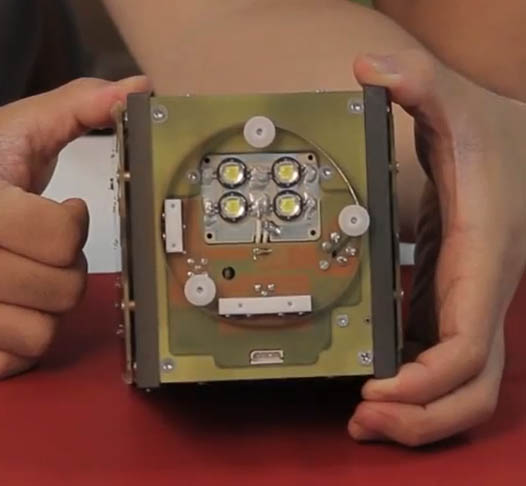
CubeSat_ModelGlasgow based Alba Orbital, who aim to use CubeSats for Space Burials, have got through to the national round of a major start-up competition.

They now need your help to go one better and win £1000 for their Space Start-up.

There is a 1 minute elevator pitch video on the Shell Livewire site describes their plans for the company.

You can vote for Alba Orbital at http://www.shell-livewire.org/awards/grand-ideas-awards

Alba Orbital believe Space is important and more start-up satellite companies should be succeeding!

Thanks for your support,

Tom Walkinshaw
Founder, Alba Orbital

Shell LiveWIRE Grand Ideas Awards http://www.shell-livewire.org/awards/grand-ideas-awards

BBC Radio Scotland interview with Tom Walkinshaw of Alba Orbital
http://www.youtube.com/watch?v=Ft6i_7FSdko

Alba Orbital use the MAKlab Studio in Glasgow, for manufacturing their prototype satellites http://www.maklab.co.uk/

Alba Orbital http://www.albaorbital.com/