TEDxKhartoum Presentation on KN-SAT1 CubeSat

KN-SAT1 Students at ST2UOK Khartoum

KN-SAT1 Students at ST2UOK Khartoum

Abubakr S. Eltayeb ST2AB is an Electrical Engineer specializing in communications systems. He is currently a member of the Cube Satellite Project which belongs to the Faculty of Engineering at University of Khartoum.

The team includes his colleagues Hala M. Othman, Mustafa Atta Mohamed and Yasir M. Osman ST2YM, and together they constructed the first satellite in Sudan with the help of Dr. Tahani Abdalla, their project manager and Dr. Nader Abdelhameed, the team manager. They designed, tested and experimentally launched a fully functional Cube Satellite prototype named KN-SAT1.

The team is now developing the Flight Model of the KN-SAT1, in preparation for its launch into outer space.

This TEDxKhartoum presentation is not in English, however, the segment from 09:12 until 13:25 contains video showing the development of the KN-SAT1 CubeSat including a test of the deployment of the antennas.

Watch TEDxKhartoum 2012: Abubakr S. Eltayeb, A Sudanese Satellite

Khartoum Amateur Radio Satellite Ground Station http://www.uk.amsat.org/4316

KN-Sat1 http://cubesat.uofk.edu/

Sudanese Amateur Radio and SWL History http://www.st2nh.com/sudanamateurradioandswlhistory

Metro Newspaper – The next space age: Cuberty

The May 14, 2012 edition of the Metro newspaper carried a story by Ben Gilliland on pages 26-27 about CubeSats. Among those mentioned is the UK amateur radio Android smartphone CubeSat STRaND-1 which is being built by volunteers at the Surrey Space Centre (SSC).

The online edition of the Metro newspaper can be read at http://e-edition.metro.co.uk/2012/05/14/ You will be prompted for an email address but anything that looks like an email address will keep the prompt happy and you can then read the newspaper.

Ben Gilliland’s article is also available on the CosmOnline website at
http://www.cosmonline.co.uk/blog/2012/05/14/next-space-age-cuberty

You can read about STRaND-1 in the AMSAT-UK publication OSCAR News here

STRaND-1 on Facebook https://www.facebook.com/nanosats

Student’s Project Could Go Into Space

Go Erie reports on the work of students from Penn State Behrend who have been building part of a satellite for AMSAT.

The report says:

The trio speaks the language of supercapacitors and charges cycles, and they offer informed views on how circuit boards can shed excess heat.

When David Jesberger, Kathleen Nicholas and Jacob Sherk graduated May 4 from Penn State Behrend, they left speaking the language of engineers. But they also left behind a finished senior project that could soon be headed into outer space.

Senior engineering students at Behrend pitch ideas each year for projects they would like to tackle in their final year. Nicholas said she, Jesberger and Sherk all bid for a chance to be part of a project for the Radio Amateur Satellite Corporation (AMSAT).

The super-capacitor based energy storage device developed by the students is designed to replace the silver–zinc battery on ARISSat type satellites.

Read the full story by Jim Martin at
http://www.goerie.com/article/20120512/NEWS02/305129968/Behrend-engineers%27-project-could-go-into-space

Student's Project Could Go Into Space

Go Erie reports on the work of students from Penn State Behrend who have been building part of a satellite for AMSAT.

The report says:

The trio speaks the language of supercapacitors and charges cycles, and they offer informed views on how circuit boards can shed excess heat.

When David Jesberger, Kathleen Nicholas and Jacob Sherk graduated May 4 from Penn State Behrend, they left speaking the language of engineers. But they also left behind a finished senior project that could soon be headed into outer space.

Senior engineering students at Behrend pitch ideas each year for projects they would like to tackle in their final year. Nicholas said she, Jesberger and Sherk all bid for a chance to be part of a project for the Radio Amateur Satellite Corporation (AMSAT).

The super-capacitor based energy storage device developed by the students is designed to replace the silver–zinc battery on ARISSat type satellites.

Read the full story by Jim Martin at
http://www.goerie.com/article/20120512/NEWS02/305129968/Behrend-engineers%27-project-could-go-into-space

Aalto-1 Mission Animation

Finnish students working on the Aalto-1 CubeSat

Finnish students working on the Aalto-1 CubeSat

Students working on the Aalto-1 CubeSat have released two new videos. In the first video Systems Engineer Antti Kestilä gives a brief introduction to the amateur radio VHF/UHF ground station on the roof of ELEC building at Aalto University Otaniemi campus.

The second video is an animation showing most of the Aalto-1 mission phases.

Aalto-1 is a student satellite project of Aalto University, Finland. When launched, it will be Finland’s first satellite. It is planned to operate at VHF-UHF and there will also be an S-band transmitter. Up to 8 watts of power will be available from the solar panels.

The main payload of the satellite is a novel tiny Fabry-Perot imaging spectrometer, developed by VTT, Finland. The primary scientific goal of the mission is to demonstrate the feasibility of MEMS Fabry-Perot spectrometers for space applications. This miniature technology can be used in nanosatellites for large a variety of remote sensing applications in the future.

High spectral resolution images can be used for water quality monitoring and land use classification.

Watch Aalto-1 // Quick Look on Ground Station

Watch Aalto-1 // Mission Loop for MoA

Aalto-1 on Facebook https://www.facebook.com/pages/Aalto-1/122101441174192

Aalto-1 Discussion Forum https://wiki.aalto.fi/display/SatForum/Aalto-1+Discussion+Forum

Aalto-1 https://wiki.aalto.fi/display/SuomiSAT/Summary

How a Pocket-Size Satellite Could Find Another Earth

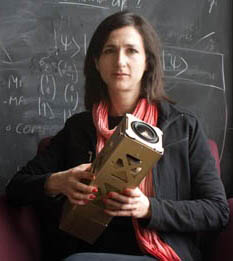
Radio Amateur Sara Seager KB1WTW - Image Credit PlanetQuest

Time Magazine reports that unlike the massive NASA Kepler probe the next mission to search for new planets will be a tiny CubeSat called ExoplanetSat.

Sara Seager KB1WTW with ExoplanetSat

Sara Seager KB1WTW with model of ExoplanetSat - Image Credit MIT

Time says: What makes ExoplanetSat even more un-NASA-like is that it began as a class project — although admittedly, the class was at MIT. It was a design-and-build course, which the university’s engineering students have to take in order to graduate. In a recent semester, the class was co-taught by Sara Seager [KB1WTW] an astrophysicist who has done groundbreaking research studying how the atmospheres of planets orbiting distant stars might look like from earthly telescopes. Seager recruited five science undergrads to join her engineers, on the theory that out in the real world, they’d eventually have to work with engineers anyway.

The group lead by Sara KB1WTW is developing a prototype ExoplanetSat capable of monitoring a single, bright, sun-like star for two years. Planned to launch late 2012 or 2013 it is hoped it will open the gates for ExoplanetSat interest and funding. Once the funding doors are opened, then the fleet of ExoplanetSats can be launched. The fleet may contain as many as a hundred of these small satellites, each focused on its own star.

In a 2011 visit to Cambridge, UK, Sara said “The reason why we’re excited is because we think that this is a really huge thing. Hundreds and thousands of years from now, people will look back and ask, what are the significant accomplishments of our society in the early twenty-first century? One of them will be that we were the first to discover other worlds and other worlds that might be like Earth. When you think back four hundred years, what do you remember? You think about Christopher Columbus and Lewis and Clark. It’s the exploration—finding things that were new to our culture. And that’s why we’re excited.

Read the Times Magazine article at http://www.time.com/time/health/article/0,8599,2114158,00.html

MIT paper on ExoplanetSat http://dspace.mit.edu/openaccess-disseminate/1721.1/61644

Presentation Slides http://mstl.atl.calpoly.edu/~bklofas/Presentations/DevelopersWorkshop2011/5_Smith_ExoplanetSat.pdf

PlanetQuest http://planetquest.jpl.nasa.gov/