Student CubeSat CATSAT II and Hydrogen Peroxide Propulsion

Students at the University of Vermont are working on a Cubesat project CATSAT II sponsored by the University and NASA.

The team have been experimenting with Hydrogen Peroxide Propulsion. In this video Mohamed Metwally, Eric Niebylski, Rudy Raab and Drew Swomley provide a brief overview of the project.

Watch UVM Capstone Design 2011/2012 – CATSAT II

NASA’s CubeSat program helps students take part in space experiments.

Watch Launch of Nanosatellites

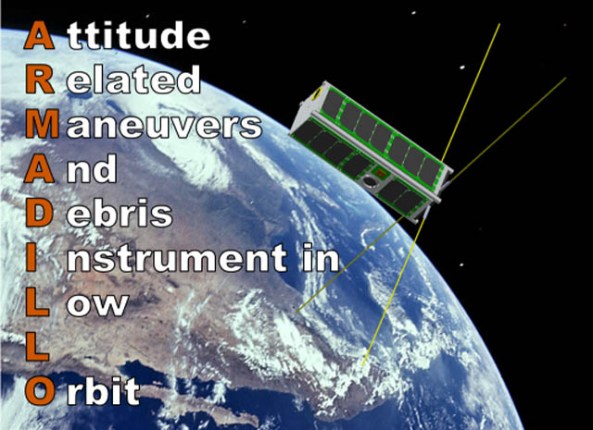
Armadillo CubeSat to use Cold Gas Thruster

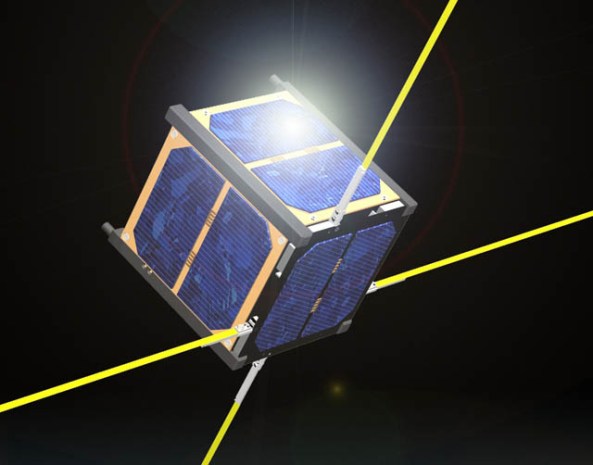
The amateur radio 3U CubeSat Armadillo is a collaboration between students at University of Texas at Austin and Baylor University.

Armadillo stands for Attitude Related Maneuvers And Debris Instrument in Low (L) Orbit and the satellite is being designed for Flight Unit delivery in June 2013 with an assumed launch in January 2014.

Mission Objectives:

– Characterize the low altitude space dust environment and the orbit effects of this space dust as potential threats to military satellites.

– Operate a cold-gas thruster to extend mission lifetime and perform a controlled de-orbit maneuver in order to gather more scientific data at different altitudes.

– Establish optical navigation by taking and downloading a celestial image to obtain an independent verification of satellite position and attitude.

– Demonstrate on-orbit reprogrammable software so the satellite may use updated commands and algorithms.

– Develop a reusable 3U picosatellite bus for potential use on future missions in an effort to cut design and fabrication costs

Watch Bevo 2 / ARMADILLO Cold Gas Thruster Pendulum Test 3

Armadillo website http://armadillo.ae.utexas.edu/

Information, Videos , News and Images about Cold Gas Thruster http://www.rtbot.net/cold_gas_thruster

Cold Gas Thruster spec sheet http://austinsat.net/datasheets/Thruster%20Spec%20Sheet%20rev2.pdf

Texas CubeSat 2011 Presentation http://lightsey.ae.utexas.edu/publications/TEXAS_CubeSat_2011_Presentation.pdf

New Frequencies for AMSAT-UK FUNcube-1

The AMSAT-UK FUNcube-1 satellite is due to launch on a DNEPR rocket from Yasny later this year.

This launch could carry around 11 amateur radio satellites including FUNcube-1 into space. As a result the International Amateur Radio Union (IARU) satellite advisory panel have had to carefully coordinate the planned operating frequencies in order to minimise the risk of interference between FUNcube-1 and other payloads on the same launch.

The IARU Amateur Satellite Frequency Coordination Panel have now confirmed the following frequencies for FUNcube-1 (these frequencies replace those previously announced)

Inverting linear transponder:
Uplink            435.150 – 435.130 MHz
Downlink        145.950 – 145.970 MHz

Telemetry:     145.935 MHz   BPSK

AMSAT-UK have announced that the power of the FUNcube-1 1200 bps BPSK telemetry beacon has been increased to 400 milliwatts. This should provide a strong signal for school students to receive using simple equipment.

Read the leaflet ‘Teach Space with a Real Satellite’ at http://tinyurl.com/TeachSpaceWithFUNcube

Gunter’s Space Page 2012 launches http://space.skyrocket.de/doc_chr/lau2012.htm

IARU Amateur Satellite Frequency Coordination Status http://www.amsat.org.uk/IARU

OSSI Art CubeSat to Launch in August

Hojun Song DS1SBO and the NovaNano FlyMate™ deployer

Hojun Song DS1SBO and the NovaNano FlyMate™ deployer

Hojun Song DS1SBO is a cutting-edge, tech-obsessed Korean artist breaking boundaries with his passion for telling stories through technology. He hopes to instill a sense of empowerment in the world, through the DIY nature and uplifting undertones in each of his works.

OSSI CubeSat

OSSI CubeSat

At univeristy he studied Electrical Engineering and Computer Science after which he started working on his art.

After years of research he has found that it is indeed possible to launch and operate a personal satellite at a fairly reasonable price. For the past six years he has been exploring ways to integrate the concept of a personal satellite project into cultural contexts and into his artistic practice.

Hojun Song’s first satellite OSSI will take off on a Soyuz rocket from Baikonour in Kazakhstan this August. He obtained his rocket launch through a new French launch brokerage company NovaNano http://www.novanano.com/. In this video he shares his story, his struggles and his plans.

Watch The Open Source Satellite Initiative by Hojun Song

The OSSI CubeSat should be delivered on May 31 in preperation for its launch on August 31. The team are working hard to finish building the satellite.

Watch Building OSSI EPS / 20120429

Open Source Satellite Initiative (OSSI) http://opensat.cc/

The Creators Project http://thecreatorsproject.com/en-uk/creators/hojun-song

DIY Satellite http://opensat.cc/download/DIYSatellite_en.pdf

Studio hhjjj http://www.hhjjj.com/

Medgar Evers College students help develop ‘CubeSat’

Medgar Evers College students and professors are excited to be part of a NASA micro satellite project that will send their CubeSat experiment into space. 

Medgar Evers College students and professors are excited to be part of a NASA satellite project that will send their CubeSat experiment into space. Read more: http://www.nydailynews.com/new-york/medgar-evers-college-students-develope-cubesat-nasa-communication-satellite-article-1.1069110#ixzz1tXRe1gw3

Medgar Evers College students help develope ‘CubeSat’ for NASA communication satellite
Eagerly await ‘CUNYSAT’ lift-off to test 3 year-long science experiment.

For a little piece of equipment, the 4×4-inch cube tucked in an anti-static bag in a plastic lined clean room at Medgar Evers College is pretty huge.

When it heads into space next year the CubeSat, as it is called, will be the culmination of three years of computer programing, engineering and testing involving more than 60 students — most of them from Medgar — from colleges across the Metro area.

Medgar professor and Project Director Shermane Austin said creating the satellite, dubbed CUNYSAT, allows students to “get experience in what NASA does, and also lets the faculty understand the science involved in these things.

“This not like a puzzle that you just put all the pieces together and see if it works,” she said. “There is a significant amount of work by the students.”

Last week several students, including Elston Alexis, Leston AlexisRalph DumervilVinchencia Henderson, Fari Lindo, Kirt St. Louis, and Bridgette Miles joined former students Riguel FabreErnst Etienne and Patrick Dumervil, as well as Austin and physics professor Leon Johnson and computer science professor Laura Zavaka to discuss the project.

Austin said students from Cornell University, City College of New York, Queensborough College, The College of Staten Island, Cooper Union, Brooklyn College and the New Jersey Institute of Technology have contributed to the project.

Basically students were charged with designing mechanical, electrical, communication, date handling, and command systems in the cube which could survive the violent vibrations of a rocket launch and the hostile temperatures of space and still communicate with a ground station manned by students at Medgar.

Although students followed some guidelines already established by National Aeronautics and Space Administration, they were responsible for writing software and repeatedly testing each system.

It is not nearly as simple as it sounds. Patrick Dumervil noted that the electrical system had to be designed to run off a conventional and a solar battery which had to be recharged by solar panels fixed to the cube.

“My job was to make sure the electrical system is balanced,” he said.

“We have to make sure the integrity of the cube is maintained,” said Etienne. “Basically the whole thing is to just maintain the integrity of the Cubesat and make sure it survives.”

The systems are installed in the cub in a clean room — students had to wear gloves, masks and paper clean suits to maintain the sterile environment.

The cube is expected to spend about 120 days in space before falling to earth, Austin said.

The launch date is secret, but Garrett Skrobot, a NASA launch engineer who created the program (formal name Educational Launch of Nanosatellite, or ELaNa) three years ago said he is only awaiting administrative approval to schedule the CUNYSAT for a space flight.

NASA has launched eight cubes so far, and has another 17 awaiting a launch date. Skrobot said he expects that Medgar will design even more sophisticated cubes for future launches. “After all, this is their first one,” he said.

Lindo, part of the ground team writing the communication software, said the team is still hopeful it can include more ambitious experiments in this first cube.

“We’re still trying to see if we can do some ionospheric experiments,” he said.

“Before working on this project I had no idea about these systems,” said Elston Alexis. “Within a few days of coming in I had learned how to track a satellite. This is a great learning experience, and it looks good on a resume.”

Miles said she is so involved in the project that “sometimes late at night I’ll get an idea and sit straight up in the bed. It really is exciting.”

Medgar Evers College website is mec.cuny.edu.

crichardson@ nydailynews.   com

Read more: http://www.nydailynews.com/new-york/medgar-evers-college-students-develope-cubesat-nasa-communication-satellite-article-1.1069110#ixzz1tXRpWDtc
Delfi-C3 (DO-64) – 4 years in orbit

Delfi-C3_DO-64_Team

Delfi-C3 (DO-64) Team at the AMSAT-UK International Space Colloquium 2008 in Guildford

On April 28, 2012 the nanosatellite Delfi-C3 (DO-64) celebrated 4 years in orbit and is still alive and kicking!

This 3-unit CubeSat, developed by the Technical University of Delft in the Netherlands has been largely developed by students and performed technology demonstration experiments for the space industry in the Netherlands. After being launched on PSLV-C9 in 2008 it has been circling the earth for 1461 days (exceeding its design lifetime with 1371 days)!

The satellite still broadcasts its telemetry and measurement data which can be received using simple amateur radio equipment and using the RASCAL software (available on the Delfi website: http://www.delfispace.nl/index.php/participation/radio-amateur-participation).

The satellite project was also the birthplace of ISIS – Innovative Solutions In Space as the company’s founders and a significant number of its employees have worked on the satellite project at the start of their careers. We congratulate the university with the milestone and excellent demonstration that well coordinated student satellite projects can produce great results and exceed all expectations.

Regards,
Jeroen Rotteveel