Ecuadorian CubeSat will monitor near-earth objects

Ecuadors first satellite NEE-01 Pegasus is slated to launch from Yasny this October on the same DNEPR rocket as the AMSAT-UK FUNcube-1.

NEE-01 Pegasus is a 1U CubeSat with two large (for a CubeSat) deployable solar panels and the Ecuadorian Civilian Space Agency (EXA) indicates 28.8 amps can be generated. There is an onboard camera to send live video from space from a 3 watt TV transmitter in the 902 MHz band along with a beacon that will send an ID and Ecuador’s national anthem.

NEE-01 Pegasus LogoOn April 25, EXA announced that it will be adding a mission to NEE-01 Pegasus: It will help monitoring near-earth objects from orbit using its onboard 720p HD video camera and will also help in the catalog and control of orbital debris (space junk), this new mission will turn the NEE-01 in to the first online, real time orbital video sentry for the planet, as the satellite has the capability to stream its video signal directly to the Internet.

It is hoped NEE-01 Pegasus will be able to detect medium to small sized near-earth objects, like very small asteroids which are normally very difficult to detect but have enough mass to pose a threath to populated areas, like the one which exploded over California in April.

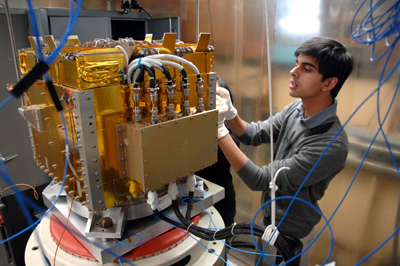
Astronaut Ronnie Nader and NEE-01 Pegasus model

Astronaut Ronnie Nader and NEE-01 Pegasus model

Another of the satellites objectives is to serve as a space platform for elementary education.

The satellite will send two signals that will be received and decoded by the EXA’s HERMES-A ground station in Guayaquil and then uploaded live to the Internet using Twitter and Facebook.

The first signal will contain text book questions and the second will contain an image related to the question. If the students are able to answer the question correctly they will be granted access to the video camera onboard the spacecraft and will be able to see earth from space as the astronauts see it in their space missions.

More advanced students will have access to the pure radio signal so they can try decoding it by themselves. The EXA will provide them with the appropriate support software free of charge.

EXA Press release http://exa.ec/bp42/index-en.html

Ecuador’s first astronaut Ronnie Nader has been leading the team building the Cubesat
http://www.exa.ec/whois.htm

NEE-01 Pegasus http://exa.ec/bp37/index-en.html

Student CubeSat First-MOVE – Vacuum Test Video

First-MOVE_Students_with_Bob_Twiggs_KE6QMD_2560

First-MOVE team members with Bob Twiggs KE6QMD

First-MOVE is an amateur radio CubeSat being built by students at the Technical University of München.

MOVE stands for München Orbital Verification Experiment. The 1U CubeSat carries a CCD camera and has two deployable solar panels carrying a new generation of solar cell – triple junction GaAs / Ge.

The transceiver, supplied by ISIS, uses a UHF uplink and VHF downlink. The antennas are mounted on the ends of the deployable solar panels.

The frequencies for First-MOVE were coordinated by the IARU as:

Downlink: 145.970 MHz
Uplink:     435.520 MHz

This video shows First-MOVE preliminary vacuum test at the LRT facilities. The EQM model was tested in vacuum conditions and at medium/low temperatures (10°C).

Watch First-MOVE Vacuum Test

First-MOVE Vibration tests http://www.uk.amsat.org/6271

First-MOVE CubeSat Solar Panel Deployment Video http://www.uk.amsat.org/6199

First-MOVE website in Google English http://tinyurl.com/First-MOVE-CubeSat

First-MOVE Communications http://tinyurl.com/First-MOVE-Communications

Multi-Cubesat Launcher Built by Naval Postgraduate School.

Vidur Kaushish, a student at the Naval Postgraduate School, works on the NPS CubeSat Launcher. (Courtesy NPS website)

Students at the Naval Postgraduate School have developed an auxiliary payload platform that will permit the launch of as many as 24 cubesats at a time. AMSAT News Service reports that the NPS CubeSat Launcher is designed to release satellites one at a time by opening spring-loaded doors at the desired orbital altitude. The first launch, slated to carry 11 cubesats, is planned for this August.


Videos of 9th Annual CubeSat Developers' Workshop

The Spring CubeSat workshop held April 18-20 proved a great success and videos of the event are now available.

Spring Workshop Videos http://mediasite01.ceng.calpoly.edu/Mediasite/Catalog/pages/catalog.aspx?catalogId=64b6f338-8445-475b-9062-84c90d54ff45

Spring Workshop Schedule http://www.cubesat.org/images/2011_Spring_Workshop/2012_workshop_schedule1.pdf

Videos of 9th Annual CubeSat Developers’ Workshop

The Spring CubeSat workshop held April 18-20 proved a great success and videos of the event are now available.

Spring Workshop Videos http://mediasite01.ceng.calpoly.edu/Mediasite/Catalog/pages/catalog.aspx?catalogId=64b6f338-8445-475b-9062-84c90d54ff45

Spring Workshop Schedule http://www.cubesat.org/images/2011_Spring_Workshop/2012_workshop_schedule1.pdf

Student Nanosat VELOX-I

VELOX-I 640Over 150 students at the Nanyang Technological University in Singapore have worked on the innovative nanosat project VELOX-I.

Velox-I - N-Sat and P-SatVELOX-I consists of two satellites: a 3U nano-satellite N-Sat and a 1U pico-satellite P-Sat. N-Sat is developed to be a robust satellite bus for future missions, and P-Sat is an experimental design to carry a scientific payload. During the mission P-Sat will be released by N-Sat.

The VELOX-I mission includes demonstrating high-resolution vision subsystem, testing a MEMS-based attitude determination and control system, verifying intersatellite RF link, and performing a quantum physics experiment.

It is hoped it will launch in 2013, a downlink of 145.980 MHz has been coordinated.

This article ‘Over 150 students helped to build it’ by Tong Su Yee appeared in The New Paper
http://www.edvantage.com.sg/edvantage/news/schoolnews/699350/Over_150_students_helped_to_build_it.html

Students reach for stars with own satellite
http://www.eee.ntu.edu.sg/Documents/Students%20reach%20for%20stars%20with%20own%20satellite.pdf

Entangled Photon Systems for Small Satellites http://quantum.nasa.gov/materials/2012-01-21-A3-Ling.pdf

Nanyang Technological University VELOX-I http://www.sarc.eee.ntu.edu.sg/Project/Pages/VELOX.aspx 

The IARU Amateur Satellite Frequency Coordination Status http://www.amsat.org.uk/iaru/