UKube-1: 4 payloads

Rt Hon David Willetts MP learns about UKube-1 visiting Clyde space, seeing the clean rooms and talking to Craig Clark about CubeSat components. Courtesy http://www.clyde-space.com/news/305_uk-science-minister-visits-clyde-space


The UK Space Agency’s pilot programme has narrowed down from a total of 20 proposals to four payloads to fly on Ukube-1 from UK industry and academia.

Payloads chosen include a CMOS (complementary metal-oxide semiconductor) Imager Demonstrator, a specialist imaging device to measure radiation damage in space developed by the Open University and Essex-based e2v technologies.

Another, the United Kingdom Students for the Exploration and Development of Space (UKSEDS) payload, myPocketQub442, is an open source system comprising five experiments, one of which will allow school pupils, university students and hobbyists to run their own experiments in space for a day.

The other two payloads are the EADS Astrium , which will test random number generation crucial to secure communications systems in the radiation environment, and TOPCAT http://www.bath.ac.uk/elec-eng/invert/topcat.html, a system designed by the University of Bath to measure space weather conditions which can adversely affect global positioning systems (GPS).

UKube-1 will also take an educational subsystem called FUNcube, developed by the voluntary organisation AMSAT-UK, to encourage young people to learn about radio, space, physics and electronics.

The spacecraft is being developed through a knowledge transfer project with Scottish spacecraft system developer Glasgow based Clyde Space and the University of Strathclyde, which Clyde Space is also funding.

One of the world’s leading firms in the micro spacecraft sector, dubbed CubeSat , Clyde Space has made components for about 40% of the 600 CubeSats launched globally so far. It also makes components for larger satellites.

Ukube-1 is also being funded by the UK Space Agency, the Technology Strategy Board and The Science and Technology Facilities Council (STFC). The agency is currently in negotiations to find a launch vehicle to take the Ukube-1 satellite into space.

UKSEDS – Students for the Exploration and Development of Space http://www.uk.amsat.org/4369

Bath TOPCAT Project http://www.uk.amsat.org/1612
TAMSAT – Internal Housekeeping Unit – IHU

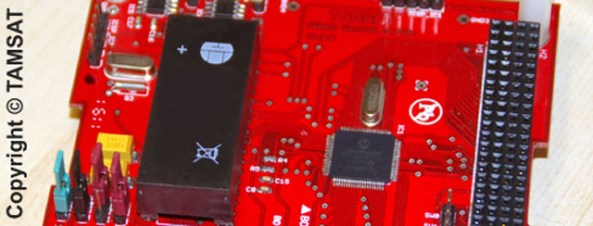
Internal Housekeeping Unit – IHU

When we first founded TAMSAT, Association of Amateur Satellite Technologies approximately two years ago, we have made a big commitment. Our commitment was to develop technology in Turkey, not any technology, but a complex one related to space systems.

I am sure during this time period those of you, who have been following us up, were wondering about the progress that has been made to realize this mission. In this article, I want to share with you an amazing adventure that we experienced in these two years. I don’t want to limit this with technological narration, but also tell you about how our members, who work simultaneously in different corners of the world, did what they do and why we waited all this time to submit our work to you. It was a long path filled with hard work, patience and long tests.

The group of articles to be published after this introductory one, will be about the ‘Internal Housekeeping Unit – IHU’ of our satellite. I just want to mention that this unit may also be referred as OBC – On Board Computer in some articles, but we are going to stick with ‘IHU’ as it has been a standard within The Radio Amateur Satellite Corporation (AMSAT) world.

We want to share some very good news later in this first article . The IHU, which is the first module of the series has a very special place for us, the hardware was originally produced in May of 2011.

The circuit design was realized utilizing EAGLE s/w, by one of our members, Barbaros ASUROGLU, whom Turkish Radio Amateurs are familiar with, through his work on PIC. After the primary tests on the IHU and the prototype were done first on computer, then on the test platform, a printed circuit in the standard PC104 was designed by Osman DALAMAN, another TAMSAT member. The circuit was tested once before it was transferred on PCB by a local printed circuit manufacturer in Istanbul. After this process the SMD circuit components were mounted on card by Osman DALAMAN. After the completion of the first IHU prototype, a second IHU prototype was prepared with the same diligence.

These two IHU prototypes, traveled a long way by land and by air in their special little nests, without any complications and reached us in the USA for the software tests. After careful planning these two IHU prototypes and two VHF/UHF receiver cards, also original products of TAMSAT were lucky enough to participate annual Dayton Radio Amateurs Convention – 2011, as surprise guests.

The reception of these first products of TAMSAT in Dayton, honored us. These 4 prototype circuits, without any software on them, brought an unexpected prestige to TAMSAT in the USA, which we will share with you later.

The hardware was tested by TAMSAT continuously and under a variety of different circumstances, between May 2011 and December 2011.

Then it was time for the toughest trial of all. The IHU was uploaded by a special software after Mr. Asuroglu’s last test and controls and was sent to Istanbul Technical University – Space Systems Design and Test Laboratories (ITU – USTTL), which is one of the two centers in Turkey authorized to run these test in this field. With this hard testing period, TAMSAT also entered a period of nervous expectancy.

And now, the good news that we mentioned before; the TAMSAT – IHU, a complete product of Turkish Engineers and a first in its field, passed all the tests and became our first licensed product to work under real space conditions.

It is my honor and duty to thank to our members Barbaros ASUROGLU and Osman DALAMAN for their sacrifice and hard work for producing our first IHU.

TAMSAT started this hard journey with a very small group of dedicated people and the mission of realizing a first in Turkey, now it is getting bigger not only with the technology it is creating, but also with your support. Right now, our base covers a variety of professionals from electronic engineers to teachers, from astronomers to civil engineers, from students to faculty. If you want to be a contributor please contact with us immediately, our doors are always open to all our friends who shares our mission.

Looking forward to share new, more detailed and informative article with you.

Sincerely,

Levent Sasmazel
TAMSAT – Project Coordinator

Contact: info@tamsat.org.tr

Web: http://www.tamsat.org.tr/
and  http://www.amsat-tr.org/

Facebook: https://www.facebook.com/profile.php?id=100000953042369

Twitter: https://twitter.com/#!/tamsat_tr

UK CubeSat Plasma Propulsion Thruster

STRaND-1 CubeSat Plasma Propulsion Test

STRaND-1 CubeSat Plasma Propulsion Thruster

The amateur radio STRaND-1 smartphone CubeSat is a joint project between SSTL and the Surrey Space Centre (SSC). It’s not only its smartphone that makes it exceptional. Engineers at the Surrey Space Centre have also developed a unique mass and power saving plasma propulsion system to fly on the satellite. This system will be the first propulsive technology to provide very precise attitude control and pointing.

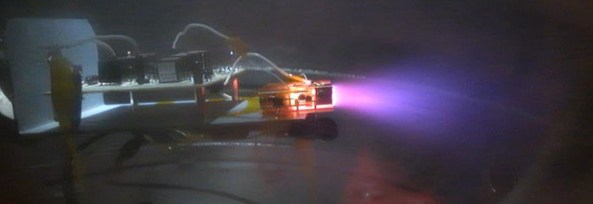
STRaND-1 will carry both a Resistojet and a Pulsed Plasma Thruster (PPT) module on board. The PPT will consist of eight micro thrusters; four located at the top of the satellite stack and four located at the bottom. The micro thrusters operate by discharging a discrete train of pulses. Each pulse is a plasma discharge that forms between two metal electrodes, much like a small lightning bolt or electrical spark. The spark erodes the metal from the electrodes and electromagnetics accelerate the eroded mass out of the nozzle, which produces thrust. This is known as the Lorentz force.

Surrey Space Centre has developed two ways of minimising mass and volume. Firstly, the electrodes which form the plasma discharge also function as the propellant. As metal is highly dense, more propellant can be stored in a smaller volume than that of conventional chemical propulsion systems. The total weight of the propellant for the whole STRaND-1 PPT system is just 10g.

Secondly, Surrey Space Centre’s novel discharge initiation system uses a mechanical contact trigger built out of a tiny piezoelectric motor only 5mm in length. This takes up less space than the conventional spark plug system which requires volume intensive circuitry.

A video of the Pulsed Plasma Thruster firing can be seen st http://www.facebook.com/video/video.php?v=10150533409463432

Download a video of the STRaND-1 presentation given at the 2011 AMSAT-UK International Space Colloquium in Guildford from http://www.batc.tv/vod/Strand.flv

A six page article on STRaND-1 appeared in the Spring 2011 issue of the AMSAT-UK publication OSCAR News available for download at http://www.uk.amsat.org/on_193_final.pdf

UK Amateur Radio Smartphone CubeSat STRaND-1 http://www.uk.amsat.org/1942

STRaND on Facebook http://www.facebook.com/nanosats

BBC TV – How Satellites Rule Our World

They are constantly circling hundreds of miles above our heads, driving our daily lives – yet we barely give satellites a second thought. Satellite engineer Dr. Maggie Aderin-Pocock Ph.D., MBE wants to change all that. She wants to make us realise and appreciate what these unsung heroes of the modern world have done for us.

Maggie reveals how satellites have revolutionised exploration, communication, location-finding and spying. She discovers how they have transformed not only the way we see our planet but our understanding of the dangers within it, like volcanoes and earthquakes. Plus, she discovers the jaw-dropping power of the technology used by satellites to make our lives run smoothly.

The final 8 minutes of the show covers CubeSats and features Peter Shaw of the amateur radio STRaND smartphone satellite project.

‘In Orbit: How Satellites Rule Our World’ was broadcast on BBC 2 at 2100 BST (2000 UT) on Sunday, March 25 and is available to watch on the web at
http://www.bbc.co.uk/iplayer/episode/b01f6qpq/In_Orbit_How_Satellites_Rule_Our_World/

It is understoood that this broadcast could be blocked in certain countries. A way around this may be to use a Proxy Server or software such as Expat Shield.

Dr. Maggie Aderin-Pocock Ph.D., MBE http://en.wikipedia.org/wiki/Maggie_Aderin-Pocock

UK Amateur Radio Smartphone CubeSat STRaND-1 http://www.uk.amsat.org/1942

WebSDR Adds 437 MHz Goliat CubeSat Coverage

The WebSDR receiver located at the Astronomical Observatory Department of “Stefan cel Mare” University in Suceava, Romania has provided coverage of the 3.5 MHz band.

Now coverage of 437.470 – 437.515 MHz has been added enabling the Romanian amateur radio CubeSat Goliat to be received.

It is operated by Andrei YO8SSQ, e-mail andrei-at-avatar.afraid.org and Cezar YO8TLC, e-mail cezarl-at-usv.ro and located at Latitude 47.6417N Longitude 26.2453E, grid locator KN37cp. The height ASL is 350m.

Listen to the 80m and Goliat WebSDR at http://sdr.opt.ro:8901/

Goliat CubeSat http://www.goliat.ro/

BBC TV Newsnight show on Clyde Space and UKube-1

UKube-1 is a 3U CubeSat being designed and produced by Clyde Space for the UK Space Agency. UKube-1 is the UK’s first CubeSat and will fly a total of 6 independent payloads. This news piece was prepared by the BBC covering Clyde Space and the UKube-1 mission.

Watch BBC Newsnight item on Clyde Space and UKube-1

UKube-1 will carry a set of AMSAT-UK FUNcube boards providing a 435/145 MHz linear transponder and BPSK telemetry beacon.