Students receive FUNcube-1 (AO-73)

Student Receiving FUNcube-1 CubeSat

Student Receiving FUNcube-1 CubeSat

David Haworth WA9ONY showed students how to receive the FUNcube-1 amateur radio CubeSat during a workshop at Pine Mountain Observatory, Oregon.

Students adjusting the antenna

Satellite Antenna

FUNcube-1 (AO-73), launched on November 21, 2013 is an educational satellite built by volunteers from AMSAT-UK and AMSAT-NL with the goal of enthusing and educating young people about radio, space, physics and electronics.

The satellite carries a BPSK telemetry beacon on 145.935 MHz for students to receive and a linear transponder for two-way amateur radio communications. In addition there is a materials science experiment, from which the school students can receive telemetry data which they can compare to the results they obtained from similar reference experiments in the classroom.

On the FUNcube Yahoo Group David posted:

FUNcube-1 activities were successful at Pine Mountain Observatory workshop on Sunday, July 12 to Wednesday 15.

During this time 759 packets were received which resulted in a ranking of 456.

The student were impressed when we were the only station receiving a packet and seeing our FM2 message.

The antenna was a Arrow II Portable 146/437-10 3 element 2 meter Yagi on a camera tripod.

Watch PMO Workshop FUNcube-1 Satellite Telemetry Pass July 13, 2015

Watch PMO Workshop FUNcube-1 Satellite Receving Equipment

Watch PMO Workshop FUNcube-1 Satellite Pass July 13, 2015

FUNcube-1 presentation PDF given by David Haworth WA9ONY at SEA-PAC on June 6, 2015

BBC News report about FUNcube-1 http://www.bbc.co.uk/news/science-environment-25084547

FUNcube Yahoo Group https://amsat-uk.org/funcube/yahoo-group/

FUNcube website http://FUNcube.org.uk/
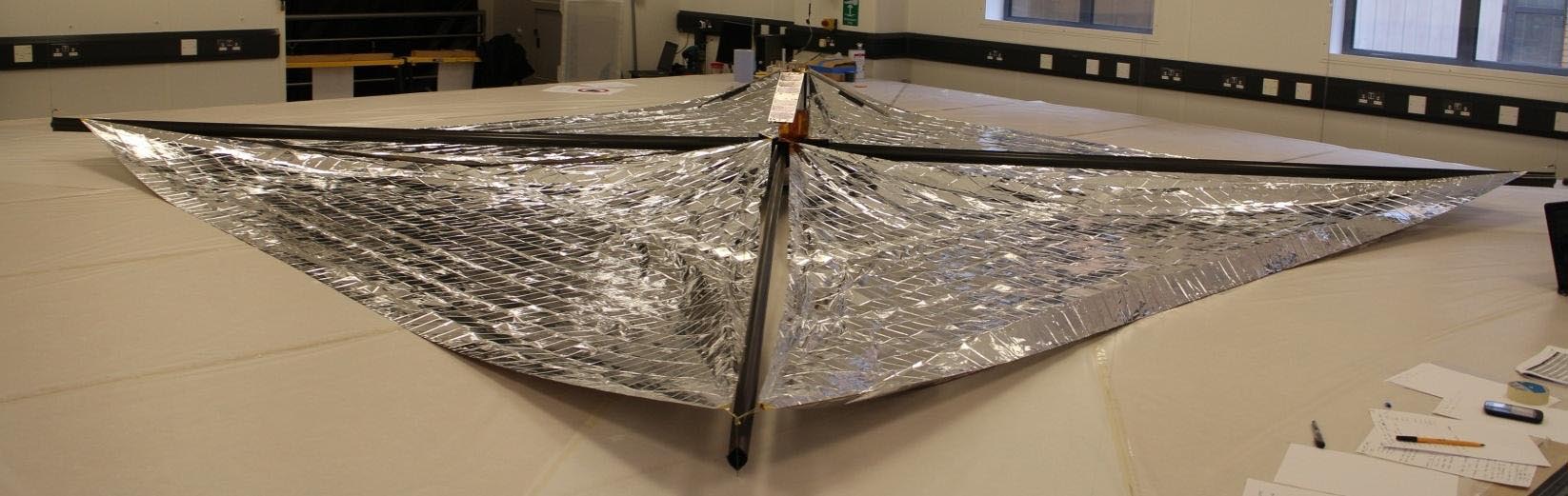
DeorbitSail – Update after 1st week in space

First Week Update by Project Manager, Chiara Massimiani:

  • Friday, Successful launch at PSLV from FLP, SDSC SHAR, India. Click for PSLV-C28 Mission page & Youtube Launch Video. Antennas successfully deployed and beacon switched on.
  • First packets received by AMSAT’er Ken Swaggart W7KKE in Lincoln, OR, USA at 20:29.
  • First packets received by Surrey Space Centre’s Satellite Operations Centre at 22:21:51 which confirmed satellite state. The DOS Team declare the satellite healthy from downlinked telemetry.
  • Saturday, first telemetry uplink requests set and successfully received back in the operations centre.
  • Communication tests activated to confirm satellite mode operations.
  • Monday, communications tests complete. The team declare the uplink and downlink as sufficient to facilitate the full mission operations.
  • Thursday, Transition from Launch & Early Operations (LEOP) Communication Mode to Nominal Communication Mode after further uplink tests.
  • Friday, Begin early ADCS commissioning.

    DeorbitSail CubeSat with Sail deployed

    DeorbitSail CubeSat with Sail deployed

Expected operations in the coming month:

  • Week commencing 20th July: Attitude Determination & Control System (ADCS) Commissioning phase to obtain attitude data.
  • After three or four weeks: End ADCS Commissioning phase with a stable attitude.
  • In one month: Payload commissioning phase – solar panel and sail deployment which completes all major operations before deorbiting.

AMSAT and supporters are, again, so very welcome to help out by receiving the beacons so we can accelerate our commissioning. Further plans are available here: http://www.surrey.ac.uk/ssc/research/space_vehicle_control/deorbitsail/

Please continue to send in your data to deorbitsail.message@gmail.com

DeorbitSail 145.975 MHz BPSK telemetry format https://amsat-uk.org/satellites/telemetry/deorbitsail/

PSAT/BRICsat Status

28 MHz PSK31 Receiver Board Flight Prototype - Brno University of Technology

28 MHz PSK31 Receiver Board Flight Prototype – Brno University of Technology

Tomas OK2PNQ provides an update on the PSK31 transponders carried by the CubeSats PSAT (NO-83) and BRICsat (NO-84).

I am from the group, which have built the PSK transponders. The PSAT is working fine and the TLE from AMSAT works for the predictions. The receiver is a bit deaf probably due to the mistuning of the receiving antenna, so please use the power, which is necessary to get solid copy in downlink.

To the BRICsat, the satellite has negative power budget, it is off for the long periods of time and switches on for short periods varying between 5 and 20 minutes approx.  In the previous weeks we had receptions every day on one pass, but between this occasions, there was week without a beep above Europe. Any kind of positive reception reports from both sides (PSK downlink, packet downlink) are welcomed.

The most important information: The BRICSAT is leading in orbit in front of the PSAT, we are using the TLE from the ULTRASAT team from the page
http://mstl.atl.calpoly.edu/~ops/ultrasat/ultrasat_jspoc.txt

and we are using ULTRASAT1=90720 as BRICsat and ULTRASAT3=90722 as PSAT.

From the receptions on omni antennas and AOS/LOS times and Doppler, those are the right elements.

Thanks for reading a bit lenghty info.

73! de Tomas OK2PNQ
http://www.urel.feec.vutbr.cz/esl/

PSK31 satellites https://amsat-uk.org/beginners/how-to-work-psk31-satellites/

ParkinsonSAT (PSAT) http://www.aprs.org/psat.html

Duchifat1 Update

Duchifat-1 Mission PatchThe Duchifat1 CubeSat, built by students at the Herzliya Science Center (4X4HSC), was launched on June 19, 2014.

Duchifat1, launched 1 year ago, was supposed to have onboard a “standard” space APRS transceiver operating on 145.825MHz.  That would have made the satellite compatible with ISS, other APRS satellites and APRS-IS.

Unfortunately, a short time before launch, we realized that technically we couldn’t keep the intended 145.825MHz transceiver in the final satellite configuration but we still wanted to make some contribution to amateur radio in space.  After a quick research we discovered that the 2nd transceiver onboard Duchifat1, the ISIS (Netherlands) TRXUV planned for Duchifat1’s command and telemetry can be programmed to also accept APRS packets!, however, limited to 14 characters long.  Also, the downlink digital modulation was not the common space APRS of 1200bd AFSK but 1200bd BPSK, and the uplink frequency is in the UHF band.

We therefore came with the idea of supporting COMPRESSED APRS, and instead of the standard digipeater, we implement kind of “store&forward” function in which the satellite collects packets during its flight in orbit and the students of Herzliya Science Center will download those packets and display them on a world map in a web site programmed by them.

We published here a few weeks ago the opening of this service and put in our web site detailed instructions on how to use the Byonics TinyTrak4 (TT4) tracker, with or without GPS to generate packets in the required format that Duchifat1 will accept.  So far, TWO pioneers used this service. THANKS PETER & MIKE!

While the TT4 solution is still the best we know for sending your actual live position to Duchifat1, we are happy to announce the ‘APRS Encoder’, a new tool in our web site that can generate for you the COMPRESSED APRS packet for Duchifat1.

The input for the new APRS Encoder is the station’s (or nearby)  coordinates set that can be obtained from Google Maps, so this solution is naturally adequate for stationary base stations, while mobile stations should still use the Byonics TT4.

​The output of the APRS Encoder is a 14 character long Compressed APRS packet that can be converted to 1200bd AFSK with a hardware TNC or software like MIXW – just copy the 14 chars string and paste it into the MIXW window. The MIXW should be set to mode Packet, using the most common “VHF 1200 baud (Standard 1200/2200Hz)” setting.  Prior registration is required.

All the details on the satellite, the registration and the APRS Encoder are at this link http://www.h-space-lab.org/

Please read all the documentation in the site.

We wish you all good luck and enjoy!

73 from 4X4HSC team: instructors 4Z1WS and 4X1DG, and the students!

DeorbitSail Launch Information

deorbitsail_slide2The CubeSat DeorbitSail built by researchers and radio amateurs at the Surrey Space Centre in Guildford carries a  1200 bps BPSK beacon on 145.975 MHz. It is expected to launch at 1627 UT on  Friday, July 10.

DeorbitSail is a 3U CubeSat sized satellite with a deployable sail that will demonstrate rapid deorbiting.

Chris Bridges 2E0OBC writes:

Dear AMSAT’ers, CubeSat’ers, Friends,

Please find attached exclusive details of a UK CubeSat called DeorbitSail flying out tomorrow evening on PSLV. Please feel free to distribute to other hams that can help out.

This contains all the info you should need including:
• Initial TLE
• DeorbitSail Flyer > Launch details, etc.
• Predicted first packet transmission on 145.975 MHz, 1k2 BPSK -> we predict to be over Russia in the evening.
• Beacon and Packet Formats are here: DOS Message Definitions RD+CPB

First packets sent in will get a Signed Certificate of thanks from the team!

If you have any telemetry or TLE/frequency information, please send it to me and/or to deorbitsail.messages@gmail.com so we can quickly learn our satellite state.

Any questions, don’t hesitate to ask!

73 Chris 2E0OBC

DEORBITSAIL
1 55554U 58056A   15191.72643157  .00000000  00000-0 +13828-4 0   335
2 55554  97.9842  81.0881 0007584 273.9578  86.0949 14.75593446209360

Follow @SpaceAtSurrey on Twitter

DeorbitSail website http://www.surrey.ac.uk/ssc/research/space_vehicle_control/deorbitsail/

Download DeorbitSail leaflet

Download DeorbitSail Message Definitions

ISRO PSLV-C28 / DMC3 Mission http://www.isro.gov.in/launcher/pslv-c28-dmc3-mission

International Space Colloquium at Guildford July 25-26
https://amsat-uk.org/2015/06/16/international-space-colloquium-at-guildford/

UWE-3 Status Report

UWE-3 LogoThe UWE-3 team have provided an update on investigations into a recent communications anomaly on the CubeSat

After the communication anomaly and the autonomous recovery of UWE-3 two weeks ago we uploaded an extended software to the OBC to analyse the event in detail. As we already have known the EPS, OBC and ADCS were not affected, so the secondary radio.

During the tests made possible by the new software we temporarily switched back to the primary radio to check its electrical characteristics and communication performance. As the values were promisingly normal we performed extensive communication tests without seeing any existing anomaly.

Therefore we will continue normal operation.

Yours sincerely,

UWE-3 Team

UWE-3 was launched with FUNcube-1 on November 21, 2013. Latest UWE-3 news at
http://www7.informatik.uni-wuerzburg.de/forschung/space_exploration/projects/uwe_3/uwe_3_news/