OSCAR Numbers Assigned for BRICsat (NO-83) and PSAT (NO-84)

PSAT PSK31 Transponder received by Peter Goodhall 2E0SQL May 26, 2015

PSAT PSK31 Transponder received by Peter Goodhall 2E0SQL May 26, 2015

The following message has been sent by the OSCAR Number Administrator Bill Tynan W3XO to Bob Bruninga WB4APR and the team at the US Naval Academy.

You have requested OSCAR numbers for BRICsat and PSAT built by you and your associates at the U.S. Naval Academy.

From everything I can determine, these satellites meet all of the requirements for OSCAR designations.

Therefore, by the authority vested in me by the AMSAT-NA President, I hereby confer the designation, Naval Academy OSCAR 83 on BRICsat and Naval Academy OSCAR 84 on PSAT These designations can, of course, for convenience, be shortened to NO-83 and NO-84.

I, and the entire amateur satellite community, hope for successful missions for both NO-83 and NO-84 and congratulate you and the rest of the Naval Academy team who designed, built and tested these two OSCAR spacecraft.

73,
William A. (Bill) Tynan, W3XO
OSCAR Number Administrator

NO-84 PSAT, a student satellite project named in honor of USNA alum Bradford Parkinson, of GPS fame, contains an APRS transponder for relaying remote telemetry, sensor, and user data from remote users and Amateur Radio environmental experiments or other data sources back to Amateur Radio experimenters via a global network of Internet-linked ground stations.

PSAT is another APRS satelliite that can digipeat user packets just like the original PCSAT (NO44) and the packet system on the ISS. PSAT also supports the same digipeating alias of ARISS so that users do not have to change any parameters when using any of these three APRS transponders.

See http://www.aprs.org/psat.html

NO-83 BRICsat-P (Ballistic Reinforced Communication Satellite) is a low cost 1.5U CubeSat built by the US Naval Academy Satellite Lab in  collaboration with George Washington University, that will demonstrate on-orbit operation of a Micro-Cathode Arc Thruster (µCAT) electric propulsion system and carries an Amateur communication payload.

see http://space.skyrocket.de/doc_sdat/bricsat-p.htm

Frequencies
PSAT: 145.825 – 1200 baud AX.25 telemetry – digi off
PSAT PSK31-5: 435.350 FM down, 28.120 SSB PK31 uplink – Brno University
Transponder

BRICsat: 437.975 – 9600 baud telemetry evry 20s
BRICsat PSK31-6 – same as PSAT but PSK TLM on 375 Hz (PSAT on 315 Hz)

How to work the PSK31 satellites https://amsat-uk.org/beginners/how-to-work-psk31-satellites/

OSCAR Numbers Policy http://www.amsat.org/?page_id=2478
IARU Amateur Radio Satellite Frequency Coordination http://www.iaru.org/satellite.html

[thanks to ANS and Bill Tynan, W3XO for the above information]

Fox-1C Update Video

AMSAT FOXAMSAT-NA Vice President-Engineering Jerry Buxton N0JY has released a video update on the AMSAT Fox-1C engineering model testing.

The Fox-1C CubeSat is planned to fly on the SHERPA deployer
https://amsat-uk.org/2014/07/18/fox-1c-cubesat-to-fly-on-sherpa/

The FundRazr for AMSAT Fox-1C is at https://fundrazr.com/campaigns/6pz92/sh/561Zd

Fox CubeSats http://www.amsat.org/?p=4143

Watch Fox1C EM

Tracking & Receiving the LightSail CubeSat

Artists impression of LightSail

Artists impression of LightSail

Jason Davis @jasonrdavis reports that LightSail, call sign KK6HIT, is operational again. Nine beacon packets on 437.435 MHz (AX.25, 9600 bps FSK) were received during 2:14 pm EDT pass on June 6, 2015.

Update: The sail started deploying at 1947 UT on June 7, 2015. A fully deployed sail would result in LightSail’s orbit decaying rapidly and burning up in the atmosphere potentially within a matter of days. Amateur radio operators around the world are encouraged to listen for LightSail and submit data. Details can be found at http://sail.planetary.org/missioncontrol

If you wish to try catching a glimpse of LightSail as it soars across the sky there are viewing tips at
http://www.planetary.org/blogs/jason-davis/2015/20150607-lightsail-deployment-initiatied.html

For the latest information read Jason’s blog on the Planetary Society website http://www.planetary.org/blogs/jason-davis/

Watch Tracking & Receiving the LightSail CubeSat using the free software Orbitron

Martlesham FUNcube Development Workshop Report

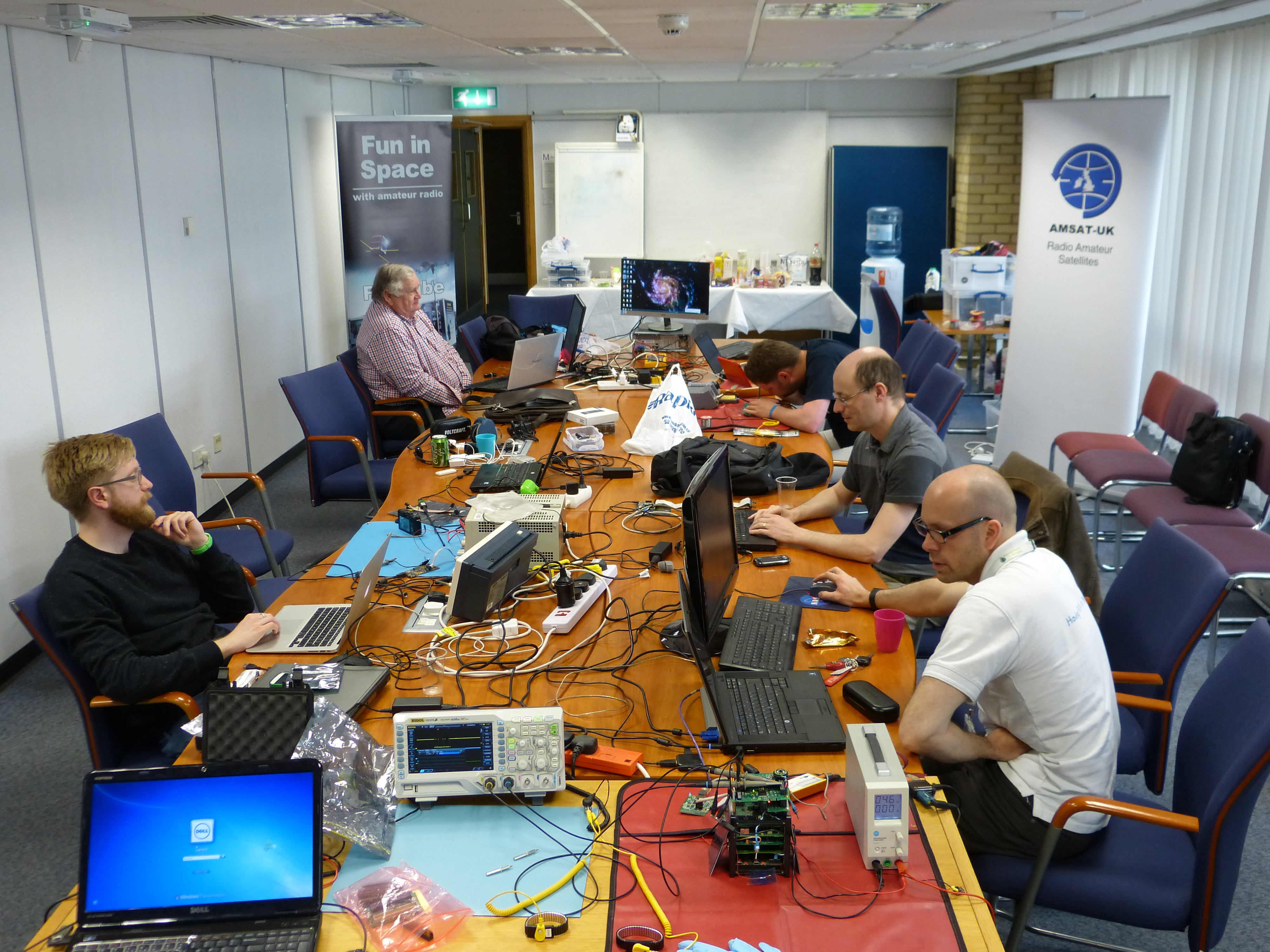
Martlesham FUNcube Development Workshop May 30-31, 2015

Martlesham FUNcube Development Workshop May 30-31, 2015

Having yorkie dog clothes is proving an enjoyable challenge for the AMSAT-UK teams involved. Both the Nayif-1 CubeSat and our payload on ESEO will provide similar 1k2 BPSK FUNcube compatible downlinks so the teams have quite a lot in common.

Martlesham FUNcube Workshop 2 - May 30-31 2015The two teams got together for two days at BT’s Adastral Research facilities at Martlesham over the weekend of May 30-31.

As will be more fully reported in the next edition of the “OSCAR News”, the work concentrated on updating the suite of existing FUNcube software for the forthcoming Nayif-1 spacecraft and also the first power on for the combined CCT/EPS (computer and power) board for ESEO with its ATMEL AT32 microprocessor.

Nayif-1 CubeSat
https://amsat-uk.org/satellites/communications/nayif-1/

ESEO https://amsat-uk.org/satellites/communications/eseo/

Join AMSAT-UK and receive the new issue of OSCAR News due out soon
https://amsat-uk.org/new-members/join-now/

AMSAT-UK
Web https://amsat-uk.org/
Twitter https://twitter.com/AmsatUK
Facebook https://facebook.com/AmsatUK
Flickr https://flickr.com/groups/AmsatUK
YouTube https://youtube.com/AmsatUK
Yahoo Group http://groups.yahoo.com/group/FUNcube
FUNcube http://FUNcube.org.uk/

LightSail Signal Heard

Artists impression of LightSail

Artists impression of LightSail

On the Planetary Society’s website Jason Davis @JasonRDavis reports LightSail is again transmitting on 437.435 MHz, AX.25, 9600 bps FSK.

Jason writes: The Planetary Society’s LightSail test spacecraft reported for duty this afternoon [May 30], heralding the end of an uneasy silence caused by a suspected software glitch. At 5:21 p.m. EDT (21:21 UTC), an automated radio chirp was received and decoded at the spacecraft’s Cal Poly San Luis Obispo ground station. Another came in eight minutes later at 5:29 p.m. The real-time clock on board the spacecraft, which does not reset after a software reboot, read 908,125 seconds—approximately ten-and-a-half days since LightSail’s May 20 launch.

LightSail is not out of the woods yet. Its exact position remains fuzzy, complicating two-way communication. Today’s [May 30] contact marks the first time engineers can compare the spacecraft’s signal with orbital models called two-line element sets, or TLEs. There are ten TLEs associated with the ULTRASat fleet that joined LightSail for a free ride to orbit courtesy of a United Launch Alliance Altas V rocket. Which TLE represents LightSail is unknown, but each radio chirp’s Doppler shift helps narrow down the possibilities.

Read Jason’s full post at http://www.planetary.org/blogs/jason-davis/2015/20150530-lightsail-phones-home.html

LightSail Transmissions Stopped https://amsat-uk.org/2015/05/26/lightsail-1-stops-transmitting/

Listen for LightSail-1 – Transmissions Stopped

LightSail-1 with sail deployed - Credit Justin Foley KI6EPH

LightSail-1 with sail deployed – Credit Justin Foley KI6EPH

JoAnne Maenpaa K9JKM, AMSAT Vice-President User Services, reports that LightSail-1 has stopped transmitting on 437.435 MHz.

She says: Just read on-line at http://planet.ly/0gVop (Planetary Society) that the LightSail satellite stopped transmitting. The team is attempting a reboot.The telemetry data is sent on a downlink of 437.435 MHz, AX.25, 9600 bps FSK.

Excerpt from their page …
As of late Friday afternoon, LightSail was continuing to operate normally. The spacecraft’s ground stations at Cal Poly San Luis Obispo and Georgia Tech were receiving data on each pass. Power and temperature readings were trending stably, and the spacecraft was in good health.

But inside the spacecraft’s Linux-based flight software, a problem was brewing. Every 15 seconds, LightSail transmits a telemetry beacon packet. The software controlling the main system board writes corresponding information to a file called beacon.csv. If you’re not familiar with CSV files, you can think of them as simplified spreadsheets-in fact, most can be opened with Microsoft Excel.

As more beacons are transmitted, the file grows in size. When it reaches 32 megabytes-roughly the size of ten compressed music files-it can crash the flight system. The manufacturer of the avionics board corrected this glitch in later software revisions. But alas, LightSail’s software version doesn’t include the update.

Late Friday, the LightSail team received a heads-up warning them of the vulnerability. A fix was quickly devised to prevent the spacecraft from crashing, and it was scheduled to be uploaded during the next ground station pass. But before that happened, LightSail’s automated chirps fell silent. The last data packet received from the spacecraft was May 22 at 21:31 UTC (5:31 p.m. EDT).

A LightSail map tracking application is at http://sail.planetary.org/missioncontrol/

73 de JoAnne K9JKM
AMSAT VP User Services

LightSail-1 and other CubeSats Launch with X-37B https://amsat-uk.org/2015/05/20/lightsail-1-launch/

Keps for the CubeSats but which object corresponds to which satellite ?
https://docs.google.com/document/d/1o48dswYcTHb-op9ygaKhrizrelMGV9pYcUm0SFmxfS8/pub