GAUSS Srl is preparing a Dnepr launch of a new satellite, UniSat-7, into a Sun Synchronous Orbit (SSO), carrying CubeSats and PocketQubes.
The launch is planned for December 2016 and they are currently looking for payload to include in their satellite.
If you are interested in including your own payload you can contact GAUSS Srl to assess the impact on the mission at launch@gaussteam.com there might be space left for your own payload/satellite.
Characteristics of the UniSat-7 mission:
• Total mass: 32 kg
• Sun-Synchronous orbit: (550 – 600 km)
• LTAN: 10:30 (confirmed)
Watch UniSat-7 Satellite
Music by Kostantinos Geradimos, Album Stereofloat, Song Crashed
AMSAT-UK and AMSAT-NL are delighted to announce that a FUNcube communications package has been selected as a major payload for the Nayif-1 CubeSat mission.
This mission is intended to provide Emirati students with a tool to design and test systems in space. It is being developed by the Emirates Institution for Advanced Science and Technology (EIAST) in partnership with American University of Sharjah (AUS).
It is expected that this payload will provide a large amount of valuable environmental data from space together with a new, enhanced, UHF to VHF linear transponder.
The AMSAT team will be working closely with the Emirati students, in collaboration with support partner, ISIS – Innovative Solutions In Space B.V. from the Netherlands, to develop this new system in time for the launch which is scheduled to take place towards the end of 2015.
The 2015 CubeSat Workshop took place on Wednesday, April 1 at the University of New South Wales (UNSW). Videos of the presentations are now available on YouTube.
Among the presenters were representatives of two UK space companies, Tom Walkinshaw of Alba Orbital and Craig Clark of Clyde Space.
FUNcube-1 (AO-73) is again transmitting telemetry. A restart took place during the 0930 UT pass over Europe.
The CubeSat had stopped transmitting at around 2018 UT on Wednesday, April 15.
The team is still investigating the situation, but have concluded from earlier telemetry analysis that it was safe to switch back to nominal operations.
During the 0930 UT pass over The Netherlands, Wouter PA3WEG commanded it back to nominal mode with full automatic mode switching.
At this time, there is no reason to believe this event was dangerous to the spacecraft, all systems were nominal and the battery is nearly full.
Many thanks for all the reports that the team have received.
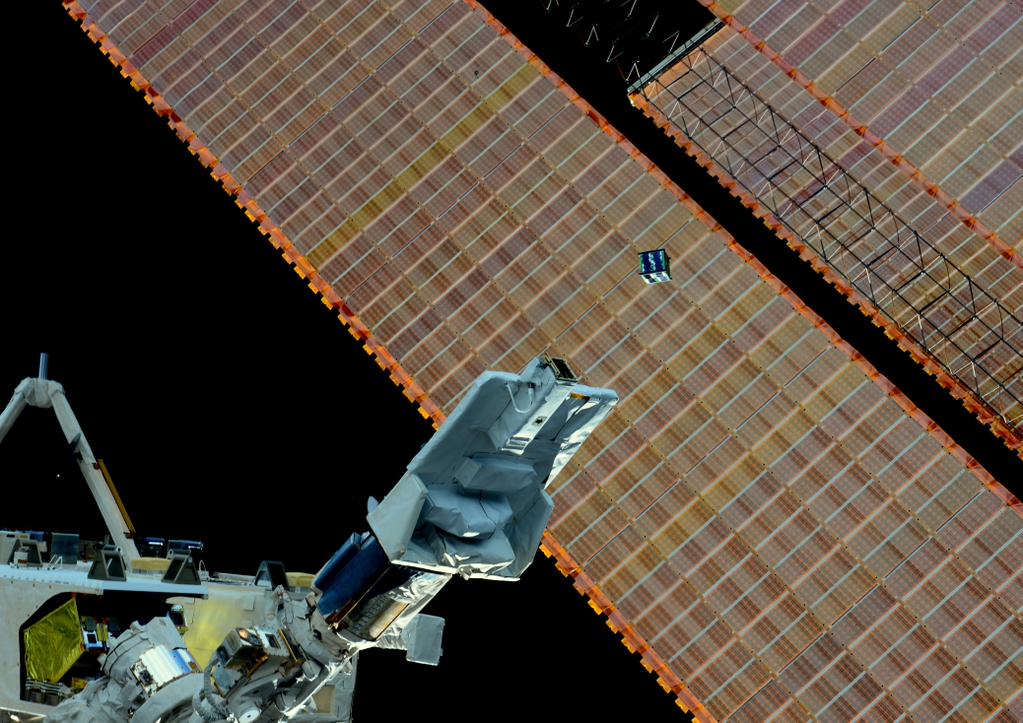
The Japanese Space Agency, JAXA, have released a video showing the deployment of the Brazilian amateur radio satellite AESP-14 from the International Space Station (ISS).
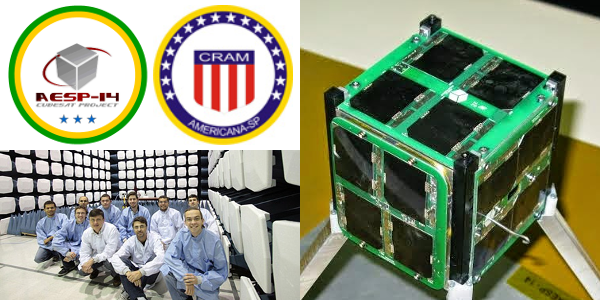
The AESP-14 is a 1U CubeSat developed by undergraduate and graduate engineering students at the Technology Institute of Aeronautics (ITA) in Brazil. The satellite’s primary mission is to test the various subsystems in the space environment.
AESP-14 CubeSat released from ISS – Photo by Samantha Cristoforetti IZ0UDF
The satellite was sent to the ISS as cargo on the SpaceX Falcon 9 mission CRS-5. Launch had been scheduled for December 16, 2014 but was postponed three times and it wasn’t until January 10, 2015 that the launch eventually took place. AESP-14 then awaited deployment from the ISS by the JEM Small Satellite Orbital Deployer (J-SSOD) which is in the Japanese Experimental Module, Kibo.
The deployment took place around 1250 UT on Thursday, February 5. The AESP-14 telemetry beacon had a power output of 500 mW and used AX.25 with 9600 bps GMSK modulation (G3RUH standard) on 437.600 MHz. It should have started transmitting 30 minutes after deployment but as of March 30 nothing had been heard. It may be the battery did not survive several months without being recharged or the antenna may have failed to deploy.
As expected, FUNcube-1 (AO-73) entered the shadow of the moon around 1000 UT on Friday, March 20, 2015.
This is what happened to the solar panel currents, they dropped to almost zero.
This is what we usually see from our Whole Orbit Data telemetry. Normally the CubeSat is in the sun for 60 minutes and in eclipse for around 30 minutes…but not this morning!




 AMSAT-UK
You must be logged in to post a comment.